Tuesday, February 15, 2022

THEATRE OF WAR: TECHNO-COLONISED PLANET

Theatre of War: Techno-Colonised Planet Gouache on paper 56 x 76 cm 2022
 

NEWS

Third Text Article

Thrilled that my article "Night Vision, Ghosts and Data Proxies: Paintings By War Artist Jon Cattapan" has been published online for Third Text, a leading peer reviewed international journal dedicated to the critical analysis of contemporary art in the global field. The hardcopy is forthcoming.

Cattapan was an official Australian war artist in Timor Leste in 2008. Key to his subsequent paintings were his experiences using night vision technology while accompanying Australian Peace Keeping forces on night patrols. The effect of the night vision green entered his paintings in ways that continue to 'speak' to us today. Thus, I analyse Cattapan's paintings through a 'future of war' lens-a future we are now living, nearly 15 yrs later. I argue that although the paintings were inspired by experiences in Timor Leste, the images could relate to the iterative modes of contemporary, and likely future war, ie: grey zone, hybrid, informational, cyber, as well as kinetic warfare.


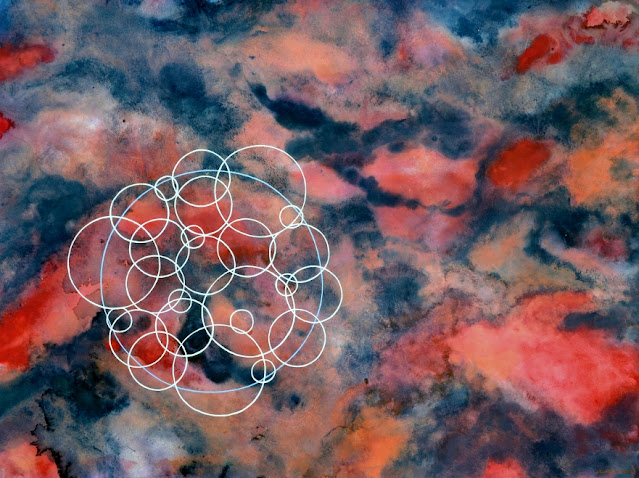
Theatre of War: Techno-Colonised Planet 

This new painting relates to a few other recent paintings - examples: Theatre of War: Plague Cloud, Theatre of War: Dromo-Domain and Theatre of War: Law

Invitation to 'Fly'
In Theatre of War: Techno-Colonised Planet you are invited to fly, in your imagination, away from Earth. When you are ready, you peer back at the planet from a distance. And, from this distance what patterns become apparent? For me, I see a planet occupied by an insidious fake cloud that extends from Earth to orbiting satellites. The outline of the pale blue dot shimmers like a ghost behind the 'cloud'. This 'cloud' represents the ubiquitous presence of interconnected and interoperable systems, all reliant on access to, and use of, the electromagnetic spectrum (EMS). 

But, what if you are not 'flying' at a great distance from Earth? What if you 'fly' in closer? What if this is an image on a computer screen and you have flown through the window of a ground control station where remote operators sit in front of an array of computer screens? What if the white circles are computer graphics indicating techno-territorial occupation? Given that civilian technology and military technology rely on the same conduit and enabler, ie: the EMS - is the fake cloud an indication of dangerous synchronicity and homogeneity of techno-system operation? Does it represent an ever-ready always-on war preparedness, especially when various iterations of contemporary war are increasingly perpetrated via technological devices and systems - grey zone, hybrid, information and cyber warfare.

Whether you are flying at close or far distance -  your imagination is the critical tool. For me, this is how imaginational metaveillance works to become a resistance to the kind of normalised techno-surveillance of the world in which we live. 

As artist and writer James Bridle notes, "Today the cloud is the central metaphor of the internet: a global system of great power and energy that nevertheless retains the aura of something noumenal and numinous, something almost impossible to grasp."* In Theatre of War: Techno-Colonised Planet I have tried to 'grasp it'. My invitation for you to take imaginational flight, is my way of sharing this quest.
  
Cheers,
Kathryn

*James Bridle, The New Dark Age: Technology and the End of the Future (London: Verso, 2018), 6.


Saturday, February 05, 2022

THEATRE OF WAR: LAW

Theatre of War: Law Gouache on paper 56 x 76 cm 2022


LEGAL AI
I read a report "VISIMO and West Point Advancing Artificial Intelligence for Judge Advocates" [January 11, 2022] which provides a brief outline of research conducted to develop an AI enabled legal assistant for the military. Not surprisingly speed is the compelling issue. Here's a quote from the report

With the development of autonomous weapons, the speed of warfare is increasing. Stationed at combatant commands and Air Operations Centers worldwide, Judge Advocate General (JAG) Corps members provide critical legal advice during combat, including use-of-force decision-making recommendations. However, Judge Advocates are not equipped to keep pace with modern combat.

SPEED
As regular readers know, I have been interested in the issue of speed and war, speed and technology, interconnectivity and inter-operability, for some time. I often refer to cultural critic Paul Virilio's various statements and ideas about speed, particularly the harnessing of light speed [or near light speed]. In regards to AI legal assistants/lawyers, embedded into the Internet of Battlefield Things speed saves time. In doing so, in an interconnected & interoperable system, speed acts as a force multiplier. Whatever is speeded up becomes part of this force multiplication. 

Speed has become an enabler, a tactic and a strategy. It is a purveyor of weaponry, but could also be considered a weapon itself. Speed could also be considered a domain - inspired by Virilio, I call it a dromo-domain

Theatre of War: Law 
This painting (top of page) was directly inspired by the article mentioned above. Like some other recent paintings I visualise a 'cloud' of circles as a parody of The Cloud, the Internet of Things, the Internet of Battlefield Things, The Internet of War Things. My 'clouds' can also be interpreted as revelatory landscapes of the normally invisible ie: the connections enabled by technological interconnectivity and interoperability. These landscapes could also be pre-emptive counter-maps, surveying and revealing bourgeoning techno-colonising forces. Like many of my paintings, the viewer can imagine soaring beyond, below, behind and in front of these techno-scapes. This is an act of what I call imaginational metaveillance. 

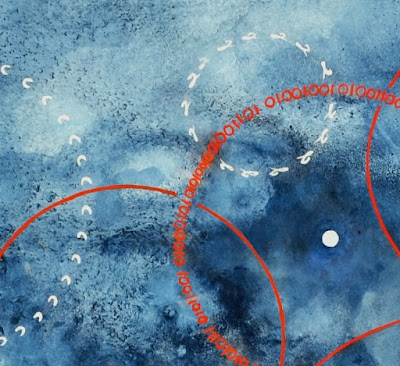
In Theatre of War: Law the central circle is a string of painted binary code 'instructing' MILITARY LAWYER. This circle is connected to an array of circles, some created using the symbol for light speed (c)  and one circle created with the symbol for photon (y). My use of these scientific symbols references the fact that all frequencies in the electromagnetic spectrum are made up of photons, travelling at the speed of light. The light spectrum is the only frequency we can see with the naked eye. 

The circles clearly extend beyond the painting, thus the central MILITARY LAWYER circle may not ultimately be central at all - is there, in fact, a centre point in an always-on interconnected and interoperable system where civilian and military assets and activities intersect? This poses questions about command and responsibility - as Virilio notes “acceleration of reality tends to reverse the principle of responsibility”.[1]

Detail Theatre of War: Law

I will leave you to ponder more. Because, of course, there are many other issues associated with AI, such as bias, unintended outcomes, accidents, nuance, and more. Time will tell how these issues will be dealt with by the developers of an AI legal tool designed to operate in fast moving battle, war, conflict situations.

Cheers,

Kathryn 


[1] Paul Virilio, The Original Accident, trans. Julie Rose (London and Malden, MA: Polity, 2007), 90.


Tuesday, January 25, 2022

THEATRE OF WAR: INTERNET OF BATTLEFIELD THINGS


Theatre of War: Internet of Battlefield Things Gouache on paper 56 x 76 cm 2022


NEWS
The Visualising War project, University of St. Andrew's UK interviewed me late last year & the podcast Painting Invisible Threats with Kathryn Brimblecombe-Fox went live earlier this month. I am thrilled to be part of such a great podcast series

And, there is really insightful accompanying post about my paintings and research Painting Invisible Threats 


Theatre of War: Internet of Battlefield Things

I think this is my 16th Theatre of War painting. The series of works on paper and oil paintings is growing. It would make a great exhibition!

AI Fighter Pilots
Theatre of War: Internet of Battlefield Things was inspired by an article in the The New Yorker, The Rise of A.I. Fighter Pilots by Sue Halpern. She writes "Artificial intelligence is being taught to fly warplanes. Can the technology be trusted?" It is a fascinating article about attempts to teach AI to fly warplanes in a dogfight. Halpern, however, does contextualise this specific aim within a broader military AI pursuit; "Artificial intelligence is being designed to improve supply logistics, intelligence gathering, and a category of wearable technology, sensors, and auxiliary robots that the military calls the Internet of Battlefield Things." 

IoBT
The Internet of Battlefield Things [IoBT] is another way to think about digital and cyber connectivity, interconnectivity, inter-operability, and their contributions to joint [military] force capabilities. Frequencies in the electromagnetic spectrum [EMS] enable these technologies, with light speed - or near light speed - operative functioning. Speed is now a key tactical and strategic component for modern militaries. Speed saves time, even nano-seconds. Speed and time create advantages in a race for the kind of technological prowess modern militaries aim for. They are viewed as essential for future war preparedness and capability.

AI and ML technologies replace the human being at junctures where human speed and time are viewed as disadvantageous or an impediment. This has spurred increasing developments in autonomous systems. These include, but are not limited to, such things as on-board sensor analysis for target identification and tracking, robotic motility through rough terrain, drone flight especially in a swarm, AI optimisation of EMS frequency use. Interestingly research is being conducted into AI military lawyer capabilities. Here is a quote from a recent announcement VISIMO and West Point Advancing Artificial Intelligence for Judge Advocates that 'speaks' to the issue of speed.

With the development of autonomous weapons, the speed of warfare is increasing. Stationed at combatant commands and Air Operations Centers worldwide, Judge Advocate General (JAG) Corps members provide critical legal advice during combat, including use-of-force decision-making recommendations. However, Judge Advocates are not equipped to keep pace with modern combat.

Theatre of War: Internet of Battlefield Things
This new painting references my last oil painting Theatre of War: Dromo-Domain. However, rather than one circle I have painted multiple circles, each created with the symbol for light-speed ie: c. I love the way the circles kind of move, if you look at them intensely. This was a discovery that's quite serendipitous!

Each circle is connected to another circle and some seem to extend beyond the painting. Regular readers will pick up that I am playing with the idea of 'the cloud', visualising it's technological construction - a fake cloud. I am also playing with the ideas of interconnectivity, inter-operability and joint force. 

With "Artificial intelligence is being designed to improve supply logistics, intelligence gathering, and a category of wearable technology, sensors, and auxiliary robots that the military calls the Internet of Battlefield Things" in mind, I have tried to question whether the IoBT is really separate from the IoT [Internet of Things]. I mean, all the activities described in the quote could also apply to civilian needs. Here, I am positing that the militarise-ability of civilian technological systems and devices as a concern. Is the contemporary theatre of war a combination of the IoT and the IoBT? In an age of cyber and information warfare, grey zone and hybrid warfare the civilian world is clearly immersed in the contemporary theatre of war. How about an Internet of War Things - IoWT - as a descriptor?

Cheers,
Kathryn
P.S. The article about AI military lawyers has sparked a few ideas for paintings - stay tuned!

Wednesday, December 22, 2021

THEATRE OF WAR: DROMO-DOMAIN

 Theatre of War: Dromo-Domain Oil on linen 90 x 100 cm 2021

CLAUSEWITZ
I think this is my 14th or 15th Theatre of War painting. I was inspired to start this ever-growing series by late 18th/early 19th century Prussian General, Carl Von Clausewitz's famous tome On War. He often mentions the term 'theatre of war'. Reading through the text, I get the impression he thought it involved a number of factors, but geography was a central theme. 

I think about what 'theatre of war' might mean in the 21st century, the age of digital and cyber technology, drones, drone swarms, ubiquitous surveillance and increasingly autonomous systems. Regular readers will know I am probably a bit dystopian in my outlook. This is because I 'see' contemporary networked, interconnected and inter-operable technology as an homogenising and standardising force that enables the 'theatre of war' to extend not only beyond geography, but also traditional ideas of military activity and reach.* Because of the shared nature of technological platforms and systems I am particularly concerned about, and interested in, the militarise-ability of civilian technology. Here, increasing military interest in the electromagnetic spectrum [EMS] as an enabler of technology, a type of fires, a manoeuvre space and a domain is a key concern. Why? Because civilian technology also relies upon access to the EMS. Information and cyber warfare, and terms such grey-zone and hybrid warfare, all 'speak' to permeable military-civilian boundaries. I am also interested in the militarisation of imagination, time and speed. So, you can see, my ideas of the contemporary 'theatre of war' encompass almost - maybe all of- everything!

DROMO - SPEED
Theatre of War: Dromo-Domain is a visual spin on Paul Virilio's thoughts on speed and the term he coined, dromology ie: the logic of speed applied to contemporary society. Virilio, in a number of books and articles*, argued and observed that speed and accelerating speeds of technological operation and development play major roles in societal, political and geopolitical stability. As developments in networked and interconnected digital and cyber technologies have accelerated, light-speed [or near light-speed] signal transmissions introduce speed as a necessary advantage for both civilian and military technology. It is commercially, politically and militarily tactical to use speed as an advantage. One of my favourite quotes from Virilio is  "The fact of having reached the light barrier, the speed of light, is a historic event, one which disorients history and also disorients the relation of human beings to the world. If that point is not stressed, then people are being disinformed, they are being lied to. For it has enormous importance. It poses a threat to geopolitics and geostrategy.” (1)

HOW TO VISUALISE SPEED
I have grappled with how to visually convey speed as an overarching dromo-domain that encompasses civilian and military technology in a pervasive and persistent 'theatre of war' that extends from Earth to orbiting satellites. 

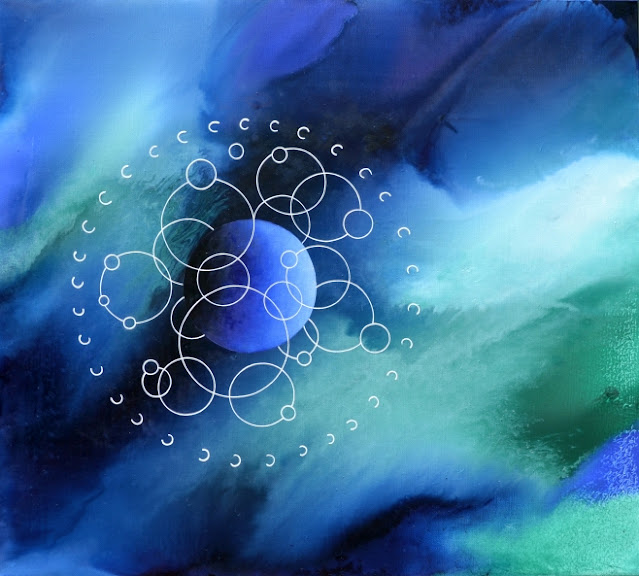
In Theatre of War: Dromo-Domain I have repeatedly painted the symbol for light speed ie: c, to form a circle around the Earth. I love how the cs look like the spurs on a spinning cog, and that a sense of speed is created. The Earth is the 'pale blue dot'. This circle of cs represents the major satellite orbiting zones around the Earth. From these orbits to Earth, is our sphere of influence, where the EMS is harnessed for an array of communication, operative and inter-operative civilian and military technological functions. How are we managing this sphere of influence? I 'see' it as a volumetrically occupied and techno-colonised space. 

In Theatre of War: Dromo-Domain the multiple overlapping white circles are indicative of civilian and military activities and domains. Clearly the term dual-use is inadequate in the era of speed, where networking, interconnectivity and interoperability scaffold us all in invisible webs of signals. This is a militarised space - a dromo-domain that enables and cradles more traditional military domains of land, sea and air. It is the meta-domain.

IMAGINATIONAL METAVEILLANCE
The cosmic-like background in Theatre of War: Dromo-Domain continues my quest to stimulate flight, your flight and mine [in imagination], to places where we can gain new perspectives. I call this 'imaginational metaveillance' - a kind of veillance that does not rely on EMS-enabled technology, thus it is untethered from it. The cosmic landscape also alludes to universal history, which includes the history of the EMS. All frequencies in the EMS are made up of photons, traveling in waves at light speed. The photon appeared around 10 seconds after the Big Bang. This kind of cosmological history really gets me thinking about how, in our sphere of influence, are we using a natural universal resource. 

* Paul Virilio and Jean Baudrillard inform my ideas here.
Cheers,
Kathryn

PS. Related recent posts/paintings include:

(1) Paul Virilio, “Red Alert in Cyberspace,” trans. Malcolm Imrie, Radical Philosophy (Nov/Dec 1995): 2.

* Just a small few examples of Virilio's work
Paul Virilio, Speed and Politics, first published 1977.
Paul Virilio, The Original Accident, trans. Julie Rose (2007
Paul Virilio, The Great Accelerator, trans. Julie Rose (2012)

Tuesday, December 14, 2021

THEATRE OF WAR: PLAGUE CLOUD


 Theatre of War: Plague Cloud Oil on linen 112 x 92 cm 2021


Theatre of War: Plague Cloud is number 13 or 14 in a growing Theatre of War series of paintings [oil paintings and works on paper]. It is also one of a number of cloud paintings ie: 'playing' with real clouds and The Cloud - the 21st century pervasive techno-network.

The Cloud
As noted in a recent post for another painting Theatre of War: The Cloud I have been researching the idea of the cloud as a metaphor. Here, John Ruskin's observations, made in two speeches at the London Institute in 1884, of 'plague clouds' and 'plague winds' have helped me think critically about The Cloud. I ask, is militarisation of technology, including the militarise-ability of civilian technology, like a 'plague wind' blowing through the electromagnetic spectrum [EMS]? Given that the EMS operatively enables contemporary technological connectivity, interconnectivity and networking, could The Cloud, therefore, be a 'plague cloud'? 

Contagion
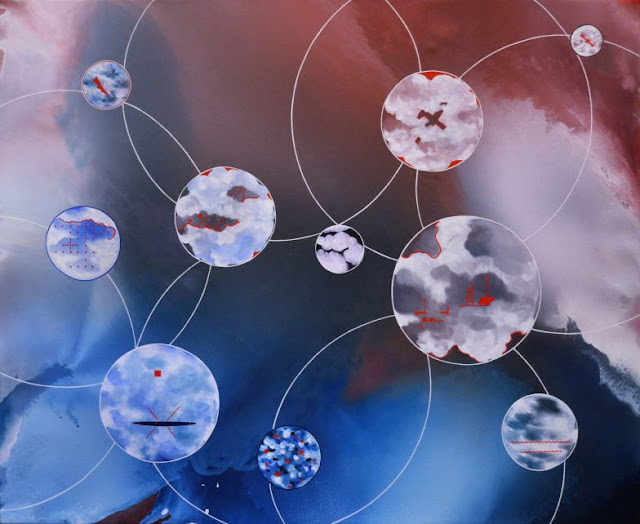
In Theatre of War: Plague Cloud I have repeated some of the motifs I used in Theatre of War: Everywhere Cloud where circles contain elements of military hardware or systems used underwater, on the water, on land, in the sky and in space. These systems 'peek' out of their 'cloudy' domains, but all of them are drawn into a larger 'cloud' of repeated circles that represent interconnectivity, networked systems, interoperability and joint force operations. This large 'cloud' extends beyond the painting. Like an airborne contagion it threatens to wrap its techno-tentacles around the globe, potentially drawing each military and civilian device into its 'cloudy' web. 

Theatre of War: Plague Cloud's background, painted with a combination of blue and rust red, appears 'dirtier' than some of my other 'cloudy' paintings. This helps to channel the idea of a plague that infects the environment. Here, I note Ruskin's observations of dirtier looking skies and clouds painted by artists, such at J. M. W Turner, who responded to a changing environment during the early 19th century industrial revolution. It also demonstrates a vulnerability, because once the world is techno-wrapped, can we unwrap ourselves or be unwrapped? What happens if The Cloud fails and it spontaneously unwraps - unravels - as connections falter, its 'promise' of persistence, resilience, connectivity and speed, broken? 

I wonder what it might be like to be uncontrollably jettisoned from the web! 

On that happy note!
Cheers,
Kathryn

Monday, December 06, 2021

LETHAL LITTER

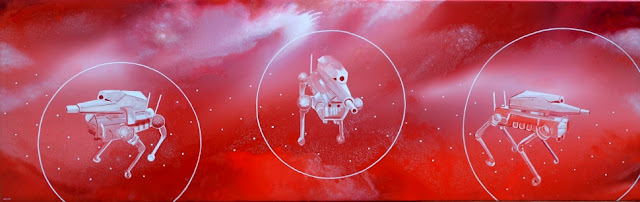
Lethal Litter Oil on linen 36 x 112 cm 2021


I'm not going to write much. But, suffice to say, the word litter in the title Lethal Litter was deliberately chosen for its multiple meanings. 

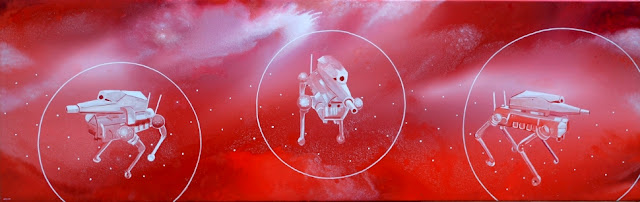
This 'litter' of  three weaponised quadruped robots (I refuse to call them dogs) scope the landscape, which is dotted with geolocating graphics. After all, landscape must be geo-mapped for robotic systems, especially those with autonomous abilities to move within and through a landscape/environment. This does not mean the robots have autonomous functionality regarding their weapons though. Some would add the word - 'yet'. 

Increasingly, robotic systems and platforms are assemblages of autonomous functions and remotely operated functions. For example movement in a rugged landscape or an unmapped urban environment can require a robot, or robots, to move autonomously, especially if remote operators are not close. Google 'robotic dogs', 'military robotic quadrupeds' etc and you'll find some fascinating and also scary videos! 

Like my other recent painting Biped and Quadruped: Warfighters, Lethal Litter was inspired by news of  experiments where robotic quadruped were weaponised. 

My last post Dogs, Quadrupeds and Robots features a few more paintings, but mostly with real dogs. 

Cheers,
Kathryn

Monday, November 29, 2021

DOGS, QUADRUPEDS AND ROBOTS

1. Content Tagging: A Spoof Watercolur on paper 30 x 42 cm 2020


This is another fun post, albeit with a dark side. My last post Face Database: Kathryn's Dataset Map was fun, but also dark.

Dogs, Quadrupeds and Robots is a collection of recent paintings where I depict dogs, one a weaponised robotic quadruped. I refuse to call the quadruped robots, dogs! 

* Since writing this post, I have created another quadruped painting, this time called Lethal Litter

The last photograph is me with our family dog - an Australian kelpie. You will see she is the model for my real dog renditions.

ROBOT THAT 'WAGGED' ITS TAIL
I have 'met' a robot quadruped (Boston Dynamics). I met this robot quadruped at the Australian Army's Landforces Exposition this year, in Brisbane. The robot was 'wandering' around the expo, its remote controller nearby. It caused quite an excited stir, with people responding to it, as it wagged its tail, went up to them and moved with dog-like movements. 

I was both surprised and not surprised by people's reactions. I was not surprised because this quadruped could certainly mimic some doggy behaviour, and living dogs are lovely! Yet, this robot was clearly a robot - and here I was, witnessing multiple adults responding quite excitedly to a non-living robotic quadruped, almost as if it was a real dog. The experience left me feeling somewhat uneasy. 

When the robot quadruped encountered me, it approached, and its tail was wagged. I refused to respond, but it was hard not to wag back! Its wagging so reminded me of our kelpie's wagging tail movements! Because I just stood there and did not respond, it moved away. The remote operator, who I had located out of the corner of my eye, seemed a bit disappointed. A few seconds later the robot stumbled, tripping on something as it turned a corner. The remote controller turned it off. While robot quadrupeds are supposed to be great on rough and difficult terrain, they're not so good at expos - for now anyway.

GREAT ARTICLE
This great article "See Spot save lives: fear, humanitarianism, and war in the development of robot quadrupeds" was recently published by Dr. Geoff Ford and Dr. Jeremy Moses. The article goes into the history of Boston Dynamic’s robot 'Spot', plus tracks public responses to images, videos and news stories about 'Spot'. The article really opens up the dilemma of civilian - military robotic use. Robots [including drones] have many good purposes, but they can be militarised, as the recent case of the weaponised quadruped developed by Ghost Robotics shows. Ford and Moses mention this weaponised quadruped in their article too. 

Regular readers will know why I found Ford and Moses's article interesting - because the militarise-ability of civilian technology needs critical attention. It is not a simple matter of dual-use. 

Clearly there's more to say, but I will leave you to think about it...
Cheers,
Kathryn
P>S Update. Another quadruped post Verification Error: Identity Crisis


2. Walking the Dog in the Drone Age  Oil on linen 82 x 102 cm 2020

Walking the Dog in the Drone Age was inspired by an early Covid story of a person in lockdown in Malta using a drone to walk their dog.   


3. Strange Times Gouache on paper


4. Border Crossing Watercolour on paper 24 x 32 cm 2020

This painting was inspired by border restrictions imposed between Australian states during the ongoing COVID19 pandemic. 


5. Biped and Quadruped: Warfighters Oil on linen 60 x 110 cm 2021

The robot quadruped is weaponised...

6. Lethal Litter Oil on linen 36 x 112 cm 2021
 
Dark play on the word litter - rubbish or a litter of puppies!

7. Future Memory Oil on linen 122 x 137 cm 2021

Future Memory does not feature a dog. It does, however, relate to Walking the Dog in the Drone Age, above. In Future Memory a human is being walked by a drone. Maybe we human beings will be the future pets?

 
8. Me with our family dog - an Australian kelpie.

Friday, November 19, 2021

KATHRYN'S DATASET MAP OF FACIAL EXPRESSIONS

Face Database: Kathryn's Dataset Map Gouache on paper 30 x 42 cm 2021


This is a bit of fun - playing with the concept of face datasets that assist in training AI for facial recognition and expression analysis. I've mapped correlations between my various faces eg: check out the links I make to the mansplaining face! 

For artists who use face datasets, or any kind of dataset created by others for an array of purposes, it is important to investigate legal and ethical issues relating to use, appropriation, exhibition, publication  and so on. These issues are particularly relevant for artists who use digital and cyber new media platforms, and who may use images or datasets from other sources. There seems to be a cascading array of issues relating to use, appropriation, privacy, copyright etc in a world of digital images, distributed or accessed via the internet. 

That's why I paint! That's why I use paint to parody and critique. I love painting!

Please enjoy Kathryn's Dataset Map. It kind of channels the emoji look, but also Humpty Dumpty and other Egg Heads   

Cheers, Kathryn😁


Sunday, November 14, 2021

SPECTRUM: ONLINE EXHIBITION

Data Data Gouache on paper 30 x 42 cm 2016


ELECTROMAGNETIC SPECTRUM
Regular readers know that I have been thinking about the increasing interest militaries around the world are paying to the electromagnetic spectrum [EMS], as an enabler of technology, a type of fires, a manoeuvre space and a domain. The fact that EMS is a shared civilian - military resource problematises military desires to dominate, appropriate and ensure access. 

In the techno-world in which we live, we are all reliant on the EMS to enable digital and cyber technologies, to allow networking and interconnectivity, and also interoperability. 

I've been interested in the EMS for some time. 

When I started painting airborne drones in 2015, I also started visualising the normally invisible signals that connect the drones to remote controllers and to GPS satellites. I also visualised sensor detection, targeting and transmission arrays. These paintings were informed by my Master of Philosophy research at the University of Queensland. I completed my M. Phil in 2017. My paintings from 2020 are inspired by my PhD research, Curtin University, Western Australia

ONLINE EXHIBITION
This online exhibition of fifteen paintings tracks my interest in the EMS and my ideas of the 'spectrum warfighter'. This fighter could be human, an enhanced human, a robot, an algorithm, an avatar in a simulated wargame. One question I think about a lot is - how doe we memorialise when the warfighter is no longer human? This question has lead me to another question - how do we memorialise when the warfighter was never alive?

Please click on the hyperlinked titles to read the previous posts for each painting.

Cheers,
Kathryn


Not a Game Gouache and watercolour on paper 57 x 76.5 cm 2016


Space Net Gouache on paper 56 x76 cm 2017


New Star-False Star Oil on linen 97 x 112 cm 2018


Charting the Invisible gouache on paper 30 x 42 cm 2019


01010111 01000001 01010010 WAR Gouache on paper 30 x 42 cm 2021


Theatre of War-Spectrum Gouache on paper 56 x 76 cm 2021


Spectrum Warfighter Gouache and watercolour on paper 30 x 42 cm 2021


Theatre of War-Domain Dominance Gouache on paper 56x76 cm 2021


Theatre of War-Spectrum Access Gouache on paper 56 x 76 cm 2021


Theatre of War-Infrared Gouache on paper 56 x 76 cm 2021

The Tree Asks, What Can't You See? Gouache on paper 30 42 cm 2021


Theatre of War-Photon Gouache on paper 56 x 76 cm 2021

Spectrum Warfighter 2 Oil on linen 61 x 66 cm 21


Theatre of War - Photons Do Not Care Oil on linen 92 x 112 cm 2021
 

Saturday, November 06, 2021

SPECTRUM WARFIGHTER 2: HUMAN, ROBOT, ALGORITHM OR AVATAR?

Spectrum Warfighter 2 Oil on linen 61 x 66 cm 2021

Spectrum warfighters and the Electromagnetic Spectrum
I've got this thing in my head - a picture of a spectrum warfighter. Is it human, is it an enhanced human or is it a robot? The term 'warfighter' can be applied to a living and non-living entity, even an algorithm. The term 'warfighter' is actually a loaded term!

I have painted a few spectrum warfighters recently* - for me, they are entities that use the electromagnetic spectrum [EMS] as a means of fighting wars, in the broadest sense. This could mean as a fixed or moving enabling node in a networked system of interoperable systems and hardware. It could also mean something more, for example, as a disseminator of information or disinformation. It could mean jamming or interrupting an adversary's signals. The spectrum warfighter, whether human or not, is an integral part of contemporary war, in all its iterative and often concurrent manifestations - grey zone, hybrid, cyber. information and kinetic warfare. 

Spectrum Warfighter 2
In my new painting Spectrum Warfighter 2 I have painted VR [virtual reality] goggles that wrap around the warfighter's head. This reflects upon military interest in augmented and integrated visual aides for things like improved situational awareness. Integrated means that the goggles can be, for example, wifi connected to other sensors carried by the warfighter, and also connected to other close or remote warfighters/hardware. Goggles can also be connected to firearms...

 My spectrum warfighter hovers, as if suspended in the sky or space, or maybe its an image on a computer screen? The warfighter's body is not complete. Maybe its torso is a visual metaphor for a system of warfighting, like a logo? Maybe my warfighter is injured, a real or metaphoric casualty? Maybe the warfighter is simply appearing out of a mist? I'll let you wonder on about the possibilities!

Spectrum Warfighting and the Metaverse
My warfighter also has no face or facial features that can help us work out whether it is human, robotic or an avatar. Facial features are obscured by the augmenting goggles, and what might be a balaclava-like hood. Who knows! Your guess is as good as mine!

If my spectrum warfighter is a 'portrait' of an avatar, maybe it is ready for wars in the Metaverse?  


*More Spectrum Warfighters:

Biped and Quadruped Warfighters
Theatre of War: Spectrum Access
Spectrum Warfighting: Invisibility

Cheers,

Kathryn


Monday, October 25, 2021

BIPED AND QUADRUPED: WARFIGHTERS

Biped and Quadruped: Warfighters Oil on linen 60 x 110 cm 2021
 

Recent news of a weaponised quadruped robot caught my interest - and dismay.

But, was I surprised?  No. 

Biped and Quadruped: Warfighters 
My new painting Biped and Quadruped Warfighters places two figures in circles against a violent red background 'landscape'. The human-like torso is equipped with multiple sensors and antennae. Here, I have also 'played' with Microsoft's recently touted networkable military grade goggles that use an 'Integrated Visual Augmentation System' to enhance soldier situational awareness. The other figure is a robotic weaponised quadruped - I refuse to call it a dog!

Is the human-like torso actually a human being, or is it also a robot, or an anthropomorphised representation of a system? You decide!

I placed each figure in a circle to denote their compliance with a network, with a 'cloud'. This refers to a few other recent paintings. Two examples are Theatre of War: Infrared and Theatre of War: Everywhere Cloud 

The quadruped warfighter seems to lead the other warfighter - they both face the same direction. The quadruped leads as a lethal scout.

Recurring Question
I have lots more to say! - but a recurring question I have is - How do we memorialise when the warfighter was never alive?


And, just in case you missed it!

THE DEAD PRUSSIAN PODCAST

My interview with Mick Cook from The Dead Prussian Podcast is live! We discuss my work, research, creative practice and the future of war. I am thrilled to be given opportunities like this! 

The term 'Dead Prussian' refers to nineteenth century General Carl von Clausewitz, who wrote the famous tome On War. Regular readers will know that I reference Clausewitz in my Theatre of War series of paintings. Clausewitz uses the term 'theatre of war' variously and often in On War.

Cheers,
Kathryn

Tuesday, October 19, 2021

THEATRE OF WAR: EVERYWHERE CLOUD

Theatre of War: Everywhere Cloud Oil on linen 92 x 112 cm 2021
 

NEWS

THE DEAD PRUSSIAN PODCAST

My interview with Mick Cook from the Dead Prussian Podcast  is live. We discuss my work, research, creative practice and the future of war. I am thrilled to be given opportunities like this! 

The term 'Dead Prussian' refers to nineteenth century General Carl von Clausewitz, who wrote the famous tome On War. Regular readers will know that I reference Clausewitz in my Theatre of War series of paintings. Clausewitz uses the term 'theatre of war' variously and often in On War.


Theatre of War: Everywhere Cloud 
My new painting Theatre of War: Everywhere Cloud is number 12 or 13 in my series Theatre of War. Clausewitz has been a great inspiration! The title also refers to Derek Gregory's idea of the everywhere war ie: war has reached beyond geography into the cyber world and space. 

Gregory's concern for people on the ground, the victims of war, is obvious in his very detailed analyses of events, such as a 2010 US drone attack that killed 23 Afghan civilians. You can hear him describe and talk about his forensic analysis of the attack in his recorded keynote speech for the Aesthetics of Drone Warfare conference, University of Sheffield, February 2020. I spoke at, and attended, this conference too - just before the pandemic derailed the planet! Gregory's keynote was riveting and disturbing - a detailed analysis of US forces' misunderstanding of data, lack of experienced personnel and more.

Clouds
Theatre of War: Everywhere Cloud is preceded by a number of other paintings that 'speak' to the idea of The Cloud, fake clouds, notions of interoperability, networking, interconnection and military joint force. Three of my most recent paintings are Paradox  and Theatre of War: The Cloud and Theatre of War: Infrared

Come Fly With Me!
As with my other two paintings, and indeed, most of my paintings, the viewer is invited to fly in imagination. Are you above, below, beside or inside the 'cloud'? I call this an act of imaginational metaveillance

Glimpses of technology are visible from behind cloud-like formations. They are painted red to indicate blood, danger, violence, fear, contagion. The red colour connects them visually across their multiple domains, from under the sea to space. Red and white circles, denoting the use of, and reliance upon, frequencies in the electromagnetic spectrum draw everything into the war-play, the theatre of war - everywhere. With light-speed signal transmission within networked systems, I argue that Gregory's notion of the everywhere war needs now to be extended in to time and speed.

If you would like to know more about what I think of speed, time and contemporary war, please listen to my Dead Prussian Podcast - Mick asks all his guest the same last question - which is - Can you please finish this sentence "War is......" 

Cheers,
Kathryn

PS. Oh, and another podcast - this time my interview with Dr. Beryl Pong. lead researcher for the Aesthetics of Drone Warfare project, University of Sheffield.