Showing posts with label Earth. Show all posts

Tuesday, February 15, 2022

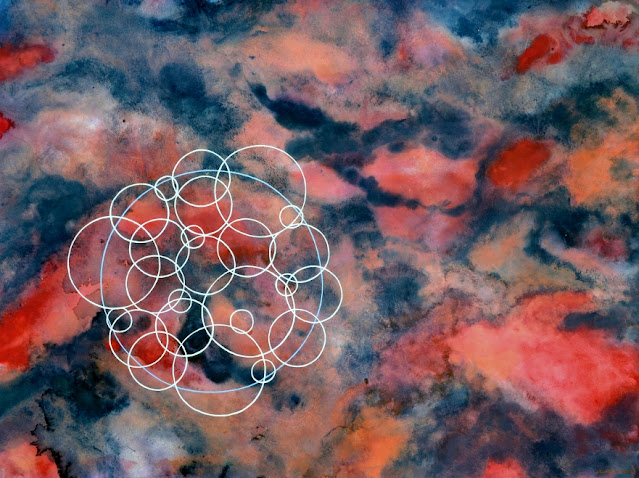
THEATRE OF WAR: TECHNO-COLONISED PLANET

Theatre of War: Techno-Colonised Planet Gouache on paper 56 x 76 cm 2022
 

NEWS

Third Text Article

Thrilled that my article "Night Vision, Ghosts and Data Proxies: Paintings By War Artist Jon Cattapan" has been published online for Third Text, a leading peer reviewed international journal dedicated to the critical analysis of contemporary art in the global field. The hardcopy is forthcoming.

Cattapan was an official Australian war artist in Timor Leste in 2008. Key to his subsequent paintings were his experiences using night vision technology while accompanying Australian Peace Keeping forces on night patrols. The effect of the night vision green entered his paintings in ways that continue to 'speak' to us today. Thus, I analyse Cattapan's paintings through a 'future of war' lens-a future we are now living, nearly 15 yrs later. I argue that although the paintings were inspired by experiences in Timor Leste, the images could relate to the iterative modes of contemporary, and likely future war, ie: grey zone, hybrid, informational, cyber, as well as kinetic warfare.


Theatre of War: Techno-Colonised Planet 

This new painting relates to a few other recent paintings - examples: Theatre of War: Plague Cloud, Theatre of War: Dromo-Domain and Theatre of War: Law

Invitation to 'Fly'
In Theatre of War: Techno-Colonised Planet you are invited to fly, in your imagination, away from Earth. When you are ready, you peer back at the planet from a distance. And, from this distance what patterns become apparent? For me, I see a planet occupied by an insidious fake cloud that extends from Earth to orbiting satellites. The outline of the pale blue dot shimmers like a ghost behind the 'cloud'. This 'cloud' represents the ubiquitous presence of interconnected and interoperable systems, all reliant on access to, and use of, the electromagnetic spectrum (EMS). 

But, what if you are not 'flying' at a great distance from Earth? What if you 'fly' in closer? What if this is an image on a computer screen and you have flown through the window of a ground control station where remote operators sit in front of an array of computer screens? What if the white circles are computer graphics indicating techno-territorial occupation? Given that civilian technology and military technology rely on the same conduit and enabler, ie: the EMS - is the fake cloud an indication of dangerous synchronicity and homogeneity of techno-system operation? Does it represent an ever-ready always-on war preparedness, especially when various iterations of contemporary war are increasingly perpetrated via technological devices and systems - grey zone, hybrid, information and cyber warfare.

Whether you are flying at close or far distance -  your imagination is the critical tool. For me, this is how imaginational metaveillance works to become a resistance to the kind of normalised techno-surveillance of the world in which we live. 

As artist and writer James Bridle notes, "Today the cloud is the central metaphor of the internet: a global system of great power and energy that nevertheless retains the aura of something noumenal and numinous, something almost impossible to grasp."* In Theatre of War: Techno-Colonised Planet I have tried to 'grasp it'. My invitation for you to take imaginational flight, is my way of sharing this quest.
  
Cheers,
Kathryn

*James Bridle, The New Dark Age: Technology and the End of the Future (London: Verso, 2018), 6.


Sunday, March 22, 2020

STRANGE TIMES AND IMAGINATION

Earth's Pulse Oil on linen 80 x 200 cm 2005

EXISTENTIAL RISK
As regular readers know I am very interested in ideas of existential risk, particularly posed by emerging technologies. I have attended talks and read quite a lot about existential risk generally, and pandemic is one of the risks I am somewhat acquainted with.

AND, here we are in the midst of a corona virus global pandemic.

IMAGINATION
Back in January, when I was preparing for my trip to the UK to attend the Aesthetics of Drone Warfare conference at the University of Sheffield, the corona virus had reared its ugly head in China. By the time I left Australia in early February I was getting worried, so I went overseas with a few masks, alcohol wipes, gloves, nasal sprays and a bar of soap in my handbag. Yes, I was that strange lady wiping her table at the hotel restaurant, opening doors with my elbow, washing my hands vigourously. My young adult children thought I was mad, but they don't now! The motto of this story is, don't dismiss someone with an imagination prone to extrapolating burgeoning negative situations into catastrophe and disaster! Remembering, too, that this someone has studied history and researched topics associated with existential risk for quite awhile.

The role played by informed imagination in times of unfolding catastrophe is an interesting one. A vivid imagination can compel action to be taken, but it can also provoke a paralysis of action. Ultimately fearful reactions to an existing situation, and subsequent imagined thoughts about the future, can be productive or non-productive.

LEADERS
But, what are the benefits or dangers of not having an imagination? Do our leaders need to have  imaginations that responds to data, are informed by a knowledge of history, are open to the expertise of others from across the sciences, social sciences and humanities? Surely an imagination is required to even 'see' how multiple sources of expertise can interact in meaningful ways? Surely an imagination is required to extrapolate future possible outcomes from graphs that map historic and current data? An imagination surely must help determine how intervention can arrest dire trajectories? I would say an imagination is needed in order to undertake logistical planning!

And, ultimately we need people who can imagine a life after pandemic, possibly a life vastly different from pre-pandemic life. And, a reminder, difference does not necessarily mean worse. Nor, does it necessarily mean better. But, it might mean we have a choice. Let's imagine in compassionate ways that are productive and meaningful. Let's imagine in ways that disallow the paralysis of fear. Rather, let fear contribute as a driver rather than a brake.


Compassion oil on linen 100 x 100 2010


Earth's Pulse [top]
This painting, from fifteen years ago, has a graph-like appearance. It 'maps' the pulse of the Earth. How do you think its currently performing?

I exhibited this painting in Abu Dhabi at my 2005 exhibition at the Abu Dhabi Cultural Foundation. A Middle Eastern man dressed is swathes of white robes and a largish head-dress came to the exhibition a few times. I cannot remember which country he came from, but he had fought in Afghanistan. On one visit to the show we had a long conversation that involved discussions about a few of the paintings. When he looked at Earth's Pulse, before even knowing the title of the painting,  he said:

"This reminds me of my own mortality."

Now, I think that demonstrates an imaginative response!


DISTANCING
As a studio-based painter I am used to working alone. With a couple of conferences cancelled I don't have much else to do, but paint...and be online! I am currently working on a painting I will call Machine Unreadable. Please check out my Instagram page for studio photo updates of work in progress. Hopefully, when the pandemic is over, I can get to exhibit some of my paintings!

In the meantime please stay safe, for yourself and others.


Showing Them Our Home Oil on linen 30 x 56 cm 2017
Me, with my three adult daughters. And, Earth, the pale blue dot.


Cheers,
Kathryn


Saturday, December 23, 2017

LOOK AGAIN AT THAT DOT. (SAGAN)

Look again at that dot. (Sagan) Oil on linen 23 x 29.5 cm 2017


Carl Sagan wrote:


Look again at that dot. That's here. That's home. That's us. On it everyone you love, everyone you know, everyone you ever heard of, every human being who ever was, lived out their lives. The aggregate of our joy and suffering, thousands of confident religions, ideologies, and economic doctrines, every hunter and forager, every hero and coward, every creator and destroyer of civilization, every king and peasant, every young couple in love, every mother and father, hopeful child, inventor and explorer, every teacher of morals, every corrupt politician, every "superstar," every "supreme leader," every saint and sinner in the history of our species lived there--on a mote of dust suspended in a sunbeam.

You can read more if you buy Sagan's book Pale Blue Dot, or check out HERE, or you can hear him speak HERE.

In 1990, as Voyager 1 started its exit from the solar system Sagan suggested that the spacecraft's camera be turned back towards Earth. The photograph called "Pale Blue Dot" showed Earth as a pale blue dot among a myriad of other shining celestial entities - a mote of dust suspended in a sunbeam. After the photograph was taken, the spacecraft's camera was turned off, to conserve power. Voyage 1 is now in interstellar space, the only human-made object travelling beyond the solar system. 

Although Look again at that dot. (Sagan) is a small painting, using cosmic perspectives, it channels big ideas. Sagan's commentary makes it clear that the past and future history of the human species relies upon the Earth. It is our home. 

How are we going, looking after it? 


__________________________________________________


Merry Christmas 
and Cheers,
Kathryn

Sunday, December 03, 2017

PALE BLUE DOT - PLANET EARTH

Pale Blue Dot Oil on linen 120 x 160 cm 2014 Private Collection


I offer you a selection of paintings that depict a.......................................... 
pale blue dot - aka Earth

I am taking the descriptor 'pale blue dot', coined by Carl Sagan for the famous photograph Voyager 1 took as it left the solar system in February 1990. At Sagan's suggestion the spacecraft's camera was turned back towards Earth. Soon after, the camera was turned off in order to conserve power for the spacecraft's continuing interstellar journey.  You can read and listen to Carl Sagan's famous words describing the photograph, and the effect it had on him and many others HERE

A snippet from Sagan:
Our posturings, our imagined self-importance, the delusion that we have some privileged position in the Universe, are challenged by this point of pale light. Our planet is a lonely speck in the great enveloping cosmic dark. In our obscurity, in all this vastness, there is no hint that help will come from elsewhere to save us from ourselves.

How poignant is - no hint that help will come from elsewhere to save us from ourselves?

In an era where emerging technologies pose existential risks, saving us from ourselves is a useful thought to ponder. In an era where weapons systems are increasingly interconnected across military and civilian arenas, and increasingly autonomous, saving us from ourselves takes on even more poignancy.  


Me in the studio working on Pale Blue Dot - helped by a glass a bubbly! 


Pale Blue Dot - AKA Earth Oil on canvas 90 x 100 cm 2017


Anomaly Detection no 2 Oil on linen 120 x 180 cm 2017


Detail of Anomaly Detection no 2


Rose Tinted Landing Oil on canvas 40 x 50 cm 2017

Have we accepted ubiquitous surveillance and always present potential targeting into our collective subconscious? I call it a 'landing' on our subconscious - a kind of insidious colonisation of imagination presented as a way to save ourselves! 


Launching the New Horizon oil on canvas 60 x 92 cm 2017

In Launching the New Horizon there is a pale blue dot, set amongst the array of other celestial dots. The 'new horizon' is created by the flat wings of the unmanned weaponised drone.


21st Century Cloud Fantasy Oil on canvas 67 x 76 cm 2017


 Australian Landscape Cutout Oil on linen 50 x 70 cm 2015

From a cosmic perspective it becomes apparent that Earth is our only home, at least for the foreseeable future. Concepts of nationhood, land ownership, borders, and sovereign power seem futile. If we all dug to the centre of the Earth, we'd all meet as one!


Planet $ oil on linen 30 x 30 cm 2011


Carl Sagan The Earth is the only world known so far to harbor life. 

Planet $ poses questions about how we 'value' our safe harbor, our home. 

Will the way we 'value' things help save us from ourselves? 

_____________________________________________________________________


Cheers,
Kathryn
www.kathrynbrimblecombe-fox.com 


Saturday, September 30, 2017

PALE BLUE DOT: AKA - EARTH


Pale Blue Dot AKA: Earth Oil on canvas 90 x 100 cm 2017


Carl Sagan's description of Earth as a 'pale blue dot' was coined after seeing the photograph Voyager 1 took as it left the solar system, February 1990. On Sagan's suggestion the spacecraft's camera was turned back towards Earth. The image of Earth, identifiable as a pale blue dot, set among a myriad of other celestial entities had, and still has, a profound affect on people. The colour blue indicates an environment that can sustain life. Voyager 1's camera was turned off not long after the famous image was taken, to enable scientists to re-purpose computers. Sagan wrote a book called Pale Blue Dot in 1994. Voyager 1 is still travelling in interstellar space. Please visit this NASA website for more information.  

In Pale Blue Dot: AKA Earth I have played with a scoping type perspective. It feels like Voyager 1 is falling back to Earth, maybe? Or, perhaps that we have been catapulted at speed away from Earth. The red flames around the pale blue dot, could represent the increasingly volatile nature of Earth's existence. They could also indicate some kind of renewal?

Regular readers will identify my play with a surveillance-like perspective, mimicking but also extending that of a militarised drone, a recurrent figure in some of my other recent paintings. Clearly, you and I, are well above or beyond the current reach of drones. Our 'surveillance' is far more sophisticated - it embraces imagination! The cosmic perspective 'reveals' the fiery threat-potential around Earth. Cosmologists, such as Lord Martin Rees suggest, that like at no other time in human history, the decisions we make now will affect whether life on Earth continues into the next centuries. A cosmic perspective reveals the kind of metaphoric precipice we now hover upon.

Cheers,
Kathryn
P.S. Please read another recent post Anomaly Detection with more paintings that represent the 'pale blue dot'


Thursday, June 08, 2017

SPACE NET

Space Net Gouache on paper 56 x 76 cm 2017


Space Net is related to another recent painting Code Empire  where I have painted Earth [or another planet?] and its moon with strings of binary code. I have not used binary code in Space Net but I was thinking about signals emanating from Earth into space - and signals emanating from space to Earth. 

AERIALS IN SPACE
In Space Net the circle could be Earth, but it could also be another planet, or it could be the centre of a space ship! The triangulated prongs could be signals or some other kind of technical infrastructure, physical or digital, that enables communication, orientation and surveillance. I painted them to look like the huge aerials my father had built beside our house on our grain farm in the middle of the Darling Downs, Queensland, Australia. These aerials facilitated reception and transmission for my father's HAM radio communication signals. In a sense I've uprooted them and sent them into space! Here in Space Net they represent structure, even if it is unseen; the kind of digital and cyber structures that net our skies, that net the space between Earth and satellites orbiting Earth, and in some cases extending beyond. An example of the latter is Voyager 1, now travelling in interstellar space. It still sends signals that NASA can receive. That's actually quite amazing! Something human beings made is now beyond our solar system...

Space Net conjures a few thoughts - if the circle in Earth, something or someone has us covered! The planet is completely connected and surveilled, cloaked in a net of signals that create unseen avenues for power and control, but by who or what? Has the planet been colonised by the forces of the algorithm, the originators lost in time? Or, is this image a spaceship carrying humanity to its next planetary home? If so, is humanity continuing its urge to colonise or is it escaping an unsustainable Earth? 

AIRBORNE MILITARISED DRONES
As regular readers know, over the last 18 months or so, the figure of the militarised airborne drone has entered my paintings. If I don't depict the actual drone, I paint its signals, to expose their presence, to aestheticise them in ways that draw attention to them. These painted 'signals' are symbolic of the increasing persistence of monitoring, surveillance and scoping of life by remotely operated and increasingly autonomous systems. Space Net can also be read as one of my dronescapes, where drones circle the Earth casting surveillance and ever-ready targeting 'nets' across the planet.


------------------------------------------------------------


NET - SURVEILLANCE is an earlier post with 2 paintings where I have exposed a drone's signals.

DRONESCAPES     Please check out my designated DRONESCAPES page. 

Cheers,
Kathryn

Thursday, May 04, 2017

HOT

Hot Gouache on paper 56 x 76 cm 2017


CROP STUBBLE
Regular readers will have noticed a few fires in my recent paintings. The inspiration is drawn from childhood memories of my father burning crop stubble. Magnificent fires, over hectares of ground, lit the sky as it darkened...best to light fires at the stillest part of the day. These fires took over the horizon in ways that brought the Milky Way closer. Embers and stars seem to meet - fleetingly. The flat treeless plain, where my parents' farm was situated, provided fire with a 'canvas' of vast proportions.   

In my recent paintings I've transported my childhood memories into cosmic landscapes where orientation is ambiguous. I really like the sense of flying! In Hot I imagine I could be an ember or a star! You could be an ember or a star too.

SERIOUSLY, HOT
But, seriously - Hot does engage with issues relating to global warming and environmental sustainability. Here, in Australia fires and firestorms seem to have become fiercer and more regular, particularly during our long hot dry summers. 'Heated' debates about how land is prepared or not prepared for the possibility of runaway fires occur, before and after fire events. Farmers, green lobbyists, environmentalists, government departments argue about the best ways to prevent fire occurring and spreading. As the arguments continue, we approach each summer with trepidation.

OTHER POSSIBILITIES
What if the fire in Hot is Earth's last remnant, consumed by cataclysmic devastation? Or, it could be a painting of the future, when the Sun meets its demise and the solar system is destroyed. Maybe Hot is the Sun's last gasp, Earth already non-existent? Maybe it's not Earth or our Sun? Maybe, it's a fire at another cosmic address?

Other fiery paintings:

Cheers,
Kathryn


Thursday, April 27, 2017

FIRE AND FLOOD: EXTREMUS

Fire and Flood: Extremus Gouache on paper 56 x 76 cm 2017


PLANETARY HOME
I have painted another image that speaks to our planetary home's current environmental dilemmas - extreme weather events, environmental degradation, pollution and more. What is not consumed by fire and heat will be subsumed by flooding waters - maybe? 

The type of landscape is unclear - it appears to be both sky and land, cosmic even. Is the fire a sign of earthly remnants burning off their last signs of existence? Is the flood the spilling of cosmic tears? Are we looking through tears down onto a landscape or up through them to an endless sky? Maybe the fire and the flood are ghostly essences, reminders that a planet once existed? 

But, maybe the fire and flood are signs of new life, a cauldron of possibility? Maybe fire, water and unseen forces are stirring universal alchemic processes that bring forth new possibilities? These new possibilities - material or spiritual...

INSPIRATION
Apart from thinking about our planet and its future, and therefore humanity's future, this painting was inspired by recent devastating floods here in Queensland, Australia, in the aftermath of super-Cyclone Debbie. I have personally experienced rising waters in four floods, one in Dalby where I grew up, two in Goondiwindi where I lived for eighteen years and one in Brisbane during the 2011 floods. Fortunately none caused major losses. However, I do know what it is like to be an island, completely cut off, snakes seeking the same high ground you are on, the dankness of mud as the waters recede...

The painting is also inspired by memories of the massive fires my father and other farmers lit to burn off crop stubble. This practice was stopped at some stage and farmers then started to plough stubble back into the soil. However, I still have vivid childhood memories of fires that covered whole paddocks. Flames leaped into the air, into darkening skies. These flames seemed to lick at the stars, teasing them. Dusk and at night were the safest times for the farmers to set fire to stubble...the air is still then. 

The dark night skies of my childhood are the entry points for my cosmic travelling - imagined in my paintings. 


RECENT NEWS
The Center for the Study of the Drone, Bard College, New York conducted an interview with me about my dronescapes. The interviewer is Maggie Barnett.  Portfolio: Dronescapes by Kathryn Brimblecombe-Fox

Cheers,
Kathryn

Sunday, March 05, 2017

BODIES OF WORK


Screen shot from the Center for the Study of the Drone, Bard College, new York  interview with me about my dronescapes. You can read the entire interview HERE  


I am very excited about the interview the Center for the Study of the Drone conducted with me. The Centre is “an interdisciplinary research institution that examines the novel and complex opportunities and challenges presented by unmanned systems technologies in both the military and civilian sphere”. 


BODY OF WORK


Top: Through the Mists of Time                Alternative Ways of Being 
Middle: Between Existences          Persistent Surveillance and Strike
Bottom: Swarm Surveillance                          Across Time and Space


Not all my recent paintings feature the figure of the drone. However, some feature a drone's surveillance features, such as signals. Others feature the tree-of-life in cosmic landscapes. Whilst individual paintings can stand alone, a body of work gives space for paintings to play off each other. By playing off each other certain aspects of imagery take on 'loaded' meanings that may not be otherwise evident.

It is often interesting to look at much earlier work to place it with recent work. I don't know about you, but with the figure of the drone and its capabilities in mind the paintings below take on an urgent reminder of our need to look after ourselves and the planet.


 Elemental 2009

Halo 2009


Cheers,
Kathryn

Saturday, February 11, 2017

CRADLE

Cradle Gouache and Watercolour on Paper 56 x 76 cm 2017


HOT
As I sit here in my office in sweltering heat I ponder the state of the planet. Here in Brisbane we have experienced days of drastic heat - one after the other. All over Australia people are sweltering under record high temperatures. The odd hot day or two is bearable, but day after day of heat + humidity is debilitating. The relentlessness of the heat is significant, because to me at least, it demonstrates change in weather patterns. I grew up in Western Queensland, Australia. Then as an adult I spent 18 year further west, before moving to Brisbane 16 years ago. Yes, it got hot out west, but I don't remember weeks of relentless heat - like we are experiencing now. I noticed it last year too, but had not previously noticed it 

So, are we humans like a frogs put in water that is slowly brought to boiling point - but the frogs do not notice they are being cooked?! Maybe?

POLLUTION
In the 60s and 70s when I was at primary school we learnt about pollution; air, water, soil, land etc. Yet, here we are a few decades later still talking about the effects of pollution - humanmade pollution! Even if humankind's pollution is ultimately not a major contributor to climate change/global warming it cannot be helping! Even if it is a minor contributor, what if it is the thing that causes the balance to tip - the last ingredient - AND - so something that demands to be addressed - by all of us? Arguing about addressing human generated pollution seems pointless because one way or another it is a major problem.

Added to environmental turmoil the world is also experiencing other kinds of turmoil - economic, political, social and cultural. My guess is that they are all connected.

CRADLE
So, I painted Cradle with humanity and the tree-of-life linked in a vast landscape as a way to envision Earth - our planet - our home. After all, it is ACTUALLY our 'cradle' as it nurtures us in every way. Let's look after it and each other....


Below is another 'cradle' work from 2015 In the Cradle 

 
In the Cradle Gouache on paper 30 x 42 cm 2015


NEWS

Red Rain on the front of Hecate and What I think About When I am Planking featured on conference material. February 2017

My painting Red Rain  is featured on the front cover of HECATE Hecate is a journal that prints material relating to women. It is is an internationally circulated refereed journal. It is published twice a year by Hecate Press, in association with the Research Group for Women, Gender, Culture and Social Change Research, in the School of Communication and Arts at the University of Queensland.

My painting What I Think About When Planking  is featuring in printed and online material for the international conference Excess Desire and Twentieth to Twenty-First Century Women's Writing  


Cheers,
Kathryn
P.S Please check out my new DRONESCAPES page 

Monday, January 02, 2017

SCOPING NEW SKIES

Scoping New Skies Gouache and watercolour on paper 30 x 42 cm 2016


THE SKY FALLS
Ubiquitous and persistent surveillance via visual and data monitoring creates a new layer of 'reality' whether we are consciously aware of it or not. Most people, however, are aware, albeit in varying degrees. People in Yemen, Northern Pakistan and Afghanistan are aware in an extreme way as they experience remotely piloted airborne drones that hover above their homes and territories. These drones provide surveillance, reconnaissance and intelligence to other, mostly western authorities, in the name of activities such as counter-insurgency operations. These drones can also target and attack. In a way the sky falls in! 

People in the west are monitored and surveilled via their use of digital devices, their movements across the world caught on surveillance cameras, their cars tracked by GPS devices and so on. Perhaps, rather than a new sky it is a whole new world? If it a whole new world, it will have a sky of sorts...? But, maybe this new sky acts like a blanket, a mechanism of suffocation. After all virtual reality gives the impression of 3 dimensions, but this is an algorithmic instruction. Maybe the 'sky' really has fallen - into the reduction that lies between zeros and ones? Here it is sobering to think about a statement made in 1994 by cultural critic Paul Virilio, in an interview with visual artist Louise Wilson. 

These new technologies try to make virtual reality more powerful than actual reality, which is the true accident. The day when virtual reality becomes more powerful than reality will be the day of the big accident.(1)   

SCOPING NEW SKIES
Scoping New Skies plays with all the thoughts expressed in the above paragraphs and more. 

In the painting, the drone scopes using co-ordinates, multiple electro-optical and data collection devices. It is also equipped with Hellfire and guided missiles. The tree-of-life sits atop a planet, maybe Earth? The tree's roots seem protected by the arced dome-like shape of the planet, but...maybe its actually more interesting than that? Maybe the dome is a kind of cosmic protector - one that the drone's surveillance systems cannot penetrate or even detect? The cosmic sky is a reminder that there is a universal space beyond the drone-space, and the orbits of GPS and communications satellites currently used to support a drone's operation. 

And, there's more...
But, I'll leave it to you now!

1. Paul Virilio. Interview with Louise Wilson "Cyberwar, God and Television: Interview with Paul Virilio", C Theory, December 1, 1994.  

_______________________________________ 

Please check out another 'sky' post and painting NEW SKY 

And 

Please check out my last post A VISIT TO THE AUSTRALIAN WAR MEMORIAL 

Cheers,
Kathryn


Saturday, April 30, 2016

A HUMAN'S HOUSE AND A POSTHUMAN'S HOUSE

A Human's House and A Posthuman's House Gouache on paper 30 x 42 cm 12016


I am still 'playing' with ideas of the posthuman! This latest painting plays with concepts of 'house' and 'home'. In September last year I wrote a blog post called HOME where I wrote about various kinds of homes, ranging from houses to planets. I wrote about why people might flee homes, mass exodus and concepts of new homes. But, in keeping with my current interest in the posthuman, as a place or an entity or both, I wondered what a posthuman house would be like. 

THE POSTHUMAN
So...the posthuman's 'house' might be THE POSTHUMAN ie: the presence, time and place combined...no separation. Why? Well...can you imagine a posthuman, like a downloaded mind, 'returning home' to a place? Wouldn't it already be 'home', embedded within its algorithmic 'instruction'? However, if a posthuman entity, such as a completely synthetic 'embodied' artificial intelligence, needed shelter then maybe it would like to have a 'house' as a home? But, maybe its 'body' could be the house? I mean, it's not like it would get cold or hot, wet or tired. However, if it needs to protect itself from radiation or other contaminants, then maybe a 'house' would be necessary?

POST-EARTH
If the Posthuman is a place, time or entity in the far distant future it might not involve Earth at all. It could be post-Earth as well as post-human. The sun's eventual demise means that a post-Earth situation will occur in billions of years time due to the solar system's demise along with the sun.  Humanity's chance to return to star dust? Yes!  Because our remains will be scattered along with Earth across space and the universe. 

So, if there was no alternative being/entity that could be classed as a posthuman, then maybe the posthuman is actually a time when we humans return to the stars? 

A Human's House and A Posthuman's House
In this new painting I have had fun with two houses - one is a human's house and the other is a posthuman's house. Yep...that's right!

The human house is a typical construction that anyone would identify as a house. The posthuman house is 'built' with four layers of binary code 'instructing' ...'House'. The pathway leading up the posthuman house is lined with zeros and ones, whereas the human house has a pathway of steps. The posthuman house's roof is a Caret symbol indicating a space, whereas the human house's roof is attached to the building. Entering the posthuman house seems impossible, whereas entry to the human house seems possible, even welcoming.

TREE-OF-LIFE
The human house has a tree! Yes, it could be any old garden variety tree, but to me it is my much loved trans-cultural/religious tree-of-life. As regular readers know the tree-of-life visually and conceptually ties my work together...in an exploration of life past, current and into the future. It acts as a beacon across time and space, especially in my cosmic inspired paintings. I class A Human's House and A Posthuman's House as being cosmic. Thus, it is one of my 'cosmic landscapes', with an 'urban' theme!

Cheers,
Kathryn
www.kathrynbrimblecombe-fox.com 

Friday, February 19, 2016

AUSTRALIAN LANDSCAPE CUTOUT

Australian Landscape Cutout Oil on linen 50 x 70 cm 2015


AUSTRALIAN LANDSCAPE CUTOUT

This is a painting from last year. I had fun with this painting - playing with cosmological ideas of landscape. As regular readers know I suggest that whilst Earth is our home, the Universe is our environment. In my work I attempt to untether landscape from Earth-bound horizons. In Australian Landscape Cutout the pale blue dot of Earth is placed against its Universal environment. And, the continent of Australia has been extracted to reveal the Universal embrace where star dust connects everything. 

Privileging a particular landscape is not my intention. Rather, I suggest that privileging a particular continental landscape becomes a myopic exercise when placed within the literal Universal environment, but also when placed against concerns about the future of humanity. Indeed, from a vast distance, Earth's geography disappears. This was clearly illustrated by the famous photograph 'Pale Blue Dot' taken by the spacecraft Voyager 1 when as it started to leave the outer solar system in 1990. Australian Landscape Cutout relates to another painting where I have extracted Australia from the Earth. This painting is called Privileged Landscape? ... notice the question mark!

Exoplanets
With talk of settlements on Mars and discoveries of potential habitable exoplanets orbiting the so-called Goldilocks zone of distant stars, suddenly there is the possibility of humanity extending its reach beyond Earth and even our solar system. I suggest that for this to happen we need to orient ourselves by extending notions of landscape. After all, in language we have extended landscape in the way we describe features on other planets, moons and so on. We use terms such as valley, mountain, plain, haze and more. By coupling language with extensions of how we think about and represent landscape, I propose we can grapple with ideas of life after Earth, life after the human even!


                                        Privileged Landscape Oil on linen 80 x 140 cm 2015


SPACE AND POPULAR CULTURE - ADELAIDE

Regular readers will know that I recently participated in an exciting event in Adelaide, Sth. Australia. I was one of four panellists for a public event 'Space and Popular Culture'. The event was for the Southern Hemisphere Space Studies Program from the International Space University [ISU: Strasbourg, France] and co-hosted at the University of Sth Australia.

The four panellists were space archaeologist Dr. Alice Gorman, me, underwater performance artist and Everest mountaineer, Dr. Sarah Jane Pell, and comedian and Mars One astronaut candidate Josh Richards. 

Please read my last post HERE for more of the details, video link etc.


RADIO INTERVIEW

I was interviewed on Radio Adelaide a day or so after the event. You can listen to it HERE


COSMOLOGY

I read this amazingly interesting essay In The Beginning by Ross Andersen in Aeon Magazine. Please read it and you will understand why I paint the way I do, why I think about the things I do, why I feel a need to express them. Andersen wrote one line that particularly grabbed me "Art, literature, religion and philosophy ignore cosmology at their peril." 

Well...all I can say...with my hand over my heart is...I do not ignore cosmology.

Cheers,
Kathryn
www.kathrynbrimblecombe-fox.com