Showing posts with label The Cloud. Show all posts

Sunday, October 12, 2025

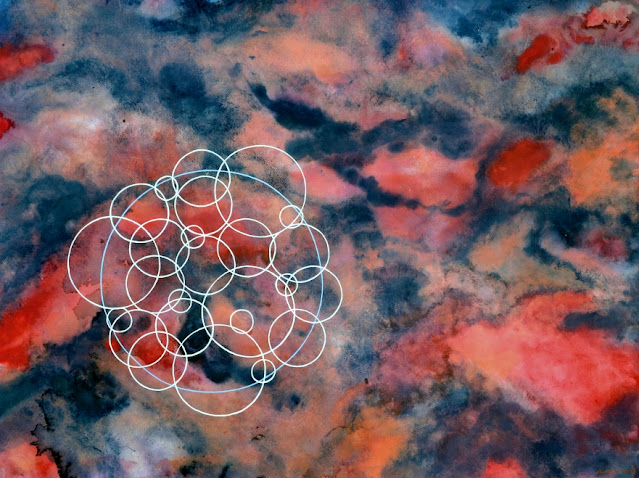
PROMPT-SCAPE

 Prompt-Scape Gouache on paper 28 x 32cm 2025

This image of Prompt-Scape (above) is a photographic documentation of a real painting, not an AI generated image erroneously called a 'painting.' Prompt-Scape visually reveals the plunder that a prompt to generate an image or text triggers. I use the word trigger deliberately! Is a prompt like a trigger, setting into motion algorithmic processes that target data to detect the statistical correlations most likely to produce what has been prompted/triggered?

I'll let you all have some fun thinking about this painting. I don't think I need to write much more about it! I will, however, leave two provocations.

1. Can the concept of surrender help us think about life in the age of AI? My article Surrendering to 'Too Powerful' technologies: From the F-111 to the MQ-28 Ghost Bat Drone' in Media, War, and Conflict journal.

2. In September I gave a seminar War in Our Hyperconnected World: Exposing the Invisible Battlespace, for colleagues in the School of Communication and Arts, and the University of Queensland, Australia. Below is one of my slides from the talk. Like Prompt-Scape it channels ideas of targeting in the Earth-to-satellite environment. The painting in the slide is Theatre of War: Techno-Seduction (2022). 

Here's a quote about Theatre of War: Techno-Seduction from my PhD thesis Drones, Signals, and the Techno-Colonisation of Landscape (2023). 

"The painted zeros and ones disembody the organic and strip the non-organic by visually reducing them to the same instructional code. This visual reduction to equivalence exposes insidious relationships, questions forces of techno-homogenisation, and raises issues of aesthetic homogenisation in an age of increasing generative AI."

Cheers,

Kathryn


Thursday, August 28, 2025

MAGIC INTELLIGENCE IN THE CLOUD? NO!

Fig 1. Magic Intelligence in The Cloud: Tech Bros Fantasy Oil on linen 112 x 97 cm2025


THE LURE OF MAGIC
The four paintings in this post were inspired by a fantastical comment made by OpenAI CEO Sam Altman in a conversation with Jony Ive, from io Products. The conversation was a prelude to a merger of OpenAI with io Products. If you watch the videoed conversation (Youtube), at around 3.50 minutes Sam Altman says, 

'We have like magic intelligence in The Cloud'. 

'Magic intelligence' is a euphemism for artificial intelligence (AI), also a problematic term. The term 'artificial intelligence' was first used in 1956 when Professor John McCarthy, Dartmouth College (USA), organised a workshop to discuss so-called thinking machines. 

From  - thinking, to artificial, to magic! AI to MI!

SALAMI
Professor of computational linguistics Emily Bender is a vocal critic of generativeAI technology, as well as the blanketing term 'artificial intelligence'. She often refers to an alternative description coined by Stefano Quintarelli -  'Systematic Approaches to Learning Algorithms and Machine Inferences  - SALAMI'. As bender points out, asking questions such as 'Is this SALAMI intelligent?' and 'Will SALAMI have emotions?' very quickly exposes the weakness in assumptions (magical thinking) that AI will ultimately have emotions, be sentient, require human/robot/AI rights, be creative, and more  

SO-CALLED: THE CLOUD
AND, 'The Cloud' is also a euphemism - for interconnected computer systems, the Internet, and the massive material infrastructure that supports our increasingly hyperconnected and data producing-consuming world. 'The Cloud' is not a wet, vapourous 'magical' place. It is a web of cables, signals, earth-satellite assets, data centres, computers and more. This infrastructure requires energy, water, and in many instances cheap human labour. These demands have worsened since the accelerated availability of generativeAI tools in the last 2-3 years. Kate Crawford, Karen Hao, Emily Bender and Alex Hanna, are a few contemporary commentators publishing research on the increasing resource and human cost of 'The Cloud'. 

Tung Hui Hu in his fascinating 2015 book A Prehistory of The Cloud  offers salient insights into the so-called 'Cloud'. For example, he notes, 'To use the cloud is to willingly put on an electronic collar; it is to fuse our hunt for data with our identities.' He reminds us that in this type of world, 'we are both the targets of others and targeters ourselves'. And, artist and author James Bridle in his 2018 book The New Dark Age: Technology and the End of the Future notes, 'Today the cloud is the central metaphor of the internet: a global system of great power and energy that nevertheless retains the aura of something noumenal and numinous, something almost impossible to grasp.' Seven yeas after Bridle made his comment, Altman grasps onto the 'something noumenal and numinous' when he attempts to conjure magical intelligence in 'The Cloud' as a lure, a promise, as aspirational... 

HYPE - MAGIC
When the hype around tech products/systems reaches a level where magic is invoked, where religiosity, and even alchemic thinking are inferred, we need to pay attention. From trusted, to trustworthy, to responsible, to safe, to agentic AI - to magic. The language of hype is expressed in words that shift as the hype surrounding the technology meets with failure, criticism, and questions. Words might give comfort - until they don't. 

My last post The Words We use: ENCODED delves into the question of language. 


Fig 2. Magic Intelligence in The Cloud Gouache on paper 76  x 56 cm 2025

The four paintings exhibited here were inspired by Altman's 'magic' statement. Like many of my paintings, I have combined painted binary code, 'clouds', militarised technology, and lines indicating signal hyperconnectivity. These are all placed in ambiguous scapes, where the viewer's perspective can wonder in imagination. 

Magic Intelligence in The Cloud (Fig 2) was the first painting I created after hearing Altman's 'magic' statement. The figure acts like a 'signal' linking the various 'clouds'. The militarise-ability of civilian technology in a hyperconnected world, as regular readers know, is a major concern of mine and a focus of my research. In this kind of world, magical thinking is very dangerous. 

Magic Intelligence in The Cloud: Tech Bros Fantasy (Fig 1) is an oil painting, clearly echoing my first work on paper, Magic Intelligence in The Cloud


Fig 3. Magic Intelligence: Exposed Gouache on paper 56  x 76 cm 2025

In Magic Intelligence: Exposed (Fig 3) the 'magic intelligence' is painted as strings of binary code, a 'label' or 'tag' on the dark cloud. Inside this dark cloud, a data centre structure extends into a seemingly unfathomable distance. The figures act as 'signals' linking 'The Cloud' to sources of data; each figure a conduit due to devices we use and carry. In our hyperconnected world, the human being becomes a node  -  this has nothing to do with magic.  
 
Fig 4. Magic Cloud: Mapped Gouache on paper 76  x 56 cm 2025


Cheers,
Kathryn

Friday, January 05, 2024

THE CLOUD IS NOT A CLOUD

 The Cloud is Not a Cloud gouache on paper 56 x 76 cm 2024

The Cloud - Swarm?
With The Cloud is Not a Cloud I wanted to pose questions about the contemporary 'Cloud' as a weaponisable and weaponised system. I was thinking about swarming technology, pondering whether the techno-Cloud, enabling complex arrays of services and capabilities, could be described as a dexterous swarm with both benign and malign latencies. However, is the techno-Cloud the swarm or the swarm enabler? Or maybe its a swarm that can spawn more swarms? The proliferation of misinformation, disinformation and fake news/images across social media is an example of this conception of swarming. 

Signals
While the techno-Cloud is underpinned by bricks and mortar, for example, buildings housing massive computer infrastructure, relay nodes dotted across the landscape and space, and other tangible devices, I am particularly interested in the invisible infrastructure. Here, I am referring to signals that ensure connectivity, interconnectivity and interoperability of devices and systems. 

Signals carrying codified data and instructions are visualised in The Cloud is Not a Cloud as lines connecting ambiguous looking shapes. Their multiple sharp edges could indicate a not-so-friendly environment, a protective stance, tactical readiness or strategic preparedness. Could The Cloud is Not a Cloud be a visualisation of military preparedness, geopolitical alignments, force posturing? Are we projecting onto the techno-Cloud fears of geo-political instability, and the type of war that needs no physical invasion? 

Red and White
I have used red and white to indicate potentialities, such as, attack, vulnerability, disguise, stealth, blood. I have deliberately implied that the colours could oscillate or merge, depending on politics, technological resilience, or non-resilience. Like many of my paintings, The Cloud is Not a Cloud can be viewed from multiple perspectives - from above, as if you are flying over the sea; from below, as if you are peering through 'clouds' to a blue sky; in front of or behind, as if you are about to walk into a spider's web...

As always, there's a lot more to think about. But, I will leave it to you now...

____________________________


Previous Posts of Interest.
The Cloud is Not a Cloud visually references some other recent paintings where I have painted odd patterns that echo the shapes of airborne drones, munitions, debris. You can see these paintings on these blog links Force Multiplication, Ghost Sky, and Ghost Shadows.

Since 2015 I have painted many paintings that refer to the techno-Cloud. You can search my BLOG by typing the word 'cloud' in the top left box above Art @ Kathryn Brimblecombe-Fox or in the 'Search this Blog' box on the right of the post.

NEWS

I am very happy to report that I am now a Dr. 
My PhD was conferred by Curtin University, Western Australia on the 1st December. 

You can access my PhD thesis: 
Drones, Signals, and the techno-Colonisation of Landscape
at Curtin's espace 


Cheers,
Kathryn
  

Wednesday, September 07, 2022

CLOUDY WAR

 Cloudy War Gouache on paper 56 x 76 cm 2022


CLOUDY?
You may have guessed that cloudy, in the title of this painting, does not mean atmospheric cloudiness, but rather, the encompassing cloudnet that is the 21st century techno-cloud, commonly called The Cloud. Regular readers will know I have created a number of paintings where I try to make visible the invisible aspects of contemporary militarised technology and war. By war, I mean not only kinetic warfare, but also information, hybrid, cyber and grey-zone warfare. The techno-cloud of interconnected and interoperable systems provides seeming instant access and connectivity to information, updates, news cycles, social media posts and posting and more. This is enabled by light-speed or near light-speed signal transmissions carried by frequencies in the electromagnetic spectrum (EMS). Speed is now an expectation.

Cloudy War
In  Cloudy War I have painted strings of binary code 'instructing' the word CLOUD. Circles of dotted lines carry the fake cloud theme further. And, yet more circles containing wave patterns reveal the underlying signalic character of this 'cloudy' war painting. Why waves? All frequencies in the EMS are made up of photons travelling in wave form at light speed. Radio waves have the longest wave lengths and gamma waves have the shortest. The radio to microwave frequencies are the most commonly used for transmission of signals that enable contemporary hardware and systems technologies. Congestion and contestation of bandwidths is prompting experimentation with other frequencies. Additionally AI systems are being developed to optimise bandwidth access, especially for the military. 

Peeping out from behind the techno-cloud are hints of various militarised hardware - airborne drones, ground-based aerial nodes, a tank, a robotic quadruped, a ship, indications of satellites. And, of course there are other hidden elements - you just have to imagine them! 

The 'fog of war' is now electromagnetically induced. 

I could go on, but I'll leave you to ponder. 

Cheers,
Kathryn


Friday, August 19, 2022

BATTLE CLOUD

Battle Cloud Gouache and watercolour on paper 30 x 42 cm 2022


IoT, IoBT, IoMT

Regular readers will know of my interest in trying to visualise the 21st century techno-cloud  - often just called The Cloud. Also, the Internet, and even the Internet of Things (IoT). 

But, did you know that the military also have terms like the Internet of Battlefield Things (IoBT) and the Internet of Military Things (IoMT)

All these 'internets' rely on the electromagnetic spectrum (EMS) for connectivity and interconnectivity, plus operability of hardware and systems, as well as inter-operability. The term dual-use, in a world where civilian technologies also rely upon the EMS becomes almost non-sensical. Why? Because in a world of not only kinetic warfare, we now have remotely operated systems, cyber warfare, hybrid warfare and information warfare. These draw civilian technologies into the various physical and cyber battlefields of our time. Our mobile phones, computers, remotely update-able vehicles and appliances, GPS, social media updates, cloud storage, cyber home assistants and more, can be, and in many instances are, tracked, hacked, surveilled, harvested for data, used as nodes and purveyors of viruses. 

What if the Internet of Things is ultimately a subsidiary of its spawned IoBT or IoMT? Where does that place the civilian in terms of complicity, unwitting or not? 

Battle Cloud

My visualisations of 21st century technology and its Cloud are created with paint - oil paint or gouache and watercolour paints. I love using paint to critically examine contemporary militarised and militarise-able technology. Why? Because, unlike the technology I critique and examine, painting is not reliant on the EMS for creation, exhibition or storage. This independence provides a critical distance. It is a form of resistance.

I listened to a fascinating conference hosted earlier in the year by the Disruption Network Lab in Berlin. The conference was called The Kill Cloud. One message from this bluntly titled conference was that the airborne drone needs to considered as part of a network. This resonated with me, and is why my PhD focusses on increasing military interest in the EMS as an enabler of technology, a type of fires (weapon), a manoeuvre space (tactics) and a domain (strategy). Any robotic hardware, whether an airborne drone, or a ground, sea or under-the-sea robotic system, functions as part of a network. The network is enabled by signals transmitted via EMS frequencies. As frequencies become more congested, due to not only increasing military needs, but also civilian needs, there is a heightened sense of urgency for militaries to dominate the EMS. Congestion is only one issue, another is contestation from state and non-state malign entities. 

I chose to paint Battle Cloud in red, after hearing the term 'kill cloud'. Maybe I could have called it Bloody Cloud or That Bloody Cloud. I don't think I need to explain the title any more - you 'get' it.

The washed out text running across the painting is binary code 'instructing' the word CLOUD. I like the way the code seems to dissolve, as if it is actually cloudy. The illusion of connection...


Three Other Cloud Paintings: 
There are actually more than three...scroll through the blog and you will see them. 

Cheers,
Kathryn


Friday, July 22, 2022

HUMAN IN THE LOOP

Human in the Loop Gouache on paper 30 x 42 cm 2022
 
NEWS

My work is included in the University of St. Andrew’s, UK, newly launched online Museum of Peace . The Museum exhibits an array of different approaches to peace in different themed ‘rooms’. You can see my exhibit in the Visualising Peace room, plus a couple of the other rooms.

I am thrilled that Otilia Meden, in her thoughtful essay "Cyber Peace and Artivism, with Kathryn Brimblecombe-Fox" has connected my earlier work with my more recent paintings.  

_______________________________________________________________


Autonomous Systems
As technological systems increasingly include autonomous functions, a plethora of questions about human work and agency arise. These questions relate to human labour and human decision making. 

With regards to weapon systems, autonomous functions within a system raise questions about a creeping attrition of human participation. This usurped participation could include activities such as, analysis of data, decisions about deployments of human and non-human warfighters, assessments of kill zones, identification of targets, and more. Autonomous functions enabled by AI and machine learning decrease delay, often caused by human beings taking time to think. Speed is increasingly viewed as a tactical and strategic edge, even a purveyor of weaponry, if not a weapon itself. I have a particular interest in speed, more specifically light-speed electromagnetic spectrum frequency-enabled connectivity and interconnectivity.

Two Paintings
The two paintings in this post, Human in the Loop and Threat, reflect upon the concepts of  'human in the loop' - 'human on the loop' - 'meaningful human control' - 'meaningless human control'. 

In Human in the Loop [above] binary code 'instructs' the word Human. This is followed by text "in the loop.". This is a reference to another recent painting Theatre of War: Law  which is a response to recent news about research into an AI legal assistant for in-combat military situations. The human being becomes an algorithm?

In Threat, binary code at the bottom of the painting 'instructs' the word HUMAN. The aerial view of what looks like a military air force base, seems to be viewed on a 'screen'. Perhaps this is drone footage? Does the code mean that a human being is monitoring the surveillance, identifying the threat, targeting the threat - or - does it mean a meaningless presence?

I use the word 'instruct' because code is essentially instructional. By painting code I attempt to make visible normally invisible instructional forces that drive our techno-world. Painting is a form of resistance, as it does not feed data back into the system. A digital photograph of a painting feeds data about the photo, not the actual process of creating the painting. 

Internet of Battlefield Things
Both paintings also indicate that interconnectivity via 'the Cloud' or the Internet of Battlefield Things [IoBT], enables interoperability across multiple domains. Another recent painting Theatre of War: Internet of Battlefield Things responds to this permutation of 'the Cloud'. 

 I have just listened to the proceedings of a very interesting and serious conference "The Kill Cloud: Networked Warfare, Drones and AI" hosted by The Disruption Network Lab, Berlin, March 2022. Sobering listening. It was a call-out to look beyond the drone [hradware], and to examine the system. This is exactly the focus of my PhD research, examining increasing military interest in the electromagnetic spectrum [EMS], as an enabler of technology, a type of fires, a manoeuvre space and a domain. Without reliable access to the EMS, connectivity, operability, interconnectivity, interoperability - at speed - could not occur. 

And, there's a lot more to write and think about, but I will leave this to you!

Cheers,
Kathryn


Threat Gouache on paper 30 x 42 cm 2022
 

Saturday, April 23, 2022

SPEED OF LIGHT

Speed of Light Oil on linen 112 x 153 cm 2022
 

Interconnecting circles form a fake cloud across a vast scape. Are you above this fake cloud or below it? The circles are formed by repeating the symbol for light speed - c. 

This painting responds to my research into increasing military interest in the electromagnetic spectrum [EMS]. All frequencies from radio to gamma waves travel at the speed of light in a vacuum. All frequencies are made up of photons. Contemporary military and civilian technologies are increasingly reliant on access to uncontested and uncontested frequencies for operation, connectivity, interconnectivity and inter-operability. Speed is key to seemingly instantaneous operation, connectivity, interconnectivity and inter-operability. 

Just a reminder that speed can kill.

As human beings harness the power and speed of the EMS for civilian and military applications, nations attempt to ensure access and use of frequencies. Even the recently announced Australia, United Kingdom and United States, AUKUS Pillar Two refers to the EMS, under "advanced capabilities";

"Electronic warfare.  The electromagnetic spectrum is increasingly contested.  The three countries will work together to share understanding of tools, techniques, and technology to enable our forces to operate in contested and degraded environments." (White House "Briefing Room" Statement April 5, 2022) 

Selection of other paintings and posts that relate to Speed of Light

Theatre of War: Dromo Domain

Theatre of War: Internet of Battlefield Things

Theatre of War: Everywhere Cloud

Theatre of War: Photons Do Not Care

Theatre of War: Photon

Cheers,

Kathryn

Tuesday, April 05, 2022

INTERFACE: BEING

Interface: Being Gouache on paper 56 x 75 cm 2022
 

Interface: Being follows my last painting Interface. And, in my last post I wrote "My head is full of ideas. Interface is a result of thinking about a lot of things. I've been writing and researching for my PhD, and this painting has been inside my head - my imagination - for a few weeks." My PhD research focuses on the increasing interest militaries around the world are paying to the electromagnetic spectrum (EMS), as an enabler of technology, a type of fires, a manoeuvre space and a domain. 

This new painting above, Interface: Being has also been inside my head for a while!

Human-Machine
The human-machine relationship is a key area of interest. As the speed of technological operation, enabled by light-speed EMS frequency transmissions, increases across inter-connected and interoperable civilian and military systems, the human being is often seen as a point of delay. I have written about this with regards to recent news that an AI military lawyer tool is under development - Theatre of War: Law   and Theatre of War: Techno-Seduction 

Interface: Being 
Interface: Being is also the result of weeks of research and thinking. Like Interface, this new painting also references Douglas Hofstadter, the technological Cloud, real clouds, AI, binary code (01001000 01010101 01001101 01000001 01001110 instructs the word HUMAN), and questions about what it means to be a human being in the 21st century. 

In this new painting, I introduce and play with the word BEING. 


BEING

TO BE

BEING HUMAN

HUMAN BEING

BEING 01001000 01010101 01001101 01000001 01001110 

01001000 01010101 01001101 01000001 01001110 BEING

HUMAN 01001000 01010101 01001101 01000001 01001110 

Interface is both a noun and a verb, and is used as both a noun and verb in computer science, and also in studies of human beings. 

In a human-machine relationship let's think about what is the interface, and what does the interfacing? Is it code - is it signal connectivity - is it human willingness or excitement (therefore, us) - is it need - maybe money - maybe power - is it speed? What do you think? How are we to BE human beings in a world dominated by accelerating developments in technology?

Painting
My choice of medium - painting - is deliberate. Painting helps me probe questions and pose new questions, without techno-interfaces or techno-interfacing. Painting is not reliant an any EMS-enabled digital or cyber technology, yet this does not preclude critique and study of these technologies. Painting is technologically and operatively detached. Detachment in a world of techno-interfaces and interfacing is a form of critical resistance.  

Cheers,

Kathryn


Tuesday, March 29, 2022

INTERFACE


Interface Gouache on paper 56 x 76 cm 2022


My head is full of ideas. Interface is a result of thinking about a lot of things. I've been writing and researching for my PhD, and this painting has been inside my head - my imagination - for a few weeks. 

Here are some ideas, books and thoughts that have influenced Interface 
  • Douglas Hofstader.
    I read Hofstadter's Godel, Escher and Bach (GEB) a number of years ago. A complex, innovative and imaginative book. During my PhD research my supervisor mentioned ambigrams. I did some research and realised that Hofstadter had invented the ambigram. Although I've often pondered his ideas of  recursion, I had forgotten that he had written briefly about ambigrams in GEB. For Hofstadter, an ambigram is a "calligraphic design that manages to squeeze two different readings into the selfsame set of curves" (GEB, p. P-19). It is something, presented in an aesthetic visual manner, that can be read in both up and down orientations.

    As regular readers know, I often use painted binary code as a way to 'play' with and parody ideas of digital technology. The painted code represents the object or thing that I am painting or expressing. I enjoy hand painting something that is normally represented so precisely in digital media. In Interface, binary code for the word HUMAN is reflected in the text HUMAN. I am visually 'playing' with up and down orientations and meanings. The painting poses questions about what it means to be human in a world where human-machine relationships are increasing. For example, what about human work, including creative work, being co-opted or assisted by algorithms?

    The 'reflection' of the binary code in the word HUMAN, and vice versa, is a kind of ambigrammatic ploy to question how we might maintain a sense of being human in the twenty-first century. The code and the word HUMAN are like shadows, but can we see them? Maybe they are shadows of shadows? Where does that place us?

    The word 'interface' is both a noun and a verb. What kinds of 21st century technological interfaces should we be aware of, as we interact and interface with them? 

  • The Cloud.
    Here I mean the technological 'cloud' - the Internet of Things (IoT) where interconnectivity and interoperability keep human beings in relationship with technological devices and systems. We cannot avoid, indeed escape, interfacing in the 21st century! Maybe this is what the shadows of shadows tells us? The background of Interface appears to be a cloudy tumultuous sky -  but  - is it a stormy sea? 

  • More Cloud
    Keeping with the 'cloud' theme, rather than the blue background representing a cloudy sky, I deliberately painted the binary code and letters in white to provide an alternative. Maybe the code/text is 'the cloud'. If you - the viewer - imagine looking up at this fake cloud, the blue background is a sky, even the cosmos. If you imagine being above the fake text-cloud, then the blue background is possibly a tumultuous sea. Maybe you are in front or behind the 'cloud', where it turns into a wall or barrier? This kind of imaginational flight, from below, to above, to around and beyond, is a critical form of engagement. I call it - imaginational metaveillance. 
     
  • Painting
    The paint medium requires no technological digital or cyber interfaces, yet it can be used to critique them. The hand of a human being is clearly evident. The dynamism between the paint and the paper surface, between the text and the background, 'speak' to relationships rather than interfaces. They 'speak' to relating rather than interfacing.

  • And, then there are ideas of post-humanity. 

  • And, of course, one of my major interests/concerns - militarised technology and the militarise-ability of civilian technology. In an interconnected and interoperable world interfaces and interfacing are key!

  • But, I will stop here and let you ponder!
Cheers,
Kathryn

Tuesday, February 15, 2022

THEATRE OF WAR: TECHNO-COLONISED PLANET

Theatre of War: Techno-Colonised Planet Gouache on paper 56 x 76 cm 2022
 

NEWS

Third Text Article

Thrilled that my article "Night Vision, Ghosts and Data Proxies: Paintings By War Artist Jon Cattapan" has been published online for Third Text, a leading peer reviewed international journal dedicated to the critical analysis of contemporary art in the global field. The hardcopy is forthcoming.

Cattapan was an official Australian war artist in Timor Leste in 2008. Key to his subsequent paintings were his experiences using night vision technology while accompanying Australian Peace Keeping forces on night patrols. The effect of the night vision green entered his paintings in ways that continue to 'speak' to us today. Thus, I analyse Cattapan's paintings through a 'future of war' lens-a future we are now living, nearly 15 yrs later. I argue that although the paintings were inspired by experiences in Timor Leste, the images could relate to the iterative modes of contemporary, and likely future war, ie: grey zone, hybrid, informational, cyber, as well as kinetic warfare.


Theatre of War: Techno-Colonised Planet 

This new painting relates to a few other recent paintings - examples: Theatre of War: Plague Cloud, Theatre of War: Dromo-Domain and Theatre of War: Law

Invitation to 'Fly'
In Theatre of War: Techno-Colonised Planet you are invited to fly, in your imagination, away from Earth. When you are ready, you peer back at the planet from a distance. And, from this distance what patterns become apparent? For me, I see a planet occupied by an insidious fake cloud that extends from Earth to orbiting satellites. The outline of the pale blue dot shimmers like a ghost behind the 'cloud'. This 'cloud' represents the ubiquitous presence of interconnected and interoperable systems, all reliant on access to, and use of, the electromagnetic spectrum (EMS). 

But, what if you are not 'flying' at a great distance from Earth? What if you 'fly' in closer? What if this is an image on a computer screen and you have flown through the window of a ground control station where remote operators sit in front of an array of computer screens? What if the white circles are computer graphics indicating techno-territorial occupation? Given that civilian technology and military technology rely on the same conduit and enabler, ie: the EMS - is the fake cloud an indication of dangerous synchronicity and homogeneity of techno-system operation? Does it represent an ever-ready always-on war preparedness, especially when various iterations of contemporary war are increasingly perpetrated via technological devices and systems - grey zone, hybrid, information and cyber warfare.

Whether you are flying at close or far distance -  your imagination is the critical tool. For me, this is how imaginational metaveillance works to become a resistance to the kind of normalised techno-surveillance of the world in which we live. 

As artist and writer James Bridle notes, "Today the cloud is the central metaphor of the internet: a global system of great power and energy that nevertheless retains the aura of something noumenal and numinous, something almost impossible to grasp."* In Theatre of War: Techno-Colonised Planet I have tried to 'grasp it'. My invitation for you to take imaginational flight, is my way of sharing this quest.
  
Cheers,
Kathryn

*James Bridle, The New Dark Age: Technology and the End of the Future (London: Verso, 2018), 6.


Tuesday, December 14, 2021

THEATRE OF WAR: PLAGUE CLOUD


 Theatre of War: Plague Cloud Oil on linen 112 x 92 cm 2021


Theatre of War: Plague Cloud is number 13 or 14 in a growing Theatre of War series of paintings [oil paintings and works on paper]. It is also one of a number of cloud paintings ie: 'playing' with real clouds and The Cloud - the 21st century pervasive techno-network.

The Cloud
As noted in a recent post for another painting Theatre of War: The Cloud I have been researching the idea of the cloud as a metaphor. Here, John Ruskin's observations, made in two speeches at the London Institute in 1884, of 'plague clouds' and 'plague winds' have helped me think critically about The Cloud. I ask, is militarisation of technology, including the militarise-ability of civilian technology, like a 'plague wind' blowing through the electromagnetic spectrum [EMS]? Given that the EMS operatively enables contemporary technological connectivity, interconnectivity and networking, could The Cloud, therefore, be a 'plague cloud'? 

Contagion
In Theatre of War: Plague Cloud I have repeated some of the motifs I used in Theatre of War: Everywhere Cloud where circles contain elements of military hardware or systems used underwater, on the water, on land, in the sky and in space. These systems 'peek' out of their 'cloudy' domains, but all of them are drawn into a larger 'cloud' of repeated circles that represent interconnectivity, networked systems, interoperability and joint force operations. This large 'cloud' extends beyond the painting. Like an airborne contagion it threatens to wrap its techno-tentacles around the globe, potentially drawing each military and civilian device into its 'cloudy' web. 

Theatre of War: Plague Cloud's background, painted with a combination of blue and rust red, appears 'dirtier' than some of my other 'cloudy' paintings. This helps to channel the idea of a plague that infects the environment. Here, I note Ruskin's observations of dirtier looking skies and clouds painted by artists, such at J. M. W Turner, who responded to a changing environment during the early 19th century industrial revolution. It also demonstrates a vulnerability, because once the world is techno-wrapped, can we unwrap ourselves or be unwrapped? What happens if The Cloud fails and it spontaneously unwraps - unravels - as connections falter, its 'promise' of persistence, resilience, connectivity and speed, broken? 

I wonder what it might be like to be uncontrollably jettisoned from the web! 

On that happy note!
Cheers,
Kathryn

Monday, October 25, 2021

BIPED AND QUADRUPED: WARFIGHTERS

Biped and Quadruped: Warfighters Oil on linen 60 x 110 cm 2021
 

Recent news of a weaponised quadruped robot caught my interest - and dismay.

But, was I surprised?  No. 

Biped and Quadruped: Warfighters 
My new painting Biped and Quadruped Warfighters places two figures in circles against a violent red background 'landscape'. The human-like torso is equipped with multiple sensors and antennae. Here, I have also 'played' with Microsoft's recently touted networkable military grade goggles that use an 'Integrated Visual Augmentation System' to enhance soldier situational awareness. The other figure is a robotic weaponised quadruped - I refuse to call it a dog!

Is the human-like torso actually a human being, or is it also a robot, or an anthropomorphised representation of a system? You decide!

I placed each figure in a circle to denote their compliance with a network, with a 'cloud'. This refers to a few other recent paintings. Two examples are Theatre of War: Infrared and Theatre of War: Everywhere Cloud 

The quadruped warfighter seems to lead the other warfighter - they both face the same direction. The quadruped leads as a lethal scout.

Recurring Question
I have lots more to say! - but a recurring question I have is - How do we memorialise when the warfighter was never alive?


And, just in case you missed it!

THE DEAD PRUSSIAN PODCAST

My interview with Mick Cook from The Dead Prussian Podcast is live! We discuss my work, research, creative practice and the future of war. I am thrilled to be given opportunities like this! 

The term 'Dead Prussian' refers to nineteenth century General Carl von Clausewitz, who wrote the famous tome On War. Regular readers will know that I reference Clausewitz in my Theatre of War series of paintings. Clausewitz uses the term 'theatre of war' variously and often in On War.

Cheers,
Kathryn

Tuesday, October 19, 2021

THEATRE OF WAR: EVERYWHERE CLOUD

Theatre of War: Everywhere Cloud Oil on linen 92 x 112 cm 2021
 

NEWS

THE DEAD PRUSSIAN PODCAST

My interview with Mick Cook from the Dead Prussian Podcast  is live. We discuss my work, research, creative practice and the future of war. I am thrilled to be given opportunities like this! 

The term 'Dead Prussian' refers to nineteenth century General Carl von Clausewitz, who wrote the famous tome On War. Regular readers will know that I reference Clausewitz in my Theatre of War series of paintings. Clausewitz uses the term 'theatre of war' variously and often in On War.


Theatre of War: Everywhere Cloud 
My new painting Theatre of War: Everywhere Cloud is number 12 or 13 in my series Theatre of War. Clausewitz has been a great inspiration! The title also refers to Derek Gregory's idea of the everywhere war ie: war has reached beyond geography into the cyber world and space. 

Gregory's concern for people on the ground, the victims of war, is obvious in his very detailed analyses of events, such as a 2010 US drone attack that killed 23 Afghan civilians. You can hear him describe and talk about his forensic analysis of the attack in his recorded keynote speech for the Aesthetics of Drone Warfare conference, University of Sheffield, February 2020. I spoke at, and attended, this conference too - just before the pandemic derailed the planet! Gregory's keynote was riveting and disturbing - a detailed analysis of US forces' misunderstanding of data, lack of experienced personnel and more.

Clouds
Theatre of War: Everywhere Cloud is preceded by a number of other paintings that 'speak' to the idea of The Cloud, fake clouds, notions of interoperability, networking, interconnection and military joint force. Three of my most recent paintings are Paradox  and Theatre of War: The Cloud and Theatre of War: Infrared

Come Fly With Me!
As with my other two paintings, and indeed, most of my paintings, the viewer is invited to fly in imagination. Are you above, below, beside or inside the 'cloud'? I call this an act of imaginational metaveillance. 

Glimpses of technology are visible from behind cloud-like formations. They are painted red to indicate blood, danger, violence, fear, contagion. The red colour connects them visually across their multiple domains, from under the sea to space. Red and white circles, denoting the use of, and reliance upon, frequencies in the electromagnetic spectrum draw everything into the war-play, the theatre of war - everywhere. With light-speed signal transmission within networked systems, I argue that Gregory's notion of the everywhere war needs now to be extended in to time and speed.

If you would like to know more about what I think of speed, time and contemporary war, please listen to my Dead Prussian Podcast - Mick asks all his guest the same last question - which is - Can you please finish this sentence "War is......" 

Cheers,
Kathryn

PS. Oh, and another podcast - this time my interview with Dr. Beryl Pong. lead researcher for the Aesthetics of Drone Warfare project, University of Sheffield. 

Monday, October 11, 2021

PARADOX

Paradox Gouache and watercolour on paper 56 x76 cm 2021


THE DEAD PRUSSIAN PODCAST
Before I write about Paradox - an alert! 

Yesterday my interview with Mick Cook from the Dead Prussian Podcast went live. We discuss my work, research, creative practice and the future of war. You can listen to my interview HERE  I am thrilled to be given opportunities like this! 

You can see the list of other great interviews on The Dead Prussian Podcast site. I have listened to quite a few, and they are always interesting, with a diverse number of topics and interviewees. 

The term 'Dead Prussian' refers to nineteenth century General Carl von Clausewitz, who wrote the famous tome On War. Regular readers will know that I reference Clausewitz in my Theatre of War series of paintings. Clausewitz uses the term 'theatre of war' variously and often in On War.


THE STORY OF PARADOX
Paradox is the result of a commission from Group Captain Jo Brick, Royal Australian Air Force. We met when I exhibited paintings at the Australian Defence College in Canberra. Group Capt Brick had written an essay "Kill the Enemy, and Don't Forget to Buy Milk on the Way Home" which had won 'Category 2: ADF Officers' section of the Jamie Cullens Defence Leadership and Ethics Essay Competition in 2019. We discussed that I would respond to the essay. Given that the essay is a reflection on the operation of airborne drones, regular readers will know this commission was right up my alley!

Group Capt Brick's thoughtful and hard hitting essay stimulated four paintings - all works on paper. Paradox is the painting she chose. I am delighted!

Below is my artist's statement, written to accompany Paradox

PARADOX

Gouache & Watercolour on Paper 2021

Artist’s Statement: Kathryn Brimblecombe-Fox

Paradox was inspired by Group Captain Jo Brick’s essay “Kill the Enemy, and Don’t Forget to Buy Milk on the Way Home”. The painting evokes the sense of liminality experienced by remote drone pilots who fight wars and insurgencies in distant countries from inside home-based ground control stations. While inside these bunkers they are at war. Upon leaving the bunker, they re-enter domestic life. As Brick notes “their psychological existence occupies both war and peace”. The ongoing rhythm of this existence creates a liminal zone where the pilot’s psyche grapples with seemingly unreconcilable paradoxes. This agitation is deepened by experiences of witnessing, perpetrating and perpetuating scopic intimacies of surveillance, identification, targeting and killing.

The circles in Paradox link and overlap in ways that draw the drone pilot, the drone, and the surveilled or targeted, together. This occurs against a vast sky, or could it be a seascape? This depends on the viewer’s perspective. A sense of flying, hovering, floating is suggested. Are you a pilot, maybe a drone, a bird or even an intergalactic space traveler passing by Earth? Perhaps you are a target, living a precarious life on the edge of life and death? A melancholic kind of resignation is felt as clouds semi-obscure details. These clouds act as visual metaphors for liminality. They also act as metaphors for the contemporary ‘cloud’ of networked, interconnected and interoperable militarised and militarise-able technologies. This techno-cloud is the drone pilot’s operational space. The colour red disrupts melancholia with warnings of violence. The red squares denote computer screens, ‘windows’ into the scoped lives of the targeted. The red tinged clouds speak to violence, blood and death; reminding us of corporeality in a techno-world. The human-like outline indicates the presence of a human in the loop, but can we be sure of this? It may be a robot.


Cheers,
Kathryn

Sunday, September 12, 2021

THEATRE OF WAR: THE CLOUD

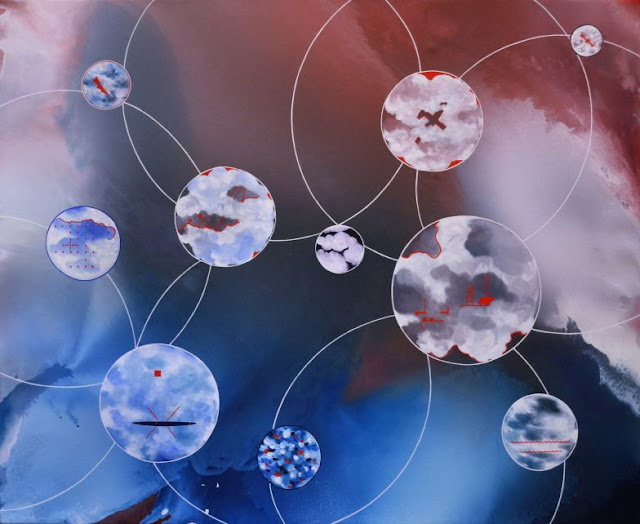
Theatre of War: The Cloud Gouache and watercolour on paper 56 x76 cm 2021


This is my 11th or 12th painting in my Theatre of War series. I'll have to write one post with all of the paintings, so you can see them as a body of work! 

PhD Research
Theatre of War: The Cloud is informed by my current PhD research into the increasing interest militaries around the world are paying to the electromagentic spectrum (EMS) as an enabler of technology, a type of fires, a manoeuvre space and a domain. I am examining the use of frequencies for military purposes, and the ability for state or non-state actors to appropriate civilian technology via the EMS. I pay particular attention to the spectrum range from radio to visible light frequencies. 

THE CLOUD
The Cloud ie: the euphemism we ascribe to the contemporary world of networked and interconnected digital and cyber technologies, is of great interest to me. The concept provides the means for interoperability, a key aim for modern militaries. This means that traditional army, navy and air forces work together using technology that networks capabilities across all of their domains. The military term 'joint force' also encompasses the digital and cyber domains of information and cyber war. The space domain is also drawn into this interoperable mix, with satellites playing pivotal roles in communication, operability and connectivity. The Cloud, however, is not just a military asset - civilian technology also relies on the connectivity, operability and communication that EMS enabled Cloud technologies and systems enable and use.

I have been researching the idea of the cloud as a metaphor. One interesting way of thinking about The Cloud is to draw upon John Ruskin's nineteenth century observations of 'plague clouds' and 'plague winds'. Is militarisation of technology, including the militarise-ability of civilian technology, like a 'plague wind' blowing through the EMS? Is The Cloud, therefore a 'plague cloud'? 

Theatre of War: The Cloud
In Theatre of War: The Cloud I have tried to represent an excavation of military interoperability. The painted-in circles at the bottom of the painting are underwater, possibly autonomous underwater vehicles or sensors. Through the middle are land-based and on-sea systems, possibly also autonomous. At the top of the painting, an airborne drone and a satellite over-watch. In each of the circles with obvious clouds, the technology is obscured. This implies that systemic complexity obscures understanding. The repetition of red and white circles across the painting indicates interconnectivity. These circles visually form a stylised cloud that draws all operations together. That this cloud extends beyond the painting is clear. It is part of The Cloud.

While I conceived Theatre of War: The Cloud as an excavation from sea to space, the painting can also be viewed as a map. This play with perspective is deliberate...

Cheers,
Kathryn