Showing posts with label theatre of war. Show all posts

Tuesday, February 15, 2022

THEATRE OF WAR: TECHNO-COLONISED PLANET

Theatre of War: Techno-Colonised Planet Gouache on paper 56 x 76 cm 2022
 

NEWS

Third Text Article

Thrilled that my article "Night Vision, Ghosts and Data Proxies: Paintings By War Artist Jon Cattapan" has been published online for Third Text, a leading peer reviewed international journal dedicated to the critical analysis of contemporary art in the global field. The hardcopy is forthcoming.

Cattapan was an official Australian war artist in Timor Leste in 2008. Key to his subsequent paintings were his experiences using night vision technology while accompanying Australian Peace Keeping forces on night patrols. The effect of the night vision green entered his paintings in ways that continue to 'speak' to us today. Thus, I analyse Cattapan's paintings through a 'future of war' lens-a future we are now living, nearly 15 yrs later. I argue that although the paintings were inspired by experiences in Timor Leste, the images could relate to the iterative modes of contemporary, and likely future war, ie: grey zone, hybrid, informational, cyber, as well as kinetic warfare.


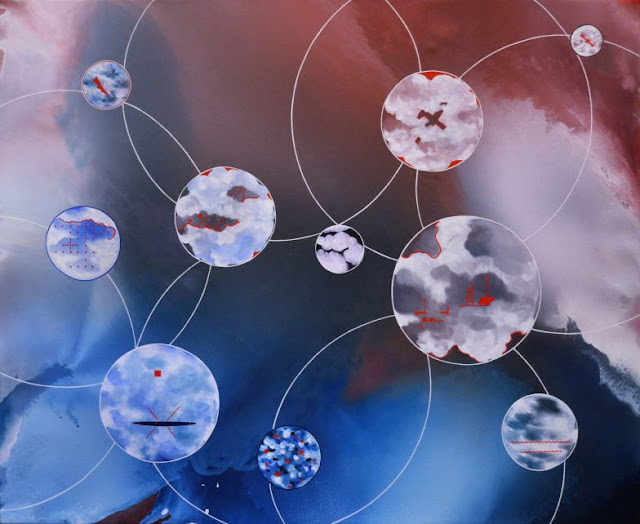
Theatre of War: Techno-Colonised Planet 

This new painting relates to a few other recent paintings - examples: Theatre of War: Plague Cloud, Theatre of War: Dromo-Domain and Theatre of War: Law

Invitation to 'Fly'
In Theatre of War: Techno-Colonised Planet you are invited to fly, in your imagination, away from Earth. When you are ready, you peer back at the planet from a distance. And, from this distance what patterns become apparent? For me, I see a planet occupied by an insidious fake cloud that extends from Earth to orbiting satellites. The outline of the pale blue dot shimmers like a ghost behind the 'cloud'. This 'cloud' represents the ubiquitous presence of interconnected and interoperable systems, all reliant on access to, and use of, the electromagnetic spectrum (EMS). 

But, what if you are not 'flying' at a great distance from Earth? What if you 'fly' in closer? What if this is an image on a computer screen and you have flown through the window of a ground control station where remote operators sit in front of an array of computer screens? What if the white circles are computer graphics indicating techno-territorial occupation? Given that civilian technology and military technology rely on the same conduit and enabler, ie: the EMS - is the fake cloud an indication of dangerous synchronicity and homogeneity of techno-system operation? Does it represent an ever-ready always-on war preparedness, especially when various iterations of contemporary war are increasingly perpetrated via technological devices and systems - grey zone, hybrid, information and cyber warfare.

Whether you are flying at close or far distance -  your imagination is the critical tool. For me, this is how imaginational metaveillance works to become a resistance to the kind of normalised techno-surveillance of the world in which we live. 

As artist and writer James Bridle notes, "Today the cloud is the central metaphor of the internet: a global system of great power and energy that nevertheless retains the aura of something noumenal and numinous, something almost impossible to grasp."* In Theatre of War: Techno-Colonised Planet I have tried to 'grasp it'. My invitation for you to take imaginational flight, is my way of sharing this quest.
  
Cheers,
Kathryn

*James Bridle, The New Dark Age: Technology and the End of the Future (London: Verso, 2018), 6.


Tuesday, December 14, 2021

THEATRE OF WAR: PLAGUE CLOUD


 Theatre of War: Plague Cloud Oil on linen 112 x 92 cm 2021


Theatre of War: Plague Cloud is number 13 or 14 in a growing Theatre of War series of paintings [oil paintings and works on paper]. It is also one of a number of cloud paintings ie: 'playing' with real clouds and The Cloud - the 21st century pervasive techno-network.

The Cloud
As noted in a recent post for another painting Theatre of War: The Cloud I have been researching the idea of the cloud as a metaphor. Here, John Ruskin's observations, made in two speeches at the London Institute in 1884, of 'plague clouds' and 'plague winds' have helped me think critically about The Cloud. I ask, is militarisation of technology, including the militarise-ability of civilian technology, like a 'plague wind' blowing through the electromagnetic spectrum [EMS]? Given that the EMS operatively enables contemporary technological connectivity, interconnectivity and networking, could The Cloud, therefore, be a 'plague cloud'? 

Contagion
In Theatre of War: Plague Cloud I have repeated some of the motifs I used in Theatre of War: Everywhere Cloud where circles contain elements of military hardware or systems used underwater, on the water, on land, in the sky and in space. These systems 'peek' out of their 'cloudy' domains, but all of them are drawn into a larger 'cloud' of repeated circles that represent interconnectivity, networked systems, interoperability and joint force operations. This large 'cloud' extends beyond the painting. Like an airborne contagion it threatens to wrap its techno-tentacles around the globe, potentially drawing each military and civilian device into its 'cloudy' web. 

Theatre of War: Plague Cloud's background, painted with a combination of blue and rust red, appears 'dirtier' than some of my other 'cloudy' paintings. This helps to channel the idea of a plague that infects the environment. Here, I note Ruskin's observations of dirtier looking skies and clouds painted by artists, such at J. M. W Turner, who responded to a changing environment during the early 19th century industrial revolution. It also demonstrates a vulnerability, because once the world is techno-wrapped, can we unwrap ourselves or be unwrapped? What happens if The Cloud fails and it spontaneously unwraps - unravels - as connections falter, its 'promise' of persistence, resilience, connectivity and speed, broken? 

I wonder what it might be like to be uncontrollably jettisoned from the web! 

On that happy note!
Cheers,
Kathryn

Tuesday, October 19, 2021

THEATRE OF WAR: EVERYWHERE CLOUD

Theatre of War: Everywhere Cloud Oil on linen 92 x 112 cm 2021
 

NEWS

THE DEAD PRUSSIAN PODCAST

My interview with Mick Cook from the Dead Prussian Podcast  is live. We discuss my work, research, creative practice and the future of war. I am thrilled to be given opportunities like this! 

The term 'Dead Prussian' refers to nineteenth century General Carl von Clausewitz, who wrote the famous tome On War. Regular readers will know that I reference Clausewitz in my Theatre of War series of paintings. Clausewitz uses the term 'theatre of war' variously and often in On War.


Theatre of War: Everywhere Cloud 
My new painting Theatre of War: Everywhere Cloud is number 12 or 13 in my series Theatre of War. Clausewitz has been a great inspiration! The title also refers to Derek Gregory's idea of the everywhere war ie: war has reached beyond geography into the cyber world and space. 

Gregory's concern for people on the ground, the victims of war, is obvious in his very detailed analyses of events, such as a 2010 US drone attack that killed 23 Afghan civilians. You can hear him describe and talk about his forensic analysis of the attack in his recorded keynote speech for the Aesthetics of Drone Warfare conference, University of Sheffield, February 2020. I spoke at, and attended, this conference too - just before the pandemic derailed the planet! Gregory's keynote was riveting and disturbing - a detailed analysis of US forces' misunderstanding of data, lack of experienced personnel and more.

Clouds
Theatre of War: Everywhere Cloud is preceded by a number of other paintings that 'speak' to the idea of The Cloud, fake clouds, notions of interoperability, networking, interconnection and military joint force. Three of my most recent paintings are Paradox  and Theatre of War: The Cloud and Theatre of War: Infrared

Come Fly With Me!
As with my other two paintings, and indeed, most of my paintings, the viewer is invited to fly in imagination. Are you above, below, beside or inside the 'cloud'? I call this an act of imaginational metaveillance

Glimpses of technology are visible from behind cloud-like formations. They are painted red to indicate blood, danger, violence, fear, contagion. The red colour connects them visually across their multiple domains, from under the sea to space. Red and white circles, denoting the use of, and reliance upon, frequencies in the electromagnetic spectrum draw everything into the war-play, the theatre of war - everywhere. With light-speed signal transmission within networked systems, I argue that Gregory's notion of the everywhere war needs now to be extended in to time and speed.

If you would like to know more about what I think of speed, time and contemporary war, please listen to my Dead Prussian Podcast - Mick asks all his guest the same last question - which is - Can you please finish this sentence "War is......" 

Cheers,
Kathryn

PS. Oh, and another podcast - this time my interview with Dr. Beryl Pong. lead researcher for the Aesthetics of Drone Warfare project, University of Sheffield. 

Sunday, October 03, 2021

THEATRE OF WAR: INFRARED

Theatre of War: Infrared Gouache on paper 56 x 76 cm 2021


I've lost count of how may paintings are now in my Theatre of War series. I think maybe 12 or 13. 

Theatre of War: Infrared continues my investigation into how Clausewitz's ideas of the theatre of war can inform critical approaches to contemporary war. I am also interested in how Clausewitz's ideas may reach their limits with the contemporary mutation of war into a kind of everywhere-ness - like a contagion. In my first Theatre of War post and painting, I explain my interest in Clausewitz. 

Theatre of War: Infrared is also a continuation of my research into the increasing military interest in the electromagnetic spectrum [EMS], as an enabler of technology, a type of fires, a manoeuvre space and a domain. I have painted a cloud-like array of circles against a red sky. Signals transmitted by various frequencies in the EMS are indicated by full lines or dotted lines. These lines visualise a signalic occupation of our extended environment, from land to space-based assets. I 'see' this as a force of techno-colonisation. The fake clouds are a clue!

The red background could be many things, a fiery war zone, a heated planet, or the use of infrared frequencies for communication, high energy lasers or detecting warm things. The latter feeds into surveillance and targeting. Ever since my pest controller showed me how his infrared camera could detect pests, the association of infrared with pest control has stuck in my mind. With this in mind,  surveillance and targeting using infrared technology could be described as acts of an exterminator.  


NEWS

* Please check out Dr Beryl Pong's article "The Aesthetics of Drone Warfare", The British Academy, September 2021. Happy to say she mentions my work, which was included in an exhibition Dr. Pong curated last year. I also presented at the Aesthetics of Drone Warfare conference at Sheffield University in February 2020 [when we could still go places!]. Dr. Pong leads the Aesthetics of Drone Warfare research project.  

* My work is also mentioned in  “Coda: the life, death, and rebirth of drone art” by Arthur Holland Michel, in DroneImaginaries: The Power of Remote Vision, Manchester Uni Press, edited by Andreas Immanuel Graafe and Kathrin Maurer.

AND

If you have not had a look at my last post Wingman: Online Exhibition please do!

Cheers,
Kathryn

Saturday, July 17, 2021

THEATRE OF WAR: PHOTONS DO NOT CARE

Theatre of War: Photons Do Not Care Oil on linen 92 x 112 cm 2021
 

This is the tenth in my series Theatre of War. It is, however, my first oil on linen in the series. The others have all been works on paper.

The title of the painting was inspired by words written by Maj John Casey in a very interesting 2020 article "Cognitive Electronic Warfare: A Move Towards EMS Maneuver Warfare" for the online journal OTH: Over the Horizon: Multi-Domain Operations and Strategy. Casey wrote "The EMS knows no limits and the photons do not care about threat envelopes, fire support coordination lines, national interests, or boundaries."

PhD
As regular readers know I am currently undertaking a creative practice-lead PhD through Curtin University, Western Australia. My research examines the increasing interest militaries around the world are paying to the electromagnetic spectrum [EMS] as an enabler of technology, a type of fires, a 'maneuver space' and a domain. Given that interconnectivity, networking and interoperability draw EMS-reliant civilian technology into militarised capabilities, I argue - we all need to pay attention. 

All frequencies in the EMS [radio to gamma] are made up of photons, massless particles agitating at different energy levels, but all travelling at the speed of light. Lower energy radio frequencies have longer wave lengths and gamma waves have very short wave lengths. The light spectrum is the only one visible to humans [without tech assistance]. 

Casey's comment that photons "know no limits" reminds us that networked and interconnected technologies utilising the EMS have operative functions that, for example, reach light speed. Photons are quantum particles existing in dimensions of space and time that are beyond human access, but not beyond human desires for optimised tactical advantages. Here, I am reminded of Paul Virilio's comment, 

The fact of having reached the light barrier, the speed of light, is a historic event, one which disorients history and also disorients the relation of human beings to the world. If that point is not stressed, then people are being disinformed, they are being lied to. For it has enormous importance. It poses a threat to geopolitics and geostrategy.*

As Casey reminds us, photons do not care about "national interests, or boundaries". Thus, we need to pay attention to military interest in the EMS as accelerating speeds of technological operation, even light speed operative capacities, are likely, as Virilio warns, to disorient the relation of human beings to the world to the point that geopolitics and geostrategy are threatenedIf we are disoriented - will we even notice? 

Theatre of War: Photons Do Not Care 
Stars in the universe sparkle, light indicating their presence and history. Mars and Earth are visible. I have painted four Loyal Wingman drones with small dots to indicate their reliance on spectrum. Are the dots photons? Are they false stars? Whatever they are, maybe they create a false universe, a strange simulation? The dotted geolocating points in the landscape reference a marshalling of natural resources to conform to strategic needs. I remind readers that the EMS is a natural and universal resource, photons appearing in the nano-seconds after the Big Bang. 

I will leave you to ponder more. 

Cheers, Kathryn

P.S. Last Theatre of War post was Theatre of War: Spectrum Access  For other posts use the Search This Blog is available on the right side of this post. 

*Paul Virilio, “Red Alert in Cyberspace,” Radical Philosophy (Nov/Dec 1995): 2.


Monday, July 05, 2021

THEATRE OF WAR: SPECTRUM ACCESS

Theatre of War: Spectrum Access Gouache on paper 56 x 76 cm 2021
 

This is my 9th Theatre of War painting. The last one was Theatre of War: Photon 

Taking Clausewitz's oft used term 'theatre of war' I suggest that the contemporary theatre of war is now staged beyond geographies of land, air and sea. It is now staged in space, cyberspace and the electromagnetic spectrum - all domains permeable to each other to allow interoperability and joint force ops. A theatre of war that is endlessly staged - thus it includes time and the future. 

My Theatre of War series addresses some of my ideas about contemporary/future theatre of war.

Theatre of War: Spectrum Access
In Theatre of War: Spectrum Access a figure carries electronic instruments. Is this figure human, an enhanced human or a robot? Maybe it is a simulation for a virtual wargame? The cosmic landscape reminds us that the electromagnetic spectrum is universal - photons appearing in the short seconds after the Big Bang. The tree-of-life, seemingly on fire, conjures thoughts about threats to humanity. And, of course, there is more...

PhD Research
Examining military use of the electromagnetic spectrum [EMS] is the core of my PhD research.  Militaries around the world are increasingly interested in the EMS as an enabler of technology, a type of fires, a 'maneuver' space and a domain. In 2020 US Department of Defense [US DoD] moved from the term 'electronic warfare' to electromagnetic warfare. 


Below are some quotes from a few articles etc that give you an idea about why I am interested in this kind of research.


"Permeating all other domains, the EMS is a foundational domain and enabler of operations in every other domain. With no regard for the sovereignty of any government or military, the EMS provides equitable access to anyone with the means to manipulate it."
Cognitive Electronic Warfare: A Move Towards EMS Maneuver Warfare by John G. Casey in Over the Horizon (OTH) journal, 2021

"The Nation has entered an age of warfighting wherein U.S. dominance in air, land, sea, space, cyberspace, and the electromagnetic spectrum (EMS) is challenged by peer and near peer adversaries. These challenges have exposed the cross-cutting reliance of U.S. Forces on the EMS, and are driving a change in how the DoD approaches activities in the EMS to maintain an all-domain advantage." 
Opening sentence of  Forward for the US DoD Electromagnetic Spectrum Superiority Strategy, October 2020 

In section 3.11 of the Australian Government - Department of Defence 2020 Force Structure Plan, it notes that the Government is investing in "joint electronic warfare battle management and analysis". It also notes that this will be "enhanced" by developing capabilities in the electromagnetic spectrum. 
Australian Government, Department of Defence 2020 Force Structure Plan Section 3.11, page 30.


"The military uses the electromagnetic spectrum - essential, yet invisible - to detect, deceive and disrupt the enemy while protecting friendly forces. As enemies become more capable, and threats more complex, controlling the spectrum is increasingly critical." 
Northrup Grumman website page "Electronic Warfare" 

Cheers,
Kathryn

Tuesday, March 09, 2021

THEATRE OF WAR: DOMAIN DOMINANCE

Theatre of War: Domain Dominance Gouache on paper 56 x 76 cm 2021


This is my seventh Theatre of War painting - my series is developing! Here is a link to my sixth painting Theatre of War: Ghosts Warn, where there are further links to earlier paintings.

THEATRE OF WAR
In these paintings I explore the notion of 'theatre of war', oft mentioned by General Carl von Clausewitz in his early nineteenth century famous tome On War. I explore the notion 'theatre of war' as a way to think about how contemporary war has seeped beyond geographic boundaries to infiltrate digital and cyber worlds, the media, social media and information. I also draw the electromagnetic spectrum [EMS] into the contemporary notion of 'theatre of war'. Why? 

The EMS is both an enabler of contemporary militarised technology and a domain of increasing military interest. Importantly the EMS also enables contemporary civilian technology. Thus, as a shared resource the EMS can clearly be described as dual use. However, I argue, that the term 'dual use' belies the complexity of contemporary technology where networking, interconnectivity and the 'Internet of Things' expose civilian technology [systems and hardware] to both overt and insidious militarise-abiliy. This militarise-ability is not just the purview of state-based defence forces, but also non-state and aberrant groups or individuals.

DOMAIN DOMINANCE
In Theatre of War: Domain Dominance I have tried to convey that EMS domain dominance, a direct US Department of Defence policy, extends the theatre of war into the invisible [except visible light] natural resource of the electromagnetic spectrum. Like the natural physical environment, the EMS is occupied, colonised and used for advantage. As an enabler of technology the EMS is a protagonist in the contemporary theatre of war, and as a domain of military interest it forms part of the extensive, everywhere stage of contemporary war. 

In Theatre of War: Domain Dominance I have depicted a number of black boxes, indicating secret or discrete capabilities. I have painted strings of binary code 'instructing' words like 'NODE', HUMAN', 'DRONE' and 'CLOUD'. Trees-of-life hover in designated zones, as does the group of human figures. Are they targets? Everything is connected by signals and wavelengths delivering coded instructions, data and information. Surveillance night-vision green clouds deceptively float, stored information stacked. Targeting cross-hairs on the far right indicate a possible mission - the map-like depiction of the 'stage' reveals the drama.

And - yes - there is more to say!

Cheers,
Kathryn


Monday, March 01, 2021

THEATRE OF WAR: GHOSTS WARN

Theatre of War: Ghosts Warn Gouache on paper 56 x 76 cm 2021


This is my sixth Theatre of War painting. The other paintings can be accessed via my post Theatre of War: Spectrum

Clausewitz
Theatre of War: Ghosts Warn is again inspired by thinking about the famous 18th/19th century General Carl von Clausewitz's famous tome On War . In this book Clausewitz regularly refers to the term 'theatre of war', even devoting a chapter to it [Book V, Chapter II]. In the 21st century the concept of 'theatre of war' extends beyond Clausewitz's idea of a "portion of the space over which war prevails as has its boundaries protected, and thus possesses a kind of independence". While the idea of a portion of space, independence and protected boundaries are blurred by new modes of warfare, such as cyberwar, information war, electronic and electromagnetic warfare, I think it is interesting to ponder what the contemporary 'theatre of war' actually might mean.

For a start, Clausewitz describes journeying to a 'theatre of war' and moving within a 'theatre of war'. With contemporary modes of warfare operating across multiple domains in mind, moving to or within theatres becomes problematic, even obsolete in certain circumstances. For example, what if we ask ourselves, are we permanently within the contemporary 'theatre of war'? If so, journeying to the 'theatre' is not possible. Maybe it's more like moving across a stage, sometimes the drama can be wild, and at other times subdued.

Clausewitz also writes about 'our theatre of war' and the enemy's 'theatre of war'. The 'theatre of war' he describes is geographically based, overlaid by strategy, movement of armies, and politics.  While the politics bit remains, geography, strategy and movement of armies are part of a complex matrix of concerns in an equally complex matrix of battle spaces, where notions of 'ours' and 'theirs' are increasingly blurred, if not similar. In a world where technology renders various modes of state and non-state warfighting capabilities as continuously engaged, escalation and de-escalation can potentially occur at light speed. This includes the information war, and its partner social media. Speed is a key ingredient that helps 'conduct' and 'produce' the contemporary everywhere-all-the-time 'theatre of war'. 

Roles Played in the Contemporary Theatre of War
In the contemporary 'theatre of war' we are all wittingly or unwittingly 'playing' roles that change in type, degree and importance. If we own a mobile phone, for example, we could provide a node for a state or non-state actor to appropriate for multiple reasons. With both state and non-state actors having commensurate or near-commensurate technical capabilities, a more synchronised and ubiquitous 'theatre of war' potentially destroys a traditionally understood story arc - declaration of war, duration of war and end of war. My ideas here are informed by cultural critic Paul Virilio's commentaries on technology, Jean Baudrillard's three essays first published in the French newspaper Libération in 1991 ie: “The Gulf War Will Not Take Place”, “The Gulf War is Not Really Taking Place,” and “The Gulf War Did Not Take Place,” March 29, 1991, plus David Kilcullen's very interesting recent book The Dragons and the Snakes: How the Rest Learned to Fight the West [2020].

Ghosts
In Theatre of War: Ghosts Warn I have painted various elements of contemporary war ie: two drones [one a Loyal Wingman drone], parodies of geolocation and terrain visualisation technology, targets, a satellite, indications of built environments, and signals transmitting instructions, information and data. All of these either normally visible or normally invisible aspects of contemporary war create a scape that overlays a background that could be a landscape or a skyscape - are you above or below this 'production' of the contemporary 'theatre of war'? Flipping your perspective could possibly be helpful!

I have also included ghosts. Maybe speed makes everything ghostly? What are these ghosts warning us about?

I'll leave it up to you to ponder.


NEW PODCAST NEWS

I was interviewed by Paris-based Cecilia Poullain for her Brave New Women series of podcasts. She asks me about my PhD, the influences of my parents, my artwork, and about being a single Mum. You can watch it here on YOUTUBE


Cheers,

Kathryn


Tuesday, October 27, 2020

THEATRE OF WAR: PATTERN RECOGNITION

Theatre of War: Pattern Recognition Gouache on paper 56 x 76 cm 2020
 

Theatre of War: Pattern Recognition is the fourth painting in what is turning out to be a series themed to theatre of war. You can see the other three at Theatre of War: Smart Team

As with the other three paintings I am experimenting with depicting the technologies of war as protagonists that could be both audiences and actors. A theatre where a strange kind of dual witnessing tangles with complicity! In each painting various drones inhabit strange landscape-stages that are patterned with parodies of geolocating or terrain visualisation computer graphics - hinting at drone imaging technology. Note, I do not say drone vision!

Loyal Wingman Drone
In each painting I have included either one or more Loyal Wingman drones. The Loyal Wingman combat drone is currently in development in Australia. Its development is a collaboration between the RAAF and Boeing. Considered a 'gamechanger' in drone technology, the first test flight is due later this year.

In Theatre of War: Pattern Recognition a Loyal Wingman drone is situated towards the bottom left of the painting. Visualised signals from its various sensors and data links form a fake star around the drone. But - are you looking down upon the drone or up towards it? As regular readers know, I like to play with multiple perspectives and a sense of flying. I think I have achieved the sense of soaring flight, in this painting, rather well! Importantly, this sense of imaginational flight provides the viewer with vantage points that cannot be accessed by the drones. After all, a drone cannot imagine! Thus, there is a human surveillance of the unfolding scene or performance. I call this kind of surveillance - imaginational metaveillance. What patterns do you 'see'? 

Imaginational Metaveillance
In Theatre of War: Pattern Recognition imaginational metaveillance provides a way to think about the contemporary theatre of war as an enduring performance, potentially with no end. What kinds of patterns indicate there might not be an end? Here, I suggest things like accelerating developments in update-able weaponisable hardware and systems, arms race competition driving iterative inventions, networked and interconnected systems operating at light speed. Underlying much of this are accelerating developments in autonomous systems, where pattern recognition is pivotal for systems to undertake data identification, analysis, monitoring and more. Indeed, machine learning and AI technologies need to be repeatedly exposed to copious amounts of data in order to 'learn'. 

Tree-of-Life
When I see computer terrain visualisation images I marvel at the technology, but I also feel despair that landscape is reduced to something that is strategised for optimal technological operation. Its a kind of reductive approach that disallows the human being. In Theatre of War: Pattern Recognition humanity is represented by the lone tree-of-life on a distant horizon. Is it swaying in a turbulent wind, aware of incoming forces? Is it the last audience? Or, does it indicate a new performance?


NEWS

The World of Drones and Robotics Congress is on here in Brisbane, November 12-13. My presentation Drones, Art and Risk Analysis will be available online as a ten minute film. When it is available I will certainly be spreading the word! 


Being filmed for my WODR presentation

Cheers,

Kathryn


Saturday, October 10, 2020

THEATRE OF WAR: SMART TEAM

Theatre of War: Smart Team Gouache and watercolour on paper 56 x 76 cm 2020
 

Theatre of War: Smart Team is number three of a Theatre of War series. I am not sure how many paintings there will ultimately be! You - and I - will just have to wait to see! 

Theatre of War
Theatre of War: Terrain Visualisation


Loyal Wingman Combat Drones 
In Theatre of War: Smart Team I have painted three Loyal Wingman combat drones and a piloted/manned fighter jet. The Royal Australian Air Force and Boeing have collaborated to develop the Loyal Wingman drone, using Australian and international expertise. The drone is designed as a 'wingman' support for piloted/manned jet aircraft. The first test flights are, apparently, to occur in late 2020. The Loyal Wingman drone has been labelled a 'gamechanger' in military drone technology. Indeed, the weaponisable drone certainly will be equipped with a plethora of advanced capabilities that range from some autonomous systems utilising AI, swarming potential, advanced electronic and electromagnetic warfare technologies, payload flexibility enhanced by interchangeable nose cones and more. This drone represents the first Australian made aircraft for over 50 years.

The Loyal Wingman drone has been developed under Boeing's Airpower Teaming System: A Smart Unmanned Force Multiplier. 

Teams of piloted/manned aircraft and unmanned highly advanced combat drones will soon be deployed into our skies. And, these teams will be smart teams! 

You can read more about Australia's Loyal Wingman drone, plus some information about similar projects in the US and the UK, here at this article Behold Boeing's Loyal Wingman Drone for Australia-as it Rapidly Takes Shape in The Drive: The Warzone. 

Theatre of War: Smart Team 
In Theatre of War: Smart Team the aircraft are linked by painted red lines. These lines indicate signal-enabled teaming capabilities. Like any 'theatre' performance, teamwork is crucial to success. In this painting the red lines forming patterns that appear to dissect the landscape seem to suggest a stage, but is it structurally sound, is it complete, is it real? These red lines mimic terrain visualising technology that would normally be seen as a graphic on a screen. Maybe we, the audience, are actually observing something on a computer screen? Or, maybe the terrain visualisation is for the drones' scopic or geolocating requirements? If we see the painting as a theatre set, the team of aircraft hang like either a prop, or a performing protagonist. The red line stretching beyond the painting's edge can be read as a literal signal connection to a satellite or a ground control station, or it can be read as some kind of string, like a puppet's string. As a metaphor, a puppet's string, conjures some troubling thoughts about who or what is ultimately the theatre's 'director' - who or what is in control. 

Maybe we are not an audience at all, but also protagonists playing a variety of roles in the contemporary theatre of war?


                               ___________________________________________________


Can you pick the Loyal Wingman drones in Theatre of War and Theatre of War: Terrain Visualisation below?


Theatre of War Gouache and watercolour on paper 56 x 76 cm 2020


          Theatre of War: Terrain Visualisation Gouache and watercolour on paper 56 x 76 cm 2020

As always, I could write more, but I will leave it here, for you to ponder.

Here is a link to a previous painting and post called Wingman

Cheers,

Kathryn

Monday, October 05, 2020

THEATRE OF WAR: TERRAIN VISUALISATION

Theatre of War: Terrain Visualisation Gouache and watercolour on paper 56 x 76 cm 2020


Looks like I am developing a series of Theatre of War paintings. 

This new painting called Theatre of War: Terrain Visualisation is linked to another recent painting and post called Theatre of War . And, I have a third painting ready to share and write about soon too. Plus a few more sheets of watercolour paper in various stages of preparation. 

Theatre of War: Terrain Visualisation again references the notion of 'Theatre of War' raised by General Carl von Clausewitz's in his famous book On War. However, It is clear that the contemporary 'theatre of war' is very different to Clauswitz's late eighteenth/early nineteenth situation. Despite this, the term 'theatre of war' provides an interesting way to think about contemporary war waged not only in physical landscapes, but in discrete 'landscapes' of digital and cyber worlds. The physical and discrete merge, however, with the use of signal enabled, digital and cyber supported, militarised technologies such as air, land and sea-based robots and drones. 

In Theatre of War: Terrain Visualisation I invite viewers to fly, in their imaginations, beyond and around proliferating drones. I have painted different kinds of airborne drones against a visual parody of computer generated terrain visualisation graphics. These graphics map physical terrain in ways that can be 'read' by digital, machine learning or AI systems. The aerial perspective reveals a stage-like strip cutting across an ambiguous landscape. But, is the viewer above or below this strip, this 'stage' in the contemporary 'theatre of war'?    

Regular readers know that I will have more to say, but I will leave it here. I have started a PhD [formal and creative practice] and need to keep some thoughts for my thesis!

Cheers,

Kathryn

Wednesday, September 02, 2020

THEATRE OF WAR

Theatre of War Gouache and watercolour on paper 56 x 76 cm 2020


This new work Theatre of War was inspired by thinking about Derek Gregory's idea of 'everywhere war'. If war is everywhere, then the whole world is a 'theatre of war'. Everywhere means just that - geographical landscape, cyber and digital worlds, space and everything in-between. It can also mean time. This is possible if you think of everywhere as being about space/place as well as time/history. 

Readers of General Carl von Clausewitz's famous book On War will be aware that he writes consistently about the 'Theatre of War'. Written during the early nineteenth century, and published posthumously by his wife in 1832, it is clear von Clausewitz's 'Theatre of War' differs from twenty-first century ideas of war operation. For von Clausewitz the 'Theatre of War' was a defined geographical situation or place. Depending on offensive or defensive actions, landscape and topography played important roles in strategy, preparation, and battle.

In the twenty-first century war has morphed beyond earthly geography and topography into discrete spaces of the cyber world, algorithms, and light speed signal transmission. It has also extended into space, where orbiting satellites are now drawn into war's network. The network helps to blur the lines between military, policing and security activities. As civilian activities collapse into militarised zones, war insidiously infiltrates everywhere. The lightspeed signalic interconnected character of contemporary war operation allows for escalation or de-escalation - perhaps war of degrees - not of a duration between declaration and end (Virilio inspiration here!).  

In Theatre of War I have set up a global 'stage' with a sky/space backdrop that could extend beyond the painting, and thus, everywhere. The lines painted over the landscape's foreground 'speak' to computer geolocating graphics. The real and virtual become inseparable. In the distance an array of different types of civilian and military drones 'act' as both audience and actors. As an audience, are the drones watching us perform? This kind of dual witnessing draws everything onto the everywhere war stage/theatre. It is a place where networked systems direct everything and everyone in what could be called a tragic complicity. With war's duration consumed by the everywhere, a curtain is no longer needed. 

Do not be fooled by what might seem beautiful.   

Update September 2022
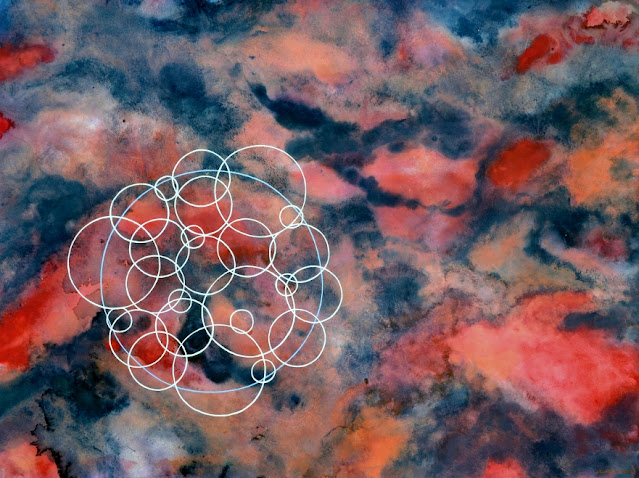
I've developed a whole series of paintings themed around the idea of 'Theatre of War'. Here are two examples. If you'd like to see more, just type 'theatre of war' into the search tab top left just below website address bar. Thinking about the concept of 'Theatre of war' is also spart of my PhD.

Cheers,
Kathryn