Showing posts with label landscape. Show all posts

Tuesday, August 13, 2024

VISUALISING THE INVISIBLE


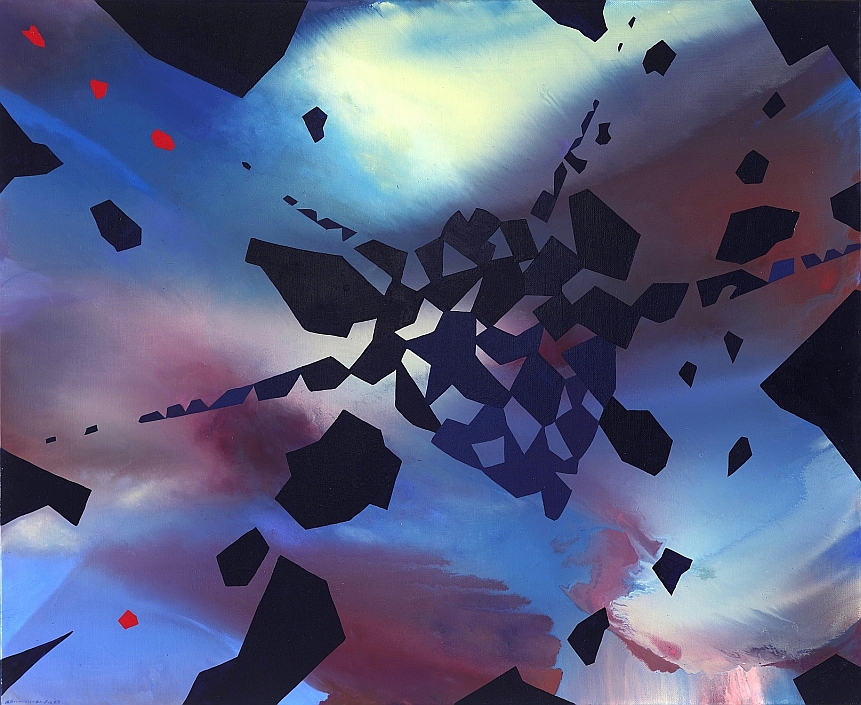
Normally Invisible  Oil on linen 50 x 122cm 2024


I've not posted for some time. I've been busy! Firstly some news about an event and a couple of publications, then at the bottom of the post a few words about my new painting, Normally Invisible (above).


EVENT

Deakin University, Law School, Centre for Law as Protection

On Friday 9th August I attended the launch of Deakin University Law School's new Centre for Law as Protection. I was thrilled to be invited to speak about my research, and to hold an exhibition - a pop-up show that I carried in my luggage from Brisbane to Melbourne, and back to Brisbane. I hung and labelled the show, before the launch event started, in about 90 minutes, and took it down about 9 hours later. Years of hanging my own shows, improvising, planning ahead, and early professional curatorial work all help this kind of frantic activity!

I am also thrilled that my painting Target (2016) is the image for the new Centre's website. Plus, the Centre has included a separate Art of Protection online exhibition of a selection of my paintings. You can view this on the Centre website.

I am so very grateful for Professor Shiri Krebs, co-director of the Centre for Law as Protection, for her enthusiasm for my art and research. The vision for the Centre is inspiring, 


The Centre for Law as Protection is building a scholarly community to study the idea of protection, shape policy and develop legal tools to protect people, animals and the environment.  


The keynote speaker for the Centre's launch was Professor Matilda Arvidsson from the University of Gothenburg, Sweden. Her presentation was inspiring. She introduced us to a  history of data collection practices, including early warnings about automating data collection. She brought us into the present with a discussion about the digital shadows we generate, and more. I keep thinking about her presentation. 

View of exhibition at the launch for Deakin University Law School's new 
Centre for the Law as Protection, August 9, 2024.

The first two paintings in the row of paintings, in the photo above, included painted binary code 'instructing' MILITARY LAWYER. Theatre of War: Law and Theatre of War: Techno-Seduction .


               Me with Professor Shiri Krebs, co-Director of the Centre for Law as Protection, Deakin University.

The paintings on the wall in the photograph above all included my version of the tree-of-life, along with various militarised technologies. The tree-of-life represents all life, and in my paintings can be considered as a symbol of a collective or an individual. 


PUBLICATIONS

Digital War Journal
In case you missed it, my commentary piece, "Light-speed, Contemporary War, and Australia's National Defence Strategic Review", in Digital War Journal, was published in May this year. It's open access, so it's accessible for everyone at this link or copy and paste - https://doi.org/10.1057/s42984-024-00091-2 

I was thrilled when the editors encouraged me to include two of my paintings. 

Drones in Society. Social Visualities
And, I have a visual essay chapter "Imaginational Metaveillance, Creative Painting Practice, and the Airborne Drone" in a new book Drones in Society. New Visual Aesthetics, edited by Elisa Serafinelli. Palgrave Macmillan. This is not open access, but you can view details at https://doi.org/10.1007/978-3-031-56984-5_8 


                                                                      Normally Invisible 

I have been painting too!

Normally Invisible (photo at the top of this post) is one of a few new works. I chose to include it in this post because it links with the idea of protection. The painting is a continuation of earlier works - Force Multiplication , Ghost Sky and Ghost Shadows.

In Normally Invisible, two scapes seem to vie for attention, the landscape in the background, and the signal-scape that seems to net or web the background landscape. The background landscape, a physical scape, is normally visible, but the signal-scape depicts normally invisible conduits of connectivity and interconnectivity. Is the normally invisible scape protective or does it pose threats? The signal-scape is visualised as a web or net to indicate its insidious occupation of our environment. The lines linking various ambiguous shapes generate geometric contours that contrast with the physical contours of mountains, valleys, plains, sky, waterways and more.

The small red shape could be interpreted as a glitch - or it could be you holding your mobile phone, a node in signal-matrix - what do you think? 

The background landscape was inspired by my childhood experiences growing up in western Queensland, Australia, where my father, a grain-grower, was also a keen ham: amateur radio. operator. I often write about my father's ham radio passion. When he died in 2016, I wrote Two Paintings of my Dad.

I will post again soon,
Kathryn

Tuesday, February 28, 2023

GHOST SHADOWS


Ghost Shadows Oil on linen 92 x 112 cm 2023


Ghost Shadows is a new painting, inspired by thinking about the Royal Australian Air Force and Boeing collaboration to develop the MQ-28 Ghost Bat drone, previously called the Loyal Wingman drone. I have a number of earlier paintings that also reference the Loyal Wingman/Ghost Bat drone. You can see them in my 2021 online exhibition Wingman (MQ-28 Ghost Bat) Online Exhibition

Ghost Bat
With this new painting I was thinking about the name Ghost Bat, the name of a real Australian bat, applied to a drone. So, that got me thinking about ghosts, bats and shadows, stealth and invisible aspects of contemporary war. I was also thinking about landscape, geographical, technological, military, and other-worldly. As regular readers know I am currently undertaking my creative practice-lead PhD with an examination of increasing military interest in the electromagnetic spectrum. 

I 'see' the technological landscape as mostly an invisible one, a stealthy signalic techno-colonised landscape from Earth to orbiting satellites. My aim, in my work, is to make the invisible 'landscape' visible! Yes, hardware and devices mark and move through our physical environments, but enabling signals are transmitted wirelessly or via discrete cables [eg: undersea internet cables]. I am mostly interested in wireless signaling/transmissions that enable light-speed or near light-speed connectivity, interconnectivity, operability and interoperability of civilian and military systems and devices. 

Shadow or Shadows 
Initially I was going to call the painting Ghost Shadow, but then I decided to make the shadow plural - thus, Ghost Shadows. The plural draws in multiple aspects of drone and robotic technologies - especially the fact that they are nodes in a system. Thinking imaginatively, what kinds of shadows does the militarised techno-system cast? Could the system be a multi-faceted shadow that we don't see - except in my painting? Maybe we should go looking for shadows! If we thought of ourselves as bats, let's lurk in the night, in the dark, using imagination to see things beyond sight. 

Fragmented Force
In  Ghost Shadows a Ghost Bat drone is identified as a fragmented force, a strange craft flying through the sky. This fragmentation 'speaks' to the drone's many capabilities, those disclosed by the developers, and those that have not been disclosed. The fragmentation evident in the whole painting alludes to pixels and the techno-reliance on imaging capabilities for operation, orientation, ISR, and targeting. Yet another interpretation could be that bits of the Ghost Bat drone have been flung into the sky. Has it spawned more bats? Or, has the drone been compromised? The dark large and small fragments might be shadow-indications of more drones or piloted aircraft - after all the Ghost Bat drone has been designed to accompany fighter jets. Thus, is this a scene of a mid-air battle between autonomously flown drones and piloted craft - debris scattered. But, is the debris material, or in an age of accelerating technological development, is it the debris of hopes and dreams?

Lots more to say - but I will leave the painting with you now! What do you think of the red fragments!?
Cheers,
Kathryn


Sunday, October 30, 2022

MAKING CODE VISIBLE: ONLINE EXHIBITION

 1. Unseen Oil on linen 90 x 80 cm 2015


2015-2022

This online exhibition of selected paintings starts with  Unseen (above), painted in 2015. Unseen is one of my first paintings where I depict binary code as part of an overall image. In this case a colourful string of zeros and ones repeatedly instructs the word LIFE. This string of visualised code extends from a branch of the tree, depicted with a colourful array of roots. The tree could be a tree-of-life, offering another kind of 'code'. Like many of my paintings a cosmic-like background helps to create a sense of flight.

Unseen was the source of inspiration for a collaboration with Brisbane-based internationally known jeweler Margot McKinney. The small series includes a fabulous necklace that follows the graphic lines of the tree, and zeros and ones. Square cut and round gems 'form' the binary code. A series of gorgeous earrings were inspired by the spiral of binary code in Picturing the Posthuman (painting number 16). I like the fact that code has been extracted and aestheticised in my paintings and in jewels made from natural geologically formed gemstones.     


LIFE and War
The next 19 paintings start with examples of recent works, ending with other earlier paintings. You will notice that as I experiment with visalising and eastheticising normally invisible code, its relationship with militarised technology and militiarise-able civilian technology becomes more politically charged. In a world where notions of warfare now include information, cyber, hybrid, grey-zone, and network-centric warfare, the key role played by code and algorithms demands attention. 

Various kinds of violence now insidiously play out in networks, enabled by light-speed transmission and reception of signals carried by radio and microwave frequencies in the electromagnetic spectrum. Signals are tentacular enablers and deliverers of codified data and instructions. 

Text Prompted AI Generated Images
This online exhibition also responds to recent hype surrounding text prompted AI image generation, using datasets of human artists' images scraped from the Internet. I offer my paintings of visualised code as a disruption and resistance to algorithmically generated image making. Painting is not reliant on digital or cyber technology, thus it has a capacity for independent critique, without feeding data back into the system. Interestingly I have discovered that one of my painting, in this online exhibition, has been scraped and used in a dataset - painting number 19 Coded Landscape. The binary code, 'instructing' the word LIFE, forms a landscape-like contour. It's kind of ironic that this painting was scraped. I add here, that the image scraped was a digital image of the painting, not digital artwork. 

A few issues relating to text prompted AI generated images [not I do not call it AI Art!] include:
  1. That work created by human artists has been scraped with intent to build datasets, without consent from original artists. 
  2. Currently, text prompted AI generated images appear very similar, exhibiting a banality that flags a creeping homogenisation of aesthetics. This is a quiet kind of violence. I am reminded of a statement made by Jean Baudrillard in Passwords (2003), where he describes a digitally coded destiny where it will be “possible to measure everything by the same extremely reductive yardstick: the binary, the alternation between 0 and 1”.
  3. While AI generated images might be considered cultural activity, production or performance, it does not mean that all AI generated/assisted images are art. 

* Please click on the hyperlinked titles to take you to the relevant posts on this BLOG. 


2. Theatre of War: Techno-Seduction Gouache on paper 56 x 76 cm 2022


In Theatre of War: Techno-Seduction visualised code is used to used to expose connections between various elements of network-centric warfare - from satellites, to drones, to military AI legal tools, to human targets. 


3.  Interface: Being HUMAN Being   Oil on linen 56 x 112 cm 2022


4. Interface Gouache o paper 56 x 76 cm 2022 


5. Competition Continuum: War  Gouache on paper 56 x 76 cm 2021

6. ME: 01001101 01000101 Oil on linen 92 x 112 cm 2021 

ME: 01001101 01000101 is a self-portrait that poses questions about portraiture in the age of facial recognition. It also raises questions about identity and verification of identity. Louise Amoore’s concerns about “how algorithms are implicated in new regimes of verification, new forms of identifying a wrong or of truth telling in the world” 'speaks' to the role played by AI in image and identity verification. Could we, weirdly and dangerously, come to a time where verification of identity is only confirmed by a digital tick?

Louise AmooreCloud Ethics: Algorithms and the Attributes of Ourselves and Others, 5-6.


7. GOD? Oil on linen 41 x 51 cm 2019 

8. HUMAN Oil on linen 31 x 36 cm 2019 


9. Drones and Code: Future Now Oil on linen 40 x 56 cm 2018


10. Manhunting Gouache on paper 56 x 76 cm 2017


11. Fake Tree Oil on linen 25 x 35 cm 2017


12. Data Heaven Oil on linen 100 x 120 cm 2017 

Code 'instructs' the word DATA in the storage centre of the fake cloud. Predominantly painted in night vision green the painting 'speaks' to surveillance and digital data storage - even after mortal death.


13. Combat Proven, Long-Range, Long-Dwell Gouache and watercolour on paper 56 x 76.5 cm 2016


14. I Am A Posthuman Gouache and watercolour on paper 42 x 30 cm 2016

01001001 00100000 01100001 01101101 00100000 01100001 00100000 01110000 01101111 01110011 01110100 01101000 01110101 01101101 01100001 01101110 00101110
The code above appears in my new painting I Am A Posthuman. It actually 'forms', or maybe 'performs', or otherwise 'instructs' a structural element to the 'figure'. You can guess the translation for sure!


15. A Human's House and A Posthuman's House Gouache on paper 30 x 42 cm 12016


16. Two Humans Gouache on paper 30 x 42 cm 2015


17. I am Am I? Gouache and watercolour on paper 30 x 42 cm 2015


18. Picturing the Posthuman Gouache and watercolour on paper 30 x 42 cm 2015


19. Coded Landscape Gouache on paper 15 x 21 cm 2015


20. Where There's Life There's... Oil on linen 92 x 102 cm 2015

Where there's life, there's hope or code?


Cheers,

Kathryn


Wednesday, May 18, 2022

HYPERSONIC

HYPERSONIC (AUKUS Dream) Oil on linen 56 x 112 cm 2022


Speed has become a central concern of mine - light speed, hypersonic speed, terms like 'accelerated warfare' +++. I have a chapter on speed in my developing PhD exegesis. I am informed by cultural critic, Paul Virilio's various commentaries on speed - speed of technological development and speed of technological operation. I am also informed by his intersection of speed and war.

HYPERSONIC
This new painting HYPERSONIC: (AUKUS Dream) references Australia's commitment, through the AUKUS [Australia, United Kingdom, United States] partnership, to develop hypersonic weapons and counter-hypersonic capabilities. The painting maps trajectories taken by hypersonic weapons. Ballistic missiles that can fly at hypersonic speeds have set flight paths, and are less manoeuvrable. Hypersonic glide and hypersonic cruise missiles are more manoeuvrable, thus they can evade detection. Evading detection means a target is more difficult to identify. Hypersonic weapons fly at speeds beyond Mach 5 [Mach 1 being the speed of sound]. Google hypersonic weapons, and you'll find lots of information.

AUKUS Pillar 2 clearly identifies hypersonic weapons and counter-hypersonic technology as key activities under the heading Advanced Capabilities. "Hypersonic and counter-hypersonic capabilities. The AUKUS partners will work together to accelerate development of advanced hypersonic and counter-hypersonic capabilities."

Note the word accelerate in the quoted sentence above. Everything is about speed!

Like many of my paintings that visualise signals, flight paths, the techno-cloud and more,  HYPERSONIC: (AUKUS Dream) is an attempt to visualise discrete or invisible aspects of contemporary war. HYPERSONIC: (AUKUS Dream) reveals a 'landscape' of trajectories - hypersonic ballistic missile trajectories and hypersonic glide/guided weapons trajectories. Hypersonic weapons cannot be easily tracked with the naked eye. Sound becomes a residue. Manoeuvrable hypersonic weapons cannot be easily tracked, full stop. Hence the AUKUS partnership is not only about hypersonic weapons R & D, but also "counter-hypersonic capabilities". 

LANDSCAPE
This landscape, like all my obvious and not-so-obvious landscapes, is inspired by my experiences growing up, and living, in western Queensland, Australia. I grew up on a naturally treeless blacksoil plain. While the western horizon is a flat line, often blurred by shimmery mirages, to the east, the Bunya Mt range cuts a majestic silhouette against expansive skies. Driving between my childhood home and Brisbane, to stay with my grandparents, meant travelling through fertile farmland, over the Great Dividing Range at Toowoomba, across the verdant Lockyer Valley, to the big city. 

As an adult I spent eighteen years living further west, in a town called Goondiwindi. Here, the landscape is not naturally treeless, but it is mostly flat. It is a harsher landscape due to less fertile soils. Prickly plants, grey plants, and hardy gums thrive. Driving to Brisbane meant crossing the Great Dividing Range at Cunningham's Gap, near a town called Warwick. One of the most spectacular landscapes I have ever seen, is on the return trip, as you drive towards Cunningham's Gap from the lowlands of the Brisbane Valley. The mountains loom like sentinels, shadows move like ghosts, and the sky is punctured by pointy peaks. It's beautiful!   

HYPERSONIC Landscape
HYPERSONIC: (AUKUS Dream) suggests that invisible forces 'etch' landscape, creating new kinds of insidious scapes that mediate landscape, as well as concepts of environment. This mediation affects how we think of human movement, borders, sovereignty, security, life and death. A patch of red dots, left of centre, references geolocating, terrain visualisation and targeting computer-graphics. This reminds us that landscape is mediated for technologies with increasingly autonomous functioning, particularly movement.  What are the implications for the future of war and humanity? 

For any living creature, human or non-human, at or near a target, speed is life changing or ending. 

Speed is key. Speed can be weapon and a purveyor of weaponry. 

"There is a certain inevitability in the domain of science and technology. We never decelerate." Paul Virilio , Desert Screen, p. 33. 

Cheers,
Kathryn

Monday, December 06, 2021

LETHAL LITTER

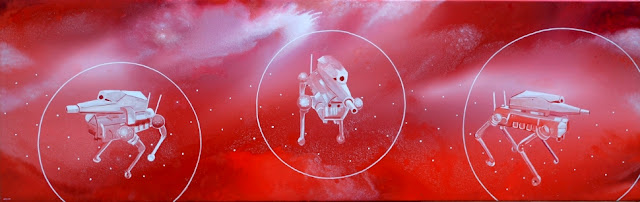
Lethal Litter Oil on linen 36 x 112 cm 2021


I'm not going to write much. But, suffice to say, the word litter in the title Lethal Litter was deliberately chosen for its multiple meanings. 

This 'litter' of  three weaponised quadruped robots (I refuse to call them dogs) scope the landscape, which is dotted with geolocating graphics. After all, landscape must be geo-mapped for robotic systems, especially those with autonomous abilities to move within and through a landscape/environment. This does not mean the robots have autonomous functionality regarding their weapons though. Some would add the word - 'yet'. 

Increasingly, robotic systems and platforms are assemblages of autonomous functions and remotely operated functions. For example movement in a rugged landscape or an unmapped urban environment can require a robot, or robots, to move autonomously, especially if remote operators are not close. Google 'robotic dogs', 'military robotic quadrupeds' etc and you'll find some fascinating and also scary videos! 

Like my other recent painting Biped and Quadruped: Warfighters, Lethal Litter was inspired by news of  experiments where robotic quadruped were weaponised. 

My last post Dogs, Quadrupeds and Robots features a few more paintings, but mostly with real dogs. 

Cheers,
Kathryn

Friday, September 03, 2021

LIMINAL OCCUPATION and INTIMATE WAR

Liminal Occupation Gouache on paper 56 x76 cm unframed 2021


Liminal Occupation and Intimate War: Mapped  'speak' to contemporary war, felt acutely by some, peripherally by others. The space between acute and peripheral is also a war zone of lethal potential, its liminality disguising the hurt.   

The paintings speak to:

Scopic intimacies of surveillance, potential lethality and fear.

Landscapes rendered as computational. The drone and its sensors require this after all!

Slipperiness of political accountability. 

Pixels, algorithms, networks, interoperability, increasingly autonomous systems. 

The everywhere stage of the theatre of war, constantly moving from literal war zone, to screen, at speed. 

And lots more.


Intimate War: Mapped Gouache on paper 56 x76 cm unframed 2021


NEWS
On the 23rd September 12 - 1 pm I am moderating a in-conversation event "Good and Evil: The Internet, AI, Law, Ethics and trust" at the University of Queensland Art Museum. Sharing the stage will be excellent panelists:
  • Associate Professor Rain Liivoja, School of Law, The University of Queensland
  • Dr. Kate Devitt, Chief Scientist of the Trusted Autonomous Systems (TAS), Adjunct Associate Professor Human-Computer Interaction, Information Technology and Electrical Engineering, The University of Queensland

Join us, if you can!

Cheers,
Kathryn


Friday, July 23, 2021

AUSTRALIAN LANDSCAPE: A METAPHOR

Australian Landscape - A Metaphor Oil on linen 61 x 66 cm 2021

As I write this the world is in the grip of the COVID19 pandemic. Mutations of the virus pose further threats. In Australia slow vaccine roll outs have placed our population in a vulnerable position. Despite having time, due to quite good pandemic management in 2020, authorities failed to secure enough vaccines, plan for distribution, formulate public education activities, foresee virus mutations as a threat and resolve weaknesses in quarantine arrangements. 

IMAGINATION
The lack of imagination in our political class [around the world] demonstrates diminished capacities to learn from history [even recent histories], to understand a globalised world, and to adopt a sophisticated mix of science and social science-based responses to the pandemic. A lack of imagination reveals poor capacities of simultaneously accounting for macro and micro concerns.

What if circumstance get out of hand as people become more frustrated and actions are increasingly politicised? Will violence and oppressive responses occur? As people lose faith, for whatever reason, in political leadership, will social unrest escalate?

ART HISTORY
As an Art Historian I can tell you there is plenty of visual evidence, over centuries, that sickness, plague and pandemic + revolution, anarchy and general social unrest are horrific, and often entwined. Art History shows the horrors of death, sickness, destruction, fear, hatred, hubris, ego, inequality, hunger and hopelessness. I argue that all politicians, policy advisors and really, just everyone, needs to learn some Art History! It might compensate for a lack of imagination....

There's a few grim images of pandemic for you to see in The Black death: Europe's Deadliest Pandemic in Human History

ANXIETIES
As I write this Australia and Australians are also experiencing anxieties about:

  • Political resistance to climate change mitigation, in some instances a growing disconnect between  electorates and their political representatives. 
  • Allegations of war crimes by some Special Forces operating in Afghanistan. 
  • How our political class is handling our relationship with China. 
  • Financial insecurity during the pandemic and post-pandemic.
  • The US - Australia alliance.
  • War talk.
  • You can add to the list here!

Australian Landscape - A Metaphor 
After reading all of the above I will let you interpret this new painting! 

If you are a regular reader you will note the tree-of-life and the geolocation grid superimposed on the landscape.

Cheers,

Kathryn


Tuesday, February 16, 2021

APPROPRIATING TITIAN'S 'SACRED AND PROFANE LOVE'

Ageless Gouache on paper 2003
 
In the early 2000s I painted a series of works on paper that dealt with love, marriage, divorce. 

If you are a regular reader, and thus aware of my more recent work - yes - there are no drones in this post! 

Part of the series included a series-within-a-series, where I appropriated Titian's early famous work Sacred and Profane Love ,1514 [below]. The painting is at the Borghese Gallery and Museum


Titian Sacred and Profane Love Oil on canvas 118 x 279 cm 1514

Sacred and Profane Love 
There has been much art historical discussion about the meaning of the Titian's painting. Questions like, which female figure represents sacred love, which represents profane love? There are questions over the title given to the painting too. Apparently the title Sacred and Profane Love may not have been recorded until the 17th century. However, there seems to be general consensus, due to various symbols in the painting, that love is a theme. For example, there is a cherub with wings, so it could be Cupid, and the clothed female figure holds a sprig of Myrtle, a symbol of marriage. This figure is also wearing what is considered bridal clothing for the period. And, the near-naked female figure is thought to be Venus, Goddess of  love, beauty, sex and fertility. I remember reading, somewhere, that the painting is a bridal portrait, but unusual for the times, because there is no husband included. Because the two women look very similar, they might represent multiple aspects of the bride - the sacred and profane, romance and lust, defiance and supplication? 

My Appropriations
In my appropriations Ageless and A Different Landscape I have replaced the distant small village, seen in Titian's painting, with modern cityscapes. In 2003, this was reference to me moving from the country to the city, when I got divorced. It could also demonstrate that themes of love traverse time. In Ageless, the dotted line is like a highway, a metaphor perhaps?

In Jigsaw and Love Puzzle the pastorale scene depicted by Titian is abstracted, with the figures merging into the landscape, becoming one with it. I have previously written about Love Puzzle in regard to landscape, and the image of the bride in the landscape. I have a whole other series dwelling on this theme too!

And, Cupid does not get a gig in any of my Titian-appropriated paintings! I am not sure why...

The face-less women elide the opportunity for portraiture to be considered. There is no gaze. And, in art historical terms this has implications - the history of the female gaze in art is oft discussed. Manet's appropriation of Titian's Venus of Urbino  [1534] to create Olympia [1863] provides just one example of where the significance of the female gaze is scrutinised - from allure to defiance. But in both cases who is the gaze and its inflection meant for. Many would say - men.


Jigsaw Gouache on paper 2003


In Monolithic Matriarchs the women are faceless, except for red circles. For me, in 2003, this indicated strength, a way to solidify the power of matriarchy. There are no gazes to be mistaken as seductive or defiant, no expressions that give away secrets. The six women repeat the figure of the bride in Titian's painting. The repetition reveals the powerfulness of her figure. The morphed shape of Venus is also repeated in the foreground. She forms the landscape on which the monolithic matriarchs are positioned. Love, lust, fertility and sex are not discarded in the matriarchy - they are private. 

So, what does it all mean - its up to you!

Cheers,
Kathryn

                                                Love Puzzle Gouache on paper 2003


                                             A Different Landscape Gouache on paper 2003


                                           Monolithic Matriarchs Gouache on paper 2003