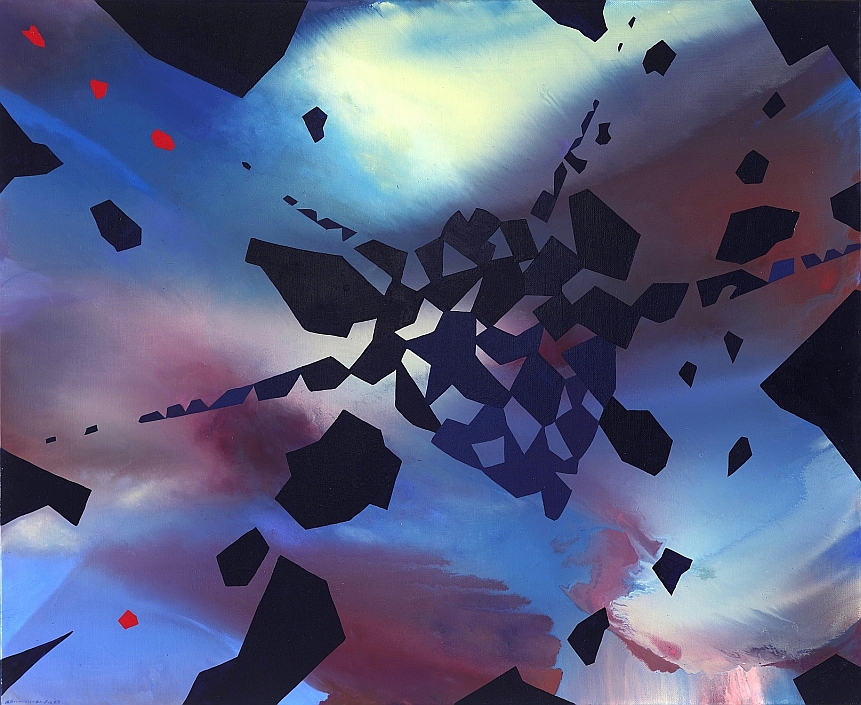
Strange Cloud Watercolour on paper 2020
Strange Cloud (above) is a dark cloud, seemingly impenetrable. An array of multi-coloured drones, acting as sentinels, are both protectors and deliverers of data. The drones' colours bely the darkness of the cloud as it dominates the scene. The cloud's vascular-like growth sucks from the environment, now a metaphor for data. A lone tree-of-life stands as a beacon for the commons and humanity on a distant horizon.
_______________________________________________________
THE CLOUD: ONLINE EXHIBITION
I was inspired to 'curate' this exhibition after listening to globally recognised artist, author and technologist, James Bridle's recent BBC presentation Under the Cloud. In this twenty-eight minute presentation Bridle "navigates the history and politics of the cloud". With inputs from other commentators, questions are raised about the cloud as a "metaphor of the internet, ethereal and fluffy - but what is it hiding?" Do listen to the presentation - it triggers a lot of questions about how we live our lives now and how we are likely to live our lives in the future.
Cloud Eyes Oil on linen 40 x 40 cm 2017
This online exhibition is a collection of paintings, where over the last few years, I have painted clouds in colours and compositions where their fluffiness is obviously a foil, a subterfuge, perhaps even a potentially dangerous seduction. Many of the paintings address some of the issues raised or alluded to in the BBC presentation.
With my interest in militarised and militarise-able technology, my paintings depicting clouds reference surveillance, tracking and monitoring, They also speak to vulnerabilities of networked systems where platforms that are owned by a few major companies compel use and compliance under guises of ease of access, swift retrieval of data, enhanced security, speed of light transactions and more. As our awe of the system, and compliance to it, transforms into need, markets are ensured.
Where does that place freedom?
Cloud Eyes (Above)
Night vision green clouds clearly indicate augmented entities/systems, capturing data to be stored, analysed, and at some stage, acted upon. The eyes in Cloud Eyes are unblinking - they are not human. Here, I challenge ascribing notions of vision or seeing to machine, digital and cyber technologies - drones. They do not see, they do not have vision [literal, imaginational, dreaming] - instead - they SCOPE! And, when you think about it, 'scoping' befits the contingencies of surveillance ie: monitoring, targeting, manhunting and attack, much better than vision and seeing....
Follow Me, Says the Tree Oil on canvas 61 x 76 cm 2017
In Follow Me, Says the Tree I have depicted an eye painted in the sky. Its pupil is a shade of night vision green. It is an unblinking false eye, with 'lashes' that appear to be more like components from a computer circuit board. The signals that radiate from the eye penetrate through a surveillance net which is scaffolded by a night vision green CLOUD - a false cloud.
However, what of the tree? It also penetrates the net of surveillance and the CLOUD, by reaching upwards towards the stars. It re-establishes perspective - the kind that can take humanity's endeavours into interstellar space. The tree's branching appearance contrasts with the clean lines of surveillance and targeting signals. Randomness, or seeming randomness, is presented as a complex decoy - but isn't that just LIFE! The tree not only erupts through the surveillance net, it also send roots underground. Where there's life there's hope it seems to say.
The New Clouds Gouache on paper 56 x 76 cm 2017
In The New Clouds I have painted airborne drone swarms as fake clouds. Just as they mimic swarming which occurs in the natural environment, they also mimic clouds. In other words fake clouds that potentially, over time, change our relationship to landscape and environment. The potential militarise-ability of The Cloud is visually and clearly inferred. Here, targeting, based on data, includes the benign opportunism of advertisers to the more mortally important targeting by militarised forces or aberrant actors.
______________________________
From 2017 blog post:
"That THE Cloud's operations actually exist and occur as a result of material infrastructure belies the notion of fluffy vapourous clouds. Data is deposited onto multiple massive servers that require space in huge buildings. Servers suck energy - for continuous operation and cooling. And, to ensure backup, rerouting and instantaneous reaction they need connection and interconnection with cables that cross continents and oceans - the internet. The harnessing of space-based assets to assist connectivity adds another layer of material infrastructure beyond Earth's atmosphere. And, in one way or another, all this infrastructure can be used for both civilian and military purposes, thus blurring the lines between battlefield and city/home."

Drone Clouds Gouache on paper 30 x 42 cm 2016
Painted over four years ago Drone Clouds (above) was inspired by thinking about how the increasing use of militarised drones creates a kind of artificial 'ceiling' in the sky. This can be viewed as both a literal and a psychological 'ceiling'. If we develop a fearful mentality that the sky is a place of threat, what happens to the beauty of cosmological perspectives? Regular readers know I have a fascination with cosmology, and the close and far distances it reveals. Threat from the sky is something that limits a fearless desire to look beyond horizons - earthly, universal and metaphoric. What happens if we become fearful of The Cloud?
Topography of Signals Oil on linen 57 x 57 cm 2019
Topography of Signals
A fluffy fake cloud, painted a light shade of night vision viridian green, hovers at the bottom right of Topography of Signals . Militarised and civilian technological hardware are connected by lines that indicate signal connections - the networked society - the militarise-ability of civilian technology. I have used red and night vision green lines to indicate augmented and dangerous surveillance capabilities, and therefore, vulnerabilites. Green screens, green car windows and green credit card chips all indicate data outflow to The Cloud, seemingly benign in all its fluffiness!
As cultural scholar Paul Virilio notes the “more powerful and high
performance the invention, the more dramatic the accident.”
Paul Virilio, The Original Accident, trans. Julie Rose (Cambridge, and
Malden, MA: Polity, 2007), 31.
Ubiquitous Surveillance - An Invisible Landscape Oil on linen 60 cm x 110cm 2017
In Ubiquitous Surveillance: An Invisible Landscape I have visually suggested a new topographical layer of the sky, yet it could also be a new topography of the land. As with many of my paintings the viewer could be above the clouds looking down or below the clouds, looking up. As the viewer oscillates from one perspective to another, the new landscape of signals and scopic trajectories suddenly becomes an amorphous entity, capable of palpitating in multiple dimensions. Like a shadow, the viewer cannot escape it. No matter where you are the surveillance follows or perhaps catches you in its virtual web.
The presence of The Cloud is clear.
So, what do you think about Tactics, below?
Tactics Oil on linen 70 x 100 cm 2017
Data Data Gouache on paper 30 x 42 cm 2016
Data Data and Cloud Storage were both painted in 2016. In Data Data signals are being received and transmitted by an ambiguous vessel-like thing - is it a cloud? In Cloud Storage (below) little boxes try to assimilate with the fluffy clouds - they are unsuccessful. Or, are they - why is one cloud outlined in red? Is it a good or bad sign?
Cloud Storage Gouache on paper 30 x 42 cm 2016
And then, Data Heaven ...
At the centre of the square, in the centre of the cloud, binary code ‘instructs’ the word DATA. The fifth line of code, ‘instructing’ the letter D, indicates algorithmic continuity. The cloud looks like an eye, with DATA as its ‘pupil’. I am playing with ideas relating to THE CLOUD, big data and humanity’s increasing reliance on digital and cyber technologies. That we can exist virtually across multiple technological platforms/systems while alive is one thing, but that this virtual existence can continue after mortal death, is indicative of - DATA Heaven, or perhaps - DATA Hell?
Data Heaven Oil on linen 100 x 120 cm 2017