Showing posts with label COVID-19. Show all posts

Friday, July 24, 2020

BORDER CROSSINGS


 Crossing the Border watercolour on paper 24 x 32 cm 2020 


More watercolour paintings! 
Following on from my last post Watercolours For Our Strange Times: Online Exhibition


Australia
As Australia confronts a renewed wave of COVID-19 infections, particularly in the state of Victoria, borders between states have closed again, or not re-opened. For Queenslanders, the recently re-opened border is now closed to visiting Victorians or people from accelerating hotspots in New South Wales. Many Queenslanders want the state's Premier to shut the borders again, completely.

Issues associated with borders and border controls are global and historical - colonial annexations,  migration control, refugee movement, trade, security and pandemic mitigation. Closing or monitoring borders for pandemic and disease control - for example: state, village, home, urban borders/boundaries - are not new strategies. Across history and the globe, from plague to cholera outbreaks, Spanish Flu to Ebola outbreaks, quarantining by border/boundary control has occurred. It is clearly a sensible method of disease transmission mitigation, especially when there is no known cure.

Drones - COVID-19
I am interested in the increased use of surveillance technology during the COVID-19 pandemic. Of particular interest is the use of airborne drones for monitoring, crowd control, spraying disinfectant, attempts to gauge temperatures etc. While perhaps laudable in intent, what happens if the use of drones for surveillance and monitoring purposes becomes normalised, and therefore enduring?

Drones Monitoring NSW - Victorian Border
The three watercolour paintings in this post are responses to recent news that police will use airborne drones to monitor the border between Victoria and NSW. This strategy has arisen particularly since the renewed outbreak of COVID-19 in Victoria in July 2020. The drones will monitor parts of the border where people could cross undetected, for instance, by swimming across the Murray River. The river forms the majority of the border and presents ample opportunity to cross if someone was determined. You can read about the use of drones to monitor the NSW - Victorian border by police in articles such as these - one in The Australian  newspaper, another in the Sydney Morning Herald, and another in Australian Aviation.

I wonder if airborne drones are being used  by enforcement authorities to monitor other borders in Australia? I assume they are, or at least, being considered. Australia is a vast country with long, often remote, borders between states and territories.

Border as Metaphor
And, of course, the idea of the border as a metaphor is tantalising, particularly so when rivers are borders. Here, I think about the River Styx, in Greek mythology the border between the underworld and the world of the living. I also think about the Rubicon*. The term 'crossing the Rubicon' relates to Julius Caesar's army crossing the Rubicon River in north east Italy in 49BC. This was considered an act of insurrection and treason, and a declaration of war against the Roman Senate. Metaphorically 'crossing the Rubicon', means there is no return. I ask, what kinds of 'no return' metaphoric borders have we crossed in terms of increasing normalisation of drone use for surveillance and targeting purposes? 

PAINTINGS
Crossing the Border [above] depicts three figures in an ambiguous, but watery, landscape. Are the figures swimming or running? They are clearly in a non-urban environment, and they express a sense of urgency or agitation. Yet, they appear to have not reached their destination. It is as if their bodies link each side of the border - can they return? Here, I am not thinking of a literal return!


 Border Crossing watercolour on paper 24 x 32 cm 2020 

In Border Crossing [above] a human figure and the figure of a dog seem ready to cross a border, a watery border. But, maybe they are already half way across a river, the lines extending downwards from their bodies acting as signs of a watery wake. Or are these elongated limbs or shadows tethering them to a shore, keeping them from reaching the other side?


Monitoring the Murray watercolour on paper 32 x 40cm 2020 

In Monitoring the Murray [above] a human figure has merged with the landscape. The figure's outstretched arm, in freestyle movement, indicates it is swimming. However, the figure has become part of the river, a clever camouflage. As the figure reaches the other side of the river, three drones are surveilling. Are the drones from the underworld? 


Previous painting and post Crossing the Rubicon

Cheers,
Kathryn

Sunday, July 12, 2020

WATERCOLOURS FOR OUR STRANGE TIMES: ONLINE EXHIBITION

[Fig.1] Sentinel Watercolour on paper 30 x 42 cm 2020


This post 'exhibits' some of my recent watercolur paintings. These watercolours are a departure from my normal oil paintings. I like having departures because experimenting with different paint mediums creates a space for thought and innovation.

The paintings in this small online exhibition all respond, in one way or another, to living through the COVID-19 pandemic. 

Watercolour Medium
The medium of watercolour provides a softness that is important at a time when people are anxious, in mourning, or even angry and frustrated. I use copious amounts of water, and I cannot help but think that there is something soothing about paintings created with water. Although I obviously also use paint and a brush, the water is essentially the creator - I am the vehicle.

Paintings
Sentinel [Fig.1] is a landscape where a tree - a tree-of-life - stands like a sentinel on a distant horizon. I was thinking about how life copes with threats and risks. Here, the horizon is both literal and metaphoric - what horizons do we cross when catastrophe knocks at our front doors? 

Maybe one horizon is the increasing use of surveillance and monitoring technology. What limits are crossed when, for example, the pandemic gives rise to an accelerating use of airborne drones? What kinds of creeping normalisation pave way for future impediments to privacy and freedom? 

In Content Tagging: A Spoof  [Fig.2], human [Fig.3] and Shadows [Fig.4] I visually spoof the way machine learning and AI need to be repeatedly exposed to images of objects, expressions and activities, in order to learn to identify them. Words are used to tag. But, I wonder, for an AI, does the tag become the object too? In Content Tagging: A Spoof I have also referenced the story of a person, in lockdown in Malta, who used a drone to walk their dog. My earlier painting Walking the Dog, In the Drone Age was also inspired by Malta story, a story that speaks to how strangeness can morph into normalcy.


[Fig.2] Content Tagging: A Spoof Watercolur on paper 30 x 42 cm 2020


[Fig.3] human watercolour on paper 24 x 32 cm 2020


[Fig.4] Shadows Watercolour on paper 30 x 42 cm 2020


The three paintings below speak to the effects of isolation during COVID-19. In Watching [Fig.5] two figures are separated by distance, but also by what looks like bars on a window. Lockdown, quarantine and social distancing are mechanisms of isolation, that are monitored in various ways, including the use of drones. That lockdown, quarantine and social distancing are necessary during a pandemic is not disputed. What I query is the way new modes of surveillance, used by security and police forces, collide with those also employed by military forces. In Watching, the drone monitors the figures, as the figures watch each other. Do the figures notice the drone though?


Watching [Fig.5] on paper 30 x 42 cm 2020


In People [Fig.6] a line of figures, are socially distanced, except for two figures on the far left. They maybe a couple? The ambiguous atmosphere of the painting reflects the sense of limbo and uncertainty that permeate societies as they grapple with COVID-19. The sense of limbo and uncertainty also permeates Apart and Together [Fig.7]. I was thinking about how all of us are experiencing the pandemic - that all of us are in this thing together. That our individual behaviour and how we adhere to safeguards, can affect other people, is of paramount importance. Staying apart actually helps to keep us together - alive. 

Do stay safe!
Kathryn


 People [Fig.6] on paper 24 x 32 cm 2020


Apart and Together [Fig.7] on paper 30 x 42 cm 2020

Thursday, May 21, 2020

BRISBANE ISO-STUDIO

My Mum gave me my easel a long time ago.


During the COVID-19 pandemic, isolation has meant I spend most days in my studio. As a painter, I am used to working alone, I am just not used to having day after day free of disruptions. At a time when the world is in a state of flux, fear and anguish, I feel lucky to have such an absorbing occupation.

When I am not in my studio I am at my office desk, writing; all kinds of writing - posts, grant applications, articles, proposals, emails. Oh, and yes - social media.

My studio is actually my garage. I paint with the garage doors up, mainly to disperse turpentine smells. However, I can see a lovely park across the road, and I can hear cyclists as they speed by. Snippets of conversations, shouted from cyclist to cyclist, sometimes intrigue me. Like when I hear bits about business deals, family antagonisms, holiday reports, problems with children or parents. It's all so tantalising. I often wonder about further details.

Of particular delight are the families out walking or cycling. And, the young children skate boarding up and down the street. I've even had people wave to me from the footpath, one couple asking if they could see what I was painting. And, a grandmother with two small children, totally unaware that I was nearby, having a long discussion about flowers in my front garden.

Isolation, for me, isn't necessarily isolating.

At the moment I am working on another new painting. And, yes it is another dronescape, a reflection on the accelerating use of drones for a plethora of reasons. I am thinking of calling the painting Drone Show. You'll get to see it soon.

I also have a self-portrait, which I am really very happy about. I am not sure when I will show it to you though. Keeping it up my sleeve for something!!!

In the meantime, here are some studio photos.


                                                            Working on Echoes Across Time
I often cut out shapes in paper to stick on my paintings, to work out how something might look. I ended up not painting an upside-down tree-of-life in Echoes Across Time.


Various resources - cut-outs, print-outs,scissors, containers, oil and coffee!


Cut-outs on the floor and me sitting to paint low down on the canvas.


Cheers,
Kathryn

Friday, April 17, 2020

$TORM

$torm Oil on linen 31 x 66 cm 2020


Like so many other people I have been keeping an eye on the news about COVID-19. The news ranges from the serious, sad, dire to hopeful - from medical research, hopes for a vaccine, to terrible deaths and seemingly miraculous recoveries, to limited PPE, isolation stories, increased surveillance and concerns if this becomes normalised, to economic strife and more.

Landscape as Metaphor
My newest painting $torm, like my recent painting On The Edge of Fury: A Landscape for Our Time [below] turns to landscape as a metaphoric way to analyse and visualise anxieties triggered by the current pandemic. In $torm I have painted a strip of red rain, falling out of, and into, a turbulent landscape. The angry red 'raindrops' are painted as small $ signs. You have to get up close to see the $ signs - this is deliberate.

How have quests for a exponential financial edges and growth, instead of simple financial exchange, predisposed the world to global pandemic? Let's think about  '$torm clouds' that have brewed for decades. 
  • industrialised farming causing breakdowns in natural containment of rare microbes, 
  • practices that cause pollution of our air, land and water, 
  • culinary desires for exotic animals exacerbating the potential for animal to human contagion transfer, 
  • nation-states fearful of losing face,
We are in the eye of the '$torm' now. How we navigate the tension between keeping people healthy/saving lives and economic considerations will define how we live with each other in post-pandemic decades. It seems some nations are handling the situation better then others.... 

Lives should always come first...

$torm
While On The Edge of Fury: A Landscape for Our Time features the flat western horizon of my childhood landscape, the landscape in $torm is inspired by the easterly horizon. In the west there was nothing, in the east the Bunya Mountain range cut a majestic silhouette against the sky. A sacred gathering place for Indigenous Australians over eons, the Bunya Mountains are never really at rest. As I went to school each day on the school bus I would gaze at the Bunya Mountains. On a hot summer's day shimmering mirages tried to obscure the mountains, but they fought back. During wild storms the mountains darkened, sentinels watching over the flat naturally treeless Pirrinuan and Jimbour Plains. As the Bunya Mountains changed colour during the course of a day, they seemed to tell stories. Maybe these stories were warnings? 

$torm, with its rolling colours and multiple contours, a night sky seemingly supporting the the whole painting, is perhaps, a warning?


On The Edge of Fury: A Landscape for Our Time  Oil on linen 30 x 40 cm 2020


$ Signs
I have previously used small $ signs to paint landscape elements. $urveillance [below] is from 2016. It 'speaks' to the military-industrial complex through a critique of surveillance, particularly undertaken by sky-based technologies, such as airborne drones and satellites. This painting intersects with $torm because there is increasing commentary on the potential future outcomes of normalising surveillance measures undertaken during the Covid-19 pandemic. A recent article 'Pandemic Drones': Useful for Enforcing Social Distancing, or for Creating a Police State by Dr. Michael Richardson [Uni of New South Wales, Australia] is an example of increasing concerns. 


 $urveillance  Gouache on paper 56 x 76 cm 2016


A few other paintings where I use small $ signs include:
Risk  2010
Planet $  2011

Cheers,
Kathryn

Saturday, March 28, 2020

ON THE EDGE OF FURY: A LANDSCAPE FOR OUR TIME

On The Edge of Fury: A Landscape for Our Time Oil on linen 30 x 40 cm 2020


PROCESS
On The Edge of Fury: A Landscape for Our Time just happened! I am actually working on another painting Machine Unreadable, nearly completed. I started to prepare a new canvas so that it would be ready to work on next week. But, I could not stop - and - On The Edge of Fury: A Landscape for Our Time is the result. This type of thing happens reasonably often, especially when there is a lot to think about. And, at the moment, with COVID-19, there is a huge amount to think about - and worry about. This kind of rapid creation also happens when I've worked intensively for some time. It's like a release valve. I consider it a normal part of the creative process, a kind of waxing and waning of intensity. 

TURMOIL - VIRUS
I wanted to create an image of turmoil, to reflect the effects of a world changed by virus. As I was pushing the paint around with a brush, pouring paint from a container and tipping the stretcher up and down to make the paint drip and flow, I suddenly thought of my childhood landscape. I've written about this landscape before [please see images below for links]. I grew up on my parent's grain farm on the flat naturally treeless black-soil Pirrinuan Plain, outside Dalby, on the fertile Darling Downs, Queensland, Australia. As we danced with endless horizons and relentless skies, distance consumed us. In stormy weather the sky seemed to overtake the landscape. With nothing to obstruct our view we could see where lightning struck the Earth, we could watch clouds rolling wildly and strips of rain pouring on parched soil many kilometers away. The unobstructed flat horizon and the unfolding distance revealed everything. 

HORIZONS
As I was playing with the paint, I suddenly painted a horizontal line across the painting. This is the flat horizon of my childhood, the marker of distance that made me who I am. The painting felt right, it spoke to me about how landscape informs us, if we a willing to watch, listen, smell and feel. With my painting, a tension between calmness and calamity offered a way to think about the effects of the virus. The flat foreground could, on the one hand, be a future of calm reflection about much needed societal change, but, on the other hand, it could also be the past. It's certainly not the present! The sky tumbles uncontrolled, maybe not only reflecting the present, but also a possible future. The flat horizon seems to suggest we have a choice about how this future might expand before us. 

The tension between land and sky is exposed in the nakedness of the flat landscape terrain - no hills, no trees, no houses. The storm, a metaphor, appears ominously ready to devour the calmness. Would this mean a future foreclosed? However, the storm is equally exposed, its fury obviously raw and hot. The flat exposed horizon demands attention, possibly offering hope as it holds the fury back, giving us some time. The horizon is a metaphor for the world to meet the fury of nature in honest and compassionate ways. Are we brave enough? I think we need to be.

Life depends on it.

Cheers,
Kahryn

*Below are some images of the Pirrinuan Plain, plus three other stormy paintings!


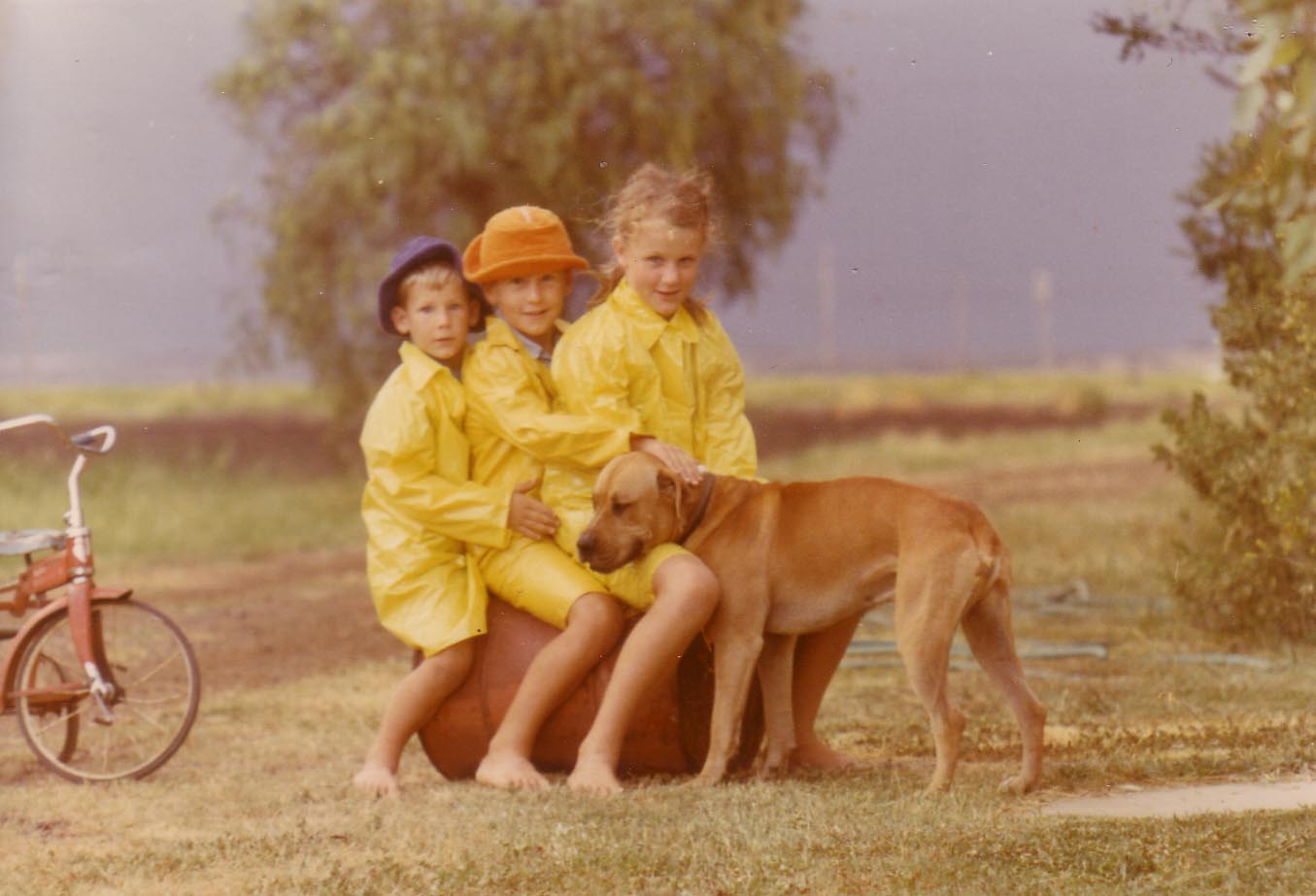
Me with my brothers Wilfred and Douglas, many years ago. The sky is stormy, although not wildly so. We had some very welcome rain.
 Me in 2015 on a trip back to Dalby and the Pirrinuan Plain. Note the flat horizon, and the rich black soil. Cotton, mainly dryland, is now farmed in the district. It was not a crop grown during my childhood. Back then it was mainly wheat, corn, sorghum.


A very old photo of the Pirrinuan Plain. Probably taken in the 1930s-1940s by my grandfather.


Stormy Weather, Where? Oil on linen 120 x 150 cm 2013


Storm Oil on linen 85 x 150 cm 2012


Sunday, March 22, 2020

STRANGE TIMES AND IMAGINATION

Earth's Pulse Oil on linen 80 x 200 cm 2005

EXISTENTIAL RISK
As regular readers know I am very interested in ideas of existential risk, particularly posed by emerging technologies. I have attended talks and read quite a lot about existential risk generally, and pandemic is one of the risks I am somewhat acquainted with.

AND, here we are in the midst of a corona virus global pandemic.

IMAGINATION
Back in January, when I was preparing for my trip to the UK to attend the Aesthetics of Drone Warfare conference at the University of Sheffield, the corona virus had reared its ugly head in China. By the time I left Australia in early February I was getting worried, so I went overseas with a few masks, alcohol wipes, gloves, nasal sprays and a bar of soap in my handbag. Yes, I was that strange lady wiping her table at the hotel restaurant, opening doors with my elbow, washing my hands vigourously. My young adult children thought I was mad, but they don't now! The motto of this story is, don't dismiss someone with an imagination prone to extrapolating burgeoning negative situations into catastrophe and disaster! Remembering, too, that this someone has studied history and researched topics associated with existential risk for quite awhile.

The role played by informed imagination in times of unfolding catastrophe is an interesting one. A vivid imagination can compel action to be taken, but it can also provoke a paralysis of action. Ultimately fearful reactions to an existing situation, and subsequent imagined thoughts about the future, can be productive or non-productive.

LEADERS
But, what are the benefits or dangers of not having an imagination? Do our leaders need to have  imaginations that responds to data, are informed by a knowledge of history, are open to the expertise of others from across the sciences, social sciences and humanities? Surely an imagination is required to even 'see' how multiple sources of expertise can interact in meaningful ways? Surely an imagination is required to extrapolate future possible outcomes from graphs that map historic and current data? An imagination surely must help determine how intervention can arrest dire trajectories? I would say an imagination is needed in order to undertake logistical planning!

And, ultimately we need people who can imagine a life after pandemic, possibly a life vastly different from pre-pandemic life. And, a reminder, difference does not necessarily mean worse. Nor, does it necessarily mean better. But, it might mean we have a choice. Let's imagine in compassionate ways that are productive and meaningful. Let's imagine in ways that disallow the paralysis of fear. Rather, let fear contribute as a driver rather than a brake.


Compassion oil on linen 100 x 100 2010


Earth's Pulse [top]
This painting, from fifteen years ago, has a graph-like appearance. It 'maps' the pulse of the Earth. How do you think its currently performing?

I exhibited this painting in Abu Dhabi at my 2005 exhibition at the Abu Dhabi Cultural Foundation. A Middle Eastern man dressed is swathes of white robes and a largish head-dress came to the exhibition a few times. I cannot remember which country he came from, but he had fought in Afghanistan. On one visit to the show we had a long conversation that involved discussions about a few of the paintings. When he looked at Earth's Pulse, before even knowing the title of the painting,  he said:

"This reminds me of my own mortality."

Now, I think that demonstrates an imaginative response!


DISTANCING
As a studio-based painter I am used to working alone. With a couple of conferences cancelled I don't have much else to do, but paint...and be online! I am currently working on a painting I will call Machine Unreadable. Please check out my Instagram page for studio photo updates of work in progress. Hopefully, when the pandemic is over, I can get to exhibit some of my paintings!

In the meantime please stay safe, for yourself and others.


Showing Them Our Home Oil on linen 30 x 56 cm 2017
Me, with my three adult daughters. And, Earth, the pale blue dot.


Cheers,
Kathryn