Showing posts with label Pirrinuan Plain. Show all posts

Friday, April 17, 2020

$TORM

$torm Oil on linen 31 x 66 cm 2020


Like so many other people I have been keeping an eye on the news about COVID-19. The news ranges from the serious, sad, dire to hopeful - from medical research, hopes for a vaccine, to terrible deaths and seemingly miraculous recoveries, to limited PPE, isolation stories, increased surveillance and concerns if this becomes normalised, to economic strife and more.

Landscape as Metaphor
My newest painting $torm, like my recent painting On The Edge of Fury: A Landscape for Our Time [below] turns to landscape as a metaphoric way to analyse and visualise anxieties triggered by the current pandemic. In $torm I have painted a strip of red rain, falling out of, and into, a turbulent landscape. The angry red 'raindrops' are painted as small $ signs. You have to get up close to see the $ signs - this is deliberate.

How have quests for a exponential financial edges and growth, instead of simple financial exchange, predisposed the world to global pandemic? Let's think about  '$torm clouds' that have brewed for decades. 
  • industrialised farming causing breakdowns in natural containment of rare microbes, 
  • practices that cause pollution of our air, land and water, 
  • culinary desires for exotic animals exacerbating the potential for animal to human contagion transfer, 
  • nation-states fearful of losing face,
We are in the eye of the '$torm' now. How we navigate the tension between keeping people healthy/saving lives and economic considerations will define how we live with each other in post-pandemic decades. It seems some nations are handling the situation better then others.... 

Lives should always come first...

$torm
While On The Edge of Fury: A Landscape for Our Time features the flat western horizon of my childhood landscape, the landscape in $torm is inspired by the easterly horizon. In the west there was nothing, in the east the Bunya Mountain range cut a majestic silhouette against the sky. A sacred gathering place for Indigenous Australians over eons, the Bunya Mountains are never really at rest. As I went to school each day on the school bus I would gaze at the Bunya Mountains. On a hot summer's day shimmering mirages tried to obscure the mountains, but they fought back. During wild storms the mountains darkened, sentinels watching over the flat naturally treeless Pirrinuan and Jimbour Plains. As the Bunya Mountains changed colour during the course of a day, they seemed to tell stories. Maybe these stories were warnings? 

$torm, with its rolling colours and multiple contours, a night sky seemingly supporting the the whole painting, is perhaps, a warning?


On The Edge of Fury: A Landscape for Our Time  Oil on linen 30 x 40 cm 2020


$ Signs
I have previously used small $ signs to paint landscape elements. $urveillance [below] is from 2016. It 'speaks' to the military-industrial complex through a critique of surveillance, particularly undertaken by sky-based technologies, such as airborne drones and satellites. This painting intersects with $torm because there is increasing commentary on the potential future outcomes of normalising surveillance measures undertaken during the Covid-19 pandemic. A recent article 'Pandemic Drones': Useful for Enforcing Social Distancing, or for Creating a Police State by Dr. Michael Richardson [Uni of New South Wales, Australia] is an example of increasing concerns. 


 $urveillance  Gouache on paper 56 x 76 cm 2016


A few other paintings where I use small $ signs include:
Risk  2010
Planet $  2011

Cheers,
Kathryn

Saturday, March 28, 2020

ON THE EDGE OF FURY: A LANDSCAPE FOR OUR TIME

On The Edge of Fury: A Landscape for Our Time Oil on linen 30 x 40 cm 2020


PROCESS
On The Edge of Fury: A Landscape for Our Time just happened! I am actually working on another painting Machine Unreadable, nearly completed. I started to prepare a new canvas so that it would be ready to work on next week. But, I could not stop - and - On The Edge of Fury: A Landscape for Our Time is the result. This type of thing happens reasonably often, especially when there is a lot to think about. And, at the moment, with COVID-19, there is a huge amount to think about - and worry about. This kind of rapid creation also happens when I've worked intensively for some time. It's like a release valve. I consider it a normal part of the creative process, a kind of waxing and waning of intensity. 

TURMOIL - VIRUS
I wanted to create an image of turmoil, to reflect the effects of a world changed by virus. As I was pushing the paint around with a brush, pouring paint from a container and tipping the stretcher up and down to make the paint drip and flow, I suddenly thought of my childhood landscape. I've written about this landscape before [please see images below for links]. I grew up on my parent's grain farm on the flat naturally treeless black-soil Pirrinuan Plain, outside Dalby, on the fertile Darling Downs, Queensland, Australia. As we danced with endless horizons and relentless skies, distance consumed us. In stormy weather the sky seemed to overtake the landscape. With nothing to obstruct our view we could see where lightning struck the Earth, we could watch clouds rolling wildly and strips of rain pouring on parched soil many kilometers away. The unobstructed flat horizon and the unfolding distance revealed everything. 

HORIZONS
As I was playing with the paint, I suddenly painted a horizontal line across the painting. This is the flat horizon of my childhood, the marker of distance that made me who I am. The painting felt right, it spoke to me about how landscape informs us, if we a willing to watch, listen, smell and feel. With my painting, a tension between calmness and calamity offered a way to think about the effects of the virus. The flat foreground could, on the one hand, be a future of calm reflection about much needed societal change, but, on the other hand, it could also be the past. It's certainly not the present! The sky tumbles uncontrolled, maybe not only reflecting the present, but also a possible future. The flat horizon seems to suggest we have a choice about how this future might expand before us. 

The tension between land and sky is exposed in the nakedness of the flat landscape terrain - no hills, no trees, no houses. The storm, a metaphor, appears ominously ready to devour the calmness. Would this mean a future foreclosed? However, the storm is equally exposed, its fury obviously raw and hot. The flat exposed horizon demands attention, possibly offering hope as it holds the fury back, giving us some time. The horizon is a metaphor for the world to meet the fury of nature in honest and compassionate ways. Are we brave enough? I think we need to be.

Life depends on it.

Cheers,
Kahryn

*Below are some images of the Pirrinuan Plain, plus three other stormy paintings!


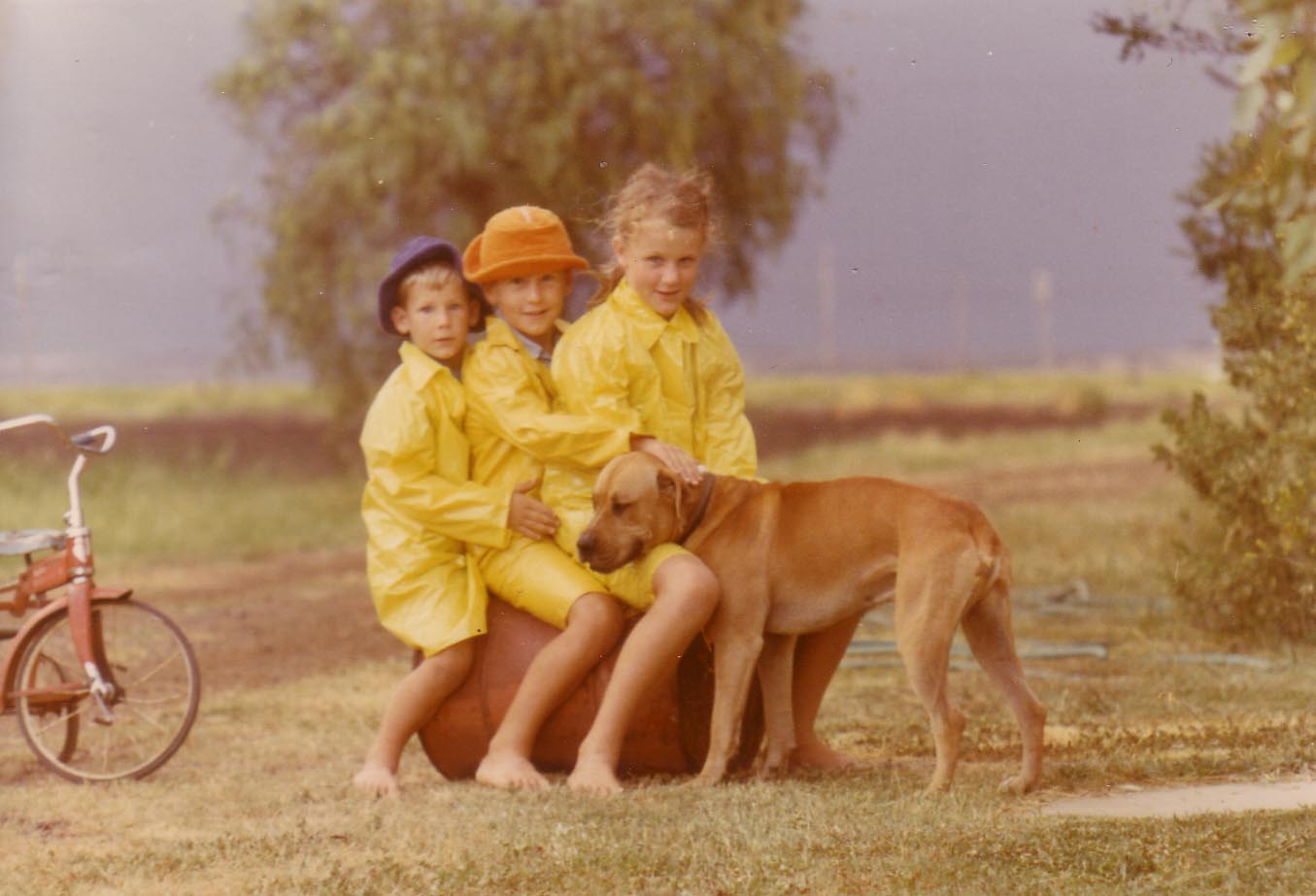
Me with my brothers Wilfred and Douglas, many years ago. The sky is stormy, although not wildly so. We had some very welcome rain.
 Me in 2015 on a trip back to Dalby and the Pirrinuan Plain. Note the flat horizon, and the rich black soil. Cotton, mainly dryland, is now farmed in the district. It was not a crop grown during my childhood. Back then it was mainly wheat, corn, sorghum.


A very old photo of the Pirrinuan Plain. Probably taken in the 1930s-1940s by my grandfather.


Stormy Weather, Where? Oil on linen 120 x 150 cm 2013


Storm Oil on linen 85 x 150 cm 2012