Showing posts with label contemporary art. Show all posts

Sunday, March 15, 2026

CATASTROPHE OF SUCCESS


Catastrophe of Success Gouache on paper 56 x 76 cm 2025


Speed, Technology, and War
Cultural theorist, Paul Virilio wrote extensive commentary about speed, technology, and war. His book Desert Screen: War at the Speed of Light (2002) is an English translation of an earlier 1991 French publication. 

Virilio identified that the first Gulf War (1990-1991) signposted a pivotal change in the character of war. He presciently observed that in the first Gulf War the “real environment for all important military action is no longer so much the geographic environment, be it desert or other terrain, but rather the electromagnetic domain” (1). The electromagnetic domain Virilio refers to is the electromagnetic spectrum (EMS), and speed of light frequencies (RF, microwave) that enable digital and cyber inter/connectivity in the earth to orbiting satellite environment. Please note, both military and civilian technologies increasingly rely upon the EMS. 

Over 35 years after Virilio's observation, our current wars are a continuation of a trend he identified - speed is the mantra. While speed is often mentioned in various government, military and defence industry media, it is not a focus of critical attention. Yet, it is the underlying agitation, for example, for the Australian government's 2023 National Defence: National Defence Strategic Review, warning that "in the contemporary strategic era, we cannot rely on geography or warning time" (2). And, another note - artificial intelligence and machine learning assist in maintaining the tempo. This, of course, involves the removal or reassignment of human beings. 

In 2012 Virilio observed, "For speed, its success is also its damage" and "Its success itself becomes a catastrophe." (3) 

Catastrophe of Success
My painting Catastrophe of Success was inspired by my research and Virilio's prescient observations. Like most of my paintings, lines connecting various elements indicate electromagnetic signals that carry data and instructions. These 'signals' seemingly extend beyond the painting into the wider environment, drawing us all into the militarised world via various hyperconnected media. 

It is important to note that in an active contemporary war zone, signal connectivity, and therefore identification of signal emissions, can mean as little as 90 seconds to ready for attack. For those in the midst of the quagmire of kinetic and signalic warfare, the bloodiness of war remains. This is why Catastrophe of Success is painted predominantly red. Speed and signal connectivity can be deadly. 

The painting is a scape - a cosmic scape, a militarised scape ... It extends from the strange hands - are they human or robotic - to orbiting satellites. Various well known symbols for connectivity occupy the scape's mid zone. They are proxies for human activity. Sky-based and space-based assets complete the 'occupation'. Look closely - there are larger drones, smaller drones, and various satellites. A smartphone, situated on the far right, displays its various apps, each one allowing instantaneous access to a plethora of choices from social media to banking. The blue squares mimic the pixelated 'sky' I have painted in the background. I ask, what is real landscape and how does our understanding of landscape change in a digitised world where we constantly gaze at screens positioned 20-30 cm from our eyes? 

There's much more to think about, but I'll leave that up to you. I will however, leave you with a sobering statement that 'speaks' to why techno-success in an increasingly dual-use age can be catastrophic. War Studies scholar Matthew Ford makes a blunt assessment of the smartphone in his book, War in the Smartphone Age: Conflict, Connectivity and the Crises at Our Fingertips (2025)He argues that the smartphone is now ‘a central weapon of war’ and an ‘integral part of the kill chain’ (4). 


*My article 'Light Speed, Contemporary War, and Australia's National Defence Strategic Review', in Digital War journal, examines the Review through the lens of speed. 

__________________________________________________________________

NEWS

I presented about my research and creative practice at the AOC Aust/NZ Convention in Canberra last week. The AOC (Old Crows) is an international non-profit professional organisation for people working in electromagnetic and information warfare capabilities. 

I am pleased to report that my presentation was very well received. And, my stance that I was not there to provide answers, but to provoke questions was also openly received.

    • My presentation was: The Invisible Battlespace: What Does it Look Like?

What does the 'invisible battlespace' look like? This seemingly simple question is addressed by contrasting standard digital representations/simulations of the EMS and the 'invisible battlespace' with research-informed creative visualisations. I present this contrast as a productive way to critique and perhaps shift current conceptualisations of the invisible battlespace.

For example, should the EMS be designated a domain, along with land, air, sea, cyberspace, and space? Does the beyond-human speed (and therefore time) of signal-enabled hyperconnectivity and interoperability position scale as a risk?

Focussing on signal invisibility and issues of speed, time, and scale, this presentation meets growing calls for new ways to imagine and think about war in an age where civilian and military digital and cyber technologies are increasing reliant on signals.

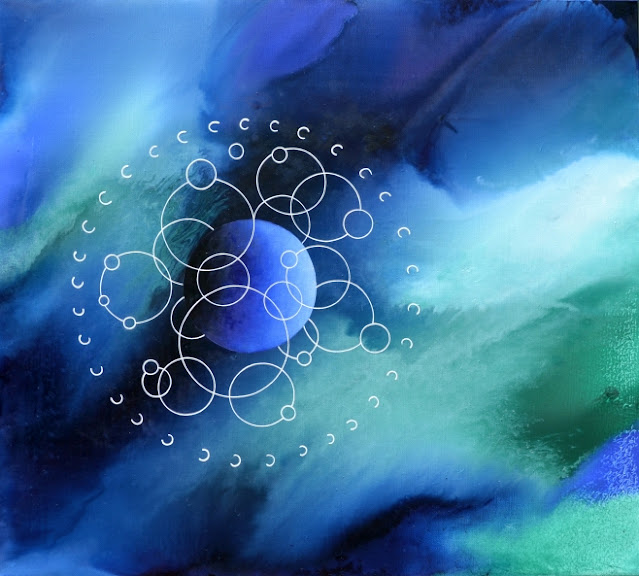
I opened my presentation with an image of my painting Theatre of War: Dromo-Domain. Dromology is a word Virilio developed for the study of speed. A speaker earlier in the conference had said we cannot see ourselves in total. So, I opened my presentation saying that with imagination we can try - with imagined flight we can conjure a totality beyond the screen, the sensor, the aperture. Theatre of War: Dromo-Domain, turned out to be the perfect opening slide - an image of the pale blue dot (after Sagan, Earth) ringed (satellite zone) by repeated symbols for lightspeed - c - and covered with interlocking circles representing hyperconnectivity via fake 'clouds'. 


Cheers,

Kathryn

Sunday, October 12, 2025

PROMPT-SCAPE

 Prompt-Scape Gouache on paper 28 x 32cm 2025

This image of Prompt-Scape (above) is a photographic documentation of a real painting, not an AI generated image erroneously called a 'painting.' Prompt-Scape visually reveals the plunder that a prompt to generate an image or text triggers. I use the word trigger deliberately! Is a prompt like a trigger, setting into motion algorithmic processes that target data to detect the statistical correlations most likely to produce what has been prompted/triggered?

I'll let you all have some fun thinking about this painting. I don't think I need to write much more about it! I will, however, leave two provocations.

1. Can the concept of surrender help us think about life in the age of AI? My article Surrendering to 'Too Powerful' technologies: From the F-111 to the MQ-28 Ghost Bat Drone' in Media, War, and Conflict journal.

2. In September I gave a seminar War in Our Hyperconnected World: Exposing the Invisible Battlespacefor colleagues in the School of Communication and Arts, and the University of Queensland, Australia. Below is one of my slides from the talk. Like Prompt-Scape it channels ideas of targeting in the Earth-to-satellite environment. The painting in the slide is Theatre of War: Techno-Seduction (2022). 

Here's a quote about Theatre of War: Techno-Seduction from my PhD thesis Drones, Signals, and the Techno-Colonisation of Landscape (2023). 

"The painted zeros and ones disembody the organic and strip the non-organic by visually reducing them to the same instructional code. This visual reduction to equivalence exposes insidious relationships, questions forces of techno-homogenisation, and raises issues of aesthetic homogenisation in an age of increasing generative AI."

Cheers,

Kathryn


Monday, May 19, 2025

THE WORDS WE USE: ENCODED?

The Words We Use: Encoded?, Gouache on paper, 56 x 76 cm, 2025


As tech companies and their PR departments work to market AI products and tools, various words are used to describe AI attributes. Many of these words are aspirational, but seemingly reassuring. If you have been reading about AI for some time, the words used to assure us human beings have ranged across multiple descriptions, for example, 'trusted AI', then 'trustworthy AI', 'safe AI', 'ethical AI', and most recently, 'agentic AI'. 

In my text-based painting, The Words We Use: Encoded?, I have painted binary code that 'instructs' words TRUSTED, TRUSTWORTHY, SAFE, AGENTIC, and ETHICAL, followed by AI. The code, and the painting's legend on the bottom left, are painted against a blue and cloudy sky-like background. Circles interlock as indicators of another kind of cloud, the techno-cloud. This fake cloud forms another skyscape, one comprised of signals, normally invisible, but pivotal for contemporary interconnectivity, and lightspeed transmission of data, instructions, and communications. A few of the circles disclose lightspeed with the scientific symbol for speed-of-light - c - painted repeatedly around their rims. The white code channels the appearance of fake angels.

By painting words as code - TRUSTED, TRUSTWORTHY, SAFE, AGENTIC, and ETHICAL - they are visualised (revealed) as simply variations of the same thing - code - rearrangements of zeros and ones. As visualised code in a list, the loss of nuance that exists between the meanings and feelings we human beings might attach to each word is clearly lost. While there are multiple forms of code used to configure algorithms, in this painting I am questioning whether human qualities of trust and agency, for example, can be encoded into AI, without them being algorithmic pastiche, merely applications rather than embedded (I won't say embodied, as that is another anthropomorphising word!) 

This comment has stuck with me:
In Passwords (2003), French cultural theorist, Jean Baudrillard, describes a digitally coded destiny where it will be “possible to measure everything by the same extremely reductive yardstick: the binary, the alternation between 0 and 1”. (*) 

In, The Words We Use: Encoded?, my list of painted code visualises the 'reductive yardstick'.

More to say, but I will leave it here for you.

Cheers,
Kathryn
PS. I have many text-based paintings where I paint binary code, as a proxy for a depiction of reality. 
* Jean Baudrillard, Passwords, Trans. Chris Turner (London and NY: Verso, 2003), 76. 


Sunday, March 30, 2025

DRONE: Ghosts and Shadows


DRONE: Ghosts and Shadows, the curated survey exhibition of the last decade of my creative practice and research is entering its last week. The exhibition is at the University of Southern Queensland Art Gallery, Toowoomba, Australia. The exhibition was curated by the gallery director, Brodie Taylor, JP (Qual), BCRA (hons), FRSA, FSA Scot, MIML, GAICD. The exhibition represents a milestone in my creative and academic journey. 

The show finishes on Friday April 4. Gallery hours Tuesday - Friday 10am - 3pm. 

The exhibition has, according to the Director, attracted hundreds of visitors. I am thrilled! The opening event was also a vibrant occasion, which ended with a panel discussion, 'War in the Age of Hyperconnectivity: What does it look like?'. I was very pleased to discuss military and civilian impacts of signal-enabled hyperconnectivity and the importance of art as a method to examine these impacts, with colleague, Dr. Samid Suliman (Griffith University) and, industry representative, Dave Devine OAM, from Alkath Group-Mellori Solutions.

Here are some photos of the exhibition, opening, and panel discussion. My artist's statement is at the end of the post. And, the exhibition essay 'Against the Sensoration of the World', by Associate Professor Michael Richardson (Uni of New South Wales), is also at the end. 

Beliefs and Battlefields is on the floor. Viewers can walk around the multi-piece painting.
Various parts can be 'read' from different perspectives. 

Left: Ghost Bat, rearrange-able 30 piece painting, 2022-2023.
Right: Ghost Cloud, 2024.

DRONE: Ghosts and Shadows exhibition.

That's me with my exhibition, DRONE: Ghosts and Shadows.

Panel: L - R: Dave Devine OAM, Dr. Kathryn Brimblecombe-Fox, Dr. Samid Suliman.

        Panel: L - R: Dave Devine OAM, Dr. Kathryn Brimblecombe-Fox, Dr. Samid Suliman.

People at the opening of DRONE: Ghosts and Shadows.
The event had to be postponed to mid-way through the exhibition due to Cyclone Alfred causing havoc and flooding across a vast area of Queensland.  


Thanks must also be given to Brodie Taylor, JP (Qual), BCRA (hons), FRSA, FSA Scot, MIML, GAICD. He is a terrific curator to work with. He had a vision for the show, and it has worked wonderfully.

Artist Statement

DRONE: Ghosts and Shadows

I invite viewers of my paintings to ‘fly’ in their imaginations, above, below, inside, and around the mechanisms of war and spawning new modes of signal-facilitated warfare - information, hybrid, cyber, space, and electromagnetic. If you ‘fly’ beyond orbiting satellites, the earth-to-satellite environment can be cosmically ‘viewed’, as an extension of landscape. It is an invisible hyper-landscape of signals carrying data and instructions, transmitted at beyond-human speed – lightspeed.

Drone: Ghost and Shadows represents a survey of my work created over the last ten years. While the paintings address militarised technology, the militarise-ability of civilian technology, and increasing military interest in the electromagnetic spectrum (EMS), each painting has multiple other influences. As a pre-teen I loved biographies of famous scientists - Marconi, Faraday, Curie, Pasteur. I also loved art. During my B.A, while majoring in art history, I undertook a year-long history subject, The History of Science. This subject has profoundly influenced my life’s work, helping to integrate my youthful fascinations, and inspiring me to ‘see’ connections between art, science, culture, technology, society, war, politics, and more. This throng of inspirations has shaped my creative practice, and my interdisciplinary post-graduate studies. 

I grew up on a farm between Dalby and Jimbour, Queensland. As I gazed across the vast landscape of endless skies and flat horizons, I ‘flew’, in imagination, above our farm. I knew what it looked like - buildings, crops, ploughed paddocks, roads - from above.  Childhood imaginational flight is the source of my creative and critical method - ‘imaginational metaveillance.’ I combine it with painting practice to interrogate the visible, and to expose the normally invisible, elements of our hyperconnected world – from civilian and military airborne drones to the lightspeed electromagnetic frequencies our civilian and military technologies rely upon for connectivity and interconnectivity. While imaginational metaveillance and painting are not reliant on digital/cyber devices, or signal connectivity, this does not preclude them as methods to critique these technologies. Rather, they provide a distance from them that affords different perspectives. DRONE: Ghosts and Shadows is your chance to ‘see’ what this distance reveals.

Below is the wonderful exhibition essay by Associate Professor, Michael Richardson (UNSW). 


OTHER NEWS
In other news, I invite you to watch/listen to the first half hour of my presentation 'Painting the Politics of Drones' at the March Visual Politics Research Program seminar, University of Queensland. The second half was Q&A

It can also be viewed on YOUTUBE

Cheers,
Kathryn

Tuesday, August 13, 2024

VISUALISING THE INVISIBLE


Normally Invisible  Oil on linen 50 x 122cm 2024


I've not posted for some time. I've been busy! Firstly some news about an event and a couple of publications, then at the bottom of the post a few words about my new painting, Normally Invisible (above).


EVENT

Deakin University, Law School, Centre for Law as Protection

On Friday 9th August I attended the launch of Deakin University Law School's new Centre for Law as Protection. I was thrilled to be invited to speak about my research, and to hold an exhibition - a pop-up show that I carried in my luggage from Brisbane to Melbourne, and back to Brisbane. I hung and labelled the show, before the launch event started, in about 90 minutes, and took it down about 9 hours later. Years of hanging my own shows, improvising, planning ahead, and early professional curatorial work all help this kind of frantic activity!

I am also thrilled that my painting Target (2016) is the image for the new Centre's website. Plus, the Centre has included a separate Art of Protection online exhibition of a selection of my paintings. You can view this on the Centre website.

I am so very grateful for Professor Shiri Krebs, co-director of the Centre for Law as Protection, for her enthusiasm for my art and research. The vision for the Centre is inspiring, 


The Centre for Law as Protection is building a scholarly community to study the idea of protection, shape policy and develop legal tools to protect people, animals and the environment.  


The keynote speaker for the Centre's launch was Professor Matilda Arvidsson from the University of Gothenburg, Sweden. Her presentation was inspiring. She introduced us to a  history of data collection practices, including early warnings about automating data collection. She brought us into the present with a discussion about the digital shadows we generate, and more. I keep thinking about her presentation. 

View of exhibition at the launch for Deakin University Law School's new 
Centre for the Law as Protection, August 9, 2024.

The first two paintings in the row of paintings, in the photo above, included painted binary code 'instructing' MILITARY LAWYER. Theatre of War: Law and Theatre of War: Techno-Seduction .


               Me with Professor Shiri Krebs, co-Director of the Centre for Law as Protection, Deakin University.

The paintings on the wall in the photograph above all included my version of the tree-of-life, along with various militarised technologies. The tree-of-life represents all life, and in my paintings can be considered as a symbol of a collective or an individual. 


PUBLICATIONS

Digital War Journal
In case you missed it, my commentary piece, "Light-speed, Contemporary War, and Australia's National Defence Strategic Review", in Digital War Journal, was published in May this year. It's open access, so it's accessible for everyone at this link or copy and paste - https://doi.org/10.1057/s42984-024-00091-2 

I was thrilled when the editors encouraged me to include two of my paintings. 

Drones in Society. Social Visualities
And, I have a visual essay chapter "Imaginational Metaveillance, Creative Painting Practice, and the Airborne Drone" in a new book Drones in Society. New Visual Aesthetics, edited by Elisa Serafinelli. Palgrave Macmillan. This is not open access, but you can view details at https://doi.org/10.1007/978-3-031-56984-5_8 


                                                                      Normally Invisible 

I have been painting too!

Normally Invisible (photo at the top of this post) is one of a few new works. I chose to include it in this post because it links with the idea of protection. The painting is a continuation of earlier works - Force Multiplication , Ghost Sky and Ghost Shadows.

In Normally Invisible, two scapes seem to vie for attention, the landscape in the background, and the signal-scape that seems to net or web the background landscape. The background landscape, a physical scape, is normally visible, but the signal-scape depicts normally invisible conduits of connectivity and interconnectivity. Is the normally invisible scape protective or does it pose threats? The signal-scape is visualised as a web or net to indicate its insidious occupation of our environment. The lines linking various ambiguous shapes generate geometric contours that contrast with the physical contours of mountains, valleys, plains, sky, waterways and more.

The small red shape could be interpreted as a glitch - or it could be you holding your mobile phone, a node in signal-matrix - what do you think? 

The background landscape was inspired by my childhood experiences growing up in western Queensland, Australia, where my father, a grain-grower, was also a keen ham: amateur radio. operator. I often write about my father's ham radio passion. When he died in 2016, I wrote Two Paintings of my Dad.

I will post again soon,
Kathryn

Saturday, May 18, 2024

OUR COSMOLOGICAL HISTORY

Our Cosmological History Gouache on paper 56 x76 cm unframed 2024


I have not posted for some time! But, there's news! A painting in an exhibition, and a published commentary piece in Digital War Journal. As the commentary piece, "Light-speed, Contemporary War, and Australia's National Defence Strategic Review", is open access, I invite you to read it at this linkhttps://doi.org/10.1057/s42984-024-00091-2 
I was thrilled when the editors encouraged me to include two of my paintings. 

THE EXHIBITION
Our Cosmological History (above) is a new painting. It is currently in an exhibition Duality - an artistic exploration of quantum science, in Sydney at Flow Studios, Camperdown, until May 20, 2024. The exhibition is hosted by The Australian Research Council Centre of Excellence for Engineered Quantum Systems (EQUS)

The exhibition includes the finalists and winners of the EQUS 'Quantum Art Competition', plus other selected artworks from entries. Very happy to say, Our Cosmological History is in the selected group. The finalist works and the extra selected works look like a high quality, engaging group of artworks, all responding to EQUS's invitation to "artists to explore quantum science through their medium of choice, drawing inspiration from the competition theme, ‘duality’".

More information about the competition and the exhibition, plus talks and workshops, is available at the EQUS exhibition webpage.

This is the artist's statement I sent when I entered the competition.

‘Our Cosmological History’ is a painting that tries to envisage the universal history of the electromagnetic spectrum (EMS), and humankind’s increasing reliance upon EMS frequencies for accelerating civilian and military technological needs. The red firecracker-like markings represent the Big Bang, and the ‘birth’ of photons within ten seconds. The dotted wavy lines represent the dual particle-wave nature of photons. I have painted seven wavy lines, from longer waves to shorter waves, to indicate EMS frequencies from radio to gamma waves, all travelling at lightspeed. This visualisation of normally invisible EMS frequencies (except the light spectrum) is augmented by painted symbols for photons (y) and lightspeed (c). A swathe of stars provides a background for a universal cosmic-scape that reveals macro and micro forces. The stars and the painted EMS frequencies appear to continue beyond the painting’s edges. This is my way of visualising that the universe and the EMS are around us, and continue beyond us, including into future history. 

Humankind’s sphere of influence, from Earth to orbiting satellites, is apparent. The pale blue dot (after Sagan) is a focal point. The sphere around the dot-Earth represents the commons where humankind harnesses the lightspeed forces of the EMS to enable connectivity, interconnectivity, operability, and interoperability of a bourgeoning array of civilian and military
technological systems and devices. ‘Our Cosmological History’, painted for EQUS, expresses awe at the wonders of the universe. At the same time, it questions how we harness powerful natural resources in an increasingly connected and volatile world.

Cheers, Kathryn


Wednesday, September 07, 2022

CLOUDY WAR

 Cloudy War Gouache on paper 56 x 76 cm 2022


CLOUDY?
You may have guessed that cloudy, in the title of this painting, does not mean atmospheric cloudiness, but rather, the encompassing cloudnet that is the 21st century techno-cloud, commonly called The Cloud. Regular readers will know I have created a number of paintings where I try to make visible the invisible aspects of contemporary militarised technology and war. By war, I mean not only kinetic warfare, but also information, hybrid, cyber and grey-zone warfare. The techno-cloud of interconnected and interoperable systems provides seeming instant access and connectivity to information, updates, news cycles, social media posts and posting and more. This is enabled by light-speed or near light-speed signal transmissions carried by frequencies in the electromagnetic spectrum (EMS). Speed is now an expectation.

Cloudy War
In  Cloudy War I have painted strings of binary code 'instructing' the word CLOUD. Circles of dotted lines carry the fake cloud theme further. And, yet more circles containing wave patterns reveal the underlying signalic character of this 'cloudy' war painting. Why waves? All frequencies in the EMS are made up of photons travelling in wave form at light speed. Radio waves have the longest wave lengths and gamma waves have the shortest. The radio to microwave frequencies are the most commonly used for transmission of signals that enable contemporary hardware and systems technologies. Congestion and contestation of bandwidths is prompting experimentation with other frequencies. Additionally AI systems are being developed to optimise bandwidth access, especially for the military. 

Peeping out from behind the techno-cloud are hints of various militarised hardware - airborne drones, ground-based aerial nodes, a tank, a robotic quadruped, a ship, indications of satellites. And, of course there are other hidden elements - you just have to imagine them! 

The 'fog of war' is now electromagnetically induced. 

I could go on, but I'll leave you to ponder. 

Cheers,
Kathryn


Friday, August 19, 2022

BATTLE CLOUD

Battle Cloud Gouache and watercolour on paper 30 x 42 cm 2022


IoT, IoBT, IoMT

Regular readers will know of my interest in trying to visualise the 21st century techno-cloud  - often just called The Cloud. Also, the Internet, and even the Internet of Things (IoT). 

But, did you know that the military also have terms like the Internet of Battlefield Things (IoBT) and the Internet of Military Things (IoMT)

All these 'internets' rely on the electromagnetic spectrum (EMS) for connectivity and interconnectivity, plus operability of hardware and systems, as well as inter-operability. The term dual-use, in a world where civilian technologies also rely upon the EMS becomes almost non-sensical. Why? Because in a world of not only kinetic warfare, we now have remotely operated systems, cyber warfare, hybrid warfare and information warfare. These draw civilian technologies into the various physical and cyber battlefields of our time. Our mobile phones, computers, remotely update-able vehicles and appliances, GPS, social media updates, cloud storage, cyber home assistants and more, can be, and in many instances are, tracked, hacked, surveilled, harvested for data, used as nodes and purveyors of viruses. 

What if the Internet of Things is ultimately a subsidiary of its spawned IoBT or IoMT? Where does that place the civilian in terms of complicity, unwitting or not? 

Battle Cloud

My visualisations of 21st century technology and its Cloud are created with paint - oil paint or gouache and watercolour paints. I love using paint to critically examine contemporary militarised and militarise-able technology. Why? Because, unlike the technology I critique and examine, painting is not reliant on the EMS for creation, exhibition or storage. This independence provides a critical distance. It is a form of resistance.

I listened to a fascinating conference hosted earlier in the year by the Disruption Network Lab in Berlin. The conference was called The Kill Cloud. One message from this bluntly titled conference was that the airborne drone needs to considered as part of a network. This resonated with me, and is why my PhD focusses on increasing military interest in the EMS as an enabler of technology, a type of fires (weapon), a manoeuvre space (tactics) and a domain (strategy). Any robotic hardware, whether an airborne drone, or a ground, sea or under-the-sea robotic system, functions as part of a network. The network is enabled by signals transmitted via EMS frequencies. As frequencies become more congested, due to not only increasing military needs, but also civilian needs, there is a heightened sense of urgency for militaries to dominate the EMS. Congestion is only one issue, another is contestation from state and non-state malign entities. 

I chose to paint Battle Cloud in red, after hearing the term 'kill cloud'. Maybe I could have called it Bloody Cloud or That Bloody Cloud. I don't think I need to explain the title any more - you 'get' it.

The washed out text running across the painting is binary code 'instructing' the word CLOUD. I like the way the code seems to dissolve, as if it is actually cloudy. The illusion of connection...


Three Other Cloud Paintings: 
There are actually more than three...scroll through the blog and you will see them. 

Cheers,
Kathryn


Wednesday, April 13, 2022

INTERFACE: Being HUMAN Being

Interface: Being HUMAN Being Oil on linen 56 x 112 cm 2022
 

Interface: Being HUMAN Being follows my last two works on paper Interface: Being  and Interface. I have been thinking about the human-machine relationship, especially where AI or ML technologies work as interfaces. I am particularly interested in the idea of AI systems operating in more human-like ways, and human beings becoming more like machines. Notice - I wrote AI operating and human beings becoming. 

And, this is a painting, not a digital work. The white on blue represents a fake cloud...

I think I will leave it there! 

Cheers,

Kathryn

P.S. Oh! The code 'instructs' HUMAN

Related Posts:  
Interface Being
Interface


Tuesday, April 05, 2022

INTERFACE: BEING

Interface: Being Gouache on paper 56 x 75 cm 2022
 

Interface: Being follows my last painting Interface. And, in my last post I wrote "My head is full of ideas. Interface is a result of thinking about a lot of things. I've been writing and researching for my PhD, and this painting has been inside my head - my imagination - for a few weeks." My PhD research focuses on the increasing interest militaries around the world are paying to the electromagnetic spectrum (EMS), as an enabler of technology, a type of fires, a manoeuvre space and a domain. 

This new painting above, Interface: Being has also been inside my head for a while!

Human-Machine
The human-machine relationship is a key area of interest. As the speed of technological operation, enabled by light-speed EMS frequency transmissions, increases across inter-connected and interoperable civilian and military systems, the human being is often seen as a point of delay. I have written about this with regards to recent news that an AI military lawyer tool is under development - Theatre of War: Law   and Theatre of War: Techno-Seduction 

Interface: Being 
Interface: Being is also the result of weeks of research and thinking. Like Interface, this new painting also references Douglas Hofstadter, the technological Cloud, real clouds, AI, binary code (01001000 01010101 01001101 01000001 01001110 instructs the word HUMAN), and questions about what it means to be a human being in the 21st century. 

In this new painting, I introduce and play with the word BEING. 


BEING

TO BE

BEING HUMAN

HUMAN BEING

BEING 01001000 01010101 01001101 01000001 01001110 

01001000 01010101 01001101 01000001 01001110 BEING

HUMAN 01001000 01010101 01001101 01000001 01001110 

Interface is both a noun and a verb, and is used as both a noun and verb in computer science, and also in studies of human beings. 

In a human-machine relationship let's think about what is the interface, and what does the interfacing? Is it code - is it signal connectivity - is it human willingness or excitement (therefore, us) - is it need - maybe money - maybe power - is it speed? What do you think? How are we to BE human beings in a world dominated by accelerating developments in technology?

Painting
My choice of medium - painting - is deliberate. Painting helps me probe questions and pose new questions, without techno-interfaces or techno-interfacing. Painting is not reliant an any EMS-enabled digital or cyber technology, yet this does not preclude critique and study of these technologies. Painting is technologically and operatively detached. Detachment in a world of techno-interfaces and interfacing is a form of critical resistance.  

Cheers,

Kathryn


Wednesday, December 22, 2021

THEATRE OF WAR: DROMO-DOMAIN

 Theatre of War: Dromo-Domain Oil on linen 90 x 100 cm 2021

CLAUSEWITZ
I think this is my 14th or 15th Theatre of War painting. I was inspired to start this ever-growing series by late 18th/early 19th century Prussian General, Carl Von Clausewitz's famous tome On War. He often mentions the term 'theatre of war'. Reading through the text, I get the impression he thought it involved a number of factors, but geography was a central theme. 

I think about what 'theatre of war' might mean in the 21st century, the age of digital and cyber technology, drones, drone swarms, ubiquitous surveillance and increasingly autonomous systems. Regular readers will know I am probably a bit dystopian in my outlook. This is because I 'see' contemporary networked, interconnected and inter-operable technology as an homogenising and standardising force that enables the 'theatre of war' to extend not only beyond geography, but also traditional ideas of military activity and reach.* Because of the shared nature of technological platforms and systems I am particularly concerned about, and interested in, the militarise-ability of civilian technology. Here, increasing military interest in the electromagnetic spectrum [EMS] as an enabler of technology, a type of fires, a manoeuvre space and a domain is a key concern. Why? Because civilian technology also relies upon access to the EMS. Information and cyber warfare, and terms such grey-zone and hybrid warfare, all 'speak' to permeable military-civilian boundaries. I am also interested in the militarisation of imagination, time and speed. So, you can see, my ideas of the contemporary 'theatre of war' encompass almost - maybe all of- everything!

DROMO - SPEED
Theatre of War: Dromo-Domain is a visual spin on Paul Virilio's thoughts on speed and the term he coined, dromology ie: the logic of speed applied to contemporary society. Virilio, in a number of books and articles*, argued and observed that speed and accelerating speeds of technological operation and development play major roles in societal, political and geopolitical stability. As developments in networked and interconnected digital and cyber technologies have accelerated, light-speed [or near light-speed] signal transmissions introduce speed as a necessary advantage for both civilian and military technology. It is commercially, politically and militarily tactical to use speed as an advantage. One of my favourite quotes from Virilio is  "The fact of having reached the light barrier, the speed of light, is a historic event, one which disorients history and also disorients the relation of human beings to the world. If that point is not stressed, then people are being disinformed, they are being lied to. For it has enormous importance. It poses a threat to geopolitics and geostrategy.” (1)

HOW TO VISUALISE SPEED
I have grappled with how to visually convey speed as an overarching dromo-domain that encompasses civilian and military technology in a pervasive and persistent 'theatre of war' that extends from Earth to orbiting satellites. 

In Theatre of War: Dromo-Domain I have repeatedly painted the symbol for light speed ie: c, to form a circle around the Earth. I love how the cs look like the spurs on a spinning cog, and that a sense of speed is created. The Earth is the 'pale blue dot'. This circle of cs represents the major satellite orbiting zones around the Earth. From these orbits to Earth, is our sphere of influence, where the EMS is harnessed for an array of communication, operative and inter-operative civilian and military technological functions. How are we managing this sphere of influence? I 'see' it as a volumetrically occupied and techno-colonised space. 

In Theatre of War: Dromo-Domain the multiple overlapping white circles are indicative of civilian and military activities and domains. Clearly the term dual-use is inadequate in the era of speed, where networking, interconnectivity and interoperability scaffold us all in invisible webs of signals. This is a militarised space - a dromo-domain that enables and cradles more traditional military domains of land, sea and air. It is the meta-domain.

IMAGINATIONAL METAVEILLANCE
The cosmic-like background in Theatre of War: Dromo-Domain continues my quest to stimulate flight, your flight and mine [in imagination], to places where we can gain new perspectives. I call this 'imaginational metaveillance' - a kind of veillance that does not rely on EMS-enabled technology, thus it is untethered from it. The cosmic landscape also alludes to universal history, which includes the history of the EMS. All frequencies in the EMS are made up of photons, traveling in waves at light speed. The photon appeared around 10 seconds after the Big Bang. This kind of cosmological history really gets me thinking about how, in our sphere of influence, are we using a natural universal resource. 

* Paul Virilio and Jean Baudrillard inform my ideas here.
Cheers,
Kathryn

PS. Related recent posts/paintings include:

(1) Paul Virilio, “Red Alert in Cyberspace,” trans. Malcolm Imrie, Radical Philosophy (Nov/Dec 1995): 2.

* Just a small few examples of Virilio's work
Paul Virilio, Speed and Politics, first published 1977.
Paul Virilio, The Original Accident, trans. Julie Rose (2007
Paul Virilio, The Great Accelerator, trans. Julie Rose (2012)

Monday, December 06, 2021

LETHAL LITTER

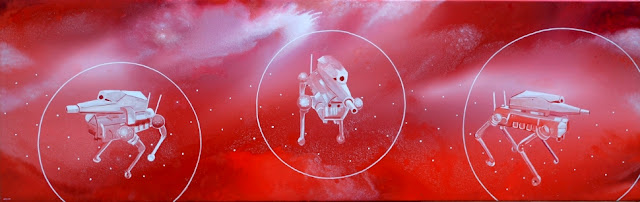
Lethal Litter Oil on linen 36 x 112 cm 2021


I'm not going to write much. But, suffice to say, the word litter in the title Lethal Litter was deliberately chosen for its multiple meanings. 

This 'litter' of  three weaponised quadruped robots (I refuse to call them dogs) scope the landscape, which is dotted with geolocating graphics. After all, landscape must be geo-mapped for robotic systems, especially those with autonomous abilities to move within and through a landscape/environment. This does not mean the robots have autonomous functionality regarding their weapons though. Some would add the word - 'yet'. 

Increasingly, robotic systems and platforms are assemblages of autonomous functions and remotely operated functions. For example movement in a rugged landscape or an unmapped urban environment can require a robot, or robots, to move autonomously, especially if remote operators are not close. Google 'robotic dogs', 'military robotic quadrupeds' etc and you'll find some fascinating and also scary videos! 

Like my other recent painting Biped and Quadruped: Warfighters, Lethal Litter was inspired by news of  experiments where robotic quadruped were weaponised. 

My last post Dogs, Quadrupeds and Robots features a few more paintings, but mostly with real dogs. 

Cheers,
Kathryn

Monday, November 29, 2021

DOGS, QUADRUPEDS AND ROBOTS

1. Content Tagging: A Spoof Watercolur on paper 30 x 42 cm 2020


This is another fun post, albeit with a dark side. My last post Face Database: Kathryn's Dataset Map was fun, but also dark.

Dogs, Quadrupeds and Robots is a collection of recent paintings where I depict dogs, one a weaponised robotic quadruped. I refuse to call the quadruped robots, dogs! 

* Since writing this post, I have created another quadruped painting, this time called Lethal Litter

The last photograph is me with our family dog - an Australian kelpie. You will see she is the model for my real dog renditions.

ROBOT THAT 'WAGGED' ITS TAIL
I have 'met' a robot quadruped (Boston Dynamics). I met this robot quadruped at the Australian Army's Landforces Exposition this year, in Brisbane. The robot was 'wandering' around the expo, its remote controller nearby. It caused quite an excited stir, with people responding to it, as it wagged its tail, went up to them and moved with dog-like movements. 

I was both surprised and not surprised by people's reactions. I was not surprised because this quadruped could certainly mimic some doggy behaviour, and living dogs are lovely! Yet, this robot was clearly a robot - and here I was, witnessing multiple adults responding quite excitedly to a non-living robotic quadruped, almost as if it was a real dog. The experience left me feeling somewhat uneasy. 

When the robot quadruped encountered me, it approached, and its tail was wagged. I refused to respond, but it was hard not to wag back! Its wagging so reminded me of our kelpie's wagging tail movements! Because I just stood there and did not respond, it moved away. The remote operator, who I had located out of the corner of my eye, seemed a bit disappointed. A few seconds later the robot stumbled, tripping on something as it turned a corner. The remote controller turned it off. While robot quadrupeds are supposed to be great on rough and difficult terrain, they're not so good at expos - for now anyway.

GREAT ARTICLE
This great article "See Spot save lives: fear, humanitarianism, and war in the development of robot quadrupeds" was recently published by Dr. Geoff Ford and Dr. Jeremy Moses. The article goes into the history of Boston Dynamic’s robot 'Spot', plus tracks public responses to images, videos and news stories about 'Spot'. The article really opens up the dilemma of civilian - military robotic use. Robots [including drones] have many good purposes, but they can be militarised, as the recent case of the weaponised quadruped developed by Ghost Robotics shows. Ford and Moses mention this weaponised quadruped in their article too. 

Regular readers will know why I found Ford and Moses's article interesting - because the militarise-ability of civilian technology needs critical attention. It is not a simple matter of dual-use. 

Clearly there's more to say, but I will leave you to think about it...
Cheers,
Kathryn
P>S Update. Another quadruped post Verification Error: Identity Crisis


2. Walking the Dog in the Drone Age  Oil on linen 82 x 102 cm 2020

Walking the Dog in the Drone Age was inspired by an early Covid story of a person in lockdown in Malta using a drone to walk their dog.   


3. Strange Times Gouache on paper


4. Border Crossing Watercolour on paper 24 x 32 cm 2020

This painting was inspired by border restrictions imposed between Australian states during the ongoing COVID19 pandemic. 


5. Biped and Quadruped: Warfighters Oil on linen 60 x 110 cm 2021

The robot quadruped is weaponised...

6. Lethal Litter Oil on linen 36 x 112 cm 2021
 
Dark play on the word litter - rubbish or a litter of puppies!

7. Future Memory Oil on linen 122 x 137 cm 2021

Future Memory does not feature a dog. It does, however, relate to Walking the Dog in the Drone Age, above. In Future Memory a human is being walked by a drone. Maybe we human beings will be the future pets?

 
8. Me with our family dog - an Australian kelpie.