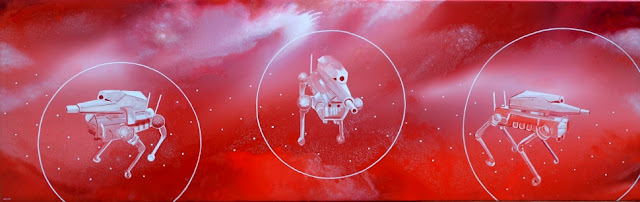
Showing posts sorted by relevance for query strange times. Sort by date Show all posts

Sunday, March 22, 2020

STRANGE TIMES AND IMAGINATION

Earth's Pulse Oil on linen 80 x 200 cm 2005

EXISTENTIAL RISK
As regular readers know I am very interested in ideas of existential risk, particularly posed by emerging technologies. I have attended talks and read quite a lot about existential risk generally, and pandemic is one of the risks I am somewhat acquainted with.

AND, here we are in the midst of a corona virus global pandemic.

IMAGINATION
Back in January, when I was preparing for my trip to the UK to attend the Aesthetics of Drone Warfare conference at the University of Sheffield, the corona virus had reared its ugly head in China. By the time I left Australia in early February I was getting worried, so I went overseas with a few masks, alcohol wipes, gloves, nasal sprays and a bar of soap in my handbag. Yes, I was that strange lady wiping her table at the hotel restaurant, opening doors with my elbow, washing my hands vigourously. My young adult children thought I was mad, but they don't now! The motto of this story is, don't dismiss someone with an imagination prone to extrapolating burgeoning negative situations into catastrophe and disaster! Remembering, too, that this someone has studied history and researched topics associated with existential risk for quite awhile.

The role played by informed imagination in times of unfolding catastrophe is an interesting one. A vivid imagination can compel action to be taken, but it can also provoke a paralysis of action. Ultimately fearful reactions to an existing situation, and subsequent imagined thoughts about the future, can be productive or non-productive.

LEADERS
But, what are the benefits or dangers of not having an imagination? Do our leaders need to have  imaginations that responds to data, are informed by a knowledge of history, are open to the expertise of others from across the sciences, social sciences and humanities? Surely an imagination is required to even 'see' how multiple sources of expertise can interact in meaningful ways? Surely an imagination is required to extrapolate future possible outcomes from graphs that map historic and current data? An imagination surely must help determine how intervention can arrest dire trajectories? I would say an imagination is needed in order to undertake logistical planning!

And, ultimately we need people who can imagine a life after pandemic, possibly a life vastly different from pre-pandemic life. And, a reminder, difference does not necessarily mean worse. Nor, does it necessarily mean better. But, it might mean we have a choice. Let's imagine in compassionate ways that are productive and meaningful. Let's imagine in ways that disallow the paralysis of fear. Rather, let fear contribute as a driver rather than a brake.


Compassion oil on linen 100 x 100 2010


Earth's Pulse [top]
This painting, from fifteen years ago, has a graph-like appearance. It 'maps' the pulse of the Earth. How do you think its currently performing?

I exhibited this painting in Abu Dhabi at my 2005 exhibition at the Abu Dhabi Cultural Foundation. A Middle Eastern man dressed is swathes of white robes and a largish head-dress came to the exhibition a few times. I cannot remember which country he came from, but he had fought in Afghanistan. On one visit to the show we had a long conversation that involved discussions about a few of the paintings. When he looked at Earth's Pulse, before even knowing the title of the painting,  he said:

"This reminds me of my own mortality."

Now, I think that demonstrates an imaginative response!


DISTANCING
As a studio-based painter I am used to working alone. With a couple of conferences cancelled I don't have much else to do, but paint...and be online! I am currently working on a painting I will call Machine Unreadable. Please check out my Instagram page for studio photo updates of work in progress. Hopefully, when the pandemic is over, I can get to exhibit some of my paintings!

In the meantime please stay safe, for yourself and others.


Showing Them Our Home Oil on linen 30 x 56 cm 2017
Me, with my three adult daughters. And, Earth, the pale blue dot.


Cheers,
Kathryn


Friday, July 24, 2020

BORDER CROSSINGS


 Crossing the Border watercolour on paper 24 x 32 cm 2020 


More watercolour paintings! 
Following on from my last post Watercolours For Our Strange Times: Online Exhibition


Australia
As Australia confronts a renewed wave of COVID-19 infections, particularly in the state of Victoria, borders between states have closed again, or not re-opened. For Queenslanders, the recently re-opened border is now closed to visiting Victorians or people from accelerating hotspots in New South Wales. Many Queenslanders want the state's Premier to shut the borders again, completely.

Issues associated with borders and border controls are global and historical - colonial annexations,  migration control, refugee movement, trade, security and pandemic mitigation. Closing or monitoring borders for pandemic and disease control - for example: state, village, home, urban borders/boundaries - are not new strategies. Across history and the globe, from plague to cholera outbreaks, Spanish Flu to Ebola outbreaks, quarantining by border/boundary control has occurred. It is clearly a sensible method of disease transmission mitigation, especially when there is no known cure.

Drones - COVID-19
I am interested in the increased use of surveillance technology during the COVID-19 pandemic. Of particular interest is the use of airborne drones for monitoring, crowd control, spraying disinfectant, attempts to gauge temperatures etc. While perhaps laudable in intent, what happens if the use of drones for surveillance and monitoring purposes becomes normalised, and therefore enduring?

Drones Monitoring NSW - Victorian Border
The three watercolour paintings in this post are responses to recent news that police will use airborne drones to monitor the border between Victoria and NSW. This strategy has arisen particularly since the renewed outbreak of COVID-19 in Victoria in July 2020. The drones will monitor parts of the border where people could cross undetected, for instance, by swimming across the Murray River. The river forms the majority of the border and presents ample opportunity to cross if someone was determined. You can read about the use of drones to monitor the NSW - Victorian border by police in articles such as these - one in The Australian  newspaper, another in the Sydney Morning Herald, and another in Australian Aviation.

I wonder if airborne drones are being used  by enforcement authorities to monitor other borders in Australia? I assume they are, or at least, being considered. Australia is a vast country with long, often remote, borders between states and territories.

Border as Metaphor
And, of course, the idea of the border as a metaphor is tantalising, particularly so when rivers are borders. Here, I think about the River Styx, in Greek mythology the border between the underworld and the world of the living. I also think about the Rubicon*. The term 'crossing the Rubicon' relates to Julius Caesar's army crossing the Rubicon River in north east Italy in 49BC. This was considered an act of insurrection and treason, and a declaration of war against the Roman Senate. Metaphorically 'crossing the Rubicon', means there is no return. I ask, what kinds of 'no return' metaphoric borders have we crossed in terms of increasing normalisation of drone use for surveillance and targeting purposes? 

PAINTINGS
Crossing the Border [above] depicts three figures in an ambiguous, but watery, landscape. Are the figures swimming or running? They are clearly in a non-urban environment, and they express a sense of urgency or agitation. Yet, they appear to have not reached their destination. It is as if their bodies link each side of the border - can they return? Here, I am not thinking of a literal return!


 Border Crossing watercolour on paper 24 x 32 cm 2020 

In Border Crossing [above] a human figure and the figure of a dog seem ready to cross a border, a watery border. But, maybe they are already half way across a river, the lines extending downwards from their bodies acting as signs of a watery wake. Or are these elongated limbs or shadows tethering them to a shore, keeping them from reaching the other side?


Monitoring the Murray watercolour on paper 32 x 40cm 2020 

In Monitoring the Murray [above] a human figure has merged with the landscape. The figure's outstretched arm, in freestyle movement, indicates it is swimming. However, the figure has become part of the river, a clever camouflage. As the figure reaches the other side of the river, three drones are surveilling. Are the drones from the underworld? 


Previous painting and post Crossing the Rubicon

Cheers,
Kathryn

Friday, April 10, 2020

MACHINE UNREADABLE


Machine Unreadable Oil on linen 56 x 76 cm 2020


Machine Unreadable was started not long after I returned from the UK in mid February, and it is now finished. I had gone to the UK to attend and present at the Aesthetics of Drone Warfare conference, University of Sheffield. One of my fellow presenters Mark Reinhardt, Professor of American Civilization at Williams College, gave an interesting talk "Killing Aesthetics? Theora, Automated War, and the Paradox of Drone Visuality" that posed questions about machine to machine scrutiny of images, or rather, their constituent data.* Here, for the machine, the data does not necessarily need to manifest into an image for human eyes. 

Reinhardt's questions intersected with concerns I have expressed in talks, and here on this blog, about attributing the ability of 'vision' to a machine eg: machine vision, drone vision. Vision as a human capability is far more than seeing with eyeball and pupil. Human vision is also about imagination, daydreaming, dreaming, visionary thinking. A machine cannot see or imagine - a machine does, however, scope. Machines that examine image data represent a removal of the human being, and therefore, even the need for an image, or as Reinhardt notes a "killing of aesthetics as both human judgement and human perception."** 

During Prof Reinhardt's presentation he mentioned the term 'machine unreadable' and suddenly I had pictures bouncing around in my head - imagination! Although I had heard the term before, I think the contexts of the talk and the conference opened a different appreciation of the term's meaning. It was one of those moments, which I love, when inspiration is sparked. 

And,

Machine Unreadable is the result.

In Machine Unreadable I have painted a 'corrupted', colourful and incomplete QR Code-like design  over a landscape. The QR Code almost becomes a landscape itself, its dispersed geometry acting like pixels that might, if completed, make up a digital image. The overlay of colourful squares and rectangles obscures the landscape behind. Is this an attempt to make the landscape unreadable? If so, who or what cannot read the landscape? Or, is the landscape the 'destination' image, if the QR Code could be scanned by a mobile phone or other digital devices? 

The 'corrupted' QR Code also acts as a camouflage, perhaps a bit like the dazzle camouflage used on British ships during World War I. Geometric patterns were painted on ships to confuse German submarine officers about the size and shape of ships, plus their speed and direction of travel. If the QR Code is a camouflage, what secrets does it hide? What might it be protecting? Is it confusing? The camouflage could be a metaphoric protection of event the idea of the image, a visual double-play where both the camouflage and the landscape are images that combine to create another image.

Machine Unreadable can be 'read' by a human being, drawing upon imagination, curiosity, experiences, knowledge, memories. This 'reading' can result in multiple interpretations that might be satisfying, enjoyable, or maybe even spark new ideas. A 'reading' could also result in disinterest! Some people might not recognise the geometric pattern as being like a QR Code, but that doesn't matter because the aesthetic response to a colourfully presented pattern incongruously laid over a landscape is likely to induce wonder. How does a machine's scoping capability compare with wonder, imagination, a sense of curiosity, and the ability to dream, daydream or even have nightmares. 

Maybe the machine is the nightmare? 

So much to think about.

Cheers,
Kathryn
  
* Check out the Aesthetics of Drone Warfare conference booklet  page 56-57 for details on Prof Reinhardt's presentation. And, then check out all the bios and abstracts!
** Ibid., P. 56. 

And, another recent post with imagination as a core topic Strange Times and Imagination

Monday, November 29, 2021

DOGS, QUADRUPEDS AND ROBOTS

1. Content Tagging: A Spoof Watercolur on paper 30 x 42 cm 2020


This is another fun post, albeit with a dark side. My last post Face Database: Kathryn's Dataset Map was fun, but also dark.

Dogs, Quadrupeds and Robots is a collection of recent paintings where I depict dogs, one a weaponised robotic quadruped. I refuse to call the quadruped robots, dogs! 

* Since writing this post, I have created another quadruped painting, this time called Lethal Litter

The last photograph is me with our family dog - an Australian kelpie. You will see she is the model for my real dog renditions.

ROBOT THAT 'WAGGED' ITS TAIL
I have 'met' a robot quadruped (Boston Dynamics). I met this robot quadruped at the Australian Army's Landforces Exposition this year, in Brisbane. The robot was 'wandering' around the expo, its remote controller nearby. It caused quite an excited stir, with people responding to it, as it wagged its tail, went up to them and moved with dog-like movements. 

I was both surprised and not surprised by people's reactions. I was not surprised because this quadruped could certainly mimic some doggy behaviour, and living dogs are lovely! Yet, this robot was clearly a robot - and here I was, witnessing multiple adults responding quite excitedly to a non-living robotic quadruped, almost as if it was a real dog. The experience left me feeling somewhat uneasy. 

When the robot quadruped encountered me, it approached, and its tail was wagged. I refused to respond, but it was hard not to wag back! Its wagging so reminded me of our kelpie's wagging tail movements! Because I just stood there and did not respond, it moved away. The remote operator, who I had located out of the corner of my eye, seemed a bit disappointed. A few seconds later the robot stumbled, tripping on something as it turned a corner. The remote controller turned it off. While robot quadrupeds are supposed to be great on rough and difficult terrain, they're not so good at expos - for now anyway.

GREAT ARTICLE
This great article "See Spot save lives: fear, humanitarianism, and war in the development of robot quadrupeds" was recently published by Dr. Geoff Ford and Dr. Jeremy Moses. The article goes into the history of Boston Dynamic’s robot 'Spot', plus tracks public responses to images, videos and news stories about 'Spot'. The article really opens up the dilemma of civilian - military robotic use. Robots [including drones] have many good purposes, but they can be militarised, as the recent case of the weaponised quadruped developed by Ghost Robotics shows. Ford and Moses mention this weaponised quadruped in their article too. 

Regular readers will know why I found Ford and Moses's article interesting - because the militarise-ability of civilian technology needs critical attention. It is not a simple matter of dual-use. 

Clearly there's more to say, but I will leave you to think about it...
Cheers,
Kathryn
P>S Update. Another quadruped post Verification Error: Identity Crisis


2. Walking the Dog in the Drone Age  Oil on linen 82 x 102 cm 2020

Walking the Dog in the Drone Age was inspired by an early Covid story of a person in lockdown in Malta using a drone to walk their dog.   


3. Strange Times Gouache on paper


4. Border Crossing Watercolour on paper 24 x 32 cm 2020

This painting was inspired by border restrictions imposed between Australian states during the ongoing COVID19 pandemic. 


5. Biped and Quadruped: Warfighters Oil on linen 60 x 110 cm 2021

The robot quadruped is weaponised...

6. Lethal Litter Oil on linen 36 x 112 cm 2021
 
Dark play on the word litter - rubbish or a litter of puppies!

7. Future Memory Oil on linen 122 x 137 cm 2021

Future Memory does not feature a dog. It does, however, relate to Walking the Dog in the Drone Age, above. In Future Memory a human is being walked by a drone. Maybe we human beings will be the future pets?

 
8. Me with our family dog - an Australian kelpie.

Sunday, July 12, 2020

WATERCOLOURS FOR OUR STRANGE TIMES: ONLINE EXHIBITION

[Fig.1] Sentinel Watercolour on paper 30 x 42 cm 2020


This post 'exhibits' some of my recent watercolur paintings. These watercolours are a departure from my normal oil paintings. I like having departures because experimenting with different paint mediums creates a space for thought and innovation.

The paintings in this small online exhibition all respond, in one way or another, to living through the COVID-19 pandemic. 

Watercolour Medium
The medium of watercolour provides a softness that is important at a time when people are anxious, in mourning, or even angry and frustrated. I use copious amounts of water, and I cannot help but think that there is something soothing about paintings created with water. Although I obviously also use paint and a brush, the water is essentially the creator - I am the vehicle.

Paintings
Sentinel [Fig.1] is a landscape where a tree - a tree-of-life - stands like a sentinel on a distant horizon. I was thinking about how life copes with threats and risks. Here, the horizon is both literal and metaphoric - what horizons do we cross when catastrophe knocks at our front doors? 

Maybe one horizon is the increasing use of surveillance and monitoring technology. What limits are crossed when, for example, the pandemic gives rise to an accelerating use of airborne drones? What kinds of creeping normalisation pave way for future impediments to privacy and freedom? 

In Content Tagging: A Spoof  [Fig.2], human [Fig.3] and Shadows [Fig.4] I visually spoof the way machine learning and AI need to be repeatedly exposed to images of objects, expressions and activities, in order to learn to identify them. Words are used to tag. But, I wonder, for an AI, does the tag become the object too? In Content Tagging: A Spoof I have also referenced the story of a person, in lockdown in Malta, who used a drone to walk their dog. My earlier painting Walking the Dog, In the Drone Age was also inspired by Malta story, a story that speaks to how strangeness can morph into normalcy.


[Fig.2] Content Tagging: A Spoof Watercolur on paper 30 x 42 cm 2020


[Fig.3] human watercolour on paper 24 x 32 cm 2020


[Fig.4] Shadows Watercolour on paper 30 x 42 cm 2020


The three paintings below speak to the effects of isolation during COVID-19. In Watching [Fig.5] two figures are separated by distance, but also by what looks like bars on a window. Lockdown, quarantine and social distancing are mechanisms of isolation, that are monitored in various ways, including the use of drones. That lockdown, quarantine and social distancing are necessary during a pandemic is not disputed. What I query is the way new modes of surveillance, used by security and police forces, collide with those also employed by military forces. In Watching, the drone monitors the figures, as the figures watch each other. Do the figures notice the drone though?


Watching [Fig.5] on paper 30 x 42 cm 2020


In People [Fig.6] a line of figures, are socially distanced, except for two figures on the far left. They maybe a couple? The ambiguous atmosphere of the painting reflects the sense of limbo and uncertainty that permeate societies as they grapple with COVID-19. The sense of limbo and uncertainty also permeates Apart and Together [Fig.7]. I was thinking about how all of us are experiencing the pandemic - that all of us are in this thing together. That our individual behaviour and how we adhere to safeguards, can affect other people, is of paramount importance. Staying apart actually helps to keep us together - alive. 

Do stay safe!
Kathryn


 People [Fig.6] on paper 24 x 32 cm 2020


Apart and Together [Fig.7] on paper 30 x 42 cm 2020

Friday, September 25, 2020

IS IT ME? PORTRAITURE IN THE AGE OF FACIAL RECOGNITION

 
                                                      Is it me? oil on linen 51 x 76 cm 2020


I started this self-portrait - or is it? - earlier this year. Although I thought it was finished I have worked on it and have just finished it. 

As regular readers know, during the pandemic I have been responding to media coverage about the use of drones, and problems with creeping normalisation of drone use.* Uses have included monitoring population compliance with COVID19 restrictions, broadcasting instructions and spraying disinfectant. Other uses that have been mooted, but I am unsure if they have actually been carried out, are checking for temperatures and heart beats to assist determination of illness. Issues of facial recognition have escalated over the last few years, and the pandemic, with co-current protests around the world about various issues, has highlighted issues of privacy, AI accuracy, bias and security.

Deep Fake and GAN Technology
While Is it me? intersects with the various issues of facial recognition, drone use and contemporary surveillance, it also triggers questions about portraiture in the age of AI and machine learning. Facial recognition technology uses biometrics scoped from photographs or image data to map facial features. These features are tagged as reference indicators for identity recognition by AI systems. Deep fake technology and generative adversarial networks (GANs) produce images of people. The latter has been used to generate portraits - note I use the word generate, rather than create. A recent controversial example of GAN 'portraiture' is the auction of the Portrait of Edmund Belamy. Sold for $432,500, the image of Belamy, a fictitious person, was generated and printed after the GAN system had been fed a "data set of 15,000 portraits painted between the 14th and 20th centuries". Even thinking about portraiture across centuries being  called a "data set" is unnerving! 

Portrait Painting
With technology changing the ways we identify and portray people, what can portrait painting say?  Is it me? is my attempt to grapple with that question. For me, my two main characteristics are my very blue eyes and my bun at the back of my head. In Is it me? I have featured these two characteristics as dominant, as if they are standing up to the computer graphic biometric indicators that scan my face. With so many images in the media of these kinds of computer graphic markings scanning faces, my inclusion of them is a parody, but also a warning. Like our natural features, will these algorithmically determined indicators become part of our 'portrait', who we are? Historically, though, portrait painting has been far more than simple identity. Good portraits are ones that reveal a personality, a sense of spirit - whether it is joyous or not. Good portraiture can also tell a story about a person. This is often achieved by combined elements such as, whether their skin is rough or smooth, what they might be wearing, the background against which they are portrayed and expression. With abstract approaches to portraiture, recognition and story-telling are bound up in painterly gesture, placement of forms, use of colour. 

Biometric scanning, gait monitoring, and surveillance of online activity and physical movements detected through devices, can be combined to 'tell a story' too. But, the purpose of the story is often linked to tracking and targeting. The 'story' becomes data, accessible for further tracking, surveillance and targeting by civilian, corporate and government entities. In the case of military, terrorist, counter-terrorist or criminal activities, tracking and targeting take on life and death questions. The point here, is that stories imparted by more traditional notions of portraiture are more ambient, and normally less instrumentally invoked.
           
ERROR?
In Is it me? I have also included a civilian drone. Its sensors are obviously scanning my face. This is a direct response to concerns about creeping normalisation of drones used for monitoring/surveillance during the pandemic period. The red ERROR suggests this portrait, according to the facial recognition technology, is not me! A small question mark after ERROR seems to indicate that the ERROR message is wrong. The smallness of the question mark channels a sense of confusion, as if the surveillance system is not sure. The flat horizon of the landscape against which I am painted, is a reference to my story. It is the landscape of my childhood, the flat, naturally treeless, black soil Pirrinuan Plain, outside Dalby on the Darling Downs, Queensland, Australia. This landscape reference is not just about where I grew up, it is also about me being an artist. The vast landscape of my childhood, where distance was my challenging playground, is still the launching pad for my imaginational flights into the cosmos. It is the foundation for my thoughts about imaginational metaveillance  

There is a lot more to say, but I will leave that up to you to think about! 


                                    Me in 2018 on a visit back to my childhood landscape

* Other posts about creeping normalisation of drone use during the pandemic

Dronescape: A Creeping Normalisation 
Border Crossings 
Watercolours for our Strange Times                                   

NEWS

My submission to present Drones, Art and Risk Analysis at the 2020 World of Drones and Robotics Congress, in Brisbane, in November, has been accepted. I will be presenting with a short film of me talking, rather than in-person. 

Cheers,

Kathryn


Saturday, August 21, 2021

INTIMATE DISTANCE

Intimate Distance Gouache and Watercolour on paper 56 x 76 cm 2021
 

This painting responds to the times in which we live. Times of pandemic, climate change, individual natural disasters, political decay, and failed wars. Sounds dire I know! Painting, for me, is a way to process what is happening. I hope you find what I 'see' of interest.

As Baudrillard, Virilio and others have noted, the effect of instantaneous delivery, onto our various screens, of news and images from hotspots around the world, draws us all into a kind of intimate experience that collapses distances of time and place. Virilio's "temporal compression" in a world of mayhem is a felt experience - a burden and an anguish. (1) 

Intimate Distance invites you to fly. Are you above or below the drone and the strange eyes? Or are you in front of them or behind them? Can you move from one perspective to another? Are the eyes representative of people or are they fake eyes, representing surveillance technologies and systems? One eye's pupil displays a targeting graphic, another eye displays a screen. What is the relationship between these two eyes? There are a few possibilities. 

Intimate Distance invites you to fly, to experiment with what I call 'imaginational metaveillance', a chance to imaginationally 'view' a big picture - to take yourself away and beyond. What kinds of patterns and anomalies can you 'see'. There is hope in the ability to move between and around different perspectives, both literal and metaphoric. 

Here is an anomaly for you. The scape, whether you are looking up at a skyscape or down upon a landscape, attempts to show another kind of scape, one which is invisible but imposed on our environment. It is the scape of technological interconnectivity, networking and interoperability, enabled by harnessing frequencies in the electromagnetic spectrum [EMS].  This new imposed 'landscape' of signals and nodes mediates human behaviour in ways that are not simply about material or visible hardware/devices. Are you aware of it? 

And, there is more to think about!

Cheers,

Kathryn

(1.) Paul Virilio, The Original Accident, trans Juli Rose (Cambridge, MA and London, UK, Polity, 2007) p. 13.


Saturday, December 10, 2016

COMBAT PROVEN, LONG-RANGE, LONG-DWELL

Combat Proven, Long-Range, Long-Dwell Gouache and watercolour on paper 56 x 76.5 cm 2016


POETIC?
The title and the painting, Combat Proven, Long-Range, Long-Dwell, were inspired by language used to describe military airborne drone technology and capabilities. This language is used by the military, drone manufacturers and associated commentators.* I have to admit that, whilst some words convey lethal capabilities, there is something strangely poetic - yes poetic! - in the way words are put together to describe a drone's characteristics. But, herein lies a danger. Words can be seductive and exciting, 'colouring' the way one might critically engage with discussions about drone use and continued developments.

'Combat proven' is self evidentiary.

'Long-range' and endurance mean the ability to fly long distances, and stay in the air for long periods of time. Here's a link listing the 10 longest range unmanned air vehicles [UAVs] [2013]

'Long-dwell' is also about endurance. Its the ability to hover or loiter over a sight of interest. A more 'poetic' description is "persistent dwell capability" . This ability enables persistent surveillance.


COMBAT PROVEN, LONG-RANGE, LONG-DWELL
In my painting Combat Proven, Long-Range, Long-Dwell I play with the capabilities implied in the title. Yes, a drone might have them, but when you think about it - so might life, in its broadest cosmological sense!

In Combat Proven, Long-Range, Long-Dwell I have painted binary code for the word DRONE on the Gray Eagle drone. It acts as both an 'instruction' and a decoration. The drone's sensor signals are targeting LIFE - I have also painted - 'instructed - the word LIFE in binary code. Yet, at the end of the 'ribbon' of  LIFE-code there is a tree - a tree-of-life - perhaps indicating LIFE'S 'persistent dwell capability'? In the cosmic sky two strange half-trees hover inside an oval or egg shaped enclosure. Is it a planet, or a thought, a portal, another universe, maybe a mirror? Could it, in fact, indicate LIFE's sophisticated capabilities that bypass human-made technologies?

I ask, is LIFE - human life - being re-calibrated as coded instructions? If so, does this then make it easier for other coded processes to 'interact' with LIFE - surveil, target and attack? Is it a pragmatic intent to reduce everything to code and its contingent interactive capabilities?

Lots of questions? I hasten to add that I have no answers, but I do 'enjoy' thinking about the questions - and painting some of the images that pop up in my my mind, as I do.


Cheers, 
Kathryn

* Christian Enemark in his fascinating book Armed Drones and the Ethics of War: Military Virtue in a Post-Heroic Age  discusses issues such as a drone's long-range and long-dwell capabilities. He thoroughly engages with concepts of 'just war' theory, proposing that contemporary times are a "post-heroic age".  Gregoire Chamayou in Theory of the Drone discusses similar issues extrapolating into propositions that drone technology has turned the world into a "[man] hunting ground". Enemark comes from an International Relations perspective and Chamayou from a philosophical one.

It's worthwhile to have a look at some of the drone manufacturing company websites - just Google - military drone manufacturers! You can also search government defence department websites too.

And, The Centre for The Study of the Drone  at Bard University, New York, is a good resource. 

Tuesday, February 24, 2015

BRIDE IN THE LANDSCAPE - ONLINE EXHIBITION

Living With Distance Diptych 120 x 160 cm


Over the last week I have been posting some older paintings on Instagram . I've also posted some to Facebook. These paintings are from my early 2000s bride-in-the-landscape series. And, something strange and pleasing has happened...people are responding to them in slightly different ways to responses I received 13 or so years ago. Did people like them years ago? Yes, but not quite in the same way.

BRIDE-IN-THE-LANDSCAPE
The painting above Living With Distance reminded me of some of the weather maps/images we Australians have recently been viewing with great interest. Cyclone Marcia hit the coast of Queensland, at Yeppoon, last week, causing great destruction. The accompanying heavy rains have caused flooding across the central and inland coast. Interestingly, when I uploaded this painting to Facebook and Instagram, I had one person comment that it looked like a weather image. This person is from California! I was thrilled that someone had picked up on what I also had seen in my own work.

When I painted Living With Distance I was thinking about the young brides who follow their rural-based husbands into the distance of geographical isolation. However, I was also 'playing' with the idea of distance within a relationship.


Assimilation Oil on linen 80 x 100 cm
 
Assimilation is also reminiscent of a weather map/image. The bride's form seems to becomes the indicator of water flow or cloud cover! When I painted this I was thinking about the country bride who becomes absorbed by the land. Her life depends on the ebbs and flows of the landscape...AND the weather. She also becomes part of a community where women are a force of spirit and involvement in everything from the arts, education, welfare, health and well being.
 
 
Flying Oil on linen 80 x 120 cm


Memory Oil on linen 80 x 100 cm
Previous posts The Moon and Memory
 
 
FLYING
The four paintings above all have a hovering or flying theme! The bride and her spirit watch from above, yet she is intrinsic to the patterns and rhythms of the land. In Flying the bride is like a cloud. Her shadow is cast across the landscape which she is a part of, but also separate from. Her presence has influence. It's as if she is a custodian or symbolic of Mother Nature looking after her Earth.
 
In Memory the bride and her young self as a child hover over a landscape that is cosmic in appearance. Maybe this is one of my early cosmic paintings...and I was not even aware of it until NOW! The phases of the moon symbolise the passing of time. The bride reflects upon the dreams she had as a child. Or, maybe the child is projecting into the future?
 
 
Life Oil on linen 80 x 200 cm
 
Life visualises the milestones of a girl's life. Birth, childhood, education, marriage, pregnancy and motherhood, death! This painting is a bit DARK methinks! I'll let you think upon that for a bit!

A DECADE ALONG
So, why are my bride-in-the-landscape paintings resonating with people in a slightly different way to ten or more years ago? There could be a number of reasons. A lot can happen in a decade. Here are some considerations, off the top of my head.

  • With the deluge of imagery on the internet and social media available today, maybe we are generally more aware of patterns across such things as weather maps and bride-in-the-landscape paintings?!
  • We currently have a heightened awareness of domestic violence, and whilst my paintings are not about domestic violence, the vulnerability of the bride symbol does affect people, even subliminally.
  • We also have heightened discussion about same sex marriage. The idea of marriage is being re-negotiated, albeit slowly, on social, religious, political and economic fronts.
  • I have daughters and I am aware that young women today are balancing many considerations against those that could be considered more traditional dreams, such as marriage and children. I am also aware that young men are taking part in these discussions. The latter is probably the thing that seems so different to when I got married, for instance!
  • Due to the internet, non-stop news, social media etc there is more awareness of the status of women in other cultures. These include traditions of marriage. And, some of these shock us.
  • And another possibility at a subliminal level. Maybe the vulnerability of Earth's sustainability seems more fragile when a bride's presence evokes purity and the call to Mother Nature?

The paintings above are only a selection of my bride series of work.

With International Women's Day next week, I will post some more of my bride paintings. Also, I have some exciting news about a painting and a UK publication! Shall keep you informed.


TESTIMONIES
My Mum's exhibition Testimonies is up! Here are the details.

My Mum, Elsie Brimblecombe, has been exhibiting her paintings for a few years now. She is inspired by the written word. Each of her exhibitions has been themed to a particular writer and book/poems.
This year's exhibition is a series of paintings inspired by the modern Greek poet Yannis Ritsos . The two paintings below will be in Elsie's exhibition.
 
Place: Upfront Club - 31 Maple St, Maleny, Queensland, Australia.
Dates: 20 February - 18 March 2015
Please check the Upfront Club for opening times - they open from 7.30 am 7 days - you can have breakfast, lunch, dinner, morning and afternoon tea there, but just check what days they open till late etc. They also have live gigs there, so you could combine seeing some art and listening to music!
 
Cheers,
Kathryn