Showing posts with label robots. Show all posts

Saturday, January 18, 2025

HOLDING ON OR LETTING GO?

Beliefs and Battlefields Gouache on paper 76 x 56 cm 2024.

NEWS!

New article, Surrendering to 'too powerful' technologies: from the F-111 to the MQ-28 Ghost Bat Drone, published in Media, War, and Conflict journal.

__________________________________________________________________________

HOLDING ON OR LETTING GO?  
Beliefs and Battlefields (above) and An Unfolding Story (below) were inspired by the work of Jacquelyn Schneider and Julia MacDonald, co-authors of a new book The Hand Behind Unmanned: Origins of the US Autonomous Military Arsenal (2024 online, 2025 print). The third painting, Another Unfolding Story (bottom)was inspired by creating the first two paintings. Jacquelyn Schneider is a Hoover Fellow, Hoover Institution, Stanford University, and is the Director of the Hoover Wargaming and Crisis Simulation Initiative. Julia MacDonald is Director, Research and Engagement Asia New Zealand Foundation, NZ. 

Having previously read some of Jacquelyn Schneider's work, when I read the early edition of this new book's Introduction, I was inspired. From a US perspective, the book examines various issues dealing with human beliefs about the conduct of war, including "technological determinism and military revolutions, force protection and casualty aversion, and service identities"(abstract)

PAINTINGS
In each painting I have painted outlines of human hands. In Beliefs and Battlefields small squares painted on three of the hands and some of the military devices mimic pixels. These pixels reference digital technology, computer graphics, and aspirational concepts of human-machine teaming. Four shadow-like hands seem to hover in the background, their white forms are ghostly. Perhaps they are reminders of human history and its drive for technological advancement. For example, the Futurists of the early twentieth century embraced the idea of industrial speed - the automobile, the train, and the airplane. Against a backdrop of the First World War and industrial inventions, the Futurists enthusiastically applauded mechanical and industrial speed as a sign of progress. 

In the late twentieth century Paul Virilio observed that during the first Gulf War (1990-1991) the “real environment for all important military action is no longer so much the geographic environment, be it desert or other terrain, but rather the electromagnetic domain” (Virilio, Desert Screen, War at the Speed of Light, 1991, 88). Invisible signals, travelling at lightspeed (or near lightspeed) transmitted images from surveillance drones to remote operators, at the same time images of war were transmitted to television sets around the world. Lightspeed, unlike mechanical speed, operates beyond human perceptions of sight, sound, feeling, and time. Since the first Gulf War the systems and machines of war are increasingly unmanned, remotely operated, autonomous, interconnected, and interoperable. Beliefs and Battlefields depicts how terrain, from earth to orbiting satellites, is enfolded into the invisible "electromagnetic domain". In the painting, unmanned and autonomous robotic systems are connected via painted lines that represent normally invisible signalic connectivity, interconnectivity and interoperability.
 
In Beliefs and Battlefields, the pixel-hands, seem instrumental. The shadow-hands, however, seem to be reaching out, perhaps from the past to the future, which is now. While contemporary war zones remind us that physical battlefields still exist, other kinds of 'battlefields' - cyber, information, political, electromagnetic - generate complexity. The term battlefield is an intriguing one. With my research into increasing military interest in the electromagnetic spectrum (EMS) in mind, a quote from United States Department of Defense’s (USDoD) October 2020 Electromagnetic Spectrum Superiority Strategy raises concerns. The document describes the EMS operational (EMSO) environment - Virilio's "electromagnetic domain" - as a "battlespace, a place where competition and warfare, as well as commerce and other nonmilitary activities, are conducted". (USDoD, 3) The earth-to-orbiting satellite environment, therefore, is a largely invisible battlespace/field that embroils both civilian and military technologies. This sense of an encompassing volumetric battlespace, from Earth to satellites, is evident in both Beliefs and Battlefields and An Unfolding Story. 

In An Unfolding Story, I have painted interconnecting circles, rather than lines, to indicate interconnectivity. These circles form a cloud-like mesh - the 'cloud'. Like the shadow-hands in Beliefs and Battlefields, the hands in this painting seem to hover between being there and not. Are they holding on or letting go? What are they holding onto or letting go of? Could it be beliefs?

An Unfolding Story, Gouache on paper 76 x 56 cm 2024.

Another Unfolding Story (below), painted some months after Beliefs and Battlefields and An Unfolding Story, is a departure from the other two paintings. However, I probably would not have painted it without the experience of thinking through and creating the other two paintings. I think there might be more to come too! Thank you Jacquelyn and Julia!

Again, hands feature, but I will let you ponder alone.
(the binary code 'instructs' repeated questions marks ?????

The painting echoes previous work On the Edge of Being and Where's The Beating Heart?. Both paintings channel the aesthetics of Douglas Hofstadter's invention, the ambigram. Check out the linked titles for more details. 

Cheers, Kathryn.


Another Unfolding Story, Gouache on paper 76 x 56 cm 2025.


Monday, November 29, 2021

DOGS, QUADRUPEDS AND ROBOTS

1. Content Tagging: A Spoof Watercolur on paper 30 x 42 cm 2020


This is another fun post, albeit with a dark side. My last post Face Database: Kathryn's Dataset Map was fun, but also dark.

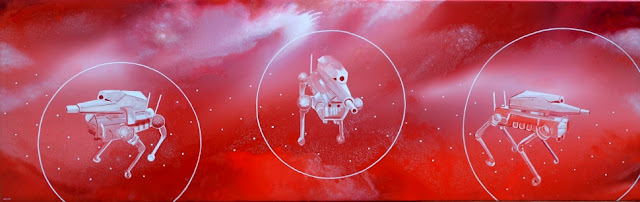
Dogs, Quadrupeds and Robots is a collection of recent paintings where I depict dogs, one a weaponised robotic quadruped. I refuse to call the quadruped robots, dogs! 

* Since writing this post, I have created another quadruped painting, this time called Lethal Litter

The last photograph is me with our family dog - an Australian kelpie. You will see she is the model for my real dog renditions.

ROBOT THAT 'WAGGED' ITS TAIL
I have 'met' a robot quadruped (Boston Dynamics). I met this robot quadruped at the Australian Army's Landforces Exposition this year, in Brisbane. The robot was 'wandering' around the expo, its remote controller nearby. It caused quite an excited stir, with people responding to it, as it wagged its tail, went up to them and moved with dog-like movements. 

I was both surprised and not surprised by people's reactions. I was not surprised because this quadruped could certainly mimic some doggy behaviour, and living dogs are lovely! Yet, this robot was clearly a robot - and here I was, witnessing multiple adults responding quite excitedly to a non-living robotic quadruped, almost as if it was a real dog. The experience left me feeling somewhat uneasy. 

When the robot quadruped encountered me, it approached, and its tail was wagged. I refused to respond, but it was hard not to wag back! Its wagging so reminded me of our kelpie's wagging tail movements! Because I just stood there and did not respond, it moved away. The remote operator, who I had located out of the corner of my eye, seemed a bit disappointed. A few seconds later the robot stumbled, tripping on something as it turned a corner. The remote controller turned it off. While robot quadrupeds are supposed to be great on rough and difficult terrain, they're not so good at expos - for now anyway.

GREAT ARTICLE
This great article "See Spot save lives: fear, humanitarianism, and war in the development of robot quadrupeds" was recently published by Dr. Geoff Ford and Dr. Jeremy Moses. The article goes into the history of Boston Dynamic’s robot 'Spot', plus tracks public responses to images, videos and news stories about 'Spot'. The article really opens up the dilemma of civilian - military robotic use. Robots [including drones] have many good purposes, but they can be militarised, as the recent case of the weaponised quadruped developed by Ghost Robotics shows. Ford and Moses mention this weaponised quadruped in their article too. 

Regular readers will know why I found Ford and Moses's article interesting - because the militarise-ability of civilian technology needs critical attention. It is not a simple matter of dual-use. 

Clearly there's more to say, but I will leave you to think about it...
Cheers,
Kathryn
P>S Update. Another quadruped post Verification Error: Identity Crisis


2. Walking the Dog in the Drone Age  Oil on linen 82 x 102 cm 2020

Walking the Dog in the Drone Age was inspired by an early Covid story of a person in lockdown in Malta using a drone to walk their dog.   


3. Strange Times Gouache on paper


4. Border Crossing Watercolour on paper 24 x 32 cm 2020

This painting was inspired by border restrictions imposed between Australian states during the ongoing COVID19 pandemic. 


5. Biped and Quadruped: Warfighters Oil on linen 60 x 110 cm 2021

The robot quadruped is weaponised...

6. Lethal Litter Oil on linen 36 x 112 cm 2021
 
Dark play on the word litter - rubbish or a litter of puppies!

7. Future Memory Oil on linen 122 x 137 cm 2021

Future Memory does not feature a dog. It does, however, relate to Walking the Dog in the Drone Age, above. In Future Memory a human is being walked by a drone. Maybe we human beings will be the future pets?

 
8. Me with our family dog - an Australian kelpie.

Thursday, January 18, 2018

CLOUDS - BEAUTIFUL ONE DAY: UNREAL THE NEXT

Fig 1. Beautiful One Day: Unreal the Next Oil on canvas 30 x 40 cm 2018


NEWS

I was thrilled to be asked to write a visual essay for Dialogue: Taking Politics Outside the Box, an e-journal located in the School of Political Science and International Relations, University of Queensland. Excited to say that New Landscapes in the Drone Age was published this week.

CLOUDS?

The new landscapes I refer to in my visual essay [mentioned above] are not just those of the land, but also the sky and space. In the drone age, in some places around the world, the sky is colonised by loitering drones -  nodes-in-the-sky, not eyes-in-the-sky - and the invisible signals they receive and transmit, to and from land and space-based assets. That airborne drones can, in many instances, quickly turn from surveillance to attack mode, makes the sky a militarised contestable place, a potential battle-space that extends from land, into the atmosphere and beyond. 


Fig 2. New Clouds Gouache on paper 56 x 76 cm 2017


Drone Swarms 

Recent developments in drone swarming technology* multiplies the impact of the scoping nature of drones. Technologists, roboticists, AI developers, and others associated with drone and autonomous systems research, study animals, such as birds and bees, to examine swarming and group behaviour. Nature provides insights, and researchers, using algorithmic processes, attempt to create systems that mimic nature's characteristics. Machine learning means that more advanced robots/systems can also learn as they interact with each other and 'experience' the world around them. Airborne drones are essentially flying robots, with increasingly autonomous systems embedded into their various functions.

I am interested in how landscape is mediated by drones and their invisible signals. I write about this in my visual essay New Landscape in the Drone Age. In this post, however, I focus on drone swarms, and the potential mediation of the skyscape.

The recently released short 7 minute film Slaughterbots presents a future where swarms of autonomous micro drones are used to control populations. Whilst fictional, it is stressed at the end of the film, that we already have the technology to create these deadly things - it is just a matter of time. Please read my visual essay A Droned Future response to Slaughterbots.  

So - to clouds.

Beautiful One Day: Unreal the Next [Fig 1] is a painting of clouds. Or is it? Positioned with some of my other recent paintings, the clouds may not be clouds at all! In New Clouds [Fig 2] and Swarm Clouds Brewing [Fig 3] you can see why. In these two paintings drone swarms attempt to mimic clouds. They camouflage themselves by mimicking nature, not only in swarm operation, but also in the subtleties of subterfuge and survival. 

But, you, the viewer, might be above the drone swarm-clouds, or you may be below them - maybe both places at once! Anything is possible in a quantum world. Your human vision, taking imaginational cosmic perspectives, turns the surveillance back onto the scoping camouflaged drones! Their subterfuge is revealed - exposed.

However, in New Clouds [Fig 2] one drone is targeted and attacked in a fiery blaze. This event leaves its mark on the skyscape. But, the significance of drone swarming technology is - if one drone is 'taken out', the others can re-calibrate and continue on their mission - whatever that may be. Therefore, taking one out seems futile...

False clouds?

So returning to Beautiful One Day, Unreal the Next [Fig 1]. The title of the painting plays with you...unreal could mean literally not real, or totally UNREAL-AMAZING-FANTASTIC-AWESOME! 

Maybe it means both? The game of disguise, camouflage, subterfuge working well...


[Fig 3] Swarm Clouds Brewing Oil on Canvas 36 x 45 cm 2017 


I am also interested in how clouds are used as a descriptive metaphor for THE CLOUD, which is not actually a singular entity, but rather, a series of mammoth data storage and processing systems - super computers. These systems built from physical hardware are, in fact, not housed in vapor, but in solid bricks and mortar behemoth buildings. 


But, that's another story, for another day!

Cheers,
Kathryn

* If you are keen to know more about drone swarming technology, just google it. There is a lot of information.


Saturday, March 25, 2017

SOMEWHERE

Somewhere Gouache on paper 56 x 76 cm 2017


Somewhere may be on Earth, but then again it may not. 

It could, however, be evidence of life on another planet, an exo-planet enticing human beings with promises for life after Earth - or - post-Earth as I like to call it. 

It could be a simulated landscape experienced via virtual reality. The lively colours a distraction from the erosion of our earthly home? Imagine sitting inside your driverless car, windows blackened so you can enjoy your virtual landscape of choice! Looking out the window, what a novelty!

Or, maybe it's a remnant of Earth flung into the universe upon the fiery demise of the sun and the solar system?

SCIENTISTS' EXCITEMENT
Over the last few days I have attended some fascinating events at the second World Science Festival held in Brisbane. I've heard some very excited scientists talking about the future of autonomous vehicles of all kinds, new ways of urban living, robotic companions for the very young and very old, 'fail-safe' artificially intelligent systems and more. The scientists' excitement is infectious. Their expertise and imaginations are to be admired - indeed many scientists seem more imaginative than artists! Somewhere could be a future landscape where the downward emanating rays are signals from benign interconnected systems designed to assist society in a variety of ways [protected from hijacking/hacking by malevolent forces, of course]. The trees may indicate a preserved/restored natural environment, the small crosses could be autonomous vehicle parking and recharging hubs, The upwardly trailing string of variously sized dots could be a holiday route to the Moon! Whether its our Moon or not, is unknown.

CONTESTED FORCES
And, here's another possibility, one where contested forces battle. Regular readers will guess that the trees are my representations of the tree-of-life. As they branch upwards, the downward emanating rays could be the scoping signals of obscured airborne surveillance drones, possibly armed? There are so many though! The small crosses may be target points or the cross-hair markings of unmanned sniper drones? Leaves and small dots cascade across the landscape. What do they 'know'? Are they seeding new life for a safer future - ready to regrow and send up new shoots when the time is right? Is the upwardly trailing constellation of coloured dots and circles a sign of escape or seepage - like blood loss? 

I 'see' Somewhere not as one landscape, but many. Each one presenting lots of questions. I also think there's something about it being quite beautiful. 


------------------------------------------------------------------------------------------


You might be interested in previous posts:

and


Cheers,
Kathryn

P.S. I also attended a robot programming workshop at the Queensland University of technology [QUT] that was part of the World Science Festival. My team of three programmed our robot to 'draw' a tree. I have a bit of an issue with describing what the robot did as 'draw', but I thoroughly enjoyed the workshop. I am working through some thoughts and will probably write about them at some stage.


Tuesday, April 28, 2015

WHERE THERE'S LIFE THERE'S...

Where There's Life There's... Oil on linen 92 x 102 cm 2015


In a recent post In Sight I wrote about an article Terminator Robots and AI Risk by Meia Chita-Tegmark. She is a PhD candidate at Boston University and a co-founder of the Future Of Life Institute, a research think- tank focused on mitigating existential risks, including those posed by human level artificial intelligence [AI].

Chita-Tegmark's article discussed how we humans 'embody' fears of artificial intelligence in the form of killer/terminator malevolent robots, often fantastically portrayed in science fiction movies. She suggests this is a misplaced fear, because the really frightening issue about AI is that it's mostly unseen...unseen code...strings of zeros and ones. She writes It's almost like we need to give our fears an embodied anchor or it's not scary anymore. But what is the price we pay for the sensation of fear that we need to nurture through embodied representations? I believe the price is blindness to the real danger. She goes on to say Evolution has not equipped us to deal with such ghostly entities that don't come in the form of steel skeletons with red shiny eyes, but in the form of menacing arrangements of zeros and ones.


So please read Chita-Tegmarks article  because....!!
it inspired my painting :

Where There's Life There's...

The painting is a landscape, but no 'normal' landscape. Why? Because it attempts to track the unseen code of life. Yep, that's it! Needless to say there are a few BIG questions. Is this code expressed by the tree, my much loved age-old transcultural/religious tree-of-life, with all its spiritual, visceral, cultural, religious, biological, vascular-like, symbolic contingencies and more? All those things that propel life and we take for granted.

Or, is there another kind of code? If you look closely [see detail images below] I have repeatedly painted LIFE in binary code, as if it is an extension of one of the tree's branches. Remnants of the branch appear intermittently along the binary code's trajectory, until they no longer appear...or maybe are not needed?

More questions:
Is the code of zeros and ones attempting to mimic life? Or, is it attempting to replace life with something completely alien? Is its intent to augment life or hijack it? Does it even have 'intent'? Even proposing 'intent' gives AI human-like qualities and this maybe dangerous too.

Chita-Tegmark's description of menacing arrangements of zeros and ones does not, upon initial sight, apply to the zeros and ones in my painting. My zeros and ones, I think, are quite beautiful and languid. They almost dance across the 'landscape' like a swarm of small butterflies. But, this is where the menace lies, don't you think? Mimicry is normally for seductive purposes and we humans certainly have been seduced by unseen zeros and ones...think of social media, data collection, online buying and selling and so much more. Zeros and ones re-purpose and control so much of our lives!


DETAIL Where There's Life There's...


Chita-Tegmark explains, in reference to unseen menacing arrangements of zeros and ones....

So, even if we do not feel the fear, we need to understand it.

I agree. And, suggest that art is a way of making 'visible' the unseen...not in a didactic or merely illustrative way, but in a suggestive, conversational and playful way, that provokes questions and wonderings.


   DETAIL Where There's Life There's...


Where There's Life There's...
The title of my painting plays on the old saying...Where there's life there's hope

BUT

MAYBE
The new 'old saying' is:

Where there's life there's code

Ok ...let's lighten it up a bit:

Where there's life there's joy - love - laughter - LIFE

I like to think the roots of my tree in Where There's Life There's... hold hopeful clues!


______________________________________________________________


You might like to also read:


NEWS

I went to the most marvellous stand-up comedy gig last week.


Happiness Through Science

I can honestly say this was one of the most passionate, intelligent, inspiring events I have been to in a long time. Robin was meant to perform for 90 mins, but he went way over time...and nobody minded.


MORETON BAY ART AWARD
Here's the painting that has been selected as a finalist for the Moreton Bay Art Award, packed up and ready to go. Actually the carrier has already been and it's on its way. The award is announced Friday 15 May.


Cheers,
Kathryn

Tuesday, March 24, 2015

IN SIGHT

In Sight Oil on linen 50 x 70 cm 2015
 
 
In Sight
 
Insight
  
...................................................................
 
Visible
 
 Capacity to gain an accurate and deep understanding of someone or something


Regular readers know of my keen interest in perspective. Now...that word perspective has a plethora of possibilities associated with it. It literally means observations of or with sight, of pupil and eye-ball kind. But, it can also carry metaphoric associations of insight, of mind's eye kind.
 
I recently read a fantastic Huffington Post article Terminator Robots and AI Risk by Meia Chita-Tegmark, who is a PhD candidate at Boston University and a founder of the Future of Life Institute, which I have mentioned in previous posts. Using arguments that humans embody their fears in order to somehow render them less fearful, she foreshadows even more fearful outcomes if we persist in embodying fear of artificial intelligence in the form of robots, killer robots etc. She explains that artificial intelligence is not moving bits and pieces, but the unseen aspects of code, information, data Chita-Tegmark writes My fear is instead that, like with any representation that reveals some things and hides others, what the terminator robot reveals is simply something about our mind and its biases, while hiding the real dangers that we are facing. Further on in the article she says, But what is the price we pay for the sensation of fear that we need to nurture through embodied representations? I believe the price is blindness to the real danger.

Chita-Tegmark's article is a perfect example of insight founded in deep understanding and intelligent reflection. I would also say it is an example of someone with clear sight of where blindness may occur. With her knowledge and experience she has shifted perspective and provided humanity with an important warning, an invitation to also shift perspective. But, will we?

I suggest to change perspectives we need disruptive insights into human nature, such as those expressed by Chita-Tegmark. Makes me think of a word that sounds the same as insight...incite.
Please read her article and visit the Future of Life Institute website.

In Sight Oil on linen 50 x 70 cm
This painting plays with lots of my favourite things...perspective, ambiguity, landscape, cosmic clues. The only element missing is my much loved age-old transcultural/religious tree-of-life! Wait till you see the painting I am currently working on though!

The landscape in In Sight is familiar, yet the colourful round balls cast a sense of the unfamiliar. They provide a cosmic clue that this landscape may not be Earth...but then again it might be? By questioning the landscape's locale it immediately untethers it from Earth-bound horizons, forcing a shift in perspective.

As I have written previously, I believe that in the 21st century cosmological age we need to re-think what 'landscape' is, what it means to us and how we represent it. If we can take 'landscape' into our universal/multiversal environment, the possibility of revealing new perspective of us, our planet and the universe/multiverse are possible. In shifting our perspective of landscape, we shift ourselves...well...we are part of the landscape, operating in its domain in a variety of ways! Imagine if we do not develop our sight and insight beyond Earth's familiar terrain...maybe it could become the domain of what Chita-Tegmark describes as menacing arrangements of zeros and ones. We could be left behind!

We may have already been...left...behind...?

In the painting, direct attention is drawn to the two balls with gun-like sights targeting them. Being caught in cross-hairs, literally and figuratively, is not a pleasant feeling. Yet, these sights need not be malevolent. They could be representative of telescopes trained on potential new planetary homes...but for whom? They could be camera lenses seeking out definition, a record of hope? And, yes they could also be malevolent!

Let's shift perspective...

I deliberately placed the two gun-like sights as if they were 'eyes' looking back at the viewer/s. But, are they human 'eyes' or maybe they are symbolic of Chita-Tegmark's menacing arrangements of zeros and ones, or maybe they are indicators of extra terrestrial intelligence...aliens! The sense of being 'watched' and recorded is pervasive in the 21st century. Think of the debates about our online behaviour, the data it generates and how and why it might be retained...and by whom or what?


In Sight Oil on linen 50 x 70 cm 2015 DETAIL
 

Yet, have I fallen into the trap Chita-Tegmark warns us about? Is my claim that the gun-like scopes are like 'eyes' just another embodiment of fear? Well, it might be...but I suggest that deliberate ambiguity, the plethora of things these 'eyes' could be and the play with shifting perspectives means I have not been caught in the trap. I'd like to think my 'play' may even expose possible cures for blindness. Maybe that's one of the most exciting things art can do? Maybe art has a capacity to incite change in unexpected ways?


Some related posts:
In Between Things: Interstellar Even
The Horizon Has Disappeared
Shared Landscape...In The Multiverse
The Value Of Landscape


NEWS
 
UK NEWS
For those of you who have not seen the news about one of my paintings being chosen for the front cover of The Independent [UK] newspaper's International Women's Day feature please check out my post Round Objects and UK News


NEXT EXHIBITION
My next exhibition will be 21 July - 2 August in Brisbane, Queensland, Australia.
I am playing with a few titles for the show...one is:

...AND ARTIFICIAL INTELLIGENCE AND...

It suggests that artificial intelligence is in a list.
For me it's...
a list of
EXISTENTIAL RISKS

On that 'Cheery' note!
Cheers

Kathryn
www.kathrynbrimblecombe-fox.com