Showing posts with label painting. Show all posts

Sunday, April 12, 2026

ROT


ROT, Gouache on paper, 56 x 76cm, 2025

I was thinking about so many issues when I painted ROT. I had just been to a panel discussion at Brisbane's Institute of Modern Art (IMA), Brain Rot in the Gallery. At the time, the IMA was screening episodes from the violent Skibidi Toilet animated Youtube series. The panel discussed the issue of brain rot in conjunction with responses to the series. Sadly the discussion did not ask why the IMA was showing the series, without further contextual elements (their screening room had no other curated challenges, contexts). Or, why a series started in 2023 had made it into a gallery space only a mere two years later. There were so many more questions, but that's for another time. 

The issue of brain rot, said to be caused or triggered by consistently consuming online content, now dominated by AI extruded content, had been of interest to me for some time. It connects with my interests in disinformation, misinformation, cognitive warfare, bot-produced content and responses, speed of content production and dissemination. Regular readers will understand my interest in speed. In our hyperconnected world (from earth-to-satellites), speed of dissemination is enable by lightspeed (or near) signal connectivity. Delivery of 'rot' to our devices is, therefore, beyond-human in both speed and scale of dissemination. I am interested in 'rot's' connection with new modes warfare - hybrid, grey-zone, information, cognitive warfare - perpetrated by drawing signal-enabled digital and cyber civilian devices and systems into militarised spaces and activities. 

ROT

In ROT, what appears to be a human brain is occupied by computer-like circuitry. This visually plays with the idea that the brain is a computer - an idea that stems from 1940's early AI research and the coining of terms such as neural network. The brain-as-computer idea has mediated and hijacked how many people think about human thinking, creativity, emotions and more. 

Radiating lines that extend from the 'brain' indicate signal connectivity, and therefore, interoperability with other nodes. Strings of binary code 'instructing' the word ROT also indicate signals and connectivity, and the dispersal of ROT as a contagion through a system. The painted signals appear to extend beyond the painting. This infers that in our hyperconnected world ROT is not contained and can reach anywhere. 

As a viewer, are you above, below, or in front of the image? No matter what your perspective, the blood-red background is meant to be unnerving. A human being bleeds, but machines, devices, algorithms, and signals do not. The red is not an oil slick. 

The unsolicited AI ALT Text that appeared when I loaded this image into a recent PowerPoint presentation encapsulates the insidiousness of AI rotting processes. The AI's banal description elides nuance, and therefore meaning.

Alt Text: A red and white watercolor painting:                             
AI-generated content may be incorrect 

I will leave it there for you to ponder more.

Kathryn


Sunday, October 12, 2025

PROMPT-SCAPE

 Prompt-Scape Gouache on paper 28 x 32cm 2025

This image of Prompt-Scape (above) is a photographic documentation of a real painting, not an AI generated image erroneously called a 'painting.' Prompt-Scape visually reveals the plunder that a prompt to generate an image or text triggers. I use the word trigger deliberately! Is a prompt like a trigger, setting into motion algorithmic processes that target data to detect the statistical correlations most likely to produce what has been prompted/triggered?

I'll let you all have some fun thinking about this painting. I don't think I need to write much more about it! I will, however, leave two provocations.

1. Can the concept of surrender help us think about life in the age of AI? My article Surrendering to 'Too Powerful' technologies: From the F-111 to the MQ-28 Ghost Bat Drone' in Media, War, and Conflict journal.

2. In September I gave a seminar War in Our Hyperconnected World: Exposing the Invisible Battlespacefor colleagues in the School of Communication and Arts, and the University of Queensland, Australia. Below is one of my slides from the talk. Like Prompt-Scape it channels ideas of targeting in the Earth-to-satellite environment. The painting in the slide is Theatre of War: Techno-Seduction (2022). 

Here's a quote about Theatre of War: Techno-Seduction from my PhD thesis Drones, Signals, and the Techno-Colonisation of Landscape (2023). 

"The painted zeros and ones disembody the organic and strip the non-organic by visually reducing them to the same instructional code. This visual reduction to equivalence exposes insidious relationships, questions forces of techno-homogenisation, and raises issues of aesthetic homogenisation in an age of increasing generative AI."

Cheers,

Kathryn


Thursday, August 28, 2025

MAGIC INTELLIGENCE IN THE CLOUD? NO!

Fig 1. Magic Intelligence in The Cloud: Tech Bros Fantasy Oil on linen 112 x 97 cm2025


THE LURE OF MAGIC
The four paintings in this post were inspired by a fantastical comment made by OpenAI CEO Sam Altman in a conversation with Jony Ive, from io Products. The conversation was a prelude to a merger of OpenAI with io Products. If you watch the videoed conversation (Youtube), at around 3.50 minutes Sam Altman says, 

'We have like magic intelligence in The Cloud'. 

'Magic intelligence' is a euphemism for artificial intelligence (AI), also a problematic term. The term 'artificial intelligence' was first used in 1956 when Professor John McCarthy, Dartmouth College (USA), organised a workshop to discuss so-called thinking machines. 

From  - thinking, to artificial, to magic! AI to MI!

SALAMI
Professor of computational linguistics Emily Bender is a vocal critic of generativeAI technology, as well as the blanketing term 'artificial intelligence'. She often refers to an alternative description coined by Stefano Quintarelli  'Systematic Approaches to Learning Algorithms and Machine Inferences  - SALAMI'. As bender points out, asking questions such as 'Is this SALAMI intelligent?' and 'Will SALAMI have emotions?' very quickly exposes the weakness in assumptions (magical thinking) that AI will ultimately have emotions, be sentient, require human/robot/AI rights, be creative, and more  

SO-CALLED: THE CLOUD
AND, 'The Cloud' is also a euphemism - for interconnected computer systems, the Internet, and the massive material infrastructure that supports our increasingly hyperconnected and data producing-consuming world. 'The Cloud' is not a wet, vapourous 'magical' place. It is a web of cables, signals, earth-satellite assets, data centres, computers and more. This infrastructure requires energy, water, and in many instances cheap human labour. These demands have worsened since the accelerated availability of generativeAI tools in the last 2-3 years. Kate Crawford, Karen Hao, Emily Bender and Alex Hanna, are a few contemporary commentators publishing research on the increasing resource and human cost of 'The Cloud'. 

Tung Hui Hu in his fascinating 2015 book A Prehistory of The Cloud  offers salient insights into the so-called 'Cloud'. For example, he notes, 'To use the cloud is to willingly put on an electronic collar; it is to fuse our hunt for data with our identities.' He reminds us that in this type of world, 'we are both the targets of others and targeters ourselves'. And, artist and author James Bridle in his 2018 book The New Dark Age: Technology and the End of the Future notes, 'Today the cloud is the central metaphor of the internet: a global system of great power and energy that nevertheless retains the aura of something noumenal and numinous, something almost impossible to grasp.' Seven yeas after Bridle made his comment, Altman grasps onto the 'something noumenal and numinous' when he attempts to conjure magical intelligence in 'The Cloud' as a lure, a promise, as aspirational... 

HYPE - MAGIC
When the hype around tech products/systems reaches a level where magic is invoked, where religiosity, and even alchemic thinking are inferred, we need to pay attention. From trusted, to trustworthy, to responsible, to safe, to agentic AI - to magic. The language of hype is expressed in words that shift as the hype surrounding the technology meets with failure, criticism, and questions. Words might give comfort - until they don't. 

My last post The Words We use: ENCODED delves into the question of language. 


Fig 2. Magic Intelligence in The Cloud Gouache on paper 76  x 56 cm 2025

The four paintings exhibited here were inspired by Altman's 'magic' statement. Like many of my paintings, I have combined painted binary code, 'clouds', militarised technology, and lines indicating signal hyperconnectivity. These are all placed in ambiguous scapes, where the viewer's perspective can wonder in imagination. 

Magic Intelligence in The Cloud (Fig 2) was the first painting I created after hearing Altman's 'magic' statement. The figure acts like a 'signal' linking the various 'clouds'. The militarise-ability of civilian technology in a hyperconnected world, as regular readers know, is a major concern of mine and a focus of my research. In this kind of world, magical thinking is very dangerous. 

Magic Intelligence in The Cloud: Tech Bros Fantasy (Fig 1) is an oil painting, clearly echoing my first work on paper, Magic Intelligence in The Cloud


Fig 3. Magic Intelligence: Exposed Gouache on paper 56  x 76 cm 2025

In Magic Intelligence: Exposed (Fig 3) the 'magic intelligence' is painted as strings of binary code, a 'label' or 'tag' on the dark cloud. Inside this dark cloud, a data centre structure extends into a seemingly unfathomable distance. The figures act as 'signals' linking 'The Cloud' to sources of data; each figure a conduit due to devices we use and carry. In our hyperconnected world, the human being becomes a node  -  this has nothing to do with magic.  
 
Fig 4. Magic Cloud: Mapped Gouache on paper 76  x 56 cm 2025


Cheers,
Kathryn

Monday, May 19, 2025

THE WORDS WE USE: ENCODED?

The Words We Use: Encoded?, Gouache on paper, 56 x 76 cm, 2025


As tech companies and their PR departments work to market AI products and tools, various words are used to describe AI attributes. Many of these words are aspirational, but seemingly reassuring. If you have been reading about AI for some time, the words used to assure us human beings have ranged across multiple descriptions, for example, 'trusted AI', then 'trustworthy AI', 'safe AI', 'ethical AI', and most recently, 'agentic AI'. 

In my text-based painting, The Words We Use: Encoded?, I have painted binary code that 'instructs' words TRUSTED, TRUSTWORTHY, SAFE, AGENTIC, and ETHICAL, followed by AI. The code, and the painting's legend on the bottom left, are painted against a blue and cloudy sky-like background. Circles interlock as indicators of another kind of cloud, the techno-cloud. This fake cloud forms another skyscape, one comprised of signals, normally invisible, but pivotal for contemporary interconnectivity, and lightspeed transmission of data, instructions, and communications. A few of the circles disclose lightspeed with the scientific symbol for speed-of-light - c - painted repeatedly around their rims. The white code channels the appearance of fake angels.

By painting words as code - TRUSTED, TRUSTWORTHY, SAFE, AGENTIC, and ETHICAL - they are visualised (revealed) as simply variations of the same thing - code - rearrangements of zeros and ones. As visualised code in a list, the loss of nuance that exists between the meanings and feelings we human beings might attach to each word is clearly lost. While there are multiple forms of code used to configure algorithms, in this painting I am questioning whether human qualities of trust and agency, for example, can be encoded into AI, without them being algorithmic pastiche, merely applications rather than embedded (I won't say embodied, as that is another anthropomorphising word!) 

This comment has stuck with me:
In Passwords (2003), French cultural theorist, Jean Baudrillard, describes a digitally coded destiny where it will be “possible to measure everything by the same extremely reductive yardstick: the binary, the alternation between 0 and 1”. (*) 

In, The Words We Use: Encoded?, my list of painted code visualises the 'reductive yardstick'.

More to say, but I will leave it here for you.

Cheers,
Kathryn
PS. I have many text-based paintings where I paint binary code, as a proxy for a depiction of reality. 
* Jean Baudrillard, Passwords, Trans. Chris Turner (London and NY: Verso, 2003), 76. 


Tuesday, April 22, 2025

SURRENDERING

(1) Surrendering to False Stars Gouache on paper 76 x 56 cm 2025


I've been thinking about literal and metaphoric surrender for some time. My article (open access), "Surrendering to 'Too Powerful' Technologies: From the F-111 to the MQ-28 Ghost Bat Drone", in Media, War and Conflict journal is an example of some of my thoughts. Here is the article's abstract :

Against a background of contemporary hyperconnected warfare and accelerating advances in drone/robotic systems, this article discusses the airborne drone in relation to concepts of surrender, both historic and contemporary, literal and metaphoric. Drawing upon Paul Virilio’s (2002[1991]) observation that, during the first Gulf War, ‘technologies employed are too powerful’, the author examines how continuing military aspirations for technological speed and lethality represent surrender to the lure of techno-power. Two incidents of human beings surrendering to drones, in Kuwait in 1991 and in Ukraine in 2023, anchor an exploration of literal and metaphoric surrender implications. This discussion is expanded through a military aviation history lens and an art historical perspective. The latter includes close visual and contextual analyses of James Rosenquist’s 1964–1965 painting F-111 and the author’s multi-piece 2022–2023 painting Ghost Bat.


PAINTINGS 

Surrendering to False Stars (fig. 1) hints at a ghost-like figure, arms outstretch to the sky. We can 'see' in our mind's eye (imagination) that the figure's face is upturned, gazing into the expanse of false stars. Are these 'stars' airborne drones, targets, memorials, signs of aesthetic homogenisation as the world is standardised for technological operations conducted at beyond-human speed ...? 

The upwards gaze is a reference to the gaze of soldiers surrendering to airborne drones and the gaze of people enthralled (or not) by sky-based drone light shows. These drone shows are designed for ground-based viewing. If you were above a drone light show, the choreography is not likely to be coherent or understandable. Unlike fireworks, in a drone light show colour and light are pre-scripted for entertainment designed to be viewed from below. Is this kind of entertainment a sign of normalisation processes that indicate our unwitting, coerced, or deliberate 'surrender' to technology? I have painted crosses over the figure's body - a visual suggestion that technology has infiltrated. Do we become our own prisons? Obviously more can be said about Surrendering to False Stars, but I will leave that to you think about.

Surrendering in All Directions (fig. 2) conveys how our use of technology divests us of our data. As we use our devices, and move about the world of hyperconnected systems and devices, our data is transmitted - who knows where... It's a kind of surrender, don't you think?


(2) Surrendering in All Directions Gouache on paper 76 x 56 cm 2025


Cheers, Kathryn

P.S. My last post was about my exhibition DRONE: Ghosts and Shadows, a curated survey show of the last decade of my practice and research. Please check it out. 

Saturday, May 18, 2024

OUR COSMOLOGICAL HISTORY

Our Cosmological History Gouache on paper 56 x76 cm unframed 2024


I have not posted for some time! But, there's news! A painting in an exhibition, and a published commentary piece in Digital War Journal. As the commentary piece, "Light-speed, Contemporary War, and Australia's National Defence Strategic Review", is open access, I invite you to read it at this linkhttps://doi.org/10.1057/s42984-024-00091-2 
I was thrilled when the editors encouraged me to include two of my paintings. 

THE EXHIBITION
Our Cosmological History (above) is a new painting. It is currently in an exhibition Duality - an artistic exploration of quantum science, in Sydney at Flow Studios, Camperdown, until May 20, 2024. The exhibition is hosted by The Australian Research Council Centre of Excellence for Engineered Quantum Systems (EQUS)

The exhibition includes the finalists and winners of the EQUS 'Quantum Art Competition', plus other selected artworks from entries. Very happy to say, Our Cosmological History is in the selected group. The finalist works and the extra selected works look like a high quality, engaging group of artworks, all responding to EQUS's invitation to "artists to explore quantum science through their medium of choice, drawing inspiration from the competition theme, ‘duality’".

More information about the competition and the exhibition, plus talks and workshops, is available at the EQUS exhibition webpage.

This is the artist's statement I sent when I entered the competition.

‘Our Cosmological History’ is a painting that tries to envisage the universal history of the electromagnetic spectrum (EMS), and humankind’s increasing reliance upon EMS frequencies for accelerating civilian and military technological needs. The red firecracker-like markings represent the Big Bang, and the ‘birth’ of photons within ten seconds. The dotted wavy lines represent the dual particle-wave nature of photons. I have painted seven wavy lines, from longer waves to shorter waves, to indicate EMS frequencies from radio to gamma waves, all travelling at lightspeed. This visualisation of normally invisible EMS frequencies (except the light spectrum) is augmented by painted symbols for photons (y) and lightspeed (c). A swathe of stars provides a background for a universal cosmic-scape that reveals macro and micro forces. The stars and the painted EMS frequencies appear to continue beyond the painting’s edges. This is my way of visualising that the universe and the EMS are around us, and continue beyond us, including into future history. 

Humankind’s sphere of influence, from Earth to orbiting satellites, is apparent. The pale blue dot (after Sagan) is a focal point. The sphere around the dot-Earth represents the commons where humankind harnesses the lightspeed forces of the EMS to enable connectivity, interconnectivity, operability, and interoperability of a bourgeoning array of civilian and military
technological systems and devices. ‘Our Cosmological History’, painted for EQUS, expresses awe at the wonders of the universe. At the same time, it questions how we harness powerful natural resources in an increasingly connected and volatile world.

Cheers, Kathryn


Tuesday, February 28, 2023

GHOST SHADOWS


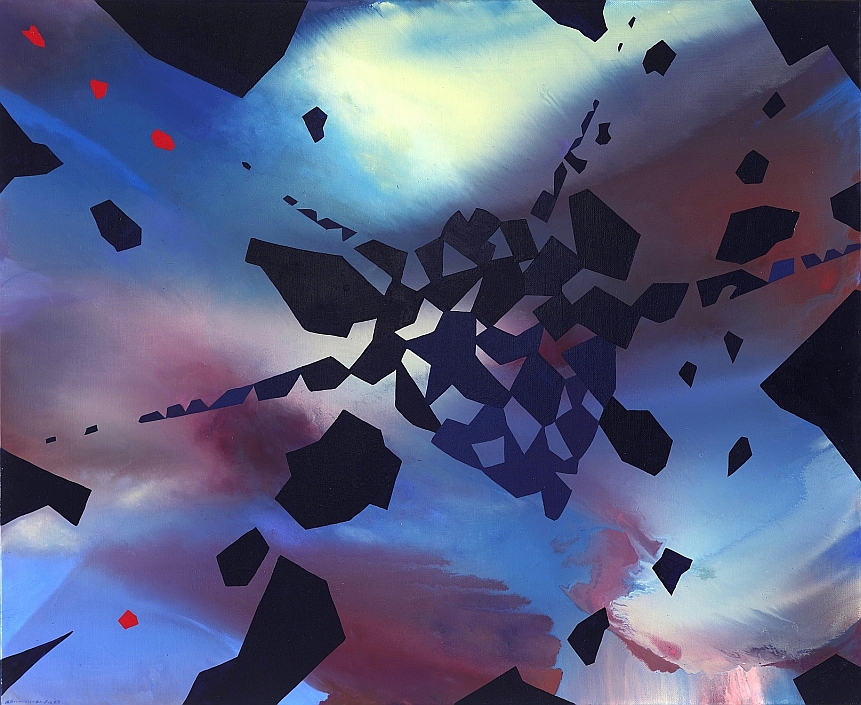
Ghost Shadows Oil on linen 92 x 112 cm 2023


Ghost Shadows is a new painting, inspired by thinking about the Royal Australian Air Force and Boeing collaboration to develop the MQ-28 Ghost Bat drone, previously called the Loyal Wingman drone. I have a number of earlier paintings that also reference the Loyal Wingman/Ghost Bat drone. You can see them in my 2021 online exhibition Wingman (MQ-28 Ghost Bat) Online Exhibition

Ghost Bat
With this new painting I was thinking about the name Ghost Bat, the name of a real Australian bat, applied to a drone. So, that got me thinking about ghosts, bats and shadows, stealth and invisible aspects of contemporary war. I was also thinking about landscape, geographical, technological, military, and other-worldly. As regular readers know I am currently undertaking my creative practice-lead PhD with an examination of increasing military interest in the electromagnetic spectrum. 

I 'see' the technological landscape as mostly an invisible one, a stealthy signalic techno-colonised landscape from Earth to orbiting satellites. My aim, in my work, is to make the invisible 'landscape' visible! Yes, hardware and devices mark and move through our physical environments, but enabling signals are transmitted wirelessly or via discrete cables [eg: undersea internet cables]. I am mostly interested in wireless signaling/transmissions that enable light-speed or near light-speed connectivity, interconnectivity, operability and interoperability of civilian and military systems and devices. 

Shadow or Shadows 
Initially I was going to call the painting Ghost Shadow, but then I decided to make the shadow plural - thus, Ghost Shadows. The plural draws in multiple aspects of drone and robotic technologies - especially the fact that they are nodes in a system. Thinking imaginatively, what kinds of shadows does the militarised techno-system cast? Could the system be a multi-faceted shadow that we don't see - except in my painting? Maybe we should go looking for shadows! If we thought of ourselves as bats, let's lurk in the night, in the dark, using imagination to see things beyond sight. 

Fragmented Force
In  Ghost Shadows a Ghost Bat drone is identified as a fragmented force, a strange craft flying through the sky. This fragmentation 'speaks' to the drone's many capabilities, those disclosed by the developers, and those that have not been disclosed. The fragmentation evident in the whole painting alludes to pixels and the techno-reliance on imaging capabilities for operation, orientation, ISR, and targeting. Yet another interpretation could be that bits of the Ghost Bat drone have been flung into the sky. Has it spawned more bats? Or, has the drone been compromised? The dark large and small fragments might be shadow-indications of more drones or piloted aircraft - after all the Ghost Bat drone has been designed to accompany fighter jets. Thus, is this a scene of a mid-air battle between autonomously flown drones and piloted craft - debris scattered. But, is the debris material, or in an age of accelerating technological development, is it the debris of hopes and dreams?

Lots more to say - but I will leave the painting with you now! What do you think of the red fragments!?
Cheers,
Kathryn


Friday, December 23, 2022

WHERE'S THE BEATING HEART?


Where's the Beating Heart? Oil on linen 112 x 92 cm 2022
Photo: Rob Frith


This new painting relates to my last painting On The Edge of Being 

Human-Machine
In both paintings I visually question the human-machine relationship, including increasing developments and expectations of these relationships. Using a visual ambigramatic [after Douglas Hofstadter] ploy in both paintings, I have painted tree-like patterns as if they are about to merge, or maybe even repel each other. It's your choice to decide! An ambigram can be read, with multiple meanings, in both an upside and downside orientation. But, they can also be read as the same....

The tree-like patterns are those of a natural tree or branching system [roots, vascular, leaves, lines on our palms etc], plus tree-like patterns uses in computer science ie: tree logic, neural networks, chip boards etc. In Where's the Beating Heart? the upper oval represents natural life and systems, and the lower oval represents coded systems and their correlative hardware. Like an ambigram, the painting could be turned the other way - maybe orientation depends on aesthetics, but also beliefs about humanity, technology and the future?

Patterns
I am not a computer scientist, nor am I an arborist, but as an artist I like to look for patterns, and I like to present what I see as provocations to prod questions. Regular readers will know that I have a keen interest in technology, undertaking technical research to inform my work. These readers will also know that my current PhD research examines increasing military interest in the electromagnetic spectrum [EMS - radio, microwave etc frequencies]. Without consistent uncongested or uncontested access to signal-transmitting frequencies in the EMS, much of our contemporary technology would flounder.  

Theatre of War
Both On the Edge of Being and Where's the Beating Heart? have been inspired by my research, particularly my interest in the idea of 'theatre of war', a phrase often used by 19the century General Carl von Clausewitz in his famous tome On War. Clearly the contemporary  'theatre of war' is different to the 19th century idea of 'theatre of war', but if war is seen as a performance, I do think performativity is still a component of war. We now have 'roles' played by technological systems and hardware that are militarised and militarise-able. Militarise-ability of civilian systems/hardware is a key interest of mine ie: connectivity, interconnectivity and interoperability of systems/hardware, are enabled by signals transmitted via EMS frequencies. New modes of war, such as cyber, information, hybrid, and network-centric warfare draw civilian systems into the 'theatre'. One example is the use of social media for information warfare - there are many other examples.

Heart
Where's the Beating Heart? poses questions about human being-ness and technological utility. As autonomous components are embedded into systems, human speed is bypassed. I ask, isn't human speed, the pace at which we work and think, part of our being-ness? This is just one of many questions I ask myself, and embed in my work. The tree-logic pattern 'pulses' with a predominantly red centre of painted conduits. Is this a fake heart? 

There's more to say, but I will leave that to you! 

Cheers, 
Kathryn
 

Sunday, October 30, 2022

MAKING CODE VISIBLE: ONLINE EXHIBITION

 1. Unseen Oil on linen 90 x 80 cm 2015


2015-2022

This online exhibition of selected paintings starts with  Unseen (above), painted in 2015. Unseen is one of my first paintings where I depict binary code as part of an overall image. In this case a colourful string of zeros and ones repeatedly instructs the word LIFE. This string of visualised code extends from a branch of the tree, depicted with a colourful array of roots. The tree could be a tree-of-life, offering another kind of 'code'. Like many of my paintings a cosmic-like background helps to create a sense of flight.

Unseen was the source of inspiration for a collaboration with Brisbane-based internationally known jeweler Margot McKinney. The small series includes a fabulous necklace that follows the graphic lines of the tree, and zeros and ones. Square cut and round gems 'form' the binary code. A series of gorgeous earrings were inspired by the spiral of binary code in Picturing the Posthuman (painting number 16). I like the fact that code has been extracted and aestheticised in my paintings and in jewels made from natural geologically formed gemstones.     


LIFE and War
The next 19 paintings start with examples of recent works, ending with other earlier paintings. You will notice that as I experiment with visalising and eastheticising normally invisible code, its relationship with militarised technology and militiarise-able civilian technology becomes more politically charged. In a world where notions of warfare now include information, cyber, hybrid, grey-zone, and network-centric warfare, the key role played by code and algorithms demands attention. 

Various kinds of violence now insidiously play out in networks, enabled by light-speed transmission and reception of signals carried by radio and microwave frequencies in the electromagnetic spectrum. Signals are tentacular enablers and deliverers of codified data and instructions. 

Text Prompted AI Generated Images
This online exhibition also responds to recent hype surrounding text prompted AI image generation, using datasets of human artists' images scraped from the Internet. I offer my paintings of visualised code as a disruption and resistance to algorithmically generated image making. Painting is not reliant on digital or cyber technology, thus it has a capacity for independent critique, without feeding data back into the system. Interestingly I have discovered that one of my painting, in this online exhibition, has been scraped and used in a dataset - painting number 19 Coded Landscape. The binary code, 'instructing' the word LIFE, forms a landscape-like contour. It's kind of ironic that this painting was scraped. I add here, that the image scraped was a digital image of the painting, not digital artwork. 

A few issues relating to text prompted AI generated images [not I do not call it AI Art!] include:
  1. That work created by human artists has been scraped with intent to build datasets, without consent from original artists. 
  2. Currently, text prompted AI generated images appear very similar, exhibiting a banality that flags a creeping homogenisation of aesthetics. This is a quiet kind of violence. I am reminded of a statement made by Jean Baudrillard in Passwords (2003), where he describes a digitally coded destiny where it will be “possible to measure everything by the same extremely reductive yardstick: the binary, the alternation between 0 and 1”.
  3. While AI generated images might be considered cultural activity, production or performance, it does not mean that all AI generated/assisted images are art. 

* Please click on the hyperlinked titles to take you to the relevant posts on this BLOG. 


2. Theatre of War: Techno-Seduction Gouache on paper 56 x 76 cm 2022


In Theatre of War: Techno-Seduction visualised code is used to used to expose connections between various elements of network-centric warfare - from satellites, to drones, to military AI legal tools, to human targets. 


3.  Interface: Being HUMAN Being   Oil on linen 56 x 112 cm 2022


4. Interface Gouache o paper 56 x 76 cm 2022 


5. Competition Continuum: War  Gouache on paper 56 x 76 cm 2021

6. ME: 01001101 01000101 Oil on linen 92 x 112 cm 2021 

ME: 01001101 01000101 is a self-portrait that poses questions about portraiture in the age of facial recognition. It also raises questions about identity and verification of identity. Louise Amoore’s concerns about “how algorithms are implicated in new regimes of verification, new forms of identifying a wrong or of truth telling in the world” 'speaks' to the role played by AI in image and identity verification. Could we, weirdly and dangerously, come to a time where verification of identity is only confirmed by a digital tick?

Louise AmooreCloud Ethics: Algorithms and the Attributes of Ourselves and Others, 5-6.


7. GOD? Oil on linen 41 x 51 cm 2019 

8. HUMAN Oil on linen 31 x 36 cm 2019 


9. Drones and Code: Future Now Oil on linen 40 x 56 cm 2018


10. Manhunting Gouache on paper 56 x 76 cm 2017


11. Fake Tree Oil on linen 25 x 35 cm 2017


12. Data Heaven Oil on linen 100 x 120 cm 2017 

Code 'instructs' the word DATA in the storage centre of the fake cloud. Predominantly painted in night vision green the painting 'speaks' to surveillance and digital data storage - even after mortal death.


13. Combat Proven, Long-Range, Long-Dwell Gouache and watercolour on paper 56 x 76.5 cm 2016


14. I Am A Posthuman Gouache and watercolour on paper 42 x 30 cm 2016

01001001 00100000 01100001 01101101 00100000 01100001 00100000 01110000 01101111 01110011 01110100 01101000 01110101 01101101 01100001 01101110 00101110
The code above appears in my new painting I Am A Posthuman. It actually 'forms', or maybe 'performs', or otherwise 'instructs' a structural element to the 'figure'. You can guess the translation for sure!


15. A Human's House and A Posthuman's House Gouache on paper 30 x 42 cm 12016


16. Two Humans Gouache on paper 30 x 42 cm 2015


17. I am Am I? Gouache and watercolour on paper 30 x 42 cm 2015


18. Picturing the Posthuman Gouache and watercolour on paper 30 x 42 cm 2015


19. Coded Landscape Gouache on paper 15 x 21 cm 2015


20. Where There's Life There's... Oil on linen 92 x 102 cm 2015

Where there's life, there's hope or code?


Cheers,

Kathryn


Thursday, October 20, 2022

THEATRE OF WAR: SENSORATION

Theatre of War: Sensoration Oil on linen 122 x 153 cm 2022


Sensorium?
This new painting Theatre of War: Sensoration was inspired by thinking about arrays of sensors eg: for surveillance, detection, tracking, data sorting, airport security etc. I am particularly interested why arrays of sensors are often called sensoriums, or considered part of the general natural world sensorium of senses and sensing. I have an issue with this! While the word sensorium does contain the word sensor, sensorium is normally applied to the human or natural world sensorium, where different senses, from sight, to hearing, touch, hindsight, emotion, feeling, even sixth sense, are experienced. So, to apply sensorium to arrays of technological sensors implies an attribution of a range of senses that sensors do not have. 

To avoid anthropomorphising technology we must pay closer attention to the language used to describe capabilities. My suggestion for the sensorium conundrum is to turn the noun sensor into a verb. Thus, the scoping and detection activities of sensors are acts of sensoring, not sensing. And, thus an array of sensors could be called a sensoration (like association, or delegation). 

PhD
I add here that my thoughts are part of a broader PhD creative practice-led research project (Curtin University, Western Australia) examining increasing military interest in the electromagnetic spectrum, as an enabler of technology, a type of fires (weapon), a manoeuvre space (tactics) and a domain (strategy). 

Registering
I do realise that human beings share the world with an ever increasing array of technological sensors, and therefore there is a relationship, whether clear or not to human beings. I add here that I doubt that sensors 'know' there is a relationship! Eyal Weizman (Founder of Forensic Architecture) and Matthew Fuller  write about the sensor-sensing-human relational characteristic of contemporary life in their very thought provoking book Investigative Aesthetics: Conflicts and Commons in the Politics of Truth (2021). While using the word sensorium to encompass the sensor-human relationship, they do not scrutinise its anthropomorphising attributes. 

Weizman and Fuller do, however, mention the act of registering - of registration. The idea of registering/registration provided a way for me to think through the conundrum of using the word sensorium to encompass sensors and human/natural world sensing. I propose that both sensors and human beings register, and that this is the relational link between the sensor sensoration and the human sensorium. A sensor will register the presence of a human being and relay or store data relating to the human being's actions, condition etc. A human being may register the presence of sensors and mediate behaviour, or possibly not care. But, a human being's act of registering a sensor, or anything else for that matter, can entail an emotional reaction - even not caring is an emotional reaction. Whereas, a sensor is incapable of caring or not caring - full stop. 

Theatre of War: Sensoration
Using the symbol for light-speed ie: c, and the symbol for photon ie: y, I have painted two outer circles. Each symbol in each circle is connected by a wavy line. These lines indicate wavelengths in the electromagnetic spectrum. This implies sensor signal connectivity and interconnectivity. An inner circle of cross-hairs coveys the idea of surveillance and monitoring, and the central cross-hair conveys the idea of targeting. This targeting could be by advertisers, information warfare bots, surveillance cameras, a drone's imaging technology or even the scoping lens of a weapon. 

Without depicting actual sensors Theatre of War: Sensoration visually critiques the idea that an array of sensors, or an environment of sensors, is a sensorium. I chose to use red and white to suggest that the sensoration - not sensorium - is a shared military and civilian space. The reliance on speed of light signal connectivity to relay data and instructions, in an network-centric world renders the civilian world of sensors ie sensoration militarise-able. 

I invite you to 'fly', in imagination, above, behind and around the sensoration. The cosmic background scape creates a distance into which you can soar. What do you see?

Cheers,
Kathryn