Showing posts with label cosmic landscape. Show all posts

Wednesday, December 22, 2021

THEATRE OF WAR: DROMO-DOMAIN

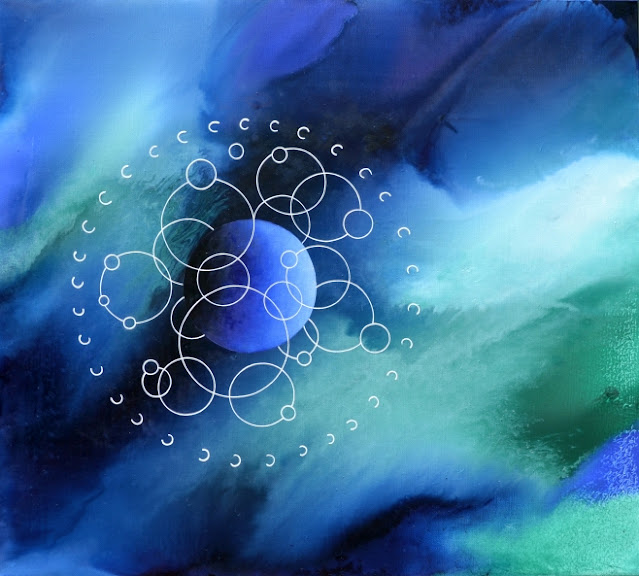
 Theatre of War: Dromo-Domain Oil on linen 90 x 100 cm 2021

CLAUSEWITZ
I think this is my 14th or 15th Theatre of War painting. I was inspired to start this ever-growing series by late 18th/early 19th century Prussian General, Carl Von Clausewitz's famous tome On War. He often mentions the term 'theatre of war'. Reading through the text, I get the impression he thought it involved a number of factors, but geography was a central theme. 

I think about what 'theatre of war' might mean in the 21st century, the age of digital and cyber technology, drones, drone swarms, ubiquitous surveillance and increasingly autonomous systems. Regular readers will know I am probably a bit dystopian in my outlook. This is because I 'see' contemporary networked, interconnected and inter-operable technology as an homogenising and standardising force that enables the 'theatre of war' to extend not only beyond geography, but also traditional ideas of military activity and reach.* Because of the shared nature of technological platforms and systems I am particularly concerned about, and interested in, the militarise-ability of civilian technology. Here, increasing military interest in the electromagnetic spectrum [EMS] as an enabler of technology, a type of fires, a manoeuvre space and a domain is a key concern. Why? Because civilian technology also relies upon access to the EMS. Information and cyber warfare, and terms such grey-zone and hybrid warfare, all 'speak' to permeable military-civilian boundaries. I am also interested in the militarisation of imagination, time and speed. So, you can see, my ideas of the contemporary 'theatre of war' encompass almost - maybe all of- everything!

DROMO - SPEED
Theatre of War: Dromo-Domain is a visual spin on Paul Virilio's thoughts on speed and the term he coined, dromology ie: the logic of speed applied to contemporary society. Virilio, in a number of books and articles*, argued and observed that speed and accelerating speeds of technological operation and development play major roles in societal, political and geopolitical stability. As developments in networked and interconnected digital and cyber technologies have accelerated, light-speed [or near light-speed] signal transmissions introduce speed as a necessary advantage for both civilian and military technology. It is commercially, politically and militarily tactical to use speed as an advantage. One of my favourite quotes from Virilio is  "The fact of having reached the light barrier, the speed of light, is a historic event, one which disorients history and also disorients the relation of human beings to the world. If that point is not stressed, then people are being disinformed, they are being lied to. For it has enormous importance. It poses a threat to geopolitics and geostrategy.” (1)

HOW TO VISUALISE SPEED
I have grappled with how to visually convey speed as an overarching dromo-domain that encompasses civilian and military technology in a pervasive and persistent 'theatre of war' that extends from Earth to orbiting satellites. 

In Theatre of War: Dromo-Domain I have repeatedly painted the symbol for light speed ie: c, to form a circle around the Earth. I love how the cs look like the spurs on a spinning cog, and that a sense of speed is created. The Earth is the 'pale blue dot'. This circle of cs represents the major satellite orbiting zones around the Earth. From these orbits to Earth, is our sphere of influence, where the EMS is harnessed for an array of communication, operative and inter-operative civilian and military technological functions. How are we managing this sphere of influence? I 'see' it as a volumetrically occupied and techno-colonised space. 

In Theatre of War: Dromo-Domain the multiple overlapping white circles are indicative of civilian and military activities and domains. Clearly the term dual-use is inadequate in the era of speed, where networking, interconnectivity and interoperability scaffold us all in invisible webs of signals. This is a militarised space - a dromo-domain that enables and cradles more traditional military domains of land, sea and air. It is the meta-domain.

IMAGINATIONAL METAVEILLANCE
The cosmic-like background in Theatre of War: Dromo-Domain continues my quest to stimulate flight, your flight and mine [in imagination], to places where we can gain new perspectives. I call this 'imaginational metaveillance' - a kind of veillance that does not rely on EMS-enabled technology, thus it is untethered from it. The cosmic landscape also alludes to universal history, which includes the history of the EMS. All frequencies in the EMS are made up of photons, traveling in waves at light speed. The photon appeared around 10 seconds after the Big Bang. This kind of cosmological history really gets me thinking about how, in our sphere of influence, are we using a natural universal resource. 

* Paul Virilio and Jean Baudrillard inform my ideas here.
Cheers,
Kathryn

PS. Related recent posts/paintings include:

(1) Paul Virilio, “Red Alert in Cyberspace,” trans. Malcolm Imrie, Radical Philosophy (Nov/Dec 1995): 2.

* Just a small few examples of Virilio's work
Paul Virilio, Speed and Politics, first published 1977.
Paul Virilio, The Original Accident, trans. Julie Rose (2007
Paul Virilio, The Great Accelerator, trans. Julie Rose (2012)

Tuesday, May 12, 2020

ECHOES ACROSS TIME

Echoes Across Time Oil on linen 97 x 115 cm 2020

The COVID-19 pandemic is occupying our thoughts, dominating the media and changing our lives. 

In the midst of thinking about 'pandemic drones' and surveillance, plus thinking about the concurrent and continuing development of militarised drones, such as the RAAF and Boeing joint Loyal Wingman drone project, I felt the need to return to a quieter contemplation.

The result of this quieter contemplation is Echoes Across Time. While it might appear quieter, I still had thoughts about the current pandemic in mind. These thoughts, however, took me on a journey across time to previous pandemics - the Bubonic Plague of the Middle Ages, early nineteenth century cholera pandemics, the Spanish Flu that traumatised people just after World War 1. Paintings, drawing and prints created by artists across time clearly depict the anguish of pandemic, the ravages of illness and the sorrow of death. 

Like war, disease is a thread that weaves its way through human history. But, life continues. Sometimes lessons are learnt, sometimes not. 

Echoes Across Time 
In Echoes Across Time a red tree-of-life stands as a beacon in a ambiguous landscape. This landscape could be time. Below the tree, a pale blue dot could be Earth. The inference is that life as we know it is dependent on our Earthly environment. Another pale dot hovers over a distant horizon. Is this our moon? Or, is it a mirror image of Earth, but without the tree-of-life. If so, why? Is it Earth before life appeared, or is it a future Earth, after life has disappeared? What secrets do the echoes across time reveal?

Human future depends on how we deal with climate change, pandemic and war. That they intersect needs attention. Perhaps listening for and hearing the echoes of the past, and the echoes that bounce back from the future, are worthwhile undertakings. I suggest that art might help! 

Cheers,
Kathryn

Sunday, April 26, 2020

WINGMAN (MQ-28 GHOST BAT)

Wingman (MQ-28 Ghost Bat) Oil on linen 97 x 115 cm 2020


UPDATE: Late March 2022 the Loyal Wingman drone in Australia will now be called Ghost Bat. Here's a Boeing Youtube Video  and an article in Defence Connect online.


The Royal Australian Air Force and Boeing are collaborating to develop a new drone, a Loyal Wingman drone.The drone will fly to support manned aircraft, hence the name 'wingman'. With surveillance, stealth and weapon carrying capabilities the drone will be piloted remotely and/or by pilots in manned aircraft of various kinds. Artificial intelligence will be incorporated as a 'force multiplier' to aid an array of capabilities. This drone, when its development is finalised, will be Australia's first 'homemade' weaponisable drone. You can read more about the Loyal Wingman drone on the Boeing Airpower Teaming System site HERE  .


Added May 5 2020: Today, further news was about the Loyal Wingman drone released by Boeing. You can read that news on the Boeing site HERE

Also today May 5 2020 , an excellent overview by Tyler Rogoway of the drone "Everything We Learned From Boeing About Its Potentially Game Changing Loyal Wingman Drone" was published in The Drive


I am not going to go into more detail about the Loyal Wingman drone, because the Boeing site has it all, including videos, press releases etc.

Wingman Oil on linen 97 x 115 cm 2020
What I am going to do is write a bit about my new painting Wingman. 

In the bottom left of the painting I have painted a Loyal Wingman drone in shades of surveillance night-vision green. I have also painted Australia's Parliament House with two civilian drones hovering in the sky above it. Parliament House is suspended in space, as if it is also an aircraft, possibly the manned system my Wingman supports? In the top left I have painted a satellite, again in shades of green. And, a pale blue dot acts as a sentinel, a reminder of 'home'. All of these elements hover in a cosmic space, but invisible signals - and politics - link them all.

The painting offers open-ended, but political and provocative, narratives. It speaks to the a present and a future increasingly occupied by militarised and militarise-able technologies with persistent and ubiquitous reach. 

What do you think? What kind of stories can be told?


Finishing the satellite in Wingman


The Word 'Wingman'
The name Loyal Wingman is an intriguing one for an unmanned system. Surely the word WingMAN, in some ways, re-mans the unmanned! Traditionally a wingman was a pilot flying as support, outside or behind a lead aircraft or formation. More colloquially, a wingman is someone who acts as support  in a social situation, for example, at a bar. 

I ask, does the word wingman, in some form or other, anthropomorphise or humanise the object - the drone? If so, what does this say about subliminal or overt human desires to have relationships with technology? After all, a drone cannot desire - so - any relationships human beings think they have with drones are going to be one-sided affairs! Does the word wingman create a sense of relationship, by promising attributes of  mateship and buddyship? 

Like ascribing attributes of vision to a drone that cannot see, let alone imagine and dream, the word wingman infers a lot more than protection. What kinds of dangers lurk when we humanise drones and other technologies by giving them names, and ascribing attributes, that denote human capabilities? 

AND, what about the word loyal? Surely a wingman is meant to be loyal, so why re-enforce loyalty in the name of a sensored, but not sentient, object? 

And, as always there is a lot more to ponder, but I will leave it to you now!


*************

I've previously written about potential problems associated with humanising or embodying the drone. Please visit my previous post with lots of paintings The Drone: Do Not Embody

_________________________________________________________

Other paintings and posts that intersect with Wingman


_________________________________________________________________________________


Showcases nine small paintings under $2000 AUD. 
Prices are current until May 18. 


Cheers,
Kathryn


Thursday, July 18, 2019

STAY ALERT: SAYS THE TREE

Stay Alert: Says the Tree Gouache on paper 56 x 76 cm 2019


For information on my forthcoming exhibition 

Occupied Landscapes: Evidence on Drones

please visit my post HERE


______________________________________________________


Stay Alert: Says The Tree


I was thinking about a painting from 2017, Forever Watched  [below]. It is one of only a few paintings where I depict human figures. In the painting a group of people are encircled. But, are they performers encircled by a spotlight on a stage, or something more sinister? Or, maybe the stage is contemporary life, one where everything we all do is monitored, surveilled, watched. 

I was thinking about Forever Watched when I was painting Stay Alert: Says the Tree [above]. In this new painting I have replaced the people with a symbolic reference to humanity and life, the tree-of-life. Regular readers will know that the tree-of-life is often depicted in my paintings. The radiating lines indicate some kind of surveillance emanating from a single point, maybe an airborne drone, a satellite...? Maybe the single point indicates control, rather than a particular device.

The split surveillance could mean a few things, increasing persistence and dominance by surveillance systems, intrusion at global and intimate levels, dispersed targeting and more. The replacement of the human figures with the trees-of-life draws us all into the surveillance system as contributors and victims. 

The two trees-of-life, however, present us with some hopeful possibilities and some dire possibilities.It depends on your perspective.

I'll leave it to you to think about these possibilities. 


*Forever Watched and Stay Alert: Says the Tree will be in my forthcoming exhibition Occupied Landscapes: Evidence on Drones. 
 

Forever Watched Gouache on paper 56 x 76 cm 2017


Tuesday, July 09, 2019

WARFIGHTER - 01010111 01000001 01010010 01000110 01001001 01000111 01001000 01010100 01000101 01010010


 WARFIGHTER Gouache on paper 15 x 21 cm 2019


_________________________________________________________


A few questions that keep me thinking are:

What happens when the warfighter is no longer human/alive?

Why has the word 'warfighter' replaced, in many instances, descriptors such as soldier, sailor, pilot? 

Is the increasing use of the word warfighter a sign that the replacement of the human being is already underway? I ask this because nonhuman devices can also be called warfighters eg: unmanned systems such as airborne, land-based and sea-based drones or robots. 

If or when the warfighter is no longer human/alive, does war become a battle between autonomous devices and systems? Will human beings still have control, or will they be held hostage to a type of war beyond our current comprehension?

If your nation's warfighters are no longer human/alive, are the enemy's warfighters also no longer human/alive? If not, is the human being's role relegated to that of victim only?

In a war fought between machines and systems what happens to sovereignty and territory? 

In a war fought between machines and systems what happens to notions such as bravery, courage, loss, victory, disgust, sacrifice and more?

How do we memorialise when the warfighter is no longer human/alive? Will memorial cease to exist as a form of human remembrance? If not, where does that place human history?

If autonomous nonhuman warfighters' initial programming is aimed at fighting, battle, deception and strategy, what happens to peace?

Are cyber systems and robots designed for civilian use, vulnerable to hijacking by the warfighting systems and robots? I assume so - then all systems are potentially militarised. Something to think about in an increasingly interconnected and networked world! 

The artificial intelligence, Alpha Go, plays the ancient game of Go with what is described as superhuman abilities, employing new manoeuvres that human beings have never thought of. This prompts the question, will self learning AI operated warfighters develop unheard of war strategies?  If so, what will war become? Will war become not superhuman, but 'other than' human?  Will human beings have any hope of understanding war once it becomes 'other than human'? Here, I protest against terms such as 'superhuman' and 'more than human', because they imply that that the human is already 'less than' the machine/system. However, if we see these systems as 'other than', rather than 'superhuman' or 'more than human', maybe critical spaces for deeper reflection on the future of war and humanity are revealed?


WARFIGHTER 
In WARFIGHTER [above] I have painted a string of binary code 'instructing' WARFIGHTER. The code seems to form a landscape element, a contour or horizon. The warfighter here is a digital system, a non-human, normally invisible combatant. Is the painting a depiction of a future warscape, one where human beings no longer exist, but the autonomous warfighting systems they developed still do? Maybe this could be a memorial to an algorithm! Is it Earth though? Maybe it is a cosmic landscape, or a virtual landscape - a simulation - Earth's remnant, an algorithm.

WARFIGHTER is similar to my earlier small painting Coded Landscape [below]. Here, the binary code 'instructs' the word LIFE. In my 2015 post, where I discuss Coded Landscape, I write about landscape. Landscape emerged out of the Big Bang and continues today on a universal scale. Here on Earth we have our physical landscape, but also our virtual landscapes. Both Coded Landscape and WARFIGHTER play with depictions of various landscapes - universal, cosmic, physical, virtual, simulated, future. Like WARFIGHTER, Coded Landscape could be a memorial too - to life.

And, there are a lot more questions....for another time.


                                     Coded Landscape Gouache on paper 15 x 21 cm 2015


Cheers,
Kathryn


Wednesday, July 03, 2019

OCCUPIED LANDSCAPES: EVIDENCE OF DRONES

Beware, Whispers the Wind Oil on linen 61 x 97 cm 2019


OCCUPIED LANDSCAPES: EVIDENCE OF DRONES


POP Gallery, 381 Brunswick St, Fortitude Valley, Brisbane, Queensland, Australia. 
POP Gallery is one of the Queensland College of Art (QCA), Griffith University, galleries. 


27 August - 14 September 2019

Please read the exhibition essay Occupied Landscapes: Evidence of Drones 
written by Dr. Federica Caso.


L to R: Mission Capable Landscape and Nowhere to Hide


A PANEL DISCUSSION happened on Saturday 31 August from 3.30 pm - 5 pmPanel Members:
  • Dr. Samid Suliman, Lecturer in Migration and Security, Griffith University. 
  • Federica Caso and Cormac Opdebeeck Wilson, both from the School of Political Science and International Studies, the University of Queensland. 
  • Kathryn Brimblecombe-Fox.


L to R: Occupied Landscape, False Lawn, Swarm Clouds Brewing


 Installation image at Occupied Landscapes: Evidence of Drones


LINKS


*You can view more paintings on my website HERE


AND - PODCAST

* I was interviewed about my paintings and research by the lead researcher, Dr. Beryl Pong, of the Aesthetics of Drone Warfare project, University of Sheffield, UK.This project is funded by a British Academy Rising Star Engagement Award for 2019-2020. Please listen to the Podcast - it's only 30 minutes.


 Mission Capable Landscape oil on linen 72 x 137 cm 2018


OCCUPIED LANDSCAPES: EVIDENCE OF DRONES is my first solo show of new work since 2015. The paintings in the exhibition reflect long-term interests in landscape, symbols [such as the tree-of-life], and existential risk posed by emerging technologies.

The paintings in the exhibition are informed by research into accelerating developments in militarised and militarise-able technology - airborne drones, persistent surveillance and increasingly autonomous systems. This research was conducted as part of my Master of Philosophy degree, completed in 2017 at the University of Queensland. Ongoing research continues to inform my work.

I am interested in how landscape is mediated by militarised and militarise-able technologies. I am particularly interested in examining the signals that enable the operation and functioning of militarised technologies. 


Anomaly Detection Gouache on paper 56 x 75 cm 2016
  Please take a look at Anomaly Detection No 2 also 


Please browse through my
BLOG to see more paintings and to read more about my practice. 


_____________________________________________


EXHIBITION ARTIST'S STATEMENT 

OCCUPIED LANDSCAPES: EVIDENCE OF DRONES


Occupied Landscapes: Evidence of Drones is an exhibition that poses questions about the mediation of landscape in the age of the drone, the era of persistent surveillance and the epoch of increasingly autonomous systems. The paintings in the exhibition are informed by my long-term interests in landscape, age-old symbols and existential risk posed by emerging technologies. My work is also informed by research into accelerating developments in contemporary militarised technology. This research was undertaken as a part of my Master of Philosophy [M.Phil], completed in 2017 at the University of Queensland.

In my paintings I invite viewers to fly, in imagination, around, above and below airborne drones that lurk in cosmic skies. As we fly, surveillance is returned to the human being as a kind of metaveillance. In other words we not only monitor the drones, we also observe what they are monitoring. This kind of observation reveals how drones, and their support infrastructure, intrude into the landscape in ways that occupy it. This occupation becomes a stealthy techno-colonisation of landscape and environment when enabling signals, ricocheting from land, into the sky and space, are exposed. By making visible the nets of invisible signals that operatively enable militarised and militarise-able technology I expose how new kinds of topographies are mapped onto landscape. However, rather than a surface occupation, it is a volumetric occupation from land into space. Imposed new signal topographies mediate human activity and movement through the signal-enabled inter-connectivity of our personal devices, computers, credit cards, mobile phones, GPS locators and more. Without signals these devices are largely inert.

In extreme cases interconnectivity enables the identification and targeting of people by systems increasingly involved in a conflation of military, security and policing activities. Here, the mediation of human activity and movement is clear. However, the ability to track and monitor general populations is an insidious kind of hostage situation that aides and abets the techno-colonisation. We are all hostages?

In my paintings depicting drones, or indications of their presence, I rarely include human figures, preferring not to attempt to tell the stories of others. However, in many of my paintings I include the age-old transcultural/religious tree-of-life as a symbol of all of humanity and life. The tree is often under threat from drones or it stands as a beacon of hope, Depending on your perspective, and perhaps where you choose to fly in imagination, humanity could be at risk of civilisation collapse and species demise, or it could harbour clues for a rich and vibrant future.


There is a lot more to think about – but, I will leave that up to you now. I hope you find Occupied Landscapes: Evidence of Drones stimulating, and therefore enjoyable. 


Drone Spiral (2) oil on linen 120 x 160 cm 2018


Cheers,
Kathryn

Thursday, May 16, 2019

CHARTING THE INVISIBLE

Charting the Invisible Gouache on paper 30 x 42 cm 2019


Charting the Invisible is another of my paintings that 'exposes' how signals operatively enable contemporary technologies to function in a networked and inter-connected manner. Without connectivity, many devices would be useless or near useless. By 'charting' the normally invisible connectivity and inter-connectivity of the modern technological world this painting can be understood as a kind of counter-map. Here, I focus on the 'map' as a subversive exposure and demonstration of the connection between militarised and civilian technologies. When you consider that security and policing activities are increasingly blurred with military activities, the militarise-ability of civilian technologies is an issue. Does this make everything dual-use? Additionally, while security, policing and military activities are generally considered necessary by many, malign entities using networked and inter-connected systems are more than unwanted interlopers. 

NODES AND DEVICES
Like my last painting and post Martial Map I have painted lines that join nodes and devices. These lines represent signal connections. For example, a ground control station is linked to an airborne weaponised drone. This control station is also linked to a communication satellite, which is also linked to the drone. The drone is linked to a mobile phone, also linked to the GPS and communication satellite. The phone is linked, then, to a car, and a computer. Some nodes and devices send signals beyond the edges of the painting, to indicate connection to other devices and nodes. And, there are more connections between all the devices, and some connections are still invisible!

TECHNO-COLONISATION
While the painting can be read as some kind of map, the cosmic landscape background positions the viewer in an ambiguous perspective. Is the viewer above or below, in front or behind, the net of signals? If they are below, the sky is netted, if they are above the planet is netted. If they are in front or behind the nets act as walls. Here, the netted appearance is important to me, as I 'see' this signal-net as an imposition on landscape, an occupier of space and a sign of a new kind of colonistion, a techno colonisation that holds us all hostage. Given the militarise-ability of civilian technology, in addition to designated militarised technology, does this colonisation come with a persistent readiness for defensive and offensive actions? If so, are we in a constant state of war preparedness, where the near light-speed delivery of data and instructions via signals expunges time for peace?  

On that 'happy' note.

Cheers,
Kathryn


Sunday, March 10, 2019

PAY ATTENTION: THE DRONES ARE HERE

 Pay Attention: The Drones Are Here Gouache on paper 30 x 42 cm 2019


AUSTRALIA AND DRONES
Australia is playing an increasingly active part in the development and procurement of airborne drones for military and associated purposes. Airborne drones are used for intelligence, surveillance and reconnaissance [ISR] purposes, with certain types of drones also capable of carrying weapon payloads.

Examples are::

*MQ 9B Sky Guardian drones have been chosen in favour of MQ 9 Reaper Drones. You can read about this decision HERE in Flight Global. These drones are weaponisable. For background on this decision please check out HERE in an Australian Financial Review article , and HERE is a Defense News: Asia Pacific article.

Triton surveillance drones are also on order. You can read about this news on the Australian Airforce website HERE

And, another drone will be manufactured here in Australia in partnership with Boeing. Currently called the "Loyal Wingman" project, you can read about it on the ABC News site HERE. And, an announcement on the current Defence Minister, Christopher Pyne's website HERE. And, on Boeing's website HERE

Australian defence forces have used surveillance drones for some time. For example the Scan Eagle drone has been used in Iraq and Afghanistan. You can read a 2007 article about the Scan Eagle drone HERE at Defence News. You can also read about a Scan Eagle drone now in the Australian War Memorial's collection HERE

* Updated Dec 3, 2019

 Not Waiting For The Future Gouache on paper 56 x 76 cm 2018


QUESTIONS
As Australia becomes more involved in militarised drone operations, procurement and developments, questions that are already being debated globally need to be debated here too. For example, questions about remote operations - surveillance, targeting and killing. The use of unmanned aircraft with sophisticated ISR capabilities, and possible weapon payloads, raises questions about asymmetric warfare. Increasingly autonomous systems employing machine learning and AI raise questions, for example, about human-in-the-loop decision making and the ethics of machine killing. The contemporary 'warfighter' could be a human being, but also an [semi] autonomous  machine. 

The appropriation of technological infrastructure and systems for surveillance and targeting purposes raises questions about the neutrality, or not, of contemporary interconnected technologies. What part does interconnected technology play in preemptive activities? The increasingly blurred lines between military, security and policing activities raise questions about the nature of  contemporary warfare, and its battle fields and spaces. The accelerating nature of technological development stimulates questions about the future of war, and the future of humanity. Are we in a new arms race? Questions about the role of science and technology come to mind. As do questions about legal and ethical frameworks that can be applied to accelerating developments. The speed of technological operation raises further questions that feed into debates about asymmetric war, human involvement, networked systems, social vulnerability, geopolitics, and more...and more.

Since 2015 I have been thinking about these types of questions. I have also undertaken formal research, completing an M. Phil [University of Queensland] that included research into contemporary militarised technology, particularly airborne drones.  

FIVE PAINTINGS
In this post I have included five paintings that reflect upon Australia and airborne drones. 

Pay Attention: The Drones Are Here [top] is my newest painting. An armed drone is pointed towards an upside-down Australia. Is the drone a new arrival, soon to join its Australian fleet? Maybe it is an Australian drone, maybe not. Australia is upside down on purpose, actually a few purposes! The small squares give the impression of pixels. Is the image a simulation? Are you another drone gazing down upon the scene? Is the painting a screen shot? Or, are you a human engaging your imagination in a way that turns human surveillance back onto the drone? Regular readers will recognise the cosmic perspective I love to use here - like in the other four paintings too. Lots of interesting questions and scenarios!

I'll leave you to ponder now. 

Cheers, Kathryn

 Aeropolitics Imagined Gouache on paper 30 x 42 cm 2016


 What If? Gouache on paper 30 x 42 cm 2016


Hot Spots Gouache on paper 30 x 42 cm 2016

Friday, December 28, 2018

LOYALTY TO EARTH AND HUMANKIND

It's Everything Oil on linen 50 x 50 cm 

Historian, Yuval Noah Harari has written an article, "Moving Beyond Nationalism: Three global problems create a need for loyalty to humankind and to planet Earth"published by The Economist. The three global problems Harari identifies are "nuclear war, climate change and technological disruption." That these three issues require global attention and co-operation is clear. Each pose major risks, even existential risks, to humanity and the planet. Combined, they pose a hellish picture of the future. 

As Harari notes, a retreat into nationalism does not protect nations from risks posed by nuclear war, climate change and technological disruption. He writes "We need to create a global identity and encourage people to be loyal to humankind and to planet Earth in addition to their particular nation."

LOYALTY
I like the idea of being "loyal to humankind and to planet Earth." Regular readers of this blog will know that this kind of sentiment underlies much of my work. My use of the age-old transcultural/religious tree-of-life, depictions of Earth as a pale blue dot, and my use of cosmic perspectives, coupled with visual signs and metaphors of contemporary risks, are attempts to focus attention on humanity and the Earth. Visual questions about militarised technology and the militarise-ability of technology, pose questions about the future of humanity and the planet.

The medium of painting moves thinking away from what artist and writer James Bridle in his fascinating book [do buy it!] The New Dark Age: Technology and the End of the Future calls "computational thinking" eg: data driven computation, computer simulation/modelling. The act of painting and the medium of painting can help remind us of alternative ways of thinking. Ways that may assist us in creating a loyalty to humankind and Earth. Ways that can critique contemporary technology - without using it for creation, exhibition and storage.*     

FOR THE ARRIVAL OF 2019
So, for the arrival of 2019 just a few days away, I have decided to upload a selection of my paintings where, variously, the tree-of-life, the pale blue dot, cosmic perspectives and images of airborne weaponised drones may induce thoughts about loyalty to humankind and Earth. 


 Future Oil on linen 91 x 102 2015


 Australian Landscape Cutout Oil on linen 55 x 80 cm 2015
This painting is a reflection upon how nationalism might work, or not work, in the 21st century. It reminds us that all nations share the one planet.


 Beacon Oil on linen 92 x 102 2014


The Birth of Landscape oil on linen 138 x 168 cm 2014
A small tree-of-life is cradled by the emergent landscape, at Earth's beginning. Ultimately life, including humankind and the planet are entangled.  


 Pale Blue Dot Oil on linen 120 x 160 cm 2014

Reading/viewing the painting above with the two below triggers a few questions about what kinds of risky anomalies are we not noticing. I propose human imagination can take us to revelatory perspectives.


 Anomaly Detection [No 2] Oil on linen 120 x 180 cm 2017


Anomaly Detection Gouache on paper 56 x 76 cm 2017


Happy New Year,
Kathryn