Showing posts with label war. Show all posts

Sunday, March 15, 2026

CATASTROPHE OF SUCCESS


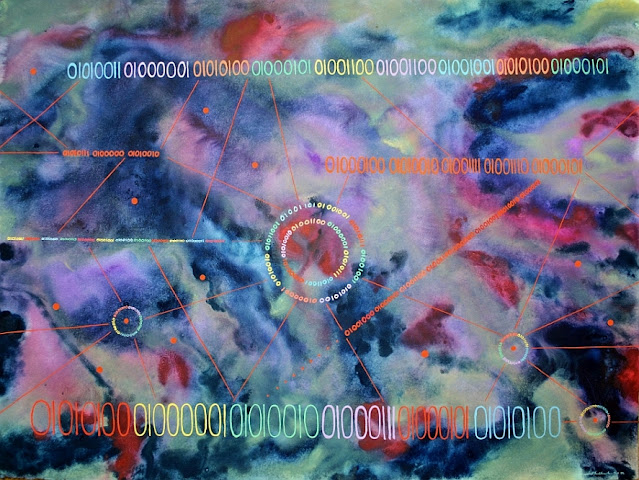
Catastrophe of Success Gouache on paper 56 x 76 cm 2025


Speed, Technology, and War
Cultural theorist, Paul Virilio wrote extensive commentary about speed, technology, and war. His book Desert Screen: War at the Speed of Light (2002) is an English translation of an earlier 1991 French publication. 

Virilio identified that the first Gulf War (1990-1991) signposted a pivotal change in the character of war. He presciently observed that in the first Gulf War the “real environment for all important military action is no longer so much the geographic environment, be it desert or other terrain, but rather the electromagnetic domain” (1). The electromagnetic domain Virilio refers to is the electromagnetic spectrum (EMS), and speed of light frequencies (RF, microwave) that enable digital and cyber inter/connectivity in the earth to orbiting satellite environment. Please note, both military and civilian technologies increasingly rely upon the EMS. 

Over 35 years after Virilio's observation, our current wars are a continuation of a trend he identified - speed is the mantra. While speed is often mentioned in various government, military and defence industry media, it is not a focus of critical attention. Yet, it is the underlying agitation, for example, for the Australian government's 2023 National Defence: National Defence Strategic Review, warning that "in the contemporary strategic era, we cannot rely on geography or warning time" (2). And, another note - artificial intelligence and machine learning assist in maintaining the tempo. This, of course, involves the removal or reassignment of human beings. 

In 2012 Virilio observed, "For speed, its success is also its damage" and "Its success itself becomes a catastrophe." (3) 

Catastrophe of Success
My painting Catastrophe of Success was inspired by my research and Virilio's prescient observations. Like most of my paintings, lines connecting various elements indicate electromagnetic signals that carry data and instructions. These 'signals' seemingly extend beyond the painting into the wider environment, drawing us all into the militarised world via various hyperconnected media. 

It is important to note that in an active contemporary war zone, signal connectivity, and therefore identification of signal emissions, can mean as little as 90 seconds to ready for attack. For those in the midst of the quagmire of kinetic and signalic warfare, the bloodiness of war remains. This is why Catastrophe of Success is painted predominantly red. Speed and signal connectivity can be deadly. 

The painting is a scape - a cosmic scape, a militarised scape ... It extends from the strange hands - are they human or robotic - to orbiting satellites. Various well known symbols for connectivity occupy the scape's mid zone. They are proxies for human activity. Sky-based and space-based assets complete the 'occupation'. Look closely - there are larger drones, smaller drones, and various satellites. A smartphone, situated on the far right, displays its various apps, each one allowing instantaneous access to a plethora of choices from social media to banking. The blue squares mimic the pixelated 'sky' I have painted in the background. I ask, what is real landscape and how does our understanding of landscape change in a digitised world where we constantly gaze at screens positioned 20-30 cm from our eyes? 

There's much more to think about, but I'll leave that up to you. I will however, leave you with a sobering statement that 'speaks' to why techno-success in an increasingly dual-use age can be catastrophic. War Studies scholar Matthew Ford makes a blunt assessment of the smartphone in his book, War in the Smartphone Age: Conflict, Connectivity and the Crises at Our Fingertips (2025)He argues that the smartphone is now ‘a central weapon of war’ and an ‘integral part of the kill chain’ (4). 


*My article 'Light Speed, Contemporary War, and Australia's National Defence Strategic Review', in Digital War journal, examines the Review through the lens of speed. 

__________________________________________________________________

NEWS

I presented about my research and creative practice at the AOC Aust/NZ Convention in Canberra last week. The AOC (Old Crows) is an international non-profit professional organisation for people working in electromagnetic and information warfare capabilities. 

I am pleased to report that my presentation was very well received. And, my stance that I was not there to provide answers, but to provoke questions was also openly received.

    • My presentation was: The Invisible Battlespace: What Does it Look Like?

What does the 'invisible battlespace' look like? This seemingly simple question is addressed by contrasting standard digital representations/simulations of the EMS and the 'invisible battlespace' with research-informed creative visualisations. I present this contrast as a productive way to critique and perhaps shift current conceptualisations of the invisible battlespace.

For example, should the EMS be designated a domain, along with land, air, sea, cyberspace, and space? Does the beyond-human speed (and therefore time) of signal-enabled hyperconnectivity and interoperability position scale as a risk?

Focussing on signal invisibility and issues of speed, time, and scale, this presentation meets growing calls for new ways to imagine and think about war in an age where civilian and military digital and cyber technologies are increasing reliant on signals.

I opened my presentation with an image of my painting Theatre of War: Dromo-Domain. Dromology is a word Virilio developed for the study of speed. A speaker earlier in the conference had said we cannot see ourselves in total. So, I opened my presentation saying that with imagination we can try - with imagined flight we can conjure a totality beyond the screen, the sensor, the aperture. Theatre of War: Dromo-Domain, turned out to be the perfect opening slide - an image of the pale blue dot (after Sagan, Earth) ringed (satellite zone) by repeated symbols for lightspeed - c - and covered with interlocking circles representing hyperconnectivity via fake 'clouds'. 


Cheers,

Kathryn

Tuesday, November 22, 2022

ON THE EDGE OF BEING

On The Edge of Being Oil on linen 112 x 92 cm 2022
 

In an age of artificial intelligence, increasingly autonomous systems, technological interconnectivity and interoperability, drones and other robots, what happens to human identity? If our future is one of being human-machine, what kind of being-ness does this impose or require? Do we become more like the machines/systems or do they become more like us? How does algorithmic/machine utility and human being-ness work together? 

On The Edge of Being
This new painting visually poses a possible immanent battle or meeting between the upper section of trees and the lower section of different kinds of 'tree's. It's up to you to ponder whether a battle or a meeting is likely. Or maybe it's something else. The free flowing tree-like branches at the top of the painting are posed with a more standardised neural network tree-like structure in the bottom half of the painting. I was thinking about being-ness vs utility. I was also thinking about trees - for example, computer science tree-logic/hierarchies and the age-old transcultural/religious tree-of-life. Both 'coded', but differently. A lot to say here, but I won't go on - and on...!

I have not only painted different tree-structures, but I have used slightly different tones of colour in each section. The green in the top part of the painting is a more real-world tree or plant green, whereas the green in the lower section is a night-vision surveillance green. I have used different yellows and blues in each section, but the same cadmium red. This red dominates as each 'tree-scape' encroaches on the fiery and tumultuous centre. The red could indicate readiness - maybe for battle. The centre section could be a war zone, but it could also indicate fertile ground. Whatever it is, for me it symbolises a rubicon - like crossing the Rubicon River. Maybe there is no way back, especially if we don't pay attention. 

In 2017 I created a painting called Crossing the Rubicon  

PhD - Light Speed
On The Edge of Being came to me as I wrote one of my PhD chapters Speed: Light Speed = c. In an era where light-speed signal transmission enables technological speed, how do expectations of beyond-human dimensions of speed, and therefore, time, impact or influence human being-ness? What metaphoric tree should we grasp onto as speed engulfs?


There is more to say, and think about...

Cheers, Kathryn 

PS: You might be interesting another painting


Monday, March 07, 2022

THEATRE OF WAR: TECHNO-SEDUCTION

Theatre of War: Techno-Seduction Gouache on paper 56 x 76 cm 2022


WAR
Like many others, the war in Ukraine is occupying my mind. The mix of traditional kinetic activity with improvisation across old and new tactics and technologies again raises questions about asymmetric warfare. 

THEATRE OF WAR: TECHNO-SEDUCTION
This new painting, Theatre of War: Techno-Seduction, has a focus on the human. Yes! By presenting everything as an algorithm, even human beings, I pose questions about  technological systems that are interconnected and interoperable. Questions about AI-enabled systems, that reduce or remove human operators are also posed.

For interconnectivity and interoperability to work seamlessly, foundational operative platforms need to be the same or very similar. Hence my use of painted binary code. 

But does homogenisation at any level strengthen resilience or not? Maybe it poses a vulnerability - like pulling out the bottom card of a house of cards, is there risk of collapse. Where does the human being fit in a world of interconnectivity, interoperability and AI-enabled systems? 

So, what have I presented or 'instructed' in algorithmic form?

At the top is SATELLITE. To the left in small zeros and ones is WAR. In the centre, as a circle of code, is MILITARY LAWYER. To the right is DRONE and angled from it is HELLFIRE. To the left of the circle in SURVEILLANCE. The three small circles of code 'instruct' HUMAN - are they warfighters, civilians, friend or foe, victims? The bottom 'instruction' is TARGET. Is the target human or not? If not a human target, destruction of buildings or infrastructure can still cause human fear, suffering and death. 

All these 'instructed' entities are connected by lines that indicate signals, and therefore, reliance on frequencies in electromagnetic spectrum for connectivity and interconnectivity to enable information and data transmission, surveillance capabilities, sensor access, news broadcasting and so on. 

The painting acts as a kind of map.

HUMAN
Despite major advances in militarised and militarise-able technologies that remove many human operators and warfighters from the immediacy of conflict zones, the death and suffering witnessed in places such as Yemen, Afghanistan, Syria, Iraq, Somalia and now Ukraine, remind us that human beings remain in the loop, as my circles indicate, as victims. 

And, we must not forget that human beings also start wars. 

_______________________________________________________________

In another recent painting and post Theatre of War: Law I explain the reference to military lawyer.

NEWS

Third Text Article

Thrilled that my article "Night Vision, Ghosts and Data Proxies: Paintings By War Artist Jon Cattapan" has been published online for Third Text, a leading peer reviewed international journal dedicated to the critical analysis of contemporary art in the global field. The hardcopy is forthcoming.

Cattapan was an official Australian war artist in Timor Leste in 2008. Key to his subsequent paintings were his experiences using night vision technology while accompanying Australian Peace Keeping forces on night patrols. The effect of the night vision green entered his paintings in ways that continue to 'speak' to us today. Thus, I analyse Cattapan's paintings through a 'future of war' lens-a future we are now living, nearly 15 yrs later. I argue that although the paintings were inspired by experiences in Timor Leste, the images could relate to the iterative modes of contemporary, and likely future war, ie: grey zone, hybrid, informational, cyber, as well as kinetic warfare.


Cheers,
Kathryn
                                                             

Sunday, September 19, 2021

FREEDOM?

Freedom? Gouache on paper 56 x 76 cm 2021


'End' of US war in Afghanistan August 2021
As US and allied forces left Afghanistan, the Taliban swiftly took over the country's leadership. A short window of time in August saw thousands of people fleeing or attempting to flee Afghanistan. Kabul airport became the epicentre for evacuations of foreigners, and Afghanis fearful for their lives under Taliban rule. 

Like I imagine many readers, I watched the news with mixed heavy feelings - despair, frustration, sadness, hope. One of many images that stuck in my head, was the photograph of the Chinook helicopter flying over the US embassy. Apparently helicopters landed at the embassy site to assist evacuation of US officials out of the embassy building to Kabul airport. 

Chinook Helicopter - Short History
The Chinook helicopter's history is interesting. Early versions were developed in the late 1950s, further developed by Boeing in the early 1960s. The helicopter was first used in combat situations in Vietnam in 1965. This large multi purpose aircraft has been 'hovering' in our visual fields for decades, via livestreamed and photographed war, conflict and humanitarian-aid reporting.. Whether the Chinook is spilling armed soldiers out of its cavernous fuselage, assisting people to flee dangerous situations, carrying equipment in its huge hold or tethered under its massive body, this helicopter is emblematic of contemporary war and conflict.

August 26 Terrorist Attack, Kabul Airport
On August 26 an ISIS-K perpetrated  terrorist attack occurred at the HKIA's Abbey gate at Kabul airport. Sixty people were killed including locals, Taliban members and 13 US service men and women. On August 29 a US retaliatory drone attack killed 10 people. On September 18 US officials confirm [unusually] that these people were all civilians and included 7 children. This signature strike [no identity, but based on patterns of behaviour] represents another horrific failure of intelligence, in a line of fatal flaws. The 2015 Brave New Films documentary Unmanned: America's Drone Wars  provides an informed, critical and horrifying historical context for the August 29 attack. 

Freedom?
Freedom? is my reaction to the recent and quick cascade of events - US and allies' retreat from Afghanistan, swift Taliban leadership take-over, scenes of mayhem at Kabul airport, terrorist attack at the airport, and 3 days later another US drone strike! 

In Freedom? I have painted a hovering Chinook helicopter. It can be 'read' as a helicopter in Afghanistan specifically, or it can be read more generally as a contemporary signifier of war, conflict and disaster. I have painted airborne weaponised drones to represent twenty years of armed drone deployments, and the proliferation of drones used by state and non-state actors around the world. The disastrous drone attack on August 29 is a dreadful indictment on retaliation disguised as a legitimate tactic. Clearly swift retribution was more important than deliberated strategy. Jean Baudrillard made many comments in his 2002 reflection on 9/11, The Spirit of Terrorism, that still reverberate today. Here's two of them to ponder "The repression of terrorism spirals around as unpredictably as the terrorist act itself" and "Another aspect of the terrorists' victory is that all other forms of violence and the destabilisation of order work in its favour."

A line of trees can be read in a multiple of ways. They can act as an horizon or a border, real or metaphoric. As many readers know I often reference the tree-of-life as a way to symbolise human life, and universal life. In Freedom? the trees can be viewed as individual people or groups of people, lives lost, lives under threat, or life as resistance. The cosmic perspective, evident in the painting, opens a critical distance where anomalies, inequalities, lethality and violence demand our attention. 

The trees on the left of the gate appear to be on fire. The trees on the right of the gate are more diversely coloured. I was thinking about people fleeing disaster, some successfully, some not successfully - often a life or death situation. I was thinking about the freedom afforded to westerners with access to things like Chinook helicopters, visas and diplomatic status. I was also thinking about freedom, hoped for and fought for by Afghanis, and others in war and conflict zones around the world. 

The gate could be the Abbey gate at Kabul airport, but that would be too simplistic. I was not there, so it is not my specific story to tell. However, the gate as a symbol is highly charged - the gate between life and death, Heaven and Hell, freedom or subjugation, justice and injustice... The gate in Freedom? is closed, but is it locked? 

Is it guarded?  

Note the question mark in the title of the painting Freedom?

There's more to say - obviously 

Kathryn


* Jean Baudrillard, The Spirit of Terrorism (London: Verso, 2002) 31, 33.


Friday, September 03, 2021

LIMINAL OCCUPATION and INTIMATE WAR

Liminal Occupation Gouache on paper 56 x76 cm unframed 2021


Liminal Occupation and Intimate War: Mapped  'speak' to contemporary war, felt acutely by some, peripherally by others. The space between acute and peripheral is also a war zone of lethal potential, its liminality disguising the hurt.   

The paintings speak to:

Scopic intimacies of surveillance, potential lethality and fear.

Landscapes rendered as computational. The drone and its sensors require this after all!

Slipperiness of political accountability. 

Pixels, algorithms, networks, interoperability, increasingly autonomous systems. 

The everywhere stage of the theatre of war, constantly moving from literal war zone, to screen, at speed. 

And lots more.


Intimate War: Mapped Gouache on paper 56 x76 cm unframed 2021


NEWS
On the 23rd September 12 - 1 pm I am moderating a in-conversation event "Good and Evil: The Internet, AI, Law, Ethics and trust" at the University of Queensland Art Museum. Sharing the stage will be excellent panelists:
  • Associate Professor Rain Liivoja, School of Law, The University of Queensland
  • Dr. Kate Devitt, Chief Scientist of the Trusted Autonomous Systems (TAS), Adjunct Associate Professor Human-Computer Interaction, Information Technology and Electrical Engineering, The University of Queensland

Join us, if you can!

Cheers,
Kathryn


Thursday, February 13, 2020

POST CONFERENCE- AESTHETICS OF DRONE WARFARE

     Ideas for new paintings, triggered at Aesthetics of Drone Warfare Conference

I attended and presented at the Aesthetics of Drone Warfare conference, University of Sheffield, last weekend. It was a thoroughly stimulating and collegiate conference, with an array of different perspectives from multiple disciplines - International Relation/Studies, Art History, Literary Studies, Geography, Cultural Studies and more. Do visit the Aesthetics of Drone Warfare project’s website to read more about their research and activities.

Keynote speaker Derek Gregory gave a forensic-like examination of the lead up and aftermath of a disastrous February 2010 drone strike in Afghanistan on three vehicles carrying civilians. Listening to his thorough step-through of US military decision making and commentary was a sobering experience that still occupies my mind. Fellow keynote speaker Antoine Bousquet presented an intriguing history of surveillance and targeting technologies using, in part, an art historical lens that drew upon the history of the development of perspective. His presentation followed research detailed in his recent book “The Eye of War”, which I highly recommend. I also attended a workshop given by Drone Wars UK. It was a great overview of their research, and research methodologies.

Every paper presented at the conference was interesting, opening up new insights and perspectives. Please take a look at the conference booklet to read the array of abstracts, and presenter bios.

I was delighted to present “Painting Airborne Militarised Drones: An Act of Imaginational Metaveillance” on a panel with two other artists and researchers, Anna Walker from the University of Plymouth, and Joseph DeLappe from Abertay University. Joseph and I had examples of our work in a small exhibition held for the duration of the conference. This was received really well by conference delegates and organisers.


I had a very interesting experience at the conference - being in the audience when my work was discussed in another researcher’s presentation. Michael Richardson from the University of New South Wales, Australia, gave a paper entitled “Drone Warfare and the Aesthetics of Nonhuman Witnessing”. I will admit to being pleased with a comment he made - that my paintings ‘pulled politics into account’. He also discussed the work of fellow Australian artist Baden Pailthorpe, as well as the fascinating Forensic Architecture group, Goldsmiths, University of London. The nonhuman witness, or to imagine what the nonhuman might witness, are ideas that open up intriguing perspectives on human/nonhuman relationships. Michael is convening a conference called Drone Cultures that addresses themes of witnessing - University of New South Wales, 30 April-1May this year. Do come along!

Going to conferences or presentations that focus on my areas of interest - militarised and militarised-able technology, contemporary war, the future, defence procurement and policy, existential risk - always trigger new ideas for new paintings. There are some photos of my notes and sketches from my notebook, top and below. Yes these scrawls will likely end up, in some way, in new paintings!

Cheers,
Kathryn


Tuesday, July 09, 2019

WARFIGHTER - 01010111 01000001 01010010 01000110 01001001 01000111 01001000 01010100 01000101 01010010


 WARFIGHTER Gouache on paper 15 x 21 cm 2019


_________________________________________________________


A few questions that keep me thinking are:

What happens when the warfighter is no longer human/alive?

Why has the word 'warfighter' replaced, in many instances, descriptors such as soldier, sailor, pilot? 

Is the increasing use of the word warfighter a sign that the replacement of the human being is already underway? I ask this because nonhuman devices can also be called warfighters eg: unmanned systems such as airborne, land-based and sea-based drones or robots. 

If or when the warfighter is no longer human/alive, does war become a battle between autonomous devices and systems? Will human beings still have control, or will they be held hostage to a type of war beyond our current comprehension?

If your nation's warfighters are no longer human/alive, are the enemy's warfighters also no longer human/alive? If not, is the human being's role relegated to that of victim only?

In a war fought between machines and systems what happens to sovereignty and territory? 

In a war fought between machines and systems what happens to notions such as bravery, courage, loss, victory, disgust, sacrifice and more?

How do we memorialise when the warfighter is no longer human/alive? Will memorial cease to exist as a form of human remembrance? If not, where does that place human history?

If autonomous nonhuman warfighters' initial programming is aimed at fighting, battle, deception and strategy, what happens to peace?

Are cyber systems and robots designed for civilian use, vulnerable to hijacking by the warfighting systems and robots? I assume so - then all systems are potentially militarised. Something to think about in an increasingly interconnected and networked world! 

The artificial intelligence, Alpha Go, plays the ancient game of Go with what is described as superhuman abilities, employing new manoeuvres that human beings have never thought of. This prompts the question, will self learning AI operated warfighters develop unheard of war strategies?  If so, what will war become? Will war become not superhuman, but 'other than' human?  Will human beings have any hope of understanding war once it becomes 'other than human'? Here, I protest against terms such as 'superhuman' and 'more than human', because they imply that that the human is already 'less than' the machine/system. However, if we see these systems as 'other than', rather than 'superhuman' or 'more than human', maybe critical spaces for deeper reflection on the future of war and humanity are revealed?


WARFIGHTER 
In WARFIGHTER [above] I have painted a string of binary code 'instructing' WARFIGHTER. The code seems to form a landscape element, a contour or horizon. The warfighter here is a digital system, a non-human, normally invisible combatant. Is the painting a depiction of a future warscape, one where human beings no longer exist, but the autonomous warfighting systems they developed still do? Maybe this could be a memorial to an algorithm! Is it Earth though? Maybe it is a cosmic landscape, or a virtual landscape - a simulation - Earth's remnant, an algorithm.

WARFIGHTER is similar to my earlier small painting Coded Landscape [below]. Here, the binary code 'instructs' the word LIFE. In my 2015 post, where I discuss Coded Landscape, I write about landscape. Landscape emerged out of the Big Bang and continues today on a universal scale. Here on Earth we have our physical landscape, but also our virtual landscapes. Both Coded Landscape and WARFIGHTER play with depictions of various landscapes - universal, cosmic, physical, virtual, simulated, future. Like WARFIGHTER, Coded Landscape could be a memorial too - to life.

And, there are a lot more questions....for another time.


                                     Coded Landscape Gouache on paper 15 x 21 cm 2015


Cheers,
Kathryn


Sunday, March 24, 2019

BEWARE, WHISPERS THE WIND

Beware, Whispers The Wind oil on linen 61 x 97 cm 


Beware, Whispers The Wind 
An armed Reaper drone creates a false horizon across a landscape. The drone's wings slice through the air. Its wide area surveillance system hangs like a bulbous probe below the aircraft's chassis. Four Hellfire missiles and two guided missiles are poised ready for release. 

Orienting graphics impose a virtual map under the drone. This map penetrates the landscape, its virtual presence indicating that it can operate anywhere, everywhere. From screen to screen, its data driven operation isolates kill zones as the drone's sensors harvest more data to facilitate full spectrum dominance.

The drone's sensors are invisibly connected by signals to enabling devices on land and in space. Operational signals instruct the harvesting of data from other networked devices; domestic, civilian and military. An invisible cartography of signals nets planet Earth with instructional codes operating outside human dimensions of space and time.  

With Beware, Whispers The Wind I wanted to play with the tension between reality and virtuality. The white drone and white lines mimic the appearance of computer graphics. Is the painting an image of a computer screen? Or, is the tumultuous and colourful landscape real?  The viewer could be facing the drone, on a screen, from another aircraft or maybe you are a bird? The viewer could also be looking down upon a drone that soars upwards, the orienting graphics creating a virtual abyss. Maybe the drone is coming into land, somewhere on a screen, on a tarmac or on our collective subconscious?

But, on a distant horizon the red tree-of-life stands as a beacon. As it leans to one side it shows us the presence of the wind. Does the wind exist in a virtual world? Is the tree-of-life and the wind sending us a message? 

What do you think?


                                                 NEWS

I am on a roundtable at the International Studies Association annual conference in Toronto. The roundtable will be discussing "Researching War Preparedness: Challenges, theories and inter/disciplinary possibilities". Wednesday 27th 8.15-10 am.

I am thrilled to be talking about my paintings where I suggest that signals represent a techno-colonisation of landscape from land, to sky, and into space! That these signals enable networking and interconnection  across civilian and military systems poses the question - are we in a perpetual state of war preparedness/readiness, for offensive and defensive activities? 

DETAILS 
Researching War Preparedness: Challenges, theories and inter/disciplinary possibilities

Participants:
  • Chair: Mark J. Lacy (Lancaster University)
  • Discussant: Maria Stern (University of Gothenburg)
  • Discussant: Mark J. Lacy (Lancaster University)
  • Participant: Christine Agius (Swinburne University)
  • Participant: Helen Dexter (The University of Leicester)
  • Participant: Kathryn Brimblecombe-Fox  (University of Queensland)
  • Participant: Victoria M Basham (Cardiff University )
  • Participant: Hannah-Marie Chidwick (University of Bristol)
  • Participant: Sara Matthews [Wilfrid Laurier] 
Abstract: 
This roundtable examines the possibilities and (interdisciplinary) prospects for advancing knowledge on war preparedness. In international relations and security studies, an overwhelming focus is on conflict and warfare, and while work on conflict prevention has a strong presence, war preparedness if often overlooked or only briefly addressed. War preparedness has been confined to military strategizing and predictive schemas and historicised too, with dominant associations focused on Cold War nuclear planning or civil defence during the Second World War. Preparing for war, however, is not solely an activity or ethos that is authored by state militaries. It requires the inculcation of citizens, public and private spaces and technologies, and is an ever-present part of everyday practices, images, discourses, and ideologies. Understanding war preparedness is vital for grasping how we theorise war and violence over time and space. Importantly, identifying how war preparedness is operationalised and rationalised requires critical engagement with dominant ideologies and material developments. This roundtable will explore the possibilities for theorising war preparedness and how interdisciplinary approaches may inform new approaches to understanding war preparedness and what this can also mean for peace.


Cheers,
Kathryn

Sunday, March 10, 2019

PAY ATTENTION: THE DRONES ARE HERE

 Pay Attention: The Drones Are Here Gouache on paper 30 x 42 cm 2019


AUSTRALIA AND DRONES
Australia is playing an increasingly active part in the development and procurement of airborne drones for military and associated purposes. Airborne drones are used for intelligence, surveillance and reconnaissance [ISR] purposes, with certain types of drones also capable of carrying weapon payloads.

Examples are::

*MQ 9B Sky Guardian drones have been chosen in favour of MQ 9 Reaper Drones. You can read about this decision HERE in Flight Global. These drones are weaponisable. For background on this decision please check out HERE in an Australian Financial Review article , and HERE is a Defense News: Asia Pacific article.

Triton surveillance drones are also on order. You can read about this news on the Australian Airforce website HERE

And, another drone will be manufactured here in Australia in partnership with Boeing. Currently called the "Loyal Wingman" project, you can read about it on the ABC News site HERE. And, an announcement on the current Defence Minister, Christopher Pyne's website HERE. And, on Boeing's website HERE

Australian defence forces have used surveillance drones for some time. For example the Scan Eagle drone has been used in Iraq and Afghanistan. You can read a 2007 article about the Scan Eagle drone HERE at Defence News. You can also read about a Scan Eagle drone now in the Australian War Memorial's collection HERE

* Updated Dec 3, 2019

 Not Waiting For The Future Gouache on paper 56 x 76 cm 2018


QUESTIONS
As Australia becomes more involved in militarised drone operations, procurement and developments, questions that are already being debated globally need to be debated here too. For example, questions about remote operations - surveillance, targeting and killing. The use of unmanned aircraft with sophisticated ISR capabilities, and possible weapon payloads, raises questions about asymmetric warfare. Increasingly autonomous systems employing machine learning and AI raise questions, for example, about human-in-the-loop decision making and the ethics of machine killing. The contemporary 'warfighter' could be a human being, but also an [semi] autonomous  machine. 

The appropriation of technological infrastructure and systems for surveillance and targeting purposes raises questions about the neutrality, or not, of contemporary interconnected technologies. What part does interconnected technology play in preemptive activities? The increasingly blurred lines between military, security and policing activities raise questions about the nature of  contemporary warfare, and its battle fields and spaces. The accelerating nature of technological development stimulates questions about the future of war, and the future of humanity. Are we in a new arms race? Questions about the role of science and technology come to mind. As do questions about legal and ethical frameworks that can be applied to accelerating developments. The speed of technological operation raises further questions that feed into debates about asymmetric war, human involvement, networked systems, social vulnerability, geopolitics, and more...and more.

Since 2015 I have been thinking about these types of questions. I have also undertaken formal research, completing an M. Phil [University of Queensland] that included research into contemporary militarised technology, particularly airborne drones.  

FIVE PAINTINGS
In this post I have included five paintings that reflect upon Australia and airborne drones. 

Pay Attention: The Drones Are Here [top] is my newest painting. An armed drone is pointed towards an upside-down Australia. Is the drone a new arrival, soon to join its Australian fleet? Maybe it is an Australian drone, maybe not. Australia is upside down on purpose, actually a few purposes! The small squares give the impression of pixels. Is the image a simulation? Are you another drone gazing down upon the scene? Is the painting a screen shot? Or, are you a human engaging your imagination in a way that turns human surveillance back onto the drone? Regular readers will recognise the cosmic perspective I love to use here - like in the other four paintings too. Lots of interesting questions and scenarios!

I'll leave you to ponder now. 

Cheers, Kathryn

 Aeropolitics Imagined Gouache on paper 30 x 42 cm 2016


 What If? Gouache on paper 30 x 42 cm 2016


Hot Spots Gouache on paper 30 x 42 cm 2016

Friday, August 31, 2018

LETHAL LANDSCAPE

Lethal Landscape Gouache on paper 56 x 76 cm 2018


LETHAL?
The landscape in Lethal Landscape does not look too lethal - does it? It does not even really look like a landscape. In fact, what parts of the painting are landscape? Is the landscape the background? If so, is this background a skyscape or a landscape? Is the viewer above or below the radiating lines, looking up or down? 

What are those lines? They are signals...

21ST CENTURY SIGNALSCAPE
The lethal landscape is not the background. Rather, lethality lies in the new imposed twenty-first century 'landscape' of signals that operatively enable militarised and militarise-able technology. As invisible signals ricochet around the world from node to node, into the sky and also space, landscape as we know it, is increasingly under occupation. This silent and invisible occupation enables a persistent readiness for offensive and defensive activities, not only by military forces, but potentially, also by aberrant state and non-state individuals or groups. 

Connectivity and networking enable the new imposed landscape of the twenty-first century to be persistently operational. Sensing/sensoring and strike capabilities across cyber space and geographical environments are enhanced by near light speed connectivity and signalling. Remote operation, long range capabilities, increasing autonomy and distributed systems contribute to lethal capability. As the Chief of the Australian Army. Lieutenant General Rick Burr, in his "Futures Statement",  Accelerated Warfare   (8 August, 2018) observes, "Future conflict is likely to be across domains where networks and integration are the key to generating military power." (1)

THE WORD ACCELERATED
Here, I want to ponder the Chief of the Army's choice of the word accelerated. I painted Lethal Landscape before I read Accelerated Warfare. But, as regular readers will know, I have previously mentioned cultural theorist Paul Virilio's ideas about accelerating developments in contemporary technology, and the accelerating speeds at which technology can operate. Speed closes distance, collapsing the space between private and public, civilian and military domains.(2) Here, we can think about cyberspace as an example of a domain where the lines between private and public, civilian and military are collapsed. The dual-use nature of technological infrastructure, including enabling signals, collapses the borders between discrete spaces. Who or what has control? As Virilio provocatively remarks in his book The Great Accelerator “acceleration of reality is now part and parcel of the loss of all self-control”.(3) And, his warning that “no technology has ever been developed that has not had to struggle against its own specific negativity” needs to be taken seriously. (4)

LETHAL LANDSCAPE
When I was painting Lethal Landscape the idea of acceleration was in my mind. Hence the sense of propulsion, whether you are positioned above a landscape of land and sea, or below a tumultuous sky. The broad array of signals seem to converge, but a persistent sense of movement means there is no destination. The viewer is drawn into the net of signals, trying to keep up, trying to focus, trying to gain clear perspective; but speed forecloses all horizons...there is no distance. 

The Chief of the Army writes "We must pull the future towards us rather than wait for it".(5) Perhaps, we are already too late? 

Cheers,
Kathryn


(1) Chief of the Australian Army in his "Futures Statement",  Accelerated Warfare   (8 August, 2018)
(2) Paul Virilio, “Cold Panic,” trans. Chris Turner, Cultural Politics 1, no. 1 (2005): 28-29.
(3) Paul Virilio, The Great Accelerator, trans. Julie Rose (Cambridge and Malden: Polity Press, 2012), 44.
(4) Paul Virilio, “Red Alert in Cyberspace,” trans. Malcolm Imrie, Radical Philosophy (Nov/Dec 1995): 2.
(5) Chief of the Australian Army in his "Futures Statement",  Accelerated Warfare   (8 August, 2018)

Friday, August 10, 2018

MILESTONES

Do You Know, Have You Met? Mixed media on paper 37 x 27 cm 1991


MILESTONES
My daughter is getting married next year. With the flurry of excitement about planning for a wedding I have reflected upon life's milestones. When I was pregnant with this daughter, my first child, I painted a series of works about her immanent birth - certainly a milestone! My maternal grand-mother, born in the nineteenth century, passed away - another milestone, a sad one -  shortly before my daughter was born, making many of these images a kind of homage to ancestry and the cycle of life.

You will notice that the pregnant figure in a few of the selected paintings seems to have multiple shadows, or iterations of herself. Maybe these are ancestral figures, maybe they are multiple aspects of the expectant mother, maybe a plethora of interpretations.... 

My last blog post Twelve Years Blogging - Twelve Paintings was an online exhibition of twelve paintings, one from each year since 2006, when I first started blogging. 

BUT, there was life and painting long before Blogspot! 

The selected paintings in this new post are from 1991, the year we bought our first mobile phone, I got a home computer, and had a baby - in the twentieth century!


Homage Mixed media on paper 37 x 27 cm 1991


COSMOLOGY
Regular readers will notice the cosmic appearance of these 1991 paintings. As you know, I still fly into the cosmos - and invite you to fly with me - in my work today! 

The babies, pregnant bellies and figures float against indefinite spaces, cosmological in possibility. In these spaces, circles and dots could be read as planets or atoms, star dust or thoughts. The tree-of-life also appears in these paintings. Here, though, the tree-of-life is linked to a familial tree, a more intimate one than the universal ones I depict in my later and more recent paintings. However, while intimate in intent in these 1991 paintings, the tree-of-life positioned in cosmic-like landscapes is never without universal potential.


Children Mixed media on paper 1991

1991
If you think about these 1991 paintings and my recent dronescape paintings, you can possibly see where my concerns about the future of humanity, in the age of the drone and the algorithm, spring from. I will leave you to think about that...but...the first Gulf War erupted in August 1990 and officially ended in February 1991, a few months before my first child was born. This war, however, never really ended, it just morphed into ongoing conflict, with battlefields existing in real and virtual spaces. These distributed battlespaces blur the lines between military, counter-insurgency, counter-terrorism and security activities. War is now a hybrid of conventional and unconventional warfare, the latter appropriating civilian technological systems and platforms to perpetrate new modes of war, such as cyberwar. Airborne drones were used in the first Gulf War, for surveillance - they were weaponised in the second Gulf War, and continue to be used in declared and non-declared war/battle situations.  

So, in the years since the birth of my first child, the world has changed.


A Pure Life, Haunted Mixed Media on paper 1991


THEMES
It is interesting to me, and I hope for the reader, to identify elements that continue to appear in my work over many years. Even though subject matter has changed, underlying themes have not. Some of these themes, such as cosmology, initially appeared before I had the words or terms to ascribe to them. 

As I have written this post, I am also struck by the links between my recent work dealing with the apparatus of war and conflict in the twenty-first century, and a personal life milestone that occurred in 1991, the year War did not really end. 

But, back to these 1991 paintings. They are joyous images. I am glad I still have some, especially as we are about to celebrate another joyous milestone.

Cheers,
Kathryn

Where Are You? Mixed media on paper 1991