Monday, November 29, 2021

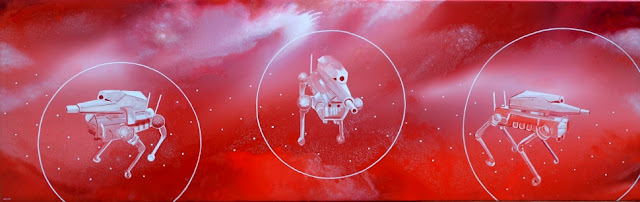
DOGS, QUADRUPEDS AND ROBOTS

1. Content Tagging: A Spoof Watercolur on paper 30 x 42 cm 2020


This is another fun post, albeit with a dark side. My last post Face Database: Kathryn's Dataset Map was fun, but also dark.

Dogs, Quadrupeds and Robots is a collection of recent paintings where I depict dogs, one a weaponised robotic quadruped. I refuse to call the quadruped robots, dogs! 

* Since writing this post, I have created another quadruped painting, this time called Lethal Litter

The last photograph is me with our family dog - an Australian kelpie. You will see she is the model for my real dog renditions.

ROBOT THAT 'WAGGED' ITS TAIL
I have 'met' a robot quadruped (Boston Dynamics). I met this robot quadruped at the Australian Army's Landforces Exposition this year, in Brisbane. The robot was 'wandering' around the expo, its remote controller nearby. It caused quite an excited stir, with people responding to it, as it wagged its tail, went up to them and moved with dog-like movements. 

I was both surprised and not surprised by people's reactions. I was not surprised because this quadruped could certainly mimic some doggy behaviour, and living dogs are lovely! Yet, this robot was clearly a robot - and here I was, witnessing multiple adults responding quite excitedly to a non-living robotic quadruped, almost as if it was a real dog. The experience left me feeling somewhat uneasy. 

When the robot quadruped encountered me, it approached, and its tail was wagged. I refused to respond, but it was hard not to wag back! Its wagging so reminded me of our kelpie's wagging tail movements! Because I just stood there and did not respond, it moved away. The remote operator, who I had located out of the corner of my eye, seemed a bit disappointed. A few seconds later the robot stumbled, tripping on something as it turned a corner. The remote controller turned it off. While robot quadrupeds are supposed to be great on rough and difficult terrain, they're not so good at expos - for now anyway.

GREAT ARTICLE
This great article "See Spot save lives: fear, humanitarianism, and war in the development of robot quadrupeds" was recently published by Dr. Geoff Ford and Dr. Jeremy Moses. The article goes into the history of Boston Dynamic’s robot 'Spot', plus tracks public responses to images, videos and news stories about 'Spot'. The article really opens up the dilemma of civilian - military robotic use. Robots [including drones] have many good purposes, but they can be militarised, as the recent case of the weaponised quadruped developed by Ghost Robotics shows. Ford and Moses mention this weaponised quadruped in their article too. 

Regular readers will know why I found Ford and Moses's article interesting - because the militarise-ability of civilian technology needs critical attention. It is not a simple matter of dual-use. 

Clearly there's more to say, but I will leave you to think about it...
Cheers,
Kathryn
P>S Update. Another quadruped post Verification Error: Identity Crisis


2. Walking the Dog in the Drone Age  Oil on linen 82 x 102 cm 2020

Walking the Dog in the Drone Age was inspired by an early Covid story of a person in lockdown in Malta using a drone to walk their dog.   


3. Strange Times Gouache on paper


4. Border Crossing Watercolour on paper 24 x 32 cm 2020

This painting was inspired by border restrictions imposed between Australian states during the ongoing COVID19 pandemic. 


5. Biped and Quadruped: Warfighters Oil on linen 60 x 110 cm 2021

The robot quadruped is weaponised...

6. Lethal Litter Oil on linen 36 x 112 cm 2021
 
Dark play on the word litter - rubbish or a litter of puppies!

7. Future Memory Oil on linen 122 x 137 cm 2021

Future Memory does not feature a dog. It does, however, relate to Walking the Dog in the Drone Age, above. In Future Memory a human is being walked by a drone. Maybe we human beings will be the future pets?

 
8. Me with our family dog - an Australian kelpie.

Friday, November 19, 2021

KATHRYN'S DATASET MAP OF FACIAL EXPRESSIONS

Face Database: Kathryn's Dataset Map Gouache on paper 30 x 42 cm 2021


This is a bit of fun - playing with the concept of face datasets that assist in training AI for facial recognition and expression analysis. I've mapped correlations between my various faces eg: check out the links I make to the mansplaining face! 

For artists who use face datasets, or any kind of dataset created by others for an array of purposes, it is important to investigate legal and ethical issues relating to use, appropriation, exhibition, publication  and so on. These issues are particularly relevant for artists who use digital and cyber new media platforms, and who may use images or datasets from other sources. There seems to be a cascading array of issues relating to use, appropriation, privacy, copyright etc in a world of digital images, distributed or accessed via the internet. 

That's why I paint! That's why I use paint to parody and critique. I love painting!

Please enjoy Kathryn's Dataset Map. It kind of channels the emoji look, but also Humpty Dumpty and other Egg Heads   

Cheers, Kathryn😁


Sunday, November 14, 2021

SPECTRUM: ONLINE EXHIBITION

Data Data Gouache on paper 30 x 42 cm 2016


ELECTROMAGNETIC SPECTRUM
Regular readers know that I have been thinking about the increasing interest militaries around the world are paying to the electromagnetic spectrum [EMS], as an enabler of technology, a type of fires, a manoeuvre space and a domain. The fact that EMS is a shared civilian - military resource problematises military desires to dominate, appropriate and ensure access. 

In the techno-world in which we live, we are all reliant on the EMS to enable digital and cyber technologies, to allow networking and interconnectivity, and also interoperability. 

I've been interested in the EMS for some time. 

When I started painting airborne drones in 2015, I also started visualising the normally invisible signals that connect the drones to remote controllers and to GPS satellites. I also visualised sensor detection, targeting and transmission arrays. These paintings were informed by my Master of Philosophy research at the University of Queensland. I completed my M. Phil in 2017. My paintings from 2020 are inspired by my PhD research, Curtin University, Western Australia

ONLINE EXHIBITION
This online exhibition of fifteen paintings tracks my interest in the EMS and my ideas of the 'spectrum warfighter'. This fighter could be human, an enhanced human, a robot, an algorithm, an avatar in a simulated wargame. One question I think about a lot is - how doe we memorialise when the warfighter is no longer human? This question has lead me to another question - how do we memorialise when the warfighter was never alive?

Please click on the hyperlinked titles to read the previous posts for each painting.

Cheers,
Kathryn


Not a Game Gouache and watercolour on paper 57 x 76.5 cm 2016


Space Net Gouache on paper 56 x76 cm 2017


New Star-False Star Oil on linen 97 x 112 cm 2018


Charting the Invisible gouache on paper 30 x 42 cm 2019


01010111 01000001 01010010 WAR Gouache on paper 30 x 42 cm 2021


Theatre of War-Spectrum Gouache on paper 56 x 76 cm 2021


Spectrum Warfighter Gouache and watercolour on paper 30 x 42 cm 2021


Theatre of War-Domain Dominance Gouache on paper 56x76 cm 2021


Theatre of War-Spectrum Access Gouache on paper 56 x 76 cm 2021


Theatre of War-Infrared Gouache on paper 56 x 76 cm 2021

The Tree Asks, What Can't You See? Gouache on paper 30 42 cm 2021


Theatre of War-Photon Gouache on paper 56 x 76 cm 2021

Spectrum Warfighter 2 Oil on linen 61 x 66 cm 21


Theatre of War - Photons Do Not Care Oil on linen 92 x 112 cm 2021
 

Saturday, November 06, 2021

SPECTRUM WARFIGHTER 2: HUMAN, ROBOT, ALGORITHM OR AVATAR?

Spectrum Warfighter 2 Oil on linen 61 x 66 cm 2021

Spectrum warfighters and the Electromagnetic Spectrum
I've got this thing in my head - a picture of a spectrum warfighter. Is it human, is it an enhanced human or is it a robot? The term 'warfighter' can be applied to a living and non-living entity, even an algorithm. The term 'warfighter' is actually a loaded term!

I have painted a few spectrum warfighters recently* - for me, they are entities that use the electromagnetic spectrum [EMS] as a means of fighting wars, in the broadest sense. This could mean as a fixed or moving enabling node in a networked system of interoperable systems and hardware. It could also mean something more, for example, as a disseminator of information or disinformation. It could mean jamming or interrupting an adversary's signals. The spectrum warfighter, whether human or not, is an integral part of contemporary war, in all its iterative and often concurrent manifestations - grey zone, hybrid, cyber. information and kinetic warfare. 

Spectrum Warfighter 2
In my new painting Spectrum Warfighter 2 I have painted VR [virtual reality] goggles that wrap around the warfighter's head. This reflects upon military interest in augmented and integrated visual aides for things like improved situational awareness. Integrated means that the goggles can be, for example, wifi connected to other sensors carried by the warfighter, and also connected to other close or remote warfighters/hardware. Goggles can also be connected to firearms...

 My spectrum warfighter hovers, as if suspended in the sky or space, or maybe its an image on a computer screen? The warfighter's body is not complete. Maybe its torso is a visual metaphor for a system of warfighting, like a logo? Maybe my warfighter is injured, a real or metaphoric casualty? Maybe the warfighter is simply appearing out of a mist? I'll let you wonder on about the possibilities!

Spectrum Warfighting and the Metaverse
My warfighter also has no face or facial features that can help us work out whether it is human, robotic or an avatar. Facial features are obscured by the augmenting goggles, and what might be a balaclava-like hood. Who knows! Your guess is as good as mine!

If my spectrum warfighter is a 'portrait' of an avatar, maybe it is ready for wars in the Metaverse?  


*More Spectrum Warfighters:

Biped and Quadruped Warfighters
Theatre of War: Spectrum Access
Spectrum Warfighting: Invisibility

Cheers,

Kathryn


Monday, October 25, 2021

BIPED AND QUADRUPED: WARFIGHTERS

Biped and Quadruped: Warfighters Oil on linen 60 x 110 cm 2021
 

Recent news of a weaponised quadruped robot caught my interest - and dismay.

But, was I surprised?  No. 

Biped and Quadruped: Warfighters 
My new painting Biped and Quadruped Warfighters places two figures in circles against a violent red background 'landscape'. The human-like torso is equipped with multiple sensors and antennae. Here, I have also 'played' with Microsoft's recently touted networkable military grade goggles that use an 'Integrated Visual Augmentation System' to enhance soldier situational awareness. The other figure is a robotic weaponised quadruped - I refuse to call it a dog!

Is the human-like torso actually a human being, or is it also a robot, or an anthropomorphised representation of a system? You decide!

I placed each figure in a circle to denote their compliance with a network, with a 'cloud'. This refers to a few other recent paintings. Two examples are Theatre of War: Infrared and Theatre of War: Everywhere Cloud 

The quadruped warfighter seems to lead the other warfighter - they both face the same direction. The quadruped leads as a lethal scout.

Recurring Question
I have lots more to say! - but a recurring question I have is - How do we memorialise when the warfighter was never alive?


And, just in case you missed it!

THE DEAD PRUSSIAN PODCAST

My interview with Mick Cook from The Dead Prussian Podcast is live! We discuss my work, research, creative practice and the future of war. I am thrilled to be given opportunities like this! 

The term 'Dead Prussian' refers to nineteenth century General Carl von Clausewitz, who wrote the famous tome On War. Regular readers will know that I reference Clausewitz in my Theatre of War series of paintings. Clausewitz uses the term 'theatre of war' variously and often in On War.

Cheers,
Kathryn

Tuesday, October 19, 2021

THEATRE OF WAR: EVERYWHERE CLOUD

Theatre of War: Everywhere Cloud Oil on linen 92 x 112 cm 2021
 

NEWS

THE DEAD PRUSSIAN PODCAST

My interview with Mick Cook from the Dead Prussian Podcast  is live. We discuss my work, research, creative practice and the future of war. I am thrilled to be given opportunities like this! 

The term 'Dead Prussian' refers to nineteenth century General Carl von Clausewitz, who wrote the famous tome On War. Regular readers will know that I reference Clausewitz in my Theatre of War series of paintings. Clausewitz uses the term 'theatre of war' variously and often in On War.


Theatre of War: Everywhere Cloud 
My new painting Theatre of War: Everywhere Cloud is number 12 or 13 in my series Theatre of War. Clausewitz has been a great inspiration! The title also refers to Derek Gregory's idea of the everywhere war ie: war has reached beyond geography into the cyber world and space. 

Gregory's concern for people on the ground, the victims of war, is obvious in his very detailed analyses of events, such as a 2010 US drone attack that killed 23 Afghan civilians. You can hear him describe and talk about his forensic analysis of the attack in his recorded keynote speech for the Aesthetics of Drone Warfare conference, University of Sheffield, February 2020. I spoke at, and attended, this conference too - just before the pandemic derailed the planet! Gregory's keynote was riveting and disturbing - a detailed analysis of US forces' misunderstanding of data, lack of experienced personnel and more.

Clouds
Theatre of War: Everywhere Cloud is preceded by a number of other paintings that 'speak' to the idea of The Cloud, fake clouds, notions of interoperability, networking, interconnection and military joint force. Three of my most recent paintings are Paradox  and Theatre of War: The Cloud and Theatre of War: Infrared

Come Fly With Me!
As with my other two paintings, and indeed, most of my paintings, the viewer is invited to fly in imagination. Are you above, below, beside or inside the 'cloud'? I call this an act of imaginational metaveillance

Glimpses of technology are visible from behind cloud-like formations. They are painted red to indicate blood, danger, violence, fear, contagion. The red colour connects them visually across their multiple domains, from under the sea to space. Red and white circles, denoting the use of, and reliance upon, frequencies in the electromagnetic spectrum draw everything into the war-play, the theatre of war - everywhere. With light-speed signal transmission within networked systems, I argue that Gregory's notion of the everywhere war needs now to be extended in to time and speed.

If you would like to know more about what I think of speed, time and contemporary war, please listen to my Dead Prussian Podcast - Mick asks all his guest the same last question - which is - Can you please finish this sentence "War is......" 

Cheers,
Kathryn

PS. Oh, and another podcast - this time my interview with Dr. Beryl Pong. lead researcher for the Aesthetics of Drone Warfare project, University of Sheffield. 

Monday, October 11, 2021

PARADOX

Paradox Gouache and watercolour on paper 56 x76 cm 2021


THE DEAD PRUSSIAN PODCAST
Before I write about Paradox - an alert! 

Yesterday my interview with Mick Cook from the Dead Prussian Podcast went live. We discuss my work, research, creative practice and the future of war. You can listen to my interview HERE  I am thrilled to be given opportunities like this! 

You can see the list of other great interviews on The Dead Prussian Podcast site. I have listened to quite a few, and they are always interesting, with a diverse number of topics and interviewees. 

The term 'Dead Prussian' refers to nineteenth century General Carl von Clausewitz, who wrote the famous tome On War. Regular readers will know that I reference Clausewitz in my Theatre of War series of paintings. Clausewitz uses the term 'theatre of war' variously and often in On War.


THE STORY OF PARADOX
Paradox is the result of a commission from Group Captain Jo Brick, Royal Australian Air Force. We met when I exhibited paintings at the Australian Defence College in Canberra. Group Capt Brick had written an essay "Kill the Enemy, and Don't Forget to Buy Milk on the Way Home" which had won 'Category 2: ADF Officers' section of the Jamie Cullens Defence Leadership and Ethics Essay Competition in 2019. We discussed that I would respond to the essay. Given that the essay is a reflection on the operation of airborne drones, regular readers will know this commission was right up my alley!

Group Capt Brick's thoughtful and hard hitting essay stimulated four paintings - all works on paper. Paradox is the painting she chose. I am delighted!

Below is my artist's statement, written to accompany Paradox

PARADOX

Gouache & Watercolour on Paper 2021

Artist’s Statement: Kathryn Brimblecombe-Fox

Paradox was inspired by Group Captain Jo Brick’s essay “Kill the Enemy, and Don’t Forget to Buy Milk on the Way Home”. The painting evokes the sense of liminality experienced by remote drone pilots who fight wars and insurgencies in distant countries from inside home-based ground control stations. While inside these bunkers they are at war. Upon leaving the bunker, they re-enter domestic life. As Brick notes “their psychological existence occupies both war and peace”. The ongoing rhythm of this existence creates a liminal zone where the pilot’s psyche grapples with seemingly unreconcilable paradoxes. This agitation is deepened by experiences of witnessing, perpetrating and perpetuating scopic intimacies of surveillance, identification, targeting and killing.

The circles in Paradox link and overlap in ways that draw the drone pilot, the drone, and the surveilled or targeted, together. This occurs against a vast sky, or could it be a seascape? This depends on the viewer’s perspective. A sense of flying, hovering, floating is suggested. Are you a pilot, maybe a drone, a bird or even an intergalactic space traveler passing by Earth? Perhaps you are a target, living a precarious life on the edge of life and death? A melancholic kind of resignation is felt as clouds semi-obscure details. These clouds act as visual metaphors for liminality. They also act as metaphors for the contemporary ‘cloud’ of networked, interconnected and interoperable militarised and militarise-able technologies. This techno-cloud is the drone pilot’s operational space. The colour red disrupts melancholia with warnings of violence. The red squares denote computer screens, ‘windows’ into the scoped lives of the targeted. The red tinged clouds speak to violence, blood and death; reminding us of corporeality in a techno-world. The human-like outline indicates the presence of a human in the loop, but can we be sure of this? It may be a robot.


Cheers,
Kathryn

Sunday, October 03, 2021

THEATRE OF WAR: INFRARED

Theatre of War: Infrared Gouache on paper 56 x 76 cm 2021


I've lost count of how may paintings are now in my Theatre of War series. I think maybe 12 or 13. 

Theatre of War: Infrared continues my investigation into how Clausewitz's ideas of the theatre of war can inform critical approaches to contemporary war. I am also interested in how Clausewitz's ideas may reach their limits with the contemporary mutation of war into a kind of everywhere-ness - like a contagion. In my first Theatre of War post and painting, I explain my interest in Clausewitz. 

Theatre of War: Infrared is also a continuation of my research into the increasing military interest in the electromagnetic spectrum [EMS], as an enabler of technology, a type of fires, a manoeuvre space and a domain. I have painted a cloud-like array of circles against a red sky. Signals transmitted by various frequencies in the EMS are indicated by full lines or dotted lines. These lines visualise a signalic occupation of our extended environment, from land to space-based assets. I 'see' this as a force of techno-colonisation. The fake clouds are a clue!

The red background could be many things, a fiery war zone, a heated planet, or the use of infrared frequencies for communication, high energy lasers or detecting warm things. The latter feeds into surveillance and targeting. Ever since my pest controller showed me how his infrared camera could detect pests, the association of infrared with pest control has stuck in my mind. With this in mind,  surveillance and targeting using infrared technology could be described as acts of an exterminator.  


NEWS

* Please check out Dr Beryl Pong's article "The Aesthetics of Drone Warfare", The British Academy, September 2021. Happy to say she mentions my work, which was included in an exhibition Dr. Pong curated last year. I also presented at the Aesthetics of Drone Warfare conference at Sheffield University in February 2020 [when we could still go places!]. Dr. Pong leads the Aesthetics of Drone Warfare research project.  

* My work is also mentioned in  “Coda: the life, death, and rebirth of drone art” by Arthur Holland Michel, in DroneImaginaries: The Power of Remote Vision, Manchester Uni Press, edited by Andreas Immanuel Graafe and Kathrin Maurer.

AND

If you have not had a look at my last post Wingman: Online Exhibition please do!

Cheers,
Kathryn

Saturday, September 25, 2021

WINGMAN (MQ-28 GHOST BAT): ONLINE EXHIBITION

                                             Wingman (MQ-28 Ghost Bat) Oil on linen 97 x 115 cm 2020


This online 'exhibition' was launched in September 2021. Since then I have made a few updates. In late March 2022 the Loyal Wingman drone was renamed the MQ-28 Ghost Bat. Here's a Boeing Youtube Video  and an article in Defence Connect online about the rename.

2024 UPDATE:

I have added two more paintings that feature my versions of Ghost Bat drones. One is Force Multiplication  and the other Ghost Sky .

2023 UPDATE: 
February 2023, I have added a new painting Ghost Shadows


WINGMAN (MQ-28 GHOST BAT): Online exhibition.

September 2021

What prompted me to curate this online exhibition?

A few days ago it was announced that the Royal Australian Air Force and Boeing jointly developed Loyal Wingman drone [MQ-28 Ghost Bat] is proposed to be assembled at the Aerospace and Defence precinct at Wellcamp airport, near Toowoomba, Queensland, Australia. You can read the Queensland Government media statement here.  

Wellcamp - Toowoomba
I know the Wellcamp area, but it has changed a lot in recent years! Since local Toowoomba company Wagners built the international airport at Wellcamp, Toowoomba has become a major hub, other than for boarding schools, retired country folk, and specialist medical help. I grew up on my parent's grain farm outside Dalby, about an hour west of Toowoomba. I went to school in Toowoomba for the last part of my secondary schooling. My maternal grandfather's family had a property at Drayton, not far from Wellcamp. My paternal grandmother grew up on a farm very close to Wellcamp, on the other side of Gowrie Mt. My paternal grandfather's first property, after returning from WW1 [Light Horse], was also close by. 

Research
As regular readers know I have been researching airborne drones, surveillance systems, and increasingly autonomous systems, for over six years [Update 2024: now nine years]. My current PhD [conferred December 2023] research examines [examined] increasing military interest in the electromagnetic spectrum [EMS] as an enabler of technology, a type of fires [weapon], a manoeuvre space and a domain. The EMS is also an enabler of civilian technology ie: communication, GPS, Internet, Cloud storage, security systems and so much more. So, my PhD research also examines [examined] how signal-enabled connectivity, interconnectivity, and interoperability of systems and devices exposes civilian technology to appropriation by state or non-state militarising forces. 

* My PhD thesis is available at Curtin University's [Western Australia] e-space, Drones, Signals, and the Techno-Colonisation of Landscape.

Wingman (Ghost Bat) Paintings
Last year [2020] I started painting images that included the Loyal Wingman drone, Australia's first manufactured military aircraft in over fifty years. Described as a 'gamechanger' in drone technology, the Loyal Wingman 
[MQ-28 Ghost Bat] is designed to accompany crewed fighter jets. There is a plethora of online commentary about the Ghost Bat drone's capabilities, which include, autonomous functions, enhanced electronic and electromagnetic capabilities, advanced multi-sensor capabilities, and stealth design. Interchangeable nose-cones will provide payload dexterity across a crewed and uncrewed teamed mission. The drone is also export-able. 

In 2019 I wrote a post Pay Attention: The Drones Are Here where I first mention the Loyal Wingman drone. 


WINGMAN - GHOST BAT

THE EXHIBITION 

While informed by extensive research, my paintings are speculative and imaginative. They are the result of what I call 'imaginational metaveillance', a 'flight' into imagined cosmic perspectives. This 'flight' is taken without the aid of augmenting or simulation technology. With the benefit of imagined distance, what anomalies can we see as we fly around and beyond drones and their support infrastructure? I say we because I invite you to 'fly' in your imagination too. 

The paintings are chronologically displayed, from the first to the most recent

Each painting in the exhibition has a hyperlinked title. Please click on these to read my previous posts about each painting. 


Theatre of War Gouache and watercolour on paper 56 x 76 cm 2020


Theatre of War: Terrain Visualisation Gouache on paper 56 x 76 cm 2020


Theatre of War: Smart Team Gouache on paper 56 c 76 cm 2020


Theatre of War: Pattern Recognition Gouache on paper 56 x 76 cm 2020


Verified Landing Site Oil on linen 92 x 112 cm 2021


Future Memory Oil on linen 122 x 137 cm 2021


                                  Theatre of War: Photons Do Not Care Oil on linen 92 x 112 cm 2021

Ghost Shadows Oil on linen 92 x 112 cm 2023


Ghost Sky oil on linen 65 x 112 cm 2023


Force Multiplication Gouache on paper 56 x 76 cm 2023


WINGMAN: List of Paintings

Wingman April 2020

Theatre of War September 2020

Theatre of War: Terrain Visualisation October 5 2020

Theatre of War: Smart Team October 10 2020

Theatre of War: Pattern Recognition October 27 2020

Verified Landing Site  April 2021

Future Memory May 2021

Artificial Trees: Pulling the Future Towards Us June 2021

Theatre of War: Photons Do Not Care  July 2021

Ghost Shadows February 2023

Ghost Sky  November 2023

Force Multiplication  December 2023


Thank you for viewing,
Kathryn


Sunday, September 19, 2021

FREEDOM?

Freedom? Gouache on paper 56 x 76 cm 2021


'End' of US war in Afghanistan August 2021
As US and allied forces left Afghanistan, the Taliban swiftly took over the country's leadership. A short window of time in August saw thousands of people fleeing or attempting to flee Afghanistan. Kabul airport became the epicentre for evacuations of foreigners, and Afghanis fearful for their lives under Taliban rule. 

Like I imagine many readers, I watched the news with mixed heavy feelings - despair, frustration, sadness, hope. One of many images that stuck in my head, was the photograph of the Chinook helicopter flying over the US embassy. Apparently helicopters landed at the embassy site to assist evacuation of US officials out of the embassy building to Kabul airport. 

Chinook Helicopter - Short History
The Chinook helicopter's history is interesting. Early versions were developed in the late 1950s, further developed by Boeing in the early 1960s. The helicopter was first used in combat situations in Vietnam in 1965. This large multi purpose aircraft has been 'hovering' in our visual fields for decades, via livestreamed and photographed war, conflict and humanitarian-aid reporting.. Whether the Chinook is spilling armed soldiers out of its cavernous fuselage, assisting people to flee dangerous situations, carrying equipment in its huge hold or tethered under its massive body, this helicopter is emblematic of contemporary war and conflict.

August 26 Terrorist Attack, Kabul Airport
On August 26 an ISIS-K perpetrated  terrorist attack occurred at the HKIA's Abbey gate at Kabul airport. Sixty people were killed including locals, Taliban members and 13 US service men and women. On August 29 a US retaliatory drone attack killed 10 people. On September 18 US officials confirm [unusually] that these people were all civilians and included 7 children. This signature strike [no identity, but based on patterns of behaviour] represents another horrific failure of intelligence, in a line of fatal flaws. The 2015 Brave New Films documentary Unmanned: America's Drone Wars  provides an informed, critical and horrifying historical context for the August 29 attack. 

Freedom?
Freedom? is my reaction to the recent and quick cascade of events - US and allies' retreat from Afghanistan, swift Taliban leadership take-over, scenes of mayhem at Kabul airport, terrorist attack at the airport, and 3 days later another US drone strike! 

In Freedom? I have painted a hovering Chinook helicopter. It can be 'read' as a helicopter in Afghanistan specifically, or it can be read more generally as a contemporary signifier of war, conflict and disaster. I have painted airborne weaponised drones to represent twenty years of armed drone deployments, and the proliferation of drones used by state and non-state actors around the world. The disastrous drone attack on August 29 is a dreadful indictment on retaliation disguised as a legitimate tactic. Clearly swift retribution was more important than deliberated strategy. Jean Baudrillard made many comments in his 2002 reflection on 9/11, The Spirit of Terrorism, that still reverberate today. Here's two of them to ponder "The repression of terrorism spirals around as unpredictably as the terrorist act itself" and "Another aspect of the terrorists' victory is that all other forms of violence and the destabilisation of order work in its favour."

A line of trees can be read in a multiple of ways. They can act as an horizon or a border, real or metaphoric. As many readers know I often reference the tree-of-life as a way to symbolise human life, and universal life. In Freedom? the trees can be viewed as individual people or groups of people, lives lost, lives under threat, or life as resistance. The cosmic perspective, evident in the painting, opens a critical distance where anomalies, inequalities, lethality and violence demand our attention. 

The trees on the left of the gate appear to be on fire. The trees on the right of the gate are more diversely coloured. I was thinking about people fleeing disaster, some successfully, some not successfully - often a life or death situation. I was thinking about the freedom afforded to westerners with access to things like Chinook helicopters, visas and diplomatic status. I was also thinking about freedom, hoped for and fought for by Afghanis, and others in war and conflict zones around the world. 

The gate could be the Abbey gate at Kabul airport, but that would be too simplistic. I was not there, so it is not my specific story to tell. However, the gate as a symbol is highly charged - the gate between life and death, Heaven and Hell, freedom or subjugation, justice and injustice... The gate in Freedom? is closed, but is it locked? 

Is it guarded?  

Note the question mark in the title of the painting Freedom?

There's more to say - obviously 

Kathryn


* Jean Baudrillard, The Spirit of Terrorism (London: Verso, 2002) 31, 33.


Sunday, September 12, 2021

THEATRE OF WAR: THE CLOUD

Theatre of War: The Cloud Gouache and watercolour on paper 56 x76 cm 2021


This is my 11th or 12th painting in my Theatre of War series. I'll have to write one post with all of the paintings, so you can see them as a body of work! 

PhD Research
Theatre of War: The Cloud is informed by my current PhD research into the increasing interest militaries around the world are paying to the electromagentic spectrum (EMS) as an enabler of technology, a type of fires, a manoeuvre space and a domain. I am examining the use of frequencies for military purposes, and the ability for state or non-state actors to appropriate civilian technology via the EMS. I pay particular attention to the spectrum range from radio to visible light frequencies. 

THE CLOUD
The Cloud ie: the euphemism we ascribe to the contemporary world of networked and interconnected digital and cyber technologies, is of great interest to me. The concept provides the means for interoperability, a key aim for modern militaries. This means that traditional army, navy and air forces work together using technology that networks capabilities across all of their domains. The military term 'joint force' also encompasses the digital and cyber domains of information and cyber war. The space domain is also drawn into this interoperable mix, with satellites playing pivotal roles in communication, operability and connectivity. The Cloud, however, is not just a military asset - civilian technology also relies on the connectivity, operability and communication that EMS enabled Cloud technologies and systems enable and use.

I have been researching the idea of the cloud as a metaphor. One interesting way of thinking about The Cloud is to draw upon John Ruskin's nineteenth century observations of 'plague clouds' and 'plague winds'. Is militarisation of technology, including the militarise-ability of civilian technology, like a 'plague wind' blowing through the EMS? Is The Cloud, therefore a 'plague cloud'? 

Theatre of War: The Cloud
In Theatre of War: The Cloud I have tried to represent an excavation of military interoperability. The painted-in circles at the bottom of the painting are underwater, possibly autonomous underwater vehicles or sensors. Through the middle are land-based and on-sea systems, possibly also autonomous. At the top of the painting, an airborne drone and a satellite over-watch. In each of the circles with obvious clouds, the technology is obscured. This implies that systemic complexity obscures understanding. The repetition of red and white circles across the painting indicates interconnectivity. These circles visually form a stylised cloud that draws all operations together. That this cloud extends beyond the painting is clear. It is part of The Cloud.

While I conceived Theatre of War: The Cloud as an excavation from sea to space, the painting can also be viewed as a map. This play with perspective is deliberate...

Cheers,
Kathryn


Friday, September 03, 2021

LIMINAL OCCUPATION and INTIMATE WAR

Liminal Occupation Gouache on paper 56 x76 cm unframed 2021


Liminal Occupation and Intimate War: Mapped  'speak' to contemporary war, felt acutely by some, peripherally by others. The space between acute and peripheral is also a war zone of lethal potential, its liminality disguising the hurt.   

The paintings speak to:

Scopic intimacies of surveillance, potential lethality and fear.

Landscapes rendered as computational. The drone and its sensors require this after all!

Slipperiness of political accountability. 

Pixels, algorithms, networks, interoperability, increasingly autonomous systems. 

The everywhere stage of the theatre of war, constantly moving from literal war zone, to screen, at speed. 

And lots more.


Intimate War: Mapped Gouache on paper 56 x76 cm unframed 2021


NEWS
On the 23rd September 12 - 1 pm I am moderating a in-conversation event "Good and Evil: The Internet, AI, Law, Ethics and trust" at the University of Queensland Art Museum. Sharing the stage will be excellent panelists:
  • Associate Professor Rain Liivoja, School of Law, The University of Queensland
  • Dr. Kate Devitt, Chief Scientist of the Trusted Autonomous Systems (TAS), Adjunct Associate Professor Human-Computer Interaction, Information Technology and Electrical Engineering, The University of Queensland

Join us, if you can!

Cheers,
Kathryn