Friday, July 22, 2022

HUMAN IN THE LOOP

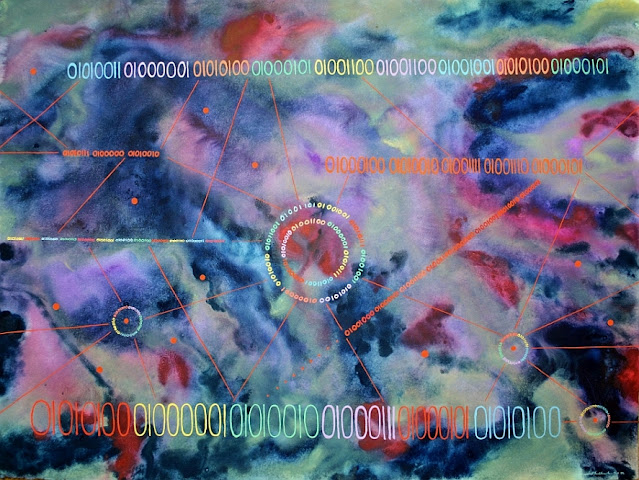
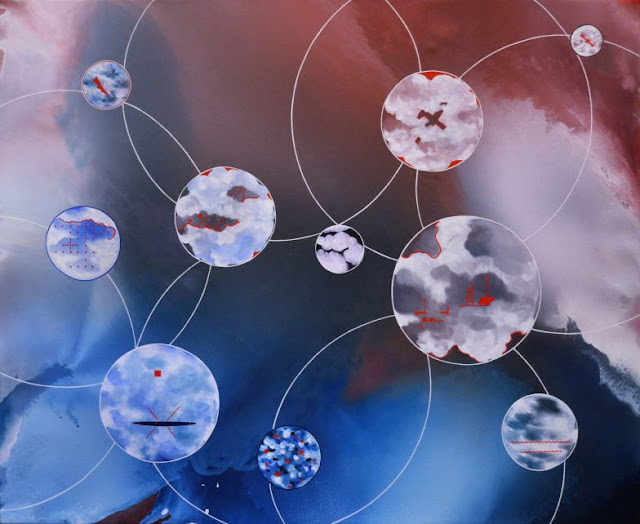
Human in the Loop Gouache on paper 30 x 42 cm 2022
 
NEWS

My work is included in the University of St. Andrew’s, UK, newly launched online Museum of Peace . The Museum exhibits an array of different approaches to peace in different themed ‘rooms’. You can see my exhibit in the Visualising Peace room, plus a couple of the other rooms.

I am thrilled that Otilia Meden, in her thoughtful essay "Cyber Peace and Artivism, with Kathryn Brimblecombe-Fox" has connected my earlier work with my more recent paintings.  

_______________________________________________________________


Autonomous Systems
As technological systems increasingly include autonomous functions, a plethora of questions about human work and agency arise. These questions relate to human labour and human decision making. 

With regards to weapon systems, autonomous functions within a system raise questions about a creeping attrition of human participation. This usurped participation could include activities such as, analysis of data, decisions about deployments of human and non-human warfighters, assessments of kill zones, identification of targets, and more. Autonomous functions enabled by AI and machine learning decrease delay, often caused by human beings taking time to think. Speed is increasingly viewed as a tactical and strategic edge, even a purveyor of weaponry, if not a weapon itself. I have a particular interest in speed, more specifically light-speed electromagnetic spectrum frequency-enabled connectivity and interconnectivity.

Two Paintings
The two paintings in this post, Human in the Loop and Threat, reflect upon the concepts of  'human in the loop' - 'human on the loop' - 'meaningful human control' - 'meaningless human control'. 

In Human in the Loop [above] binary code 'instructs' the word Human. This is followed by text "in the loop.". This is a reference to another recent painting Theatre of War: Law  which is a response to recent news about research into an AI legal assistant for in-combat military situations. The human being becomes an algorithm?

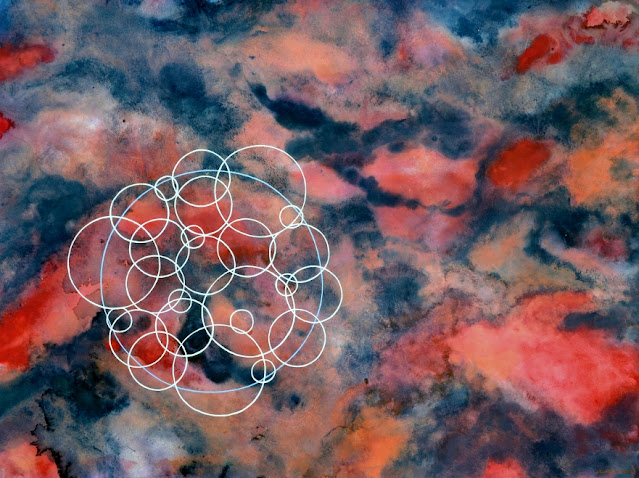
In Threat, binary code at the bottom of the painting 'instructs' the word HUMAN. The aerial view of what looks like a military air force base, seems to be viewed on a 'screen'. Perhaps this is drone footage? Does the code mean that a human being is monitoring the surveillance, identifying the threat, targeting the threat - or - does it mean a meaningless presence?

I use the word 'instruct' because code is essentially instructional. By painting code I attempt to make visible normally invisible instructional forces that drive our techno-world. Painting is a form of resistance, as it does not feed data back into the system. A digital photograph of a painting feeds data about the photo, not the actual process of creating the painting. 

Internet of Battlefield Things
Both paintings also indicate that interconnectivity via 'the Cloud' or the Internet of Battlefield Things [IoBT], enables interoperability across multiple domains. Another recent painting Theatre of War: Internet of Battlefield Things responds to this permutation of 'the Cloud'. 

 I have just listened to the proceedings of a very interesting and serious conference "The Kill Cloud: Networked Warfare, Drones and AI" hosted by The Disruption Network Lab, Berlin, March 2022. Sobering listening. It was a call-out to look beyond the drone [hradware], and to examine the system. This is exactly the focus of my PhD research, examining increasing military interest in the electromagnetic spectrum [EMS], as an enabler of technology, a type of fires, a manoeuvre space and a domain. Without reliable access to the EMS, connectivity, operability, interconnectivity, interoperability - at speed - could not occur. 

And, there's a lot more to write and think about, but I will leave this to you!

Cheers,
Kathryn


Threat Gouache on paper 30 x 42 cm 2022
 

Monday, June 13, 2022

LIGHT SPEED: CRASH

 Light Speed: Crash (After Virilio) Oil on linen 66 x 112 cm 2022


The light barrier “is not something one can cross: you crash into it.”


"To have reached the light barrier, to have reached the speed of light, is a historical event which throws history in disarray and jumbles up the relation of the living being towards the world." 

Both quotes Paul Virilio Speed and Information: CyberspaceAlarm!,” CTheory (August 27, 1995).  
 
_____________________________


Regular readers will know of my interest in the speed of light, the electromagnetic spectrum, technology, war, humanity and the future. One of my other recent paintings is called Speed of Light

Light Speed: Crash (After Virilio) (above) was inspired by reading French cultural theorist Paul Virilio's multiple works on themes of speed, technology and war. As you can see from the date of the above two quotes, Virilio was insightful and incisive in his critiques of technology and speed in the twentieth century. His book Desert Screen: War at the Speed of Light  was first published in 1991, during the first Gulf War. Like Jean Baudrillard, Virilio saw this war's embrace of instantaneous signal transmission of instructions and imagery, as a historical milestone. Since then, the utilisation of the electromagnetic spectrum to enable seeming instantaneity, has conditioned us to speed - light speed or near light speed signal connectivity, interconnectivity, to enable operability and interoperability across civilian and military technologies and systems.

One limit, if not the only limit for these technologies and systems is light speed. It is "not something one can cross: you crash into it.” As we scramble to make sure speed gives us an edge, whether it's high frequency stock trading or weapon delivery/detection, how far/fast can we go?

In Light Speed: Crash (After Virilio) I have tried to give an impression of speed. The cosmic landscape alludes to the fact that the electromagnetic spectrum is universal with a history embedded in the universe's cosmological history. The painting seems to indicate an imminent crash. A 'wall' of symbols visually suggests a limit. These symbols are  c - light speed and y - photon. All frequencies in the electromagnetic spectrum are made up of photons travelling at the speed of light. Radio waves have longer wave lengths, while gamma waves have the shortest wave lengths.  The light spectrum is the only one visible to the unaided human eye.

NEWS

In May, Autonomous Weapon Systems and the Protection of the Human Person: An International Law Analysis by Dr. Diego Mauri, was published by Edward Elgar Publishing. Thrilled that my painting Manhunting 2017 is on the front cover. I met Dr. Mauri at the Aesthetics of Drone Warfare conference, University of Sheffield in February 2020. We were both presenters. 

The book is a thoughtful examination, through an International Law lens, of issues associated with increasingly autonomous weapon systems (AWS). This is intersected with a history of AWS, ethical issues & more. The examination keeps the human being as central to the discussion.


Cheers,
Kathryn

Wednesday, May 18, 2022

HYPERSONIC

HYPERSONIC (AUKUS Dream) Oil on linen 56 x 112 cm 2022


Speed has become a central concern of mine - light speed, hypersonic speed, terms like 'accelerated warfare' +++. I have a chapter on speed in my developing PhD exegesis. I am informed by cultural critic, Paul Virilio's various commentaries on speed - speed of technological development and speed of technological operation. I am also informed by his intersection of speed and war.

HYPERSONIC
This new painting HYPERSONIC: (AUKUS Dream) references Australia's commitment, through the AUKUS [Australia, United Kingdom, United States] partnership, to develop hypersonic weapons and counter-hypersonic capabilities. The painting maps trajectories taken by hypersonic weapons. Ballistic missiles that can fly at hypersonic speeds have set flight paths, and are less manoeuvrable. Hypersonic glide and hypersonic cruise missiles are more manoeuvrable, thus they can evade detection. Evading detection means a target is more difficult to identify. Hypersonic weapons fly at speeds beyond Mach 5 [Mach 1 being the speed of sound]. Google hypersonic weapons, and you'll find lots of information.

AUKUS Pillar 2 clearly identifies hypersonic weapons and counter-hypersonic technology as key activities under the heading Advanced Capabilities. "Hypersonic and counter-hypersonic capabilities. The AUKUS partners will work together to accelerate development of advanced hypersonic and counter-hypersonic capabilities."

Note the word accelerate in the quoted sentence above. Everything is about speed!

Like many of my paintings that visualise signals, flight paths, the techno-cloud and more,  HYPERSONIC: (AUKUS Dream) is an attempt to visualise discrete or invisible aspects of contemporary war. HYPERSONIC: (AUKUS Dream) reveals a 'landscape' of trajectories - hypersonic ballistic missile trajectories and hypersonic glide/guided weapons trajectories. Hypersonic weapons cannot be easily tracked with the naked eye. Sound becomes a residue. Manoeuvrable hypersonic weapons cannot be easily tracked, full stop. Hence the AUKUS partnership is not only about hypersonic weapons R & D, but also "counter-hypersonic capabilities". 

LANDSCAPE
This landscape, like all my obvious and not-so-obvious landscapes, is inspired by my experiences growing up, and living, in western Queensland, Australia. I grew up on a naturally treeless blacksoil plain. While the western horizon is a flat line, often blurred by shimmery mirages, to the east, the Bunya Mt range cuts a majestic silhouette against expansive skies. Driving between my childhood home and Brisbane, to stay with my grandparents, meant travelling through fertile farmland, over the Great Dividing Range at Toowoomba, across the verdant Lockyer Valley, to the big city. 

As an adult I spent eighteen years living further west, in a town called Goondiwindi. Here, the landscape is not naturally treeless, but it is mostly flat. It is a harsher landscape due to less fertile soils. Prickly plants, grey plants, and hardy gums thrive. Driving to Brisbane meant crossing the Great Dividing Range at Cunningham's Gap, near a town called Warwick. One of the most spectacular landscapes I have ever seen, is on the return trip, as you drive towards Cunningham's Gap from the lowlands of the Brisbane Valley. The mountains loom like sentinels, shadows move like ghosts, and the sky is punctured by pointy peaks. It's beautiful!   

HYPERSONIC Landscape
HYPERSONIC: (AUKUS Dream) suggests that invisible forces 'etch' landscape, creating new kinds of insidious scapes that mediate landscape, as well as concepts of environment. This mediation affects how we think of human movement, borders, sovereignty, security, life and death. A patch of red dots, left of centre, references geolocating, terrain visualisation and targeting computer-graphics. This reminds us that landscape is mediated for technologies with increasingly autonomous functioning, particularly movement.  What are the implications for the future of war and humanity? 

For any living creature, human or non-human, at or near a target, speed is life changing or ending. 

Speed is key. Speed can be weapon and a purveyor of weaponry. 

"There is a certain inevitability in the domain of science and technology. We never decelerate." Paul Virilio , Desert Screen, p. 33. 

Cheers,
Kathryn

Saturday, April 23, 2022

SPEED OF LIGHT

Speed of Light Oil on linen 112 x 153 cm 2022
 

Interconnecting circles form a fake cloud across a vast scape. Are you above this fake cloud or below it? The circles are formed by repeating the symbol for light speed - c. 

This painting responds to my research into increasing military interest in the electromagnetic spectrum [EMS]. All frequencies from radio to gamma waves travel at the speed of light in a vacuum. All frequencies are made up of photons. Contemporary military and civilian technologies are increasingly reliant on access to uncontested and uncontested frequencies for operation, connectivity, interconnectivity and inter-operability. Speed is key to seemingly instantaneous operation, connectivity, interconnectivity and inter-operability. 

Just a reminder that speed can kill.

As human beings harness the power and speed of the EMS for civilian and military applications, nations attempt to ensure access and use of frequencies. Even the recently announced Australia, United Kingdom and United States, AUKUS Pillar Two refers to the EMS, under "advanced capabilities";

"Electronic warfare.  The electromagnetic spectrum is increasingly contested.  The three countries will work together to share understanding of tools, techniques, and technology to enable our forces to operate in contested and degraded environments." (White House "Briefing Room" Statement April 5, 2022) 

Selection of other paintings and posts that relate to Speed of Light

Theatre of War: Dromo Domain

Theatre of War: Internet of Battlefield Things

Theatre of War: Everywhere Cloud

Theatre of War: Photons Do Not Care

Theatre of War: Photon

Cheers,

Kathryn

Wednesday, April 13, 2022

INTERFACE: Being HUMAN Being

Interface: Being HUMAN Being Oil on linen 56 x 112 cm 2022
 

Interface: Being HUMAN Being follows my last two works on paper Interface: Being  and Interface. I have been thinking about the human-machine relationship, especially where AI or ML technologies work as interfaces. I am particularly interested in the idea of AI systems operating in more human-like ways, and human beings becoming more like machines. Notice - I wrote AI operating and human beings becoming. 

And, this is a painting, not a digital work. The white on blue represents a fake cloud...

I think I will leave it there! 

Cheers,

Kathryn

P.S. Oh! The code 'instructs' HUMAN

Related Posts:  
Interface Being
Interface


Tuesday, April 05, 2022

INTERFACE: BEING

Interface: Being Gouache on paper 56 x 75 cm 2022
 

Interface: Being follows my last painting Interface. And, in my last post I wrote "My head is full of ideas. Interface is a result of thinking about a lot of things. I've been writing and researching for my PhD, and this painting has been inside my head - my imagination - for a few weeks." My PhD research focuses on the increasing interest militaries around the world are paying to the electromagnetic spectrum (EMS), as an enabler of technology, a type of fires, a manoeuvre space and a domain. 

This new painting above, Interface: Being has also been inside my head for a while!

Human-Machine
The human-machine relationship is a key area of interest. As the speed of technological operation, enabled by light-speed EMS frequency transmissions, increases across inter-connected and interoperable civilian and military systems, the human being is often seen as a point of delay. I have written about this with regards to recent news that an AI military lawyer tool is under development - Theatre of War: Law   and Theatre of War: Techno-Seduction 

Interface: Being 
Interface: Being is also the result of weeks of research and thinking. Like Interface, this new painting also references Douglas Hofstadter, the technological Cloud, real clouds, AI, binary code (01001000 01010101 01001101 01000001 01001110 instructs the word HUMAN), and questions about what it means to be a human being in the 21st century. 

In this new painting, I introduce and play with the word BEING. 


BEING

TO BE

BEING HUMAN

HUMAN BEING

BEING 01001000 01010101 01001101 01000001 01001110 

01001000 01010101 01001101 01000001 01001110 BEING

HUMAN 01001000 01010101 01001101 01000001 01001110 

Interface is both a noun and a verb, and is used as both a noun and verb in computer science, and also in studies of human beings. 

In a human-machine relationship let's think about what is the interface, and what does the interfacing? Is it code - is it signal connectivity - is it human willingness or excitement (therefore, us) - is it need - maybe money - maybe power - is it speed? What do you think? How are we to BE human beings in a world dominated by accelerating developments in technology?

Painting
My choice of medium - painting - is deliberate. Painting helps me probe questions and pose new questions, without techno-interfaces or techno-interfacing. Painting is not reliant an any EMS-enabled digital or cyber technology, yet this does not preclude critique and study of these technologies. Painting is technologically and operatively detached. Detachment in a world of techno-interfaces and interfacing is a form of critical resistance.  

Cheers,

Kathryn


Tuesday, March 29, 2022

INTERFACE


Interface Gouache on paper 56 x 76 cm 2022


My head is full of ideas. Interface is a result of thinking about a lot of things. I've been writing and researching for my PhD, and this painting has been inside my head - my imagination - for a few weeks. 

Here are some ideas, books and thoughts that have influenced Interface 
  • Douglas Hofstader.
    I read Hofstadter's Godel, Escher and Bach (GEB) a number of years ago. A complex, innovative and imaginative book. During my PhD research my supervisor mentioned ambigrams. I did some research and realised that Hofstadter had invented the ambigram. Although I've often pondered his ideas of  recursion, I had forgotten that he had written briefly about ambigrams in GEB. For Hofstadter, an ambigram is a "calligraphic design that manages to squeeze two different readings into the selfsame set of curves" (GEB, p. P-19). It is something, presented in an aesthetic visual manner, that can be read in both up and down orientations.

    As regular readers know, I often use painted binary code as a way to 'play' with and parody ideas of digital technology. The painted code represents the object or thing that I am painting or expressing. I enjoy hand painting something that is normally represented so precisely in digital media. In Interface, binary code for the word HUMAN is reflected in the text HUMAN. I am visually 'playing' with up and down orientations and meanings. The painting poses questions about what it means to be human in a world where human-machine relationships are increasing. For example, what about human work, including creative work, being co-opted or assisted by algorithms?

    The 'reflection' of the binary code in the word HUMAN, and vice versa, is a kind of ambigrammatic ploy to question how we might maintain a sense of being human in the twenty-first century. The code and the word HUMAN are like shadows, but can we see them? Maybe they are shadows of shadows? Where does that place us?

    The word 'interface' is both a noun and a verb. What kinds of 21st century technological interfaces should we be aware of, as we interact and interface with them? 

  • The Cloud.
    Here I mean the technological 'cloud' - the Internet of Things (IoT) where interconnectivity and interoperability keep human beings in relationship with technological devices and systems. We cannot avoid, indeed escape, interfacing in the 21st century! Maybe this is what the shadows of shadows tells us? The background of Interface appears to be a cloudy tumultuous sky -  but  - is it a stormy sea? 

  • More Cloud
    Keeping with the 'cloud' theme, rather than the blue background representing a cloudy sky, I deliberately painted the binary code and letters in white to provide an alternative. Maybe the code/text is 'the cloud'. If you - the viewer - imagine looking up at this fake cloud, the blue background is a sky, even the cosmos. If you imagine being above the fake text-cloud, then the blue background is possibly a tumultuous sea. Maybe you are in front or behind the 'cloud', where it turns into a wall or barrier? This kind of imaginational flight, from below, to above, to around and beyond, is a critical form of engagement. I call it - imaginational metaveillance
     
  • Painting
    The paint medium requires no technological digital or cyber interfaces, yet it can be used to critique them. The hand of a human being is clearly evident. The dynamism between the paint and the paper surface, between the text and the background, 'speak' to relationships rather than interfaces. They 'speak' to relating rather than interfacing.

  • And, then there are ideas of post-humanity. 

  • And, of course, one of my major interests/concerns - militarised technology and the militarise-ability of civilian technology. In an interconnected and interoperable world interfaces and interfacing are key!

  • But, I will stop here and let you ponder!
Cheers,
Kathryn

Monday, March 07, 2022

THEATRE OF WAR: TECHNO-SEDUCTION

Theatre of War: Techno-Seduction Gouache on paper 56 x 76 cm 2022


WAR
Like many others, the war in Ukraine is occupying my mind. The mix of traditional kinetic activity with improvisation across old and new tactics and technologies again raises questions about asymmetric warfare. 

THEATRE OF WAR: TECHNO-SEDUCTION
This new painting, Theatre of War: Techno-Seduction, has a focus on the human. Yes! By presenting everything as an algorithm, even human beings, I pose questions about  technological systems that are interconnected and interoperable. Questions about AI-enabled systems, that reduce or remove human operators are also posed.

For interconnectivity and interoperability to work seamlessly, foundational operative platforms need to be the same or very similar. Hence my use of painted binary code. 

But does homogenisation at any level strengthen resilience or not? Maybe it poses a vulnerability - like pulling out the bottom card of a house of cards, is there risk of collapse. Where does the human being fit in a world of interconnectivity, interoperability and AI-enabled systems? 

So, what have I presented or 'instructed' in algorithmic form?

At the top is SATELLITE. To the left in small zeros and ones is WAR. In the centre, as a circle of code, is MILITARY LAWYER. To the right is DRONE and angled from it is HELLFIRE. To the left of the circle in SURVEILLANCE. The three small circles of code 'instruct' HUMAN - are they warfighters, civilians, friend or foe, victims? The bottom 'instruction' is TARGET. Is the target human or not? If not a human target, destruction of buildings or infrastructure can still cause human fear, suffering and death. 

All these 'instructed' entities are connected by lines that indicate signals, and therefore, reliance on frequencies in electromagnetic spectrum for connectivity and interconnectivity to enable information and data transmission, surveillance capabilities, sensor access, news broadcasting and so on. 

The painting acts as a kind of map.

HUMAN
Despite major advances in militarised and militarise-able technologies that remove many human operators and warfighters from the immediacy of conflict zones, the death and suffering witnessed in places such as Yemen, Afghanistan, Syria, Iraq, Somalia and now Ukraine, remind us that human beings remain in the loop, as my circles indicate, as victims. 

And, we must not forget that human beings also start wars. 

_______________________________________________________________

In another recent painting and post Theatre of War: Law I explain the reference to military lawyer.

NEWS

Third Text Article

Thrilled that my article "Night Vision, Ghosts and Data Proxies: Paintings By War Artist Jon Cattapan" has been published online for Third Text, a leading peer reviewed international journal dedicated to the critical analysis of contemporary art in the global field. The hardcopy is forthcoming.

Cattapan was an official Australian war artist in Timor Leste in 2008. Key to his subsequent paintings were his experiences using night vision technology while accompanying Australian Peace Keeping forces on night patrols. The effect of the night vision green entered his paintings in ways that continue to 'speak' to us today. Thus, I analyse Cattapan's paintings through a 'future of war' lens-a future we are now living, nearly 15 yrs later. I argue that although the paintings were inspired by experiences in Timor Leste, the images could relate to the iterative modes of contemporary, and likely future war, ie: grey zone, hybrid, informational, cyber, as well as kinetic warfare.


Cheers,
Kathryn
                                                             

Tuesday, February 15, 2022

THEATRE OF WAR: TECHNO-COLONISED PLANET

Theatre of War: Techno-Colonised Planet Gouache on paper 56 x 76 cm 2022
 

NEWS

Third Text Article

Thrilled that my article "Night Vision, Ghosts and Data Proxies: Paintings By War Artist Jon Cattapan" has been published online for Third Text, a leading peer reviewed international journal dedicated to the critical analysis of contemporary art in the global field. The hardcopy is forthcoming.

Cattapan was an official Australian war artist in Timor Leste in 2008. Key to his subsequent paintings were his experiences using night vision technology while accompanying Australian Peace Keeping forces on night patrols. The effect of the night vision green entered his paintings in ways that continue to 'speak' to us today. Thus, I analyse Cattapan's paintings through a 'future of war' lens-a future we are now living, nearly 15 yrs later. I argue that although the paintings were inspired by experiences in Timor Leste, the images could relate to the iterative modes of contemporary, and likely future war, ie: grey zone, hybrid, informational, cyber, as well as kinetic warfare.


Theatre of War: Techno-Colonised Planet 

This new painting relates to a few other recent paintings - examples: Theatre of War: Plague Cloud, Theatre of War: Dromo-Domain and Theatre of War: Law

Invitation to 'Fly'
In Theatre of War: Techno-Colonised Planet you are invited to fly, in your imagination, away from Earth. When you are ready, you peer back at the planet from a distance. And, from this distance what patterns become apparent? For me, I see a planet occupied by an insidious fake cloud that extends from Earth to orbiting satellites. The outline of the pale blue dot shimmers like a ghost behind the 'cloud'. This 'cloud' represents the ubiquitous presence of interconnected and interoperable systems, all reliant on access to, and use of, the electromagnetic spectrum (EMS). 

But, what if you are not 'flying' at a great distance from Earth? What if you 'fly' in closer? What if this is an image on a computer screen and you have flown through the window of a ground control station where remote operators sit in front of an array of computer screens? What if the white circles are computer graphics indicating techno-territorial occupation? Given that civilian technology and military technology rely on the same conduit and enabler, ie: the EMS - is the fake cloud an indication of dangerous synchronicity and homogeneity of techno-system operation? Does it represent an ever-ready always-on war preparedness, especially when various iterations of contemporary war are increasingly perpetrated via technological devices and systems - grey zone, hybrid, information and cyber warfare.

Whether you are flying at close or far distance -  your imagination is the critical tool. For me, this is how imaginational metaveillance works to become a resistance to the kind of normalised techno-surveillance of the world in which we live. 

As artist and writer James Bridle notes, "Today the cloud is the central metaphor of the internet: a global system of great power and energy that nevertheless retains the aura of something noumenal and numinous, something almost impossible to grasp."* In Theatre of War: Techno-Colonised Planet I have tried to 'grasp it'. My invitation for you to take imaginational flight, is my way of sharing this quest.
  
Cheers,
Kathryn

*James Bridle, The New Dark Age: Technology and the End of the Future (London: Verso, 2018), 6.


Saturday, February 05, 2022

THEATRE OF WAR: LAW

Theatre of War: Law Gouache on paper 56 x 76 cm 2022


LEGAL AI
I read a report "VISIMO and West Point Advancing Artificial Intelligence for Judge Advocates" [January 11, 2022] which provides a brief outline of research conducted to develop an AI enabled legal assistant for the military. Not surprisingly speed is the compelling issue. Here's a quote from the report

With the development of autonomous weapons, the speed of warfare is increasing. Stationed at combatant commands and Air Operations Centers worldwide, Judge Advocate General (JAG) Corps members provide critical legal advice during combat, including use-of-force decision-making recommendations. However, Judge Advocates are not equipped to keep pace with modern combat.

SPEED
As regular readers know, I have been interested in the issue of speed and war, speed and technology, interconnectivity and inter-operability, for some time. I often refer to cultural critic Paul Virilio's various statements and ideas about speed, particularly the harnessing of light speed [or near light speed]. In regards to AI legal assistants/lawyers, embedded into the Internet of Battlefield Things speed saves time. In doing so, in an interconnected & interoperable system, speed acts as a force multiplier. Whatever is speeded up becomes part of this force multiplication. 

Speed has become an enabler, a tactic and a strategy. It is a purveyor of weaponry, but could also be considered a weapon itself. Speed could also be considered a domain - inspired by Virilio, I call it a dromo-domain

Theatre of War: Law 
This painting (top of page) was directly inspired by the article mentioned above. Like some other recent paintings I visualise a 'cloud' of circles as a parody of The Cloud, the Internet of Things, the Internet of Battlefield Things, The Internet of War Things. My 'clouds' can also be interpreted as revelatory landscapes of the normally invisible ie: the connections enabled by technological interconnectivity and interoperability. These landscapes could also be pre-emptive counter-maps, surveying and revealing bourgeoning techno-colonising forces. Like many of my paintings, the viewer can imagine soaring beyond, below, behind and in front of these techno-scapes. This is an act of what I call imaginational metaveillance. 

In Theatre of War: Law the central circle is a string of painted binary code 'instructing' MILITARY LAWYER. This circle is connected to an array of circles, some created using the symbol for light speed (c)  and one circle created with the symbol for photon (y). My use of these scientific symbols references the fact that all frequencies in the electromagnetic spectrum are made up of photons, travelling at the speed of light. The light spectrum is the only frequency we can see with the naked eye. 

The circles clearly extend beyond the painting, thus the central MILITARY LAWYER circle may not ultimately be central at all - is there, in fact, a centre point in an always-on interconnected and interoperable system where civilian and military assets and activities intersect? This poses questions about command and responsibility - as Virilio notes “acceleration of reality tends to reverse the principle of responsibility”.[1]

Detail Theatre of War: Law

I will leave you to ponder more. Because, of course, there are many other issues associated with AI, such as bias, unintended outcomes, accidents, nuance, and more. Time will tell how these issues will be dealt with by the developers of an AI legal tool designed to operate in fast moving battle, war, conflict situations.

Cheers,

Kathryn 


[1] Paul Virilio, The Original Accident, trans. Julie Rose (London and Malden, MA: Polity, 2007), 90.


Tuesday, January 25, 2022

THEATRE OF WAR: INTERNET OF BATTLEFIELD THINGS


Theatre of War: Internet of Battlefield Things Gouache on paper 56 x 76 cm 2022


NEWS
The Visualising War project, University of St. Andrew's UK interviewed me late last year & the podcast Painting Invisible Threats with Kathryn Brimblecombe-Fox went live earlier this month. I am thrilled to be part of such a great podcast series

And, there is really insightful accompanying post about my paintings and research Painting Invisible Threats 


Theatre of War: Internet of Battlefield Things

I think this is my 16th Theatre of War painting. The series of works on paper and oil paintings is growing. It would make a great exhibition!

AI Fighter Pilots
Theatre of War: Internet of Battlefield Things was inspired by an article in the The New Yorker, The Rise of A.I. Fighter Pilots by Sue Halpern. She writes "Artificial intelligence is being taught to fly warplanes. Can the technology be trusted?" It is a fascinating article about attempts to teach AI to fly warplanes in a dogfight. Halpern, however, does contextualise this specific aim within a broader military AI pursuit; "Artificial intelligence is being designed to improve supply logistics, intelligence gathering, and a category of wearable technology, sensors, and auxiliary robots that the military calls the Internet of Battlefield Things." 

IoBT
The Internet of Battlefield Things [IoBT] is another way to think about digital and cyber connectivity, interconnectivity, inter-operability, and their contributions to joint [military] force capabilities. Frequencies in the electromagnetic spectrum [EMS] enable these technologies, with light speed - or near light speed - operative functioning. Speed is now a key tactical and strategic component for modern militaries. Speed saves time, even nano-seconds. Speed and time create advantages in a race for the kind of technological prowess modern militaries aim for. They are viewed as essential for future war preparedness and capability.

AI and ML technologies replace the human being at junctures where human speed and time are viewed as disadvantageous or an impediment. This has spurred increasing developments in autonomous systems. These include, but are not limited to, such things as on-board sensor analysis for target identification and tracking, robotic motility through rough terrain, drone flight especially in a swarm, AI optimisation of EMS frequency use. Interestingly research is being conducted into AI military lawyer capabilities. Here is a quote from a recent announcement VISIMO and West Point Advancing Artificial Intelligence for Judge Advocates that 'speaks' to the issue of speed.

With the development of autonomous weapons, the speed of warfare is increasing. Stationed at combatant commands and Air Operations Centers worldwide, Judge Advocate General (JAG) Corps members provide critical legal advice during combat, including use-of-force decision-making recommendations. However, Judge Advocates are not equipped to keep pace with modern combat.

Theatre of War: Internet of Battlefield Things
This new painting references my last oil painting Theatre of War: Dromo-Domain. However, rather than one circle I have painted multiple circles, each created with the symbol for light-speed ie: c. I love the way the circles kind of move, if you look at them intensely. This was a discovery that's quite serendipitous!

Each circle is connected to another circle and some seem to extend beyond the painting. Regular readers will pick up that I am playing with the idea of 'the cloud', visualising it's technological construction - a fake cloud. I am also playing with the ideas of interconnectivity, inter-operability and joint force. 

With "Artificial intelligence is being designed to improve supply logistics, intelligence gathering, and a category of wearable technology, sensors, and auxiliary robots that the military calls the Internet of Battlefield Things" in mind, I have tried to question whether the IoBT is really separate from the IoT [Internet of Things]. I mean, all the activities described in the quote could also apply to civilian needs. Here, I am positing that the militarise-ability of civilian technological systems and devices as a concern. Is the contemporary theatre of war a combination of the IoT and the IoBT? In an age of cyber and information warfare, grey zone and hybrid warfare the civilian world is clearly immersed in the contemporary theatre of war. How about an Internet of War Things - IoWT - as a descriptor?

Cheers,
Kathryn
P.S. The article about AI military lawyers has sparked a few ideas for paintings - stay tuned!

Wednesday, December 22, 2021

THEATRE OF WAR: DROMO-DOMAIN

 Theatre of War: Dromo-Domain Oil on linen 90 x 100 cm 2021

CLAUSEWITZ
I think this is my 14th or 15th Theatre of War painting. I was inspired to start this ever-growing series by late 18th/early 19th century Prussian General, Carl Von Clausewitz's famous tome On War. He often mentions the term 'theatre of war'. Reading through the text, I get the impression he thought it involved a number of factors, but geography was a central theme. 

I think about what 'theatre of war' might mean in the 21st century, the age of digital and cyber technology, drones, drone swarms, ubiquitous surveillance and increasingly autonomous systems. Regular readers will know I am probably a bit dystopian in my outlook. This is because I 'see' contemporary networked, interconnected and inter-operable technology as an homogenising and standardising force that enables the 'theatre of war' to extend not only beyond geography, but also traditional ideas of military activity and reach.* Because of the shared nature of technological platforms and systems I am particularly concerned about, and interested in, the militarise-ability of civilian technology. Here, increasing military interest in the electromagnetic spectrum [EMS] as an enabler of technology, a type of fires, a manoeuvre space and a domain is a key concern. Why? Because civilian technology also relies upon access to the EMS. Information and cyber warfare, and terms such grey-zone and hybrid warfare, all 'speak' to permeable military-civilian boundaries. I am also interested in the militarisation of imagination, time and speed. So, you can see, my ideas of the contemporary 'theatre of war' encompass almost - maybe all of- everything!

DROMO - SPEED
Theatre of War: Dromo-Domain is a visual spin on Paul Virilio's thoughts on speed and the term he coined, dromology ie: the logic of speed applied to contemporary society. Virilio, in a number of books and articles*, argued and observed that speed and accelerating speeds of technological operation and development play major roles in societal, political and geopolitical stability. As developments in networked and interconnected digital and cyber technologies have accelerated, light-speed [or near light-speed] signal transmissions introduce speed as a necessary advantage for both civilian and military technology. It is commercially, politically and militarily tactical to use speed as an advantage. One of my favourite quotes from Virilio is  "The fact of having reached the light barrier, the speed of light, is a historic event, one which disorients history and also disorients the relation of human beings to the world. If that point is not stressed, then people are being disinformed, they are being lied to. For it has enormous importance. It poses a threat to geopolitics and geostrategy.” (1)

HOW TO VISUALISE SPEED
I have grappled with how to visually convey speed as an overarching dromo-domain that encompasses civilian and military technology in a pervasive and persistent 'theatre of war' that extends from Earth to orbiting satellites. 

In Theatre of War: Dromo-Domain I have repeatedly painted the symbol for light speed ie: c, to form a circle around the Earth. I love how the cs look like the spurs on a spinning cog, and that a sense of speed is created. The Earth is the 'pale blue dot'. This circle of cs represents the major satellite orbiting zones around the Earth. From these orbits to Earth, is our sphere of influence, where the EMS is harnessed for an array of communication, operative and inter-operative civilian and military technological functions. How are we managing this sphere of influence? I 'see' it as a volumetrically occupied and techno-colonised space. 

In Theatre of War: Dromo-Domain the multiple overlapping white circles are indicative of civilian and military activities and domains. Clearly the term dual-use is inadequate in the era of speed, where networking, interconnectivity and interoperability scaffold us all in invisible webs of signals. This is a militarised space - a dromo-domain that enables and cradles more traditional military domains of land, sea and air. It is the meta-domain.

IMAGINATIONAL METAVEILLANCE
The cosmic-like background in Theatre of War: Dromo-Domain continues my quest to stimulate flight, your flight and mine [in imagination], to places where we can gain new perspectives. I call this 'imaginational metaveillance' - a kind of veillance that does not rely on EMS-enabled technology, thus it is untethered from it. The cosmic landscape also alludes to universal history, which includes the history of the EMS. All frequencies in the EMS are made up of photons, traveling in waves at light speed. The photon appeared around 10 seconds after the Big Bang. This kind of cosmological history really gets me thinking about how, in our sphere of influence, are we using a natural universal resource. 

* Paul Virilio and Jean Baudrillard inform my ideas here.
Cheers,
Kathryn

PS. Related recent posts/paintings include:

(1) Paul Virilio, “Red Alert in Cyberspace,” trans. Malcolm Imrie, Radical Philosophy (Nov/Dec 1995): 2.

* Just a small few examples of Virilio's work
Paul Virilio, Speed and Politics, first published 1977.
Paul Virilio, The Original Accident, trans. Julie Rose (2007
Paul Virilio, The Great Accelerator, trans. Julie Rose (2012)

Tuesday, December 14, 2021

THEATRE OF WAR: PLAGUE CLOUD


 Theatre of War: Plague Cloud Oil on linen 112 x 92 cm 2021


Theatre of War: Plague Cloud is number 13 or 14 in a growing Theatre of War series of paintings [oil paintings and works on paper]. It is also one of a number of cloud paintings ie: 'playing' with real clouds and The Cloud - the 21st century pervasive techno-network.

The Cloud
As noted in a recent post for another painting Theatre of War: The Cloud I have been researching the idea of the cloud as a metaphor. Here, John Ruskin's observations, made in two speeches at the London Institute in 1884, of 'plague clouds' and 'plague winds' have helped me think critically about The Cloud. I ask, is militarisation of technology, including the militarise-ability of civilian technology, like a 'plague wind' blowing through the electromagnetic spectrum [EMS]? Given that the EMS operatively enables contemporary technological connectivity, interconnectivity and networking, could The Cloud, therefore, be a 'plague cloud'? 

Contagion
In Theatre of War: Plague Cloud I have repeated some of the motifs I used in Theatre of War: Everywhere Cloud where circles contain elements of military hardware or systems used underwater, on the water, on land, in the sky and in space. These systems 'peek' out of their 'cloudy' domains, but all of them are drawn into a larger 'cloud' of repeated circles that represent interconnectivity, networked systems, interoperability and joint force operations. This large 'cloud' extends beyond the painting. Like an airborne contagion it threatens to wrap its techno-tentacles around the globe, potentially drawing each military and civilian device into its 'cloudy' web. 

Theatre of War: Plague Cloud's background, painted with a combination of blue and rust red, appears 'dirtier' than some of my other 'cloudy' paintings. This helps to channel the idea of a plague that infects the environment. Here, I note Ruskin's observations of dirtier looking skies and clouds painted by artists, such at J. M. W Turner, who responded to a changing environment during the early 19th century industrial revolution. It also demonstrates a vulnerability, because once the world is techno-wrapped, can we unwrap ourselves or be unwrapped? What happens if The Cloud fails and it spontaneously unwraps - unravels - as connections falter, its 'promise' of persistence, resilience, connectivity and speed, broken? 

I wonder what it might be like to be uncontrollably jettisoned from the web! 

On that happy note!
Cheers,
Kathryn