Showing posts with label astronomy. Show all posts

Sunday, June 26, 2016

BOUNDARIES - ZONES - PERSPECTIVE


In The Zone Gouache on paper 24 x 32 cm 2016


WORLD NEWS
Like many people in the world I watch current events and developments- everything from US elections, our forthcoming Australian federal elections, BREXIT, financial news and markets, world and Australian art news, environmental updates, the ubiquity of social media, fast paced development of artificial intelligence, weaponised technology, war and conflict in various places around the world, refugee news and lots more. There seems to be a tapestry of mayhem and uncertainty at the moment! 

PERSPECTIVE - LOST
So, I have been thinking about perspective...yes regular readers will know that ideas of perspective, both literal and metaphoric, have interested me for many many years. In the current world, perspective seems to have lost its scope! This is despite astronomers delving deeper into our universe, showing us that the literal distance of perspective is seemingly endless, and that the perspective of time is equally so. In doing so science has highlighted humankind's place not only within Earth's trajectory through time and space, but also the Universe's. Now that's very big picture stuff which should stretch our capacities to think deeply about different points of view...even as I have suggested before...maybe developing skills in seeing multiple perspectives simultaneously. Humankind's survival and the planet's sustainability may depend on it. 


Boundaries? Gouache on paper 21 x 29,5 cm 2016


ABYSS
Yet, the current world seems to be one where divides in beliefs strangle perspective and create abyss-like voids that seem impossible to traverse. These are potentially dangerous zones if caught in them. Perspective cannot wield its revelatory capacities in dark dark places where steep walls provide little opportunity for escape. The sky and the universe cannot be seen from deep within the abysses' darkness...perspective's, literal and metaphoric, agency is quelled...in the dark it becomes difficult to see another's point of view...ignorance...

But, we know that for every abyss there is a tall mountain with expansive views  - the opposite also exists. Both the abyss and the tall mountain reminds us of human endeavour. It's all about perspective...really.  

ART AND SCIENCE
I propose that art can provide a guiding light! And, in its own way partner with science's universal reach that teaches us about perspective's revelatory capacities. In doing so wonder and imagination work their magic - stirring spirit. 


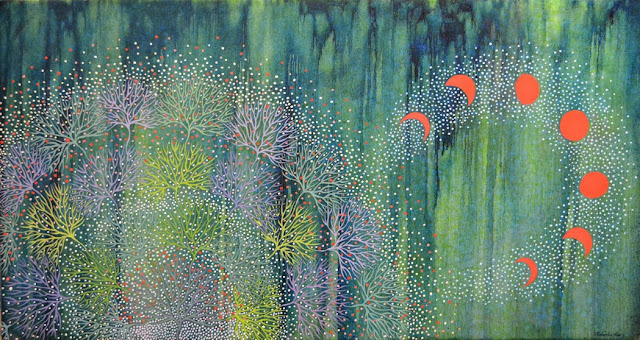
It Depends on Your Perspective  Gouache on paper 24 x 32 cm 2016


These three works on paper are all landscapes in one sense but they are also many other things! Depends on your perspective!


Cheers,
Kathryn
www.kathrynbrimblecombe-fox.com 

Wednesday, December 24, 2014

GREENER PASTURES

Greener Pastures: Goldilocks, Billy Goats Gruff and Exoplanets Oil on linen 60 x 60 cm 2014

Greener Pastures
Billy Goats Gruff
The story of the Three Billy Goats Gruff  was read to me when I was little. Lots of fables and stories were read to me by my Mum. Some I remember really well and some I don't. Billy Goats Gruff  is one that I remember. Three goats see greener pastures on the other side of a bridge. They have greedily eaten all the food on their side, so they decide to be brave and cross the bridge. But a hungry and wicked troll lives under the bridge, ready to attack anyone who wants to pass over. The troll is tricked into letting the two smaller goats cross, but attacks the third and larger goat, who is very strong and manages to toss the troll into the water. The three goats apparently live happily ever after.

BUT

I wonder if they did.

What if they were greedy again and ate all the food in their new pastures? If others could peacefully cross the bridge, did the goats share? If others successfully joined the goats did they develop systems to sustain the green pastures of food?

Goldilocks and Potential Earth-Like Planets
In recent years astronomers have found a number of potential Earth-like planets in other solar systems. Yes, possibly humans could survive on these planets! That's once we work out how to get there! 

Another old story, also read to me by my Mum, is often used to metaphorically describe these newly discovered potentially habitable planets. This story is Goldilocks and The Three Bears. Goldilocks goes for a walk in the forest and discovers a quaint little cottage. The owners, Papa, Mama and Baby Bear, have gone for a walk and left their breakfast porridge to cool down. Even though no-one is home Goldilocks enters the cottage. She discovers the bowls of porridge. She tries each one, Papa Bear's is too hot, Mama Bear's is too cold, but Baby Bear's porridge is just right. Goldilocks goes onto try the bears' chairs and beds too and is found by the bears sleeping in Baby bear's 'just right' bed.

Astronomers and cosmologists describe potentially habitable planets as existing in the 'Goldilocks Zone' of stars...that is...it's not too hot nor too cold, it's 'just right'! Thus, maybe there is water and all sorts of other things that would please our hearts, lungs and stomachs! Some of these planets have even been described as possibly being super-habitable ie: even more abundant than Earth. Please read my earlier post called New World Habitability: Vacation Anyone? for more ideas and links on super-habitability...and even plain ordinary habitability!


http://kathrynbrimblecombeart.blogspot.com.au/2014/02/new-world-habitability-vacation-anyone.html
New World Habitability - Vacation Anyone? oil on linen 70 x 102 cm 2014


Obviously our Earth exists in the 'Goldilocks Zone' of our sun. It's been 'just right' for a long time! Can it last? Well no...because the demise of our Sun in around 4 billion years will obviously have serious implications for the entire solar system! But, what can we do in the meantime?

Just as the Billy Goats gruff spied greener pastures we humans think we may have too. However, there are two BUTS. One is, are we like the goats and greedily consuming our way through Earth's natural resources, thus hastening the need to find another 'home', before we are really ready to conquer the quest of getting there? And, the second BUT is - the 'bridge' we need to 'cross' is outstandingly more convoluted and difficult than the one the goats had to cross! Time and space are incredibly complex issues....

And,

New Painting Above Greener Pastures
The green circle could be a planet...maybe another habitable planet, but possibly even Earth? The green circle pulses against the red and hot surrounding environment which suggests a few things ranging from danger, to passion, to potency, fertility, heat, fire...across time and space....the 'bridge'.


Cheers,
Kathryn

Friday, October 17, 2014

BIRTH OF LIGHT


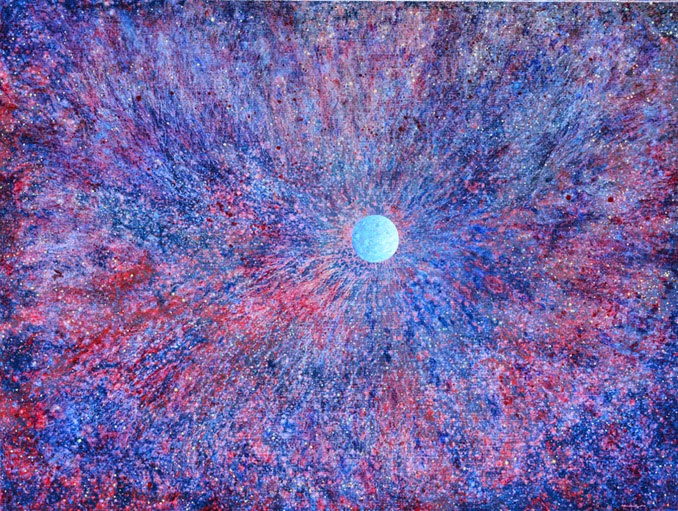
Birth Of Light Oil on linen 122 x 153 cm 2014


I've been painting!
 
 
And reading...three books at once. One is Wonders Of The Universe by Brian Cox and Andrew Cohen. It's the book based on the BBC series of the same name which is hosted by Brian Cox. The first chapter is called Messengers and light, visible and not visible [eg: Cosmic Microwave Background CMB] is the main topic. Light, which exhibits a wave/particle [photon] duality, brings us information from and about the early stages of the Universe our 13.7 billion year old environment.
 
It is amazing to realise that visible light emanating from stars, and other entities in space, is old by the time it reaches us. We are seeing the past in our present because light takes time to reach us. As Cox and Cohen write about human awareness through sight, even when we look at ourselves in a mirror, Without realising it, we are all travelling back in time by the most minuscule amount. The consequence of light travelling fast, but not infinitely fast, is the you see everything as it was in the past. The text goes onto say However, the further we are away from an object, the greater the delay becomes.[1] For example light from the our sun takes 8.3 minutes to reach us and from Neptune it takes 4 hours. With the help of Earth-based telescopes and observational spacecraft we augment our ability to see back into time. For example for just over 20 years the Hubble Space Telescope, in orbit 600 km from Earth, has brought us images of deep space that have changed our Universal perspectives. These changes influence science and spirituality, both having awe in common.
 
For the naked eye, without help from technology, the night sky is a 'jewel box' of sparkles and luscious bling. I find it intriguing to think about those who lived 100s and 1000s of years ago, who without technology, made valuable and interesting observations of the night sky. For instance, Australian Aboriginal astronomy has provided interesting perspectives for modern scientists. An article called The First Astronomers by Andi Horvath, in The Age newspaper, briefly describes some of the sophisticated observations made by Aboriginal people. You can do some more research yourself, as there is plenty available.
 
LIGHT'S BRUSHSROKES
The night sky provides a black canvas for visible light to 'paint' Universal history upon. Every night the 'painting' subtly changes. Daylight saturates us with warmth, illumination and energy, but as night arrives it's like turning a page in the story of time. It's also fascinating to think that light, in all its visible and invisible permutations, itself has a history. Whilst photons appeared in the first three minutes of the Universe, it took along time for visible light to emit. This happened about 400 million years later when stars and galaxies started to form. You will need to read a book like The Wonders Of The Universe to get more detail on this incredible history. I recommend it.
 
METAPHOR
Light as a metaphor, for knowledge, pathways, spirit, guidance and more, has interested me for a long time. A previous post called Let There Be Light   is a small online exhibition of a few of my 'light' paintings. It is easy to understand why light, especially visible light, has entered humankind's cultural, spiritual and religious endeavours and beliefs in the form of metaphor. Through ritual, ceremony and artistic interpretation light essentially celebrates wonder...and how amazingly appropriate is that! It links us back to the beginnings of time! It also links us all, for humanity as a whole, across time, is witness to this light. The shared metaphor and symbol across cultures and religions, is like a thread that knits us together.
 
BIRTH OF LIGHT Oil on linen 122 x 153 cm
My new painting Birth Of Light tries to capture light's 'brushstrokes' across time and space, those 'strokes' that illuminate and those that provide unseen, but felt or detectible forces. Yet, like many of my paintings, there is an ambiguity because it could be an image of the beginnings of the Universe, yet also maybe one star, or a galaxy, or it could be a thought emitting knowledge and creativity that affects the world, or it could be an eye...the very thing that enables us to see light. It could also be the culmination of human spirituality, the thread drawing us together. I like the idea of humanity being woven together by light.

This painting is not a scientific illustration or an artist's impression. It a creative piece inspired by wonder and awe. I will say though, that it is definitely a cosmic 'landscape'...a landscape untethered from Earth's horizons. A scape of humanity's soul...maybe?
 
Birth Of Light is related to my earlier painting, below, called Pale Blue Dot [inspired by Carl Sagan]
 
I also wrote a post a few weeks ago called Art -Science -Imagination -Wonder which might interest you. it was inspired by something astronaut Chris Hadfield said in an interview on Australian TV.
 
 
http://kathrynbrimblecombeart.blogspot.com.au/2014/07/pale-blue-dot.html
 Pale Blue Dot [Inspired by Carl Sagan] oil on linen 120 x 150 cm 2014
 
 Footnotes:
1. Cox, B and Cohen, A Wonders Of The Universe Harper Collins, London, 2011 P.44
 
 
OTHER NEWS
Tomorrow night Saturday 18 October 2014 I am one of 13 artists from Barcelona, Brisbane, Paris and Sydney in a one night exhibition called Painted Prose. We have each responded to poems written by Brent Bridgeford. The poem I responded to is called In Abysm Inhere which actually uses light and dark as very forceful metaphors for internal battles.
 
The exhibition is on at Substation 4, 22 Petrie Tce, Brisbane, Queensland, Australia - 7 pm.
 
My painting is An Eternal Dance [below]. In this painting I have played with light and contrasting dark. I am really happy with it.
 
 
An Eternal Dance Gouache on paper 32 x 114 cm 2014
 
 
Cheers,
Kathryn


Friday, August 22, 2014

ART - SCIENCE - IMAGINATION - WONDER


I Spy Oil on linen 36 x 36 cm 2014


INTERVIEW WITH COL CHRIS HADFIELD - ASTRONAUT
 
On Wednesday night this week I watched Chris Uhlmann, from the ABC's 7.30 Report, interview Canadian astronaut Col Chris Hadfield. It was only short, but it was fantastic! Chris Hadfield is on a whirlwind speaking tour in Australia, but unfortunately he is not coming to Brisbane. He's the astronaut who sang and recorded himself singing David Bowie's classic Space Oddity while he was commander of the International Space Station [ISS]. You can watch it HERE 

At around the 6 minute mark of the interview Chris Uhlmann asks Chris Hadfield, in reference to space and the Universe, Having seen the Earth from space and seen the universe beyond it, can it all be defined by science or only by poetry or perhaps even faith.
Chris Hadfield answered by saying ...exploring the solar system is teaching us a lot and it's technically really interesting and it's important, both politically and economically and technologically. But to me, the fact that so many people watched that music version of 'Space Oddity' that I did, to me, that really shows the importance, if you want to actually communicate, the importance of art. I mean, science, technology, engineering, math - they drive the economy, but we're people, we're not machines and washing machines and robots. We're humans. And to share the wonder and experience of what's going on, that is expressed through art, through music and through writing and through poetry and to try and get to the very essence of what's important.  

Yay! Yay! ART!

Notice how Chris Hadfield describes Art as a way of expressing wonder and the essence of what's important. Neither word....wonder or essence...are essentially scientific, yet they are incredibly apt to describe reactions to scientific research, investigation and discovery...and help propel and nourish these activities, at the same time as engaging those of us who are not at the cutting edge of scientific activity. The relationship between Art and Science, I think, works best when awe is the common denominator, driver, impulse.


http://kathrynbrimblecombeart.blogspot.com.au/2012/05/on-edge.html
On The Edge Gouache on paper 34. x 53.5 2001


INSPIRATION AND IMAGINATION
 
But not everyone can be an astronaut or even a passenger on a space craft. So, how does art engage with the scientific investigations of space and the Universe? I mean there are no joy flights designed for artists to literally experience outer space. The key is...imagination. The song Chris Hadfield sang in space, David Bowie's Space Oddity, was released in 1969 to coincide with the Moon Landing. The lyrics were inspired by Stanley Kubrick's1968 film 2001: A Space Odyssey which Bowie went to see several times. Stanley Kubrick, in turn, was inspired by a documentary called Universe which was made in 1960 by Roman Kroiton and Colin Law for the National Film Board Of Canada in conjunction with the David Dunlap Observatory, Ontario. It's an amazing black and white film and I really encourage you to watch it HERE.
 
I just love the cascading inspirations...

About the 4 minute mark of Universe the narrator asks a question pondering what would the first people to travel into space see and experience. Remember this is 1960...only 3 years after the first satellite [Sputnik 1] went into space and nine years before the moon landing. The narrator answers his question by saying We can in imagination journey into these spaces...and the film is the answer with its special effects combined with some imagery of space and also of an astronomer working at night in the David Dunlap Observatory. But, the key word is imagination! Working with the scientific knowledge, that existed in 1960, the film makers extrapolated using imagination to make a film that went on to inspire.

The dance between knowledge [eg: scientific knowledge] and imagination is ambidextrous, with the lead being taken in turns. One may take control yet the other may beckon to 'come hither' and vice versa!


http://kathrynbrimblecombeart.blogspot.com.au/p/my-book-for-everyone-words-and.html
Star Dust Mixed on paper 30 x 42 cm 1997 [This image is the cover of my book For Everyone
 

MAYBE?

Chris Hadfield, singing Space Oddity and videoing himself, with the ISS as his 'stage' and Universe as his 'backdrop', very successfully beckoned people to 'come hither', come closer to share his experience, to engage more intimately with distance, to feel the Universal 'music', to gasp in wonder, to laugh a little, to think differently, expose themselves to new perspectives [literal and metaphoric]...and more.

In the 7.30 Report Chris Hadfield explains the moment when he decided as a 10 year old that he would be an astronaut I watched the first two human beings walk on the Moon, Neil Armstrong and Buzz Aldrin, the summer I turned 10. And I decided that night - and it wasn't just watching them on television, it was going outside afterwards and looking up at the Moon and seeing - trying to link what I'd seen on the television now with looking at the Moon itself and making the conscious decision at that point that, "I'm going to grow up to be something; you know, why don't I grow up to be that?" I wonder how many people have been inspired by Hadfield's singing space video? Maybe there are children who are now holding close desires to be something they had not thought of before? Maybe there are people who now engage with scientific research of our Universal environment? Maybe there is less fear of the unknown? And, most importantly maybe more people, leave their computers-look up from their phones, and actually go outside to look up at the stars...and wonder!

MOON LANDING 1969

I too watched the Moon Landing in1969. My Dad insisted that my brothers and I stayed home from school to watch it live. I still remember the blurry black and white images on our box of a TV. I did not decide to be an astronaut, but the gravitas of the event still lives within. Although, I think I had already taken 'flight'. Isn't that what artists do!?

___________________________________________________________


In my last post THAT WORD - LANDSCAPE I describe the distance of my childhood landscape and my experiences 'flying'!

You might be interested in my MOON post too.


http://kathrynbrimblecombeart.blogspot.com.au/2012/01/moon.html
When I was A Child I Dreamt I could Fly oil on linen 80 x 120 cm 2003


AND
 
That brings me to my forthcoming exhibition
 
From Earth-Bound Horizons 
 
2 - 14 September here in Brisbane
Please visit the exhibition's site HERE
 

http://kathrynbrimblecombeart.blogspot.com.au/p/untethering-landscape.html

 
Cheers,
Kathryn
 
I am on INSTAGRAM now too
kathrynbrimblecombefox


Monday, January 13, 2014

THE UNIVERSE DRAWS YOU OUT LIKE A MULTI-DIMENSIONAL HORIZON

The Universe Draws You Out Like A Multi-Dimensional Horizon [Inspired by Tim Winton]
Oil on linen 50 x 50 cm
 
 
I am again going to refer to Australian author Tim Winton's wonderful speech The Island Seen and Felt: Some Thoughts About Landscapes: presented at the Royal Academy in London, November 2013. You can listen to it at the Royal Academy's site HERE
 
My previous posts, where I wax lyrical about the speech, are ENCOUNTERING LANDSCAPE and FALLING OUT INTO IT The latter is also the title of a new painting, inspired by a phrase in Winton's speech.
 
Now to another of Winton's phrases which also struck chords with me, On my island the heavens draw you out like a multidimensional horizon... His island, is Australia...my island too.
 
Regular readers will totally 'get' why this phrase grabbed my heart and my imagination. I often write about my ideas on the need to develop skills in seeing multi-perspectives [even simultaneously]. I am sure that modern cosmology, with its exciting explorations into close and far distances, is inviting us to see new perspectives. AND, with these new and multiple perspectives, potentially seen simultaneously, who knows what new questions and answers, ie: metaphoric horizons, will be revealed!
 
So...yes...perspective invites us to also consider horizons, both literal and metaphoric. Indeed, contemporary cosmological research is pushing our horizons in all directions. For example, the Universe maybe a Multiverse...now that's a huge shift in horizon don't you think! But Winton's words that the heavens [ie: the Universe/Night sky] draw you out like a multidimensional horizon suggest that horizons are not just 'out there' but that they exist within us, as if we are landscape too, as if we have horizons imbedded in our psyches connecting us with the Universal landscape of existence. As Winton's speech seems to suggest, in the distance of the Australian landscape there's space to sense these horizons, be absorbed by them, discover new ones...or maybe even return to them?
 
My new painting above The Universe Draws You Out Like A Multi-Dimensional Horizon is one of the images that came to my mind when I read Winton's evocative words. The three coloured lines create amorphous shapes which mirror many of the patterns and shapes seen under a microscope, but also seen in Space. The play between the micro and macro is deliberate, yet at the same time the viewer feels drawn into a portal, as if finally finding a connection to the Universe, in all its diversity...a dance with all horizons.

3D
Many of my paintings go 3D when viewed with 3D glasses [not the movie ones though...simple ones] and this painting is one of them. The longer you look at it the more 3D it goes with each line separating even further as if it is tugging at you...yes tugging at your inner horizons!
 

http://kathrynbrimblecombeart.blogspot.com.au/2013/04/are-we-there-yet.html
Are We There Yet? Oil on linen 80 x 140 cm 2013
 
 
THE MOON
Two interesting website/articles have made me think more about horizons...being drawn out of us. One is a collaborative artwork/project called The Moon by two famous artists, Ai Weiwei and Olafur Eliasson. It's a site where, once logged in, people can draw on the Moon! You can read more about the project in a ARTnews article  'How Ai Weiwei and Olafur Eliasson Got 35,000 People to Draw on the Moon' by Robin Cembalest. You can draw on the Moon by clicking HERE [Firefox or Chrome].
 
The Moon project is interesting because it gets people thinking beyond Earth-bound horizons, even if they are doing in the short distance between themselves and their computer. It is also significant because as Ai Weiwei is restricted from leaving China, yet he is able to collaborate with Olafur Eliasson in a project that has attracted thousands of people from around the world... AND, it's 'on the moon'! This poses interesting questions about man-made boundaries and borders, which indeed pale into insignificance when 'viewed' with a lunar, or even better a cosmic, perspective. The power of imagination is up to the challenge to breakdown restrictions that keep perspective limited! I think projects like Ai Weiwei's and Eliasson's The Moon are more than important.
 
THE FIRST ASTRONOMERS
The second thing of interest is a fascinating article in The Melbourne Age called The First Astronomers, by Andi Horvath. It's an article about Australian Indigenous Astronomy. As the opening sentence says As Australia has the oldest continuous culture on Earth, the first Australians were very likely to have also been the first astronomers. The article goes onto discuss how astrophysicist Ray Norris and wildlife expert Cilla Norris in 2008 documented Aboriginal Astronomy stories told by community elders. This resulted in their book Emu Dreaming: An Introduction To Australian Aboriginal Astronomy. The Melbourne Age article goes onto discuss astrophysicist Alan Duffy's recent experiences, teaching indigenous and non-indigenous astronomy, in schools in the Pilbara.
 
There is one section of the article that got me really thinking...yes about perspective...and horizons:
Dr Duffy explained to the students that Indigenous astronomy is a great example of how sophisticated Aboriginal science and culture was through its development. He also explored the fundamental difference in the way traditional European astronomy conceives the constellations by connecting the dots of stars to form pictures attributed to Greek mythology, whereas Aboriginal astronomy connects not just the stars but also the black spaces in-between. Two different ways of viewing the same night’s sky!

"The school kids were very excited by the “emu in the sky” which stretches out in what European astronomers call the Milky Way,” he says. “Once you see it, you can never look at the Milky Way the same way again. As a constellation, it is far more convincing than the obscure European pictures."

So...for me key phrases are: Two different ways of viewing the same night’s sky! and ...you can never look at the Milky Way the same way again. Methinks Tim Winton's observation that On my island the heavens draw you out like a multidimensional horizon...is spot on!

Cheers,
Kathryn
www.kathrynbrimblecombe-fox.com


Monday, November 11, 2013

KNOWING LANDSCAPE - ART AND SCIENCE

http://kathrynbrimblecombeart.blogspot.com.au/2010/11/beginning-of-everything.html
The Beginning Of Everything Oil on linen 90 x 180c m 2010
 
During the week I read an interesting article Science and Art: How Astronomical Artists Look At Nature by well known American space artist William K Hartmann who also happens to have a B.Sc [physics], M.Sc [geology] and  [PhD [astronomy]. The an article is essentially about knowing landscape.
 
He starts the article, People often ask me — and I often ask myself — is there an interplay between my planetary science research and my painting? Does my interest in painting affect the way I do science? I’m pretty sure the answer is yes, but it’s hard to explain why, even to myself! He then goes on to try to explain that there are various ways of “knowing.” He continues, So there’s a kind of knowledge that I call “body knowledge” that comes from bodily and visual experience, as well as a “mind knowledge” that comes from traditional scientific activities such as quantitative data analysis, numerical modeling, classifying and breaking natural phenomena into constituent aspects.

Hartmann suggests that the knowledge he gains as an artist, observing and painting landscape, helps him as a scientist observing and scrutinising imagery sent back to Earth by satellites and probes. He writes that as a scientist working with the Mariner 9, Mars Global Surveyor and Mars Express imaging teams the body knowledge seemed to provide a different “starting point” for analysis than the theoretical considerations of my colleagues.

I am not a scientist, but I have scientists in my family. And as regular readers know, I have a keen interest in science. My two brothers both have science degrees, one in computing and the other in physics [lighting: M.Sc]. Yet, both are also artists. One is a photographer and the other a musician and lighting designer. I've seen how mind knowledge and body knowledge, across and between science and art, play and interact with each other.

I resonate with Hartmann's description of body knowledge as if in the process of repeated and consistent observation of landscape, it ultimately enters your body as a knowing... I would go further to suggest that it perhaps returns to, or re-enters the body, as a kind of remembering...of star dust.


http://kathrynbrimblecombeart.blogspot.com.au/2012/10/returning.html
Returning Oil on linen 50 x 94 cm 2012

This takes me to an experience I had only a few days ago. I participated in a Shaman's walk lead by an old friend Heather Price. A group of eight women shared four hours of reflection which included a walk along one of the paths at Mt Cootha here in Brisbane, Queensland, Australia. Without going into too much detail the walk was an activity of deep observation ie: observing nature and then observing our reactions to particular elements of it, followed by investigations of possible meaning and metaphor. This process takes you from being simply an observer to being a participant in, as well a partner with, nature. Observation at many levels induces a quiet kind of absorption into the cycles of life that nature represents so beautifully. My experience with Heather and the other women was that of a kind of returning to, and a remembering of, the beginning of all life...the Universal landscape. For me as an artist, it was pure inspiration. For me, as a person, it was a perfect reminder.
 
Observation, for an artist, can simply be about taking note of how things look, but it can be so much more than this. All kinds of observation, from how things look, to observing one's own emotional and intellectual reactions, to sensing vibrations, noticing sounds and movement and 'seeing' links between everything, all manifest into a kind of knowing that enters the body...or...perhaps re-enters the body. As Hartmann says, In any case, as I’ve come to know the history and community of landscape painters, I’ve been impressed that they have absorbed all sorts of knowledge from nature that physical scientists do no yet know, or do not even study.
 
 
I painted The Wind Oil on linen 80 x 120 cm 2001
 
Landscape is an integral part of humanity's experience of life. It orientates us, feeds us, provides energy for us, induces awe, challenges us and gives us a place to call 'home'. It can embrace us and it can also annihilate us, and at both extremes, and in the spaces in between there are reminders that we are part of the body of landscape. We are never really separate from it. Indeed, when we die it enfolds us as we return to dust. At some time in the far distant future Earth will also return to star dust, as a result of our Sun's death throes.  
 
This takes me to a point I have written about a lot...that concepts of landscape need to be untethered from Earth-bound horizons, because whilst Earth maybe our home, the Universe is our environment. Landscape reminds us that we come from the same star dust that created the planets and the Universe...we are landscape too!
 
 
http://kathrynbrimblecombeart.blogspot.com.au/2010/09/cosmic-dust.html
Cosmic Dust Oil on linen 120 x 160 cm 2010


Cheers,
Kathryn
 

Monday, July 01, 2013

SUPER-EARTHS


Super-Earths Discovered Oil on linen 80 x 140 cm 2013
 
RECENT HEADLINES
 
Super-Earths discovered in stellar cluster ABC Science
Trio of 'super Earths' discovered in a star's habitable zone  Sydney Morning Herald June 26 2013
Found! 3 Super-Earth Planets That Could Support Alien Life Space.com
Star is crowded by super-Earths BBC Science And Environment
Super-Earth’ trio may support life Japan Times
Super-Earths detected in nearby star system WIRED
 
 
Last week it was reported that astronomers discovered a nearby star system with 3 possible 'Super-Earths' within the habitable zone around the star. Super-Earths are planets less massive than Neptune, but more massive than our own Earth. These newly discovered Super-Earths have the potential to sustain life. A 'habitable zone' refers to the temperature region around a star where liquid water could exist.  Planets outside our solar system are called exoplanets.
 
If you want to know more check out the articles linked above.
 
SUPER-EARTHS DISCOVERED
Oil on linen 80 x 140 cm
 
Now, to my new painting Super-Earths Discovered
 
Regular readers will see a continuation with other recent galactic-type paintings. They will also identify my 'play' with landscape and my attempts to untether ideas of 'landscape' from being Earth-bound. New perspectives, revealed by astronomical discoveries, open us to possibilities and potentials that push perspective beyond horizons previously thought to be at the extreme of distance.
They also afford us new ways of viewing ourselves...don't you think? As I have written before, perspective is both literal and metaphoric.
 
In my painting Super-Earths Discovered a mountainous landscape is shadowed by a massive 'planet'. The orientating mountainous landscape, whilst Earth-like, may not be Earth. It may be one of the newly discovered Super-Earths! Where is the viewer ie: you and me? We may be on the third planet, or in a space craft tripping our way between planets or we may be situated on a neighbouring mountain range gazing across the treacherous landscape. Fun hey!!!
 
So, alien life is a possibility on these newly discovered Super-Earths. We humans do seem to have a great urge to find 'space mates'. Yet, apart from the possibility of alien life, habitable Super-Earths also offer us alternative 'homes'. You know, when a cataclysmic occurrence, natural or human-made, makes Earth un-inhabitable or non-existent...except as debris [please check out my previous post HOPE]. Let's transport our imaginations into a far distant future...then ten to one hundred times the distance! In order to ensure humanity's survival, what if the 'powers that be' send something, that will ignite human DNA, in a space ship to the most habitable Super-Earth? Imagine that upon landing a mechanism causes the dormant DNA device to trigger life. Ah Ha! But, would we be human like we are now or would we appear more alien-like? There's a story there!
 
Regular readers will notice the tree...my much loved age-old transcultural/religious tree-of-life symbol. The tree signifies...life! In Super-Earths Discovered  the tree is like a beacon. Is it welcoming or warning?
 
A couple of other recent galactic paintings:
 
 
THE CREATION OF
SUPER-EARTHS DISCOVERED
 
I have recently posted some photos of me working...and people seem to really like it. I have had numerous requests for more. To see the previous post please click HERE
 
So here goes...the following photos are of me painting Super-Earths Discovered
 
 The initial preparation of the stretched linen. Photo: Edwina Fox
 

 Splashing turps around. Photo: Edwina Fox
 
 
Waiting to run, dribble and dry. Photo: Edwina Fox
 
 
Early stages
 
 
I use rags as well as brushes!
 
And here's video:
 
 
My next solo exhibition
________________________________________________________________________
 
 
All of this is n preparation for my next solo exhibition
 
COSMIC ADDRESS
15- 27 October
Brisbane
 
Check out my recent COSMIC ADDRESS preview notification HERE
 
And to see a painting and post called COSMIC ADDRESS please click HERE
 
________________________________________________________________________
 
VERY INTERESTING
 
Take a look at this video:
 
 
It is a project to send images of life on Earth into space. It's a kind of art installation. The images will be placed in some kind of capsule attached to a satellite which will be launched into orbit around Earth. Will they survive the mainstreet satellite highway up there? If the capsule survives for eons will it stand the heat of our sun in its hades-like dying days? Will aliens discover the images, and if so what will they think? Is the project adding to potential space debris and compromising space sustainability? Is this more about reflecting upon ourselves rather than sending messages afar? Perspective works in wonderful ways! 
 
Cheers,
Kathryn