Tuesday, January 28, 2014

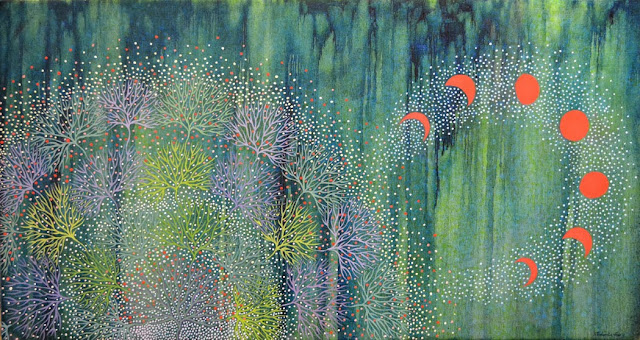
SURRENDERING HORIZON

Surrendering Horizon Oil on linen 100 x 150 cm 2014
 
I return to the concept of 'horizon'. Yes, the concept...horizon as a metaphor as well as a literal element of landscape. But then again 'landscape' can be used as a metaphor for our internal psyches. The dance between the literal and metaphoric entices, excites, probes and ultimately extends the 'horizon/s' of our thinking.
 
I wrote a post recently called The Universe Draws You Out Like A Multi-Dimensional Horizon The painting and the post were inspired by well known Australian author Tim Winton's speech The Island Seen and Felt: Some Thoughts About Landscapes: presented at the Royal Academy in London, November 2013. You can listen to it at the Royal Academy's site HERE  The idea that horizon exists within us, to be drawn out by the Universe is really exciting. It alludes to the fact that we are part of the landscape, not separate from it, physically, emotionally or spiritually. After all, when we die we literally return to 'landscape' in burial or cremation. And, when our planet finally reaches its demise, a few billion years away, we and Earth return to the stars...to the 'landscape' of the Universe.
 
In Surrendering Horizon [above] I have 'torn' the horizon line away from the landscape. It now seems to draw the landscape towards new perspectives, as it enjoys relinquishing its tethered state. It almost playfully entices the landscape to reach out, and in this process, lifts its 'eyes' towards Universal [possibly even Multiversal] distance.
 
The untethered horizon offers the opportunity to look back from its playful place...to look back at Earth...and to look back at Earth placed within its Universal environment. Indeed, from a distance, not only is the planet visible for scrutiny, but so is its position amongst other celestial bodies. I wonder how important manmade borders and boundaries appear from distance that places Earth within a Universal perspective? I wonder how vulnerably beautiful our planet looks...this vulnerability and beauty imploring us to think more expansively about how we live on, love and share Earth?
 
Regular readers will notice my tree...the age-old transcultural/religious tree of life. Notice that I have painted it the same colour as the mountainous horizon and the untethered one. I'll let you think about that!

And, something else to think about. The title Surrendering Horizon ...is the horizon surrendering itself or are we surrendering it...or both?
 
------------------------------------------------------------------------------
 
And, more about landscape. My brother Wilfred Brimblecombe has recently taken some amazing photographs of the landscape surrounding the family farm, which was sold in the 1980s. Please visit his website WILFRED BRIMBLECOMBE: Photography, Stories, Ephemera future and past  There are a couple of terrific photographs of rain falling but evaporating before it hits the ground.
 
 
Cheers,
Kathryn


Tuesday, January 21, 2014

DIZZYING PERSPECTIVE

Dizzying Perspective [inspired by Tim Winton] Oil on linen 50 x 50 cm 2014
 
 
Dizzying Perspective relates to my last two posts and their accompanying new paintings Falling Out Into It and The Universe Draws You Out Like A Multi-Dimensional Horizon Yes, again the terrific speech The Island Seen and Felt: Some Thoughts About Landscapes by Tim Winton at London's Royal Academy in November 2013 has struck a chord of inspiration in me! You can hear the speech HERE
 
Dizzying Perspective is deceptively simple....so say myself! For me....there are many questions-Are we drawn towards the dark circle? Are we propelled away from it? Is it the only point of reference? Is it solid or is it a new portal? Where am I in relation to the 'scape' before me? Is it a vast 'scape' or a microscopic one? Is the dark circle Earth or is it a galactic body seen from Earth? Or, maybe Earth is nowhere around in this part of the Universe? Where am I?
 
I am sure you might have even more questions.
 
Words by Tim Winton, which I previously quoted in my earlier post Falling Out Into It, have again inspired me:   At night in the desert the sky sucks at you, star-by-star, galaxy-by-galaxy. You feel as if you could fall out into it at any moment. It's terrifyingly vertiginous.
 
VERTIGO
This time the bit that got me excited is It's terrifyingly vertiginous. Why? Because, I sense that Winton uses the word terrifying, not simply to suggest a scary physical experience where loss of balance and dizziness induce stumbling and nausea. Metaphorically speaking terrifyingly vertiginous may be more about the revelatory possibilities of new insights and perspectives revealed in the process of letting go...falling out into it.
 
But, I want to return to my previously mentioned ideas of untethering landscape from Earth-bound horizons. The terrifyingly vertiginous experience of falling out into the Universe is provocative, because it invites us to let go of Earth-bound horizons. It actually demands us to leave the safety of the known to welcome new perspectives of ourselves, our planet and our Universal environment.
 
FEAR
Essentially, I think, Tim Winton suggests we confront fears of letting go, fears of the unknown, fears of shifting perspectives. I've been with people who are literally fearful of the distance in the Australian landscape. These people, mainly city born and bred or from Europe, actually expressed their fears in words and with real physical reactions. They felt more than uncomfortable with the open skies and the vast often desolate distances. Their physical reactions were obvious: strange tiredness, gripping themselves or anchor points in a vehicle, normally confident gaits affected by trepidation, eyes darting hither and thither...all signs suggesting a sense of vertigo. But, maybe we need to place ourselves at the mercy of distance, fall out into it, let go...and in the terrifying vertiginous experience we may discover new ways to live and be, new questions and thus possible answers to problems that are plaguing us with their intensity and danger. Who knows? But, I suggest it is worth trying!
 
Dizzying Perspective is similar to an earlier painting which I called Where? This painting asks questions to, indeed its title is a question. It asks about time and space. Both paintings, I sense, move beyond their physical limits of size ie: 50 x 50 cm. There is something quite satisfying about painting an image of Universal vastness on a 50 x 50 cm canvas! A bit like the size differential of Dr. Who's marvellous Tardis.
 
 
http://kathrynbrimblecombeart.blogspot.com.au/2013/05/looking-in-rear-vision-mirror.html
Where? Oil on linen 50 x 50 cm
 
 
GOOD NEWS
My entry for the biennial $20,000 Stanthorpe Art Prize has been selected as a finalist. This means that the actual painting now gets sent to Stanthorpe to hang with the other finalists and to be considered for the prize which is announced at the end of February. I shall keep you posted!
 
Cheers,
Kathryn
 

Monday, January 13, 2014

THE UNIVERSE DRAWS YOU OUT LIKE A MULTI-DIMENSIONAL HORIZON

The Universe Draws You Out Like A Multi-Dimensional Horizon [Inspired by Tim Winton]
Oil on linen 50 x 50 cm
 
 
I am again going to refer to Australian author Tim Winton's wonderful speech The Island Seen and Felt: Some Thoughts About Landscapes: presented at the Royal Academy in London, November 2013. You can listen to it at the Royal Academy's site HERE
 
My previous posts, where I wax lyrical about the speech, are ENCOUNTERING LANDSCAPE and FALLING OUT INTO IT The latter is also the title of a new painting, inspired by a phrase in Winton's speech.
 
Now to another of Winton's phrases which also struck chords with me, On my island the heavens draw you out like a multidimensional horizon... His island, is Australia...my island too.
 
Regular readers will totally 'get' why this phrase grabbed my heart and my imagination. I often write about my ideas on the need to develop skills in seeing multi-perspectives [even simultaneously]. I am sure that modern cosmology, with its exciting explorations into close and far distances, is inviting us to see new perspectives. AND, with these new and multiple perspectives, potentially seen simultaneously, who knows what new questions and answers, ie: metaphoric horizons, will be revealed!
 
So...yes...perspective invites us to also consider horizons, both literal and metaphoric. Indeed, contemporary cosmological research is pushing our horizons in all directions. For example, the Universe maybe a Multiverse...now that's a huge shift in horizon don't you think! But Winton's words that the heavens [ie: the Universe/Night sky] draw you out like a multidimensional horizon suggest that horizons are not just 'out there' but that they exist within us, as if we are landscape too, as if we have horizons imbedded in our psyches connecting us with the Universal landscape of existence. As Winton's speech seems to suggest, in the distance of the Australian landscape there's space to sense these horizons, be absorbed by them, discover new ones...or maybe even return to them?
 
My new painting above The Universe Draws You Out Like A Multi-Dimensional Horizon is one of the images that came to my mind when I read Winton's evocative words. The three coloured lines create amorphous shapes which mirror many of the patterns and shapes seen under a microscope, but also seen in Space. The play between the micro and macro is deliberate, yet at the same time the viewer feels drawn into a portal, as if finally finding a connection to the Universe, in all its diversity...a dance with all horizons.

3D
Many of my paintings go 3D when viewed with 3D glasses [not the movie ones though...simple ones] and this painting is one of them. The longer you look at it the more 3D it goes with each line separating even further as if it is tugging at you...yes tugging at your inner horizons!
 

http://kathrynbrimblecombeart.blogspot.com.au/2013/04/are-we-there-yet.html
Are We There Yet? Oil on linen 80 x 140 cm 2013
 
 
THE MOON
Two interesting website/articles have made me think more about horizons...being drawn out of us. One is a collaborative artwork/project called The Moon by two famous artists, Ai Weiwei and Olafur Eliasson. It's a site where, once logged in, people can draw on the Moon! You can read more about the project in a ARTnews article  'How Ai Weiwei and Olafur Eliasson Got 35,000 People to Draw on the Moon' by Robin Cembalest. You can draw on the Moon by clicking HERE [Firefox or Chrome].
 
The Moon project is interesting because it gets people thinking beyond Earth-bound horizons, even if they are doing in the short distance between themselves and their computer. It is also significant because as Ai Weiwei is restricted from leaving China, yet he is able to collaborate with Olafur Eliasson in a project that has attracted thousands of people from around the world... AND, it's 'on the moon'! This poses interesting questions about man-made boundaries and borders, which indeed pale into insignificance when 'viewed' with a lunar, or even better a cosmic, perspective. The power of imagination is up to the challenge to breakdown restrictions that keep perspective limited! I think projects like Ai Weiwei's and Eliasson's The Moon are more than important.
 
THE FIRST ASTRONOMERS
The second thing of interest is a fascinating article in The Melbourne Age called The First Astronomers, by Andi Horvath. It's an article about Australian Indigenous Astronomy. As the opening sentence says As Australia has the oldest continuous culture on Earth, the first Australians were very likely to have also been the first astronomers. The article goes onto discuss how astrophysicist Ray Norris and wildlife expert Cilla Norris in 2008 documented Aboriginal Astronomy stories told by community elders. This resulted in their book Emu Dreaming: An Introduction To Australian Aboriginal Astronomy. The Melbourne Age article goes onto discuss astrophysicist Alan Duffy's recent experiences, teaching indigenous and non-indigenous astronomy, in schools in the Pilbara.
 
There is one section of the article that got me really thinking...yes about perspective...and horizons:
Dr Duffy explained to the students that Indigenous astronomy is a great example of how sophisticated Aboriginal science and culture was through its development. He also explored the fundamental difference in the way traditional European astronomy conceives the constellations by connecting the dots of stars to form pictures attributed to Greek mythology, whereas Aboriginal astronomy connects not just the stars but also the black spaces in-between. Two different ways of viewing the same night’s sky!

"The school kids were very excited by the “emu in the sky” which stretches out in what European astronomers call the Milky Way,” he says. “Once you see it, you can never look at the Milky Way the same way again. As a constellation, it is far more convincing than the obscure European pictures."

So...for me key phrases are: Two different ways of viewing the same night’s sky! and ...you can never look at the Milky Way the same way again. Methinks Tim Winton's observation that On my island the heavens draw you out like a multidimensional horizon...is spot on!

Cheers,
Kathryn
www.kathrynbrimblecombe-fox.com


Sunday, January 05, 2014

FALLING OUT INTO IT


Falling Out Into It Oil on linen 70 x 120 cm 2014
[Inspired By Time Winton]

At night in the desert the sky sucks at you, star-by-star, galaxy-by-galaxy. You feel as if you could fall out into it at any moment. It's terrifyingly vertiginous.
[Quote: 'Wild Brown Land' an edited transcript in 'The Australian' December 14, 2013 of The Island Seen and Felt: Some Thoughts About Landscapes by well known Australian author Tim Winton, presented to the Royal Academy, London, November 14, 2013.] You can listen to the speech HERE

AMAZING WORDS
Tim Winton's words are amazing. When I read them, and others, images popped into my head and resonances were deeply felt. In a recent post  ENCOUNTERING LANDSCAPE I write more generally about the speech and my reaction to it. However, there are some phrases that have stayed with me, their words mulled over, eliciting the kind images in my mind that asked to be painted.

I grew up on a grain farm on the flat treeless Pirrinuan Plain, outside Dalby on the Darling Downs, Queensland, Australia. I remember vertiginous feelings when, as a child, I'd lie on soft clover staring at the sky. I remember my Dad had a marvellous vegetable garden that also grew the lushest clover. I'd lay down on it and immediately feel like I was flying and sinking at the same time...that is until the day I noticed the prickles had started to form!

The vast sky of my childhood, uninterrupted by mountains or trees, has stayed with me. During the day it was mostly a relentless blue. But, now and then storm clouds would roll majestically across the plain. These clouds, nuanced with colours of grey, black and indigo blue were sometimes tinged with a green hue, a sign of hail. At night the sky, if uncluttered by clouds, glittered with the Milky Way, a swathe of jewel-like lights. My grandmother, a keen star gazer, often took my brothers and me out into the night to see various constellations, our necks bent back so we could take it all in. However, a stormy night sky was another experience. Lightning giving momentary spotlight to features we knew well, as if demanding us to take notice.

'...FALL OUT INTO IT.'
So, the quote from Tim Winton's speech grabbed my attention! The significant bit is fall out into it. Not fall out from it, but fall out into it, as if gravity might release its grip on us. These beautifully simple few words capture so much of my thoughts about perspective, distance...and the possibilities that new ways of seeing, new perspectives, can reveal different questions and answers to the issues that plague humanity.

We possibly need to feel a sense of terrifying vertigo in order to disrupt the norm, to recalibrate senses, to disturb the status quo, to re-ignite awe and wonder...and more. To deliberately welcome this kind of disruption, and even agitate for it, is quite subversive, don't you think? Agitation does not have to be outrageous, aggressive or in-your-face. Indeed, maybe a deliberately
contemplative state leading to a kind of dizziness that helps to ultimately shift perspective is more revolutionary than trying really hard to make a point via didactic means, aggressive and not? Maybe, lying down on the grass to stare at the sky, welcoming that sense of falling into it, is all we need to do, both literally and metaphorically. Yes, let's look up from our smart phones and computers!

I love the idea of 'falling out into it' for another, but related reason. Regular readers will know of my interest in untethering notions of 'landscape' from Earth-bound horizons. The idea of 'falling out into it'...into the Universe...is a way to assist imagination to grasp the concept! The cosmos is calling, imploring...

Falling Out Into It Oil on linen 70 x 120 cm 2014
So, to my new painting. With Falling Out Into It I wanted to create a 'landscape' that was ambiguous in orientation and locale. I wanted a sense of transparency where parts of the landscape revealed the cosmos through itself, as if the viewer could move into and beyond the 'landscape', like a traveller through time and matter, ultimately becoming time and matter... or maybe remembering them? I wanted to create a sense that the viewer was literally falling out into the night sky, the Universe. Yet, there's a possibility of grabbing onto the 'landscape' of mountains too, before letting go and travelling further...! Metaphorically speaking...think of the possibilities for psyche.

Falling Out Into It is similar to another painting I did last year. Multiple Landscapes [below] also has a sense of disorientation. It's a painting that explores the possibility of seeing multiple perspectives, even simultaneously. And, I'd suggest that in a vertiginous state one would see multiple landscapes especially if you kept your eyes open! Now there's a clue....

http://kathrynbrimblecombeart.blogspot.com.au/2013/07/multiple-landscapes.html
Multiple Landscapes Oil on linen 80 x 140 cm 2013


Happy New Year to you all!
Cheers,
Kathryn

Monday, December 30, 2013

CUTLINES: '...sense of perspective is under review.'

Composite photo of Cutlines 1.2 x .9m at Soapbox Gallery Brisbane 2002
 
CUTLINES
In 2002, just before my exhibition Distance in London, I held a show called Cutlines at SoapBox Gallery. The gallery was one of the best artist run galleries in Brisbane at the time. Sadly it closed its physical doors a few years ago. However, the artist/director Franz Ehmann still keeps the website for his own work.
 
The main part of the Cutlines exhibition was a continuous work on paper that ran around two walls of the gallery space. The length 9m and the height 1.2m. The painting was a vast landscape. Below the painting I marked the wall at random intervals with cut-line indicators. Yep, that's right, I was prepared to cut the painting. Why? Because, I was thinking about how we divide land up into countries, states, and properties. If someone had wanted a piece of the painting, I'd have cut it...for a price of course! Yes, you guessed there's more to it than money...some commentary too...questions about ownership, borders, 'value' and more.
 
I also had some small works on paper on another wall. These were each given a title with the name of a property ie: Australian rural properties that I have known, or know of, such as 'Rugby', 'Glencoe', 'Taunton', 'Windulka', 'Oklahoma', 'Benelawin', 'Nungwai' and so on.
 
Dr. Sally Butler, an Art Historian at the University of Queensland wrote a review of Cutlines for 'Eyeline Magazine'. You can read the review on my website by clicking HERE . And, the 'Eyeline' website is HERE
 
 
 Detail of Cutlines Gouche and watercolour on paper 1.2 x 9m
 
PERSPECTIVE
Today I reread Dr. Butler's review of Cutlines. It's been awhile since I had last read it. She wrote something that whilst I've seen it before, it now leaps out as something quite prophetic!
 
The micro and macro scale of these paintings subverts traditional landscape format, but so too does the spatial scope of the work. Space, or place, is clearly being measured and creates a recurring impression that our sense of perspective is under review.
 
The exact bit that has me excited is creates a recurring impression that our sense of perspective is under review.
 
I feel quite humbled that Dr. Butler saw a 'review of perspective' in my work...over ten years ago...and today I articulate my interest in, and concern about, perspective here on this BLOG and very consciously in my painting. I suggest that developing skills in seeing multiple perspectives, even simultaneously, is something we humans need to think about. I suggest that modern cosmological research is revealing new perspectives which implore our attention. A renegotiation of perspective may hold clues to new ways of 'seeing'...and thus new and different questions....leading to answers never dreamed of. By untethering notions of 'landscape' from Earth-bound horizons, as cosmology invites us to do, may help us in our renegotiation. Landscape painting as much more to offer us...if we're game to launch ourselves beyond seemingly safe horizons.


Detail of Cutlines  Gouache and watercolour on paper 1.2 x 9m
 
CUTLINES NOW
Some of you may be wondering where Cutlines is now. Well...it did not get cut into pieces. Why? because people were horrified that I'd 'destroy' such, as they said, beautiful painting. Cutting a painting...slicing up the land...?
 
Cutlines is rolled up and has been under my bed for years. Maybe I will have to bring it out and coax it out of its rolled state!?
 
NEWS
I've been painting over the festive season. One of the paintings I cannot show you, as it will be entered into the Mandorla Religious Art Prize later in 2014. I can't show you because one of the regulations is that the entered painting cannot have been exhibited before...and some would say that uploading an image on the web is akin to 'exhibition'. I am just being cautious.
 
But, there is another painting...nearly finished. It was inspired by the speech/article, by well known Australian author Tim Winton, which I wrote about in my last BLOG post 'Encountering Landscape'


Cheers,
Kathryn
 

Tuesday, December 17, 2013

ENCOUNTERING LANDSCAPE

http://kathrynbrimblecombeart.blogspot.com.au/2010/11/beginning-of-everything.html
The Beginning of Everything oil on linen 90 x 180 cm 2010
 
In this post:
1. A reflection on an excellent speech made by well known Australian author Tim Winton
2. Good news about some sales! 
 
 
The Island Seen and Felt: Some Thoughts About Landscapes:
by well known Australian author Tim Winton

There's an article in last weekend's Weekend Australian Review [Dec 14-15] called 'Wild Brown Land'. It is an edited transcript of The Island Seen and Felt: Some Thoughts About Landscapes by well known Australian author Tim Winton, presented to the Royal Academy, London, November 14, 2013. It was a fascinating read. But, even better, you can hear the speech by clicking HERE The speech/article is a heartfelt and important reminder of why we need to take note of landscape, paying attention to writers and artists who continue to be preoccupied with it.

So much of what Tim Winton said/wrote resonated with me, even his first encounters with the European landscape during the 1980s. I too was travelling to Europe for the first time, with excited anticipation of seeing the landscapes I had only seen in paintings and photographs. I totally understand what Tim Winton felt when he says, In the first instance I struggled with scale. In Europe the dimensions of physical space seemed compressed. The looming vertical presence of mountains cut me off from the distant horizon. I remember driving from Italy into Switzerland and feeling locked in, as if the intense beautiful green mountains would swamp me. I remember remarking to my travelling partner that I longed to see distance.

Winton not only describes European landscapes as compressed, but that they are also humanised ie: evidence of human activity and presence is everywhere. This is definitely something I noticed and felt on my first encounters with the European landscape. The landscape space was occupied, often transformed. Whereas the Australian landscape of my childhood, living on a flat treeless black soil plain, and early married life, living further west with prickly plants and red dirt, certainly did not feel dominated by human forces. Indeed, there were always reminders that nature held the upper hand...flood, drought, wild storms, insect plagues, searing heat. The built environment of houses, homesteads, sheds, tanks etc did not provide spaces that could wilfully ignore the outside. Yes, they could be refuges, but not enough to obscure the elements. Flyscreens only kept out a percentage of insects, snakes could slither under and into houses and sheds [even tractor cabins]....whirlwinds spread dust into every cavity, fire sent soot and smell, cracked earth shifted building foundations, the heat blistered paint and varnish...So, I really, really 'get it' when Winton says, Australia is a place with more geography than architecture, where openness trumps enclosure.


http://kathrynbrimblecombeart.blogspot.com.au/2007/06/through-flyscreen.html
Through The Flyscreen oil on linen 80 x 100 cm 2002

The distance in the Australian landscape is not empty, but replete with life forces and a spirit. They rise from the primordial dust. For me this distance, both intimate and vast, holds clues to dextrous understanding of  perspective. As regular readers know, I am fascinated by perspective, especially in an age where new cosmological research is revealing horizons never before dreamed of. For me, the Australian landscape is a preparatory teacher of perspective, even my much touted multi-perspective experienced simultaneously...but are we brave enough to listen and learn? There is certainly a kind of 'safety' in the closed distances of cities, but it's the myopic distances of technology that concern me more. By this I mean the literal distance between a phone, computer, tablet and user...where 'entertainment', 'community' and 'connection' are 'experienced'. Metaphorically speaking this diminished distance perhaps does not bode well for imagination, laterality, independence.


http://kathrynbrimblecombeart.blogspot.com.au/2010/09/cosmic-dust.html
Cosmic Dust oil on linen 120 x 160 cm 2011

Even, buildings have windows to look out of, but where are the 'windows' to create a textured experience in the distance between person and phone? I am reminded of my recent posts where I discuss the metaphor of 'looking out the windows'...please check them out: Looking Out The Windows and Looking In The rear Vision Mirror - Cosmically Speaking

Now to something else Tim Winton said...On my island the heavens draw you out like a multidimensional horizon...I just love this! Can I repeat... the heavens draw you out like a multidimensional horizon. The cosmos has the ability to draw out of us a multidimensional horizon! Regular readers will know why I am excited by this sentence. To me this is perspective teasing out the potency that exists within and all around us. The potency that an Australian landscape is replete with. Distance connecting us to the cosmos. We are the essence of horizon, like everything else...and not just one horizon, but a multi-dimensional one! And, if this is the case, learning skills in multi-perspective should not need to be learnt, but remembered...don't you think?

And, again from Winton At night in the desert the sky sucks at you, star-by-star, galaxy-by-galaxy. You feel as if you could fall out into it at any moment. It's terrifyingly vertiginous. I need to repeat another short and excellent phrase...fall out into it... Note Winton does not say 'fall from it'. That would be far too simple for a being who has been drawn out like a multidimensional horizon!


http://kathrynbrimblecombeart.blogspot.com.au/2012/07/galactic-horizons.html
Galactic Horizons and Beyond oil on linen 85 x 150 cm 2012

Winton ends by discussing the sense of patriotism that is born from a reverence for land. He says, Patriotism has evolved to include a reverence for the land itself, and the passion to defend the natural world as if it were family. I am reminded of the passionate displays of protest regarding the environment that reverberate around the world. In Australia two issues [related] that excite passion are potential threats to the Great Barrier Reef and coal seam gas extraction, a process that certainly does transform a landscape, both on top and below. Winton goes on to say that this reverence for land, and defence of the natural world, are reasons for why artists and writers, especially Australian ones, return to it. If he's right about the drawing out of us a multidimensional horizon then we also have the capacity to defend with cosmic perspectives...!

SALES:
Over the last few weeks I've had some painting go to lovely homes: Three in fact...!
The two most recent sales are Sending Love and Night Time Electric Storm

Cheers,
Kathryn
www.kathrynbrimblecombe-fox.com


Sunday, December 08, 2013

BUSY

Prepared canvases
 
NEW PAINTINGS IN PREPARATION
 
Some new stretched linen stretchers arrived during the week. Very exciting...I have been itching to get back to my painting, after my recent exhibition COSMIC ADDRESS. The photo above shows a few of the stretchers with their preliminary foundations under way. They will change a lot over long courses of time!
 
Notice the concrete floor...lots of residual paint from years of me throwing it around...well not literally...actually...maybe sometimes!
 
It's been such a busy week since I posted last weekend. I have not thought too much about anything, other than getting what has to be done...done! Some things not pleasant and some things reasonably enjoyable.
 
So, this post is not a deep and meaningful one! Please check out last week's post COMPLEXITY for a D and M.
 
But, I would like to alert you to a few things:
 
NEWS
  • Please view my recent Christmas Greetings and Studio Update HERE
 
http://kathrynbrimblecombeart.blogspot.com.au/2012/11/cosmic-ouroboros.html
Cosmic Ouroborus Oil on linen 120 a 150 cm 2012
 
  • My post COSMIC OUROBORUS is still the most popular post on my BLOG. The snake eating its own tail weaves its magic! The painting of the same name Cosmic Ouroborus is above. You can read the post HERE
  • I am planning to visit Abu Dhabi again next year. Returning after nearly 7 years...too long! My exhibition at the Abu Dhabi Cultural Foundation in December 2005 was a very important and pivotal experience for me. I have been wanting to return to Abu Dhabi for a long time, but the GFC made it a tad difficult. My visit next year will not be to exhibit, but to reconnect with what's been happening in the art scene...which is a massive amount! Who knows where it might lead...
 
 
http://kathrynbrimblecombeart.blogspot.com.au/2012/01/sap-of-life.html
    Sap of Life Oil on linen 55 x 80 cm 2012
 
  • I have made, for want of a better term, a Gift Gallery on my website...suggestions for gifts under $3,500 AUD [as of Dec 2013] If you are after inspiration for a Christmas gift for someone, or a treat for yourself, please check out my suggestions HERE                                Sap of Life [above] is one of my suggestions.
 
3 RECENT LANDSCAPE POSTS
 
Regular readers will know of my quest to untether notions of landscape from Earth-bound horizons. I have written about my ideas, with accompanying paintings, for a long time. But, there are three recent post I am particularly pleased with...can I say that about my own posts...well I have written it anyway! The three posts are...and I invite you to check them out. [Just click on a title and you'll be taken to the post]
 
 
Until next week!
Cheers,
Kathryn


Monday, December 02, 2013

COMPLEXITY

Into The Symphony Oil on linen 120 x 160 cm 2008

COMPLEXITY AND BIG HISTORY
Over the last week I have attended two events that have made me think again about complexity. The first event was a lecture given by Prof David Christian. The title of the lecture was 'Is There Progress In The History Of The Universe?' It was the plenary session for a conference 'Perspectives in Progress' at the University of Queensland.

Prof Christian, from Australia's Macquarie University, is the Director of the Big History Institute. If you're wondering what Big History is please visit the Institute's webpage HERE and the Big History Project page HERE. Big History is enthusiastically supported by Bill Gates. Make sure you click on 'Learn More'...this takes you to a page where you can listen to and watch Prof Christian speak.

Here's a quote from the Big History Institute's introduction to the question What is Big History?

Big History is the attempt to understand, in a unified and interdisciplinary way, the history of the Cosmos, Earth, Life and Humanity. Big History is ambitious - it seeks understanding by bringing together and linking the knowledge available in many different scholarly disciplines.
To continue please visit the Big History Institute's webpage:
 
BIG LANDSCAPE
Upon reading the quote above, regular readers will need no explanation for my enthusiasm for Big History! Big History is like a 'Big Landscape'...and as regular readers know I am keen to untether notions of 'landscape' from Earth-bound horizons, so we can see, experience and benefit from its full and cosmic potential! Big History takes perspective seriously! I read about it a few years ago and have been following it on various forums ever since...even recommending its program to my children's school. Happily it is now one of Big History's pilot schools.


http://kathrynbrimblecombeart.blogspot.com.au/2013/06/untethered-landscape.html
Untethered Landscape Oil on linen 50 x 50 cm 2013
 
But back to complexity: Prof Christian suggested that the progress of the Universe is one of increasing complexity. From just after the Big Bang when two basic chemicals existed ie: hydrogen and helium, pockets of 'Goldilocks' conditions have enabled the Universe to progress towards more and more complex 'life'. The formation of stars, planets, galaxies are outcomes of these pockets of 'Goldilocks' conditions. On planet Earth the appearance and evolution of organic life, of all kinds, is the result of just-the-right conditions. How lucky is that?! How lucky are we?! I am reminded of cosmologist, astrophysicist and Astronomer Royal, Lord Martin Rees's similar message in his fascinating book 'Just Six Numbers'.

THE SOUND OF MUSIC
The second event that made me think of complexity was only last night. I attended a performance of 'L'Enfance Du Christ' at St Andrews Uniting Church in Brisbane's CBD. The performance involved two main groups, the Brisbane Concert Choir at St Andrews and the Sinfonia of Saint Andrews. The Musical Director was Debra Shearer-Dirie.

The performance was marvellous and so deceptively simple...yep the perfect kind of complexity! The nearly two hour performance embraced the interior of the church, enfolding the audience in a story- telling that took you to the stars and beyond. There were no major theatrics and there was no technological augmentation of light or sound. In fact, no microphones. The choir, the soloists and the musicians certainly did not need any augmentation. The audience received purity and beauty in the mastery, genius and talent of the performers... and let's not forget the score and lyrics. I am not a musician and I cannot sing very well, but there's something very special about the human voice in choir...a community of voices stroking your heart as they couple with each other and with the sounds of the orchestra, creating miracles of consecutive 'pivotal moments' that transport everyone. In a way, when you experience something like this, it's akin to experiencing the history of the Universe in metaphor...and in just two hours!

Prof Christian suggested that with complexity comes an inherent vulnerability and fragility. As if exponential growth/progress reaches a point where breakdown occurs, thus sparking something that maybe quite different. I am reminded of the music I heard last night...I suspect music has a capacity to prophesise this very set of circumstances...I also think it holds clues to ways of working with circumstances of all kinds. And, this is what all good music, performance and art can achieve...an experience of exponential emotion and complexity that exposes vulnerability, before being released in the 'colour' of contrast, nuance and rhythm. Sounds simple...but fortunately it's not!

OTHER NEWS
I had a delivery of new stretched linen stretchers today and so I can get back into paintings. I'd run out of them and whilst I have made some attempts with gouache on paper, I am so very keen to return to my oil paints!

Cheers,
Kathryn
www.kathrynbrimblecombe-fox.com
 

Sunday, November 24, 2013

DISAPPEARING LANDSCAPE?

Disappearance Gouache on paper 37.6 x 28 cm 1995

This is a post about landscape...so just wade through the car bits at the beginning...there is a context...I promise.

WINDOW SHOPPING
I have been 'window shopping' for a new car. Regular readers will know that this is something I do from time to time. For years, in fact...and as yet no new car!

In an earlier post about cars 'Looking Out The Windows' I wrote about the propensity for sloped backs, as a design feature, in new SUVs and station wagons. Damn annoying when you want to pack an exhibition of paintings.

My latest window shopping exercise has frustrated me for a different reason. This time it's the diminishing size of  rear and rear-side windows. Various bulk heads and side panels seem to have taken up more space than in the past. The result is reduced vision...of eye ball and pupil kind.

But!

All is not lost...apparently. When I mention my concern to car salespeople I'm told cameras, parking sensors and more, not only compensate for smaller sized windows, but provide the driver with much more 'visibility'.

Then, when I ask, 'But, what if systems fail?' the response is close to incredulity...how could I even think that this might happen? To confound the issue more, and to the embarrassment of my car-loving daughter who window shops with me, I ask, 'But, what if systems do fail and humanity has lost the ability to look out the windows and therefore has lost all the accompanying dexterities of spatial distance, understanding of speed, ratios of all kinds and general environment awareness?' In response to this, I am normally given a what-are-you-talking-about-mad-lady stare by the salesperson... and a death stare from my daughter.

LOSS
But, seriously...if we don't think to look out the windows [literally and metaphorically]...I'd suggest there's a plethora of things that would be lost. One of these is landscape. Yep, landscape, the very thing we drive in, on, about, into, over and under! As technology increases its infiltration into our everyday lives, to the point that we rely on it to remember for us, orientate us, entertain us, drive us and more, an insidious disappearance of environment occurs...because we are no longer conscious, or as conscious, of it.


Hidden Secrets Oil on linen 120 x 160 cm 2005


The disappearance of landscape is an interesting notion. But, possibly more so if one can sit outside the 'disappearance' as an observer. And, I'd suggest that the Universal perspectives revealed by contemporary cosmological research provide us with the opportunity to observe from a multitude of viewpoints.

UNTETHERING
I have previously written about my ideas of untethering notions of landscape from Earth-bound horizons. Maybe we need to do this to save landscape...like a kind of 'cloud storage'...so it can be retrieved in the future? If contemporary scifi and dystopian cinema is anything to go by, the future of Earth's landscape is far from promising. Think of the recent film 'Elysium'. In contemporary writing think of Cormac McCarthy's 'The Road'.

Yet, there is always hope! In 'Elysium' hope is represented by the distant perspective photograph of the Earth shown to our young hero. In 'The Road' it's represented by the beauty of the prose.

__________________________________________________________________________

To read my earlier post about 'Elysium' please click HERE and to read about 'The Road' please click HERE


http://kathrynbrimblecombeart.blogspot.com.au/2013/05/hope.html
 Hope Oil on linen 80 x 140 cm 2013


* I have written about landscape many times since I started my BLOG in August 2006.
 
Cheers,
Kathryn

Sunday, November 17, 2013

THE VALUE OF LANDSCAPE


Halo Oil on linen 82 x 182 cm 2009

Around the world people are concerned about issues of climate change and global warming. All kinds of pollution compromise our environment, ultimately causing changes to the quality of life-sustaining elements such as land, air, water, soil and more. The big issue is how humanity's actions impact on not just life-sustaining elements, but climate in general. Halo [above] depicts the Earth created by a tree-of-life which is encircled by a 'halo' of white... representing our atmosphere.

I remember in the late 60s, when I was at primary school, learning about various kinds of pollution . That's a long time ago and we are still battling with, and arguing about, ways to mitigate pollution and its insidious effects. Obviously attempts have been made, but new technologies create new kinds of waste and pollution, and rising consumerism and industrial/technological 'progress' not only in the west, but also in developing countries, creates excess and demand. The recent movie Gravity starring Sandra Bullock and George Clooney uses a real modern day pollution issue as the catalyst for an action packed storyline. The pollution is space debris...yep in just over 55 years since the first satellite went into space we have created what's called 'orbital space debris'! I recently wrote about this in my post Something About Space

Why did I call this post The Value Of Landscape? Yes, it is a 'loaded' title! As we draw financial value from the literal landscape [mining, agriculture, urban development etc] are we losing sight of its real value which goes way beyond the monetary? In my last post Knowing Landscape - Art and Science I wrote Landscape is an integral part of humanity's experience of life. It orientates us, feeds us, provides energy for us, induces awe, challenges us and gives us a place to call 'home'. It can embrace us and it can also annihilate us, and at both extremes, and in the spaces in between there are reminders that we are part of the body of landscape. We are never really separate from it. Indeed, when we die it enfolds us as we return to dust. At some time in the far distant future Earth will also return to star dust, as a result of our Sun's death throes. 


http://kathrynbrimblecombeart.blogspot.com.au/2008/07/earth-for-sale-120-x-160-cm-oil-on.html
Earth For Sale Oil on linen 120 x 160 cm 2008
This ambiguous 'landscape' is painted with small $ signs.
 
 
DEPICTION OF LANDSCAPE
But, what about the depiction of landscape and its 'value' to humanity? Yep, The Value Of Landscape is definitely a loaded title! Since humankind could pick up drawing utensils, the depiction of landscape [and landscape elements] orientated people physically as well as emotionally and spiritually. Myths, stories and legends drew upon landscape, and landscape elements, as metaphors for various aspects of human existence. These stories were illustrated or illuminated through various artforms across time. Landscape depiction certainly has a long and fascinating history...one which has a deep underlying value to humanity's sense of self, space and place.

But, what of contemporary landscape depiction? There are still artists who faithfully reproduce real landscapes scenes with traditional techniques and those who use super-reality contemporary methods. There are artists who photograph landscape, artists who manipulate landscape and its elements in more abstract ways, environmentally concerned artists who depict the destruction of landscape reminding the viewer of loss, fantasy artists who create magical landscapes as if trying to recapture the untouched environment...and so on.


Galactic Horizons and Beyond Oil on linen 85 x 150 cm 2012

UNTETHERING LANDSCAPE
Regular readers have probably worked out where I am going next! Yep, let's untether concepts of landscape depiction from earth-bound horizons and explore the new perspectives [of close and far distance] that contemporary cosmological [the study of the Universe] research has revealed. Untethering does not mean we abandon Earth-bound landscape depiction! It just means we may see it differently and in doing so potentially assist in discovering new ways of 'seeing' our environmental issues. These new ways of 'seeing' may stimulate different questions...and subsequently reveal the answers our Earth environment needs.

But, even the concept of environment changes when 'seen' with the perspectives revealed by cosmology! As I have previously written, cosmic perspectives orientate us, and Earth, within a Universal environment...Earth maybe our home, but the Universe is our environment.


http://kathrynbrimblecombeart.blogspot.com.au/2013/03/cosmic-address.html
Cosmic Address Oil on linen 90 x 180cm 2013


Cheers,
Kathryn
www.kathrynbrimblecombe-fox.com

Monday, November 11, 2013

KNOWING LANDSCAPE - ART AND SCIENCE

http://kathrynbrimblecombeart.blogspot.com.au/2010/11/beginning-of-everything.html
The Beginning Of Everything Oil on linen 90 x 180c m 2010
 
During the week I read an interesting article Science and Art: How Astronomical Artists Look At Nature by well known American space artist William K Hartmann who also happens to have a B.Sc [physics], M.Sc [geology] and  [PhD [astronomy]. The an article is essentially about knowing landscape.
 
He starts the article, People often ask me — and I often ask myself — is there an interplay between my planetary science research and my painting? Does my interest in painting affect the way I do science? I’m pretty sure the answer is yes, but it’s hard to explain why, even to myself! He then goes on to try to explain that there are various ways of “knowing.” He continues, So there’s a kind of knowledge that I call “body knowledge” that comes from bodily and visual experience, as well as a “mind knowledge” that comes from traditional scientific activities such as quantitative data analysis, numerical modeling, classifying and breaking natural phenomena into constituent aspects.

Hartmann suggests that the knowledge he gains as an artist, observing and painting landscape, helps him as a scientist observing and scrutinising imagery sent back to Earth by satellites and probes. He writes that as a scientist working with the Mariner 9, Mars Global Surveyor and Mars Express imaging teams the body knowledge seemed to provide a different “starting point” for analysis than the theoretical considerations of my colleagues.

I am not a scientist, but I have scientists in my family. And as regular readers know, I have a keen interest in science. My two brothers both have science degrees, one in computing and the other in physics [lighting: M.Sc]. Yet, both are also artists. One is a photographer and the other a musician and lighting designer. I've seen how mind knowledge and body knowledge, across and between science and art, play and interact with each other.

I resonate with Hartmann's description of body knowledge as if in the process of repeated and consistent observation of landscape, it ultimately enters your body as a knowing... I would go further to suggest that it perhaps returns to, or re-enters the body, as a kind of remembering...of star dust.


http://kathrynbrimblecombeart.blogspot.com.au/2012/10/returning.html
Returning Oil on linen 50 x 94 cm 2012

This takes me to an experience I had only a few days ago. I participated in a Shaman's walk lead by an old friend Heather Price. A group of eight women shared four hours of reflection which included a walk along one of the paths at Mt Cootha here in Brisbane, Queensland, Australia. Without going into too much detail the walk was an activity of deep observation ie: observing nature and then observing our reactions to particular elements of it, followed by investigations of possible meaning and metaphor. This process takes you from being simply an observer to being a participant in, as well a partner with, nature. Observation at many levels induces a quiet kind of absorption into the cycles of life that nature represents so beautifully. My experience with Heather and the other women was that of a kind of returning to, and a remembering of, the beginning of all life...the Universal landscape. For me as an artist, it was pure inspiration. For me, as a person, it was a perfect reminder.
 
Observation, for an artist, can simply be about taking note of how things look, but it can be so much more than this. All kinds of observation, from how things look, to observing one's own emotional and intellectual reactions, to sensing vibrations, noticing sounds and movement and 'seeing' links between everything, all manifest into a kind of knowing that enters the body...or...perhaps re-enters the body. As Hartmann says, In any case, as I’ve come to know the history and community of landscape painters, I’ve been impressed that they have absorbed all sorts of knowledge from nature that physical scientists do no yet know, or do not even study.
 
 
I painted The Wind Oil on linen 80 x 120 cm 2001
 
Landscape is an integral part of humanity's experience of life. It orientates us, feeds us, provides energy for us, induces awe, challenges us and gives us a place to call 'home'. It can embrace us and it can also annihilate us, and at both extremes, and in the spaces in between there are reminders that we are part of the body of landscape. We are never really separate from it. Indeed, when we die it enfolds us as we return to dust. At some time in the far distant future Earth will also return to star dust, as a result of our Sun's death throes.  
 
This takes me to a point I have written about a lot...that concepts of landscape need to be untethered from Earth-bound horizons, because whilst Earth maybe our home, the Universe is our environment. Landscape reminds us that we come from the same star dust that created the planets and the Universe...we are landscape too!
 
 
http://kathrynbrimblecombeart.blogspot.com.au/2010/09/cosmic-dust.html
Cosmic Dust Oil on linen 120 x 160 cm 2010


Cheers,
Kathryn
 

Sunday, November 03, 2013

WATCHING THE UNIVERSE

Watching The Universe gouache on paper 30 x 42 cm 2013
 
It's one week since my solo exhibition COSMIC ADDRESS ended. And, it was a great exhibition! I really loved 'putting on a show' for everyone! I wrote a recent post called PUTTING ON A SHOW ... all about the behind-the-scenes activities of exhibiting...paintings!
 
I have not created any new work either during or after the exhibition. But, I have started to think about a body of new work for my next exhibition in 2014...about a year away.
 
Watching The Universe
The painting above Watching The Universe was painted in the few weeks leading up to COSMIC ADDRESS. Yes, I will be continuing the cosmology theme. The background gives an illusion of vast Space, yet it could also be the intimate interior of something only visible with the help of a microscope. Both have Universal dimensions! The line work is indicative of eyes watching, either watching you the viewer or watching the vortex-like Space visible in the middle of the painting.
 
There's a multiplicity of perspectives to be explored!
 
Watching The Universe was inspired by a few influences. 
  • Prof Nick Bostrom's theory that we are living in a computer simulation devised by post humans who re-live their human existence via a simulation which they 'watch' and vicariously 'live'. Not only is it a re-living of the human existence but also a re-telling or re-evolution of all existence since the Big Bang. I wrote a recent post COUNT DOWN where I discuss this theory a little more. 
  • Another influence is the discovery of various Earth-like planets in other star systems. Here's one article http://news.sciencemag.org/2011/09/super-earth-found-habitable-zone There are plenty of articles 'out there'... so you can discover for yourself. The search for other Earth-like planets opens up the possibility of aliens, or my more kindly term 'space mates', who may or may not be watching us, as we attempt to find and see them. The discovery of other Earth-like planets also poses the possibility that at some time in the far distant future we humans might have somewhere else to call 'home'. Please check out my previous post SUPER EARTHS
  • A phrase in Physicist/Cosmologist Prof Joel Primack and Lawyer/Philosopher Nancy Ellen Abrams book The New Universe And The Human Future

    As much as people around the world hope to find aliens beings on other planets the possibility exists that only our eyes see this universe' P. 65This kind of phrase may seem anthropocentric, but it does not exclude the possibility of other life forms. It actually implies a kind of responsibility for us to continue in our quest to know as much as possible about our Universal environment.
  • I was thinking about the increasing surveillance in our lives...drones, mobile phone tracking, street cameras, GPS systems, data collection and more. But, as we watch, and are watched, with all kinds of devices, are we essentially navel gazing? If so, are we [except a few] missing out on 'seeing' the vast perspectives and frontiers of Universal knowledge? Maybe...maybe not? A recent post called LOOKING OUT THE WINDOWS investigates learned myopia [metaphoric and literal].
  • In 1995 I painted a work on paper called Dare To Be Yourself. It is one of the paintings in my book For Everyone It is a painting of a family of four being watched! In this case the eyes are 'alien' eyes casting their gazes across a family who did something that was not the norm.
 
Dare To Be Yourself Gouache on paper 28 x 37.6 cm 1997 


 And for those who missed it, here's a video of my exhibition COSMIC ADDRESS

 
Cheers,
Kathryn