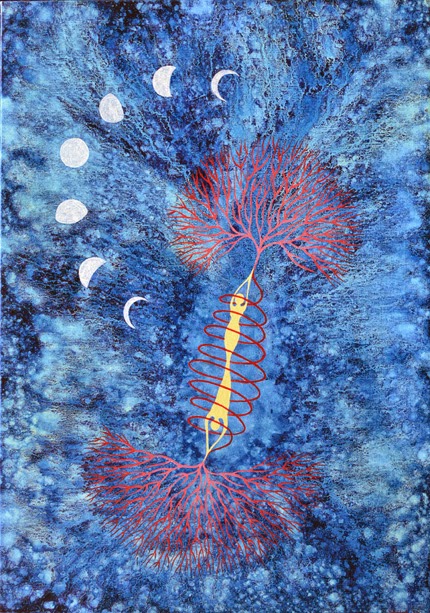
Showing posts with label creativity. Show all posts

Thursday, March 24, 2016

PROACTIONARY AND PRECAUTIONARY

 Line drawing  pen and ink 1974 


1974 - 1976
In 1974 - 76 when I was in my mid teens I drew these two drawings. I can remember drawing them. The bottom one even ended up being framed. So, someone decided it was a good work and warranted special treatment.

The top drawing was inspired by a sideboard my parents had in the dining room of the house I grew up in. An old lamp was placed on top of it. I've embellished the arrangement of items with additional vases and a 'garden' of small branches and flowers. 

The drawing below is from my imagination. Yet, the practice of drawing from nature and my immediate environment is evident. I used to do a lot of drawing of things I saw. The stylised trees or branches are not dissimilar to those in the drawing above. The juxtapositoning of these organic forms with geometric ones is something I used to love to do. It was great to play with patterns  - working out how various elements best 'fit' together as I proceeded with the drawing process. 

ERROR
Yes, there was some trial and error. I cannot tell you where the errors were made, but I know they were - and I covered them up or changed tack to turn them into parts of the pattern. Yet, I was also thinking ahead about how I might fit the image into the size of paper, how I might render the outer edges to create some kind of visual framing and so on. 

PROACTIONARY - PRECAUTIONARY
Drawing, and painting too, are processes where both proactionary and precautionary principles work in tandem. Proactionary means trial and error, learning as you go, solving problems as they appear and welcoming the accident as an opportunity. Precautionary means firstly, ascertaining risk factors and secondly, working out ways to avoid and mitigate these risks.  Actions like making sure you have enough space to draw where nothing can be knocked over to spill on the paper is a precautionary action. The artist works out what risks are not worth taking. But, events like ink pooling in a glob at the end of your nib just as you touch the paper creates instances where error can be turned into something positive, thus an example of proactionary principles. A glob of ink can be  manipulated to create a darkened section of the drawing, a shadow, or anything else that 'speaks' to the image. By embracing 'errors' I have found that changes of tack or approach produce unexpected, but often fantastic outcomes. Problem solving, amongst many other processes, is very much part of creativity. Yet, I would suggest that there is something about the tension between proactionary and precautionary concerns that heightens creative impulses, like a push me/pull you energy.
   
ACCIDENT
I still love drawing. I love the immediacy of making a mark. But, I also love the trepidation I feel when my hand might wobble, when I can see ink dripping towards the nib, when I notice an insect fly into a wet mark, when I accidently pick up the wrong pen or brush and make a mark before realising...there's a myriad of things that could be classed as errors! 

In fact, as regular readers know I deliberately introduce accidents, especially when I paint. I let the paint drip, pool and coalesce. I may let it dry completely before applying more paint. Or, I might throw more turps onto the canvas, or partially wipe away some paint. I watch what happens as the paint does its own thing. I make decisions about when to intervene. All of this scrutiny and action takes place in the immediate environment of my studio, within the attention of my sensibilities, over a period of time that I can measure, predict and manage. 

I can intervene...and I don't need to have the power on or the batteries charged!


Line drawing pen and ink 1974 - 76


Cheers,
Kathryn
www.kathrynbrimblecombe-fox.com

Monday, February 16, 2015

ART - MOVIES - ARTIFICIAL INTELLIGENCE


Code oil on linen 60 x 110 cm 2015
Pulsing, unnatural colours create an artificial looking environment. Some of the tree's branches appear to be sections of a computer motherboard. One branch twists its way across the unreal sky. As it curls into a small twist it ends with painted binary code 'instructing' LIFE. 


GOING TO THE MOVIES
There are a couple of movies coming out soon that I'm really looking forward to seeing. One is called Chappie from District 9 director Neil Blomkamp.

The other movie is called Ex Machina directed by Alex Garland.

Both  movies are stories involving artificial general intelligence, robots and human reactions to them.

Both movies are being screened at a time when serious discussions about artificial intelligence [AI] and potential artificial general intelligence [AGI] are occurring around the world. These discussions are taking place at various new scientific and philosophical research centres eg: Centre for the Study of Existential Risk at Cambridge University. 

There are potential advantages, and  also potential major risks associated with accelerating developments in artificial intelligence, and possible future super artificial intelligence. What may have been considered scifi ten or more years ago, is no longer a tenant of the impossible. 

KINGSMAN: THE SECRET SERVICE
Last week I saw another movie... Kingsman: The Secret Service I loved it...a spy spoof, with Colin Firth as one of the leading characters. But, there are links to the discussion about technology's capability to transform/change humanity. In the movie a super-rich malevolent megalomaniac attempts to take control of human free-will via implants triggered by sensors activated in mobile phones. In a way, his deranged intelligence, coupled with his immense technological power, are metaphors for  the fears and hopes surrounding AI and AGI. We also see low Earth orbit satellite destruction, remote control of vehicles and a lot more techno gadgetry; much of it spoofing James Bond movies.

EXISTENTIAL RISK
Yet, like a couple of other movies I have recently written about  [Interstellar and The Hunger Games], Kingsman: The Secret Service channels fears of existential risk. It's not overt, but it pervades as a background resonance. Rather than spoiling the movie for those who have not seen it, all I will say is that existential risk caused by climate change is a catalyst for the story. This is essentially the same catalyst for the story that unfolds in Interstellar. Each movie takes entirely different storytelling paths though.

The existential or catastrophic risks and fears associated with AI and AGI seem to drive Chappie and Ex Machina. I am particularly looking forward to Chappie as I have seen a few previews and I am fascinated that even in a few minutes Chappie's 'personality' was obvious. Chappie is an 'intelligent' robot. But, even though Chappie is clearly a robot, the moviemakers have successfully utilised anthropomorphising techniques [beyond making it a biped with head and arms] to create a character with personality, intelligence and seeming sentience. For example, in the previews, we see the robot engaging with a dog, just like a human would. And, we see the robot drawing, en plein air, a picture of a car it is observing. Portraying a robot to relate to an animal, particularly a dog [humankind's best friend], and creating 'art' are clever ways to anthropomorphise! I gather that in Ex Machina a scene where the intelligent robot, Ava, is drawing is also pivotal. Yet, there is a danger in anthropomorphising robots, AI, AGI etc...I think anyway. By doing so we project ourselves onto the robot/AI. That projection is a kind of wishful thinking with all its inherent blind spots!


http://kathrynbrimblecombeart.blogspot.com.au/2011/06/meeting-place-of-mind.html
Meeting Place Of The Mind Oil on linen 100 x 70 cm
 

ART AND AI/AGI
I am keen to see what Chappie does with its drawing. I am also keen to see Ava's drawing. Why? Because there's drawing - and then there's drawing! Yet, there must be something about art and creating art that we humans understand as an essential sign of  being human. So, if a machine can 'create' art then it must pass THE TEST [Turing Test]. But as I wrote above, there's drawing - and then there's drawing...rendering something perfectly with technical and realistic virtuosity is not necessarily art or creative. What would happen if the robot/AI made a mistake, how would it problem solve? Indeed, maybe making a mistake would be a sign of human-ness?


Cheers,
Kathryn
www.kathrynbrimblecombe-fox.com


Sunday, June 22, 2014

THE HORIZON HAS DISAPPEARED

The Horizon Has Disappeared Gouache on paper 46 x 115 cm 2014
 
The horizon has disappeared...what does this mean? Well, for me, quite a number of things.
 
  • With new cosmological research known horizons about the Universe have been transcended, yielded, vanquished. So, whilst literal horizons have been pushed to places beyond dreams, what does this mean for other kinds of horizons? What other kinds? Well, let's see...humanity's future and past: the Universe's past and future: humanity's intellectual, emotional and spiritual capabilities and beliefs...and more. It's exciting... and daunting.
  • What does it mean to be human in an age where augmented reality, simulation, artificial intelligence and technology 'provide' so-called enhanced experiences, automated labour, economic benefits and more? The horizons of possibility, once viewed as science fiction, are now not so fantastical. They may have been propelled afar, but they are also often obscured. And, if they are, what else maybe obscured, hazy or blurred? Entering a fog can be frightening. If it lifts there's often a bright sunny day, but if it doesn't...?
  • The horizon of what constitutes threat to individuals, nations and the world has shifted. Terrorism, cyber terrorism, bio terrorism, trans-national crime are all now aided and abetted via technology...yet technology is something we welcome into our everyday lives, often without thinking of its dark side...or even being aware that there is a potential dark side. Squadrons of fighter jets, no matter how hi-tech, will have little impact on an orchestrated cyber attack...don't you think? Traditional modes of defence left their horizons back in the 20th century. New defensive and pre-emptive tactics, I suggest, will be found in scientific research plus new ways of forging relationship and exchange. And, culture and the arts are vey much part of this! [If you do a quick Google on the top threats to world/national security all of the ones I have listed above are mentioned.]
  • I wrote a post awhile ago where I suggested that the driverless car maybe a metaphor for the disappearance of landscape. How? Well, imagine a car being driven by a computer. The occupants are sitting behind darkened windows. They are passing the time with entertainment provided via various kinds of devices, some may even be imbedded in their bodies! Well, there's no need to look out the window is there! No need to orientate oneself, no need to keep a watchful eye on other traffic, road conditions, terrain etc. No need to distract children by pointing out interesting things along the way. In a sense the landscape disappears! As we lose literal sight of and interest in it, plus lose abilities to negotiate our way through it, what happens to horizons? Are they actually diminished? Do they disappear or are they extended? And, what about relationships if all occupants are individually entertained? No conversation, no commentary and probably no fights! My earlier post was called Looking Out The Windows
The Horizon Has Disappeared Gouache on paper 46 x 115 cm 2014
This is an ambiguous landscape. Is the viewer flying above the landscape? Or are they part of it? Is it actually a landscape?
 
For me 'landscape' is a metaphor for the internal 'landscape' of the human psyche. It is also a metaphor for many other kinds of 'landscape'...Universal, macro, micro, political, spiritual and more.
 
If you have a pair of simple 3d glasses put them on...the painting separates into various dimensions. Many of my paintings do this! The impression of multiple dimensions, alludes to multiple horizons! It also alludes to the possibility of other horizons beyond sight too. This I like very much. This 3d phenomena is not done deliberately...I have no desire to paint 3d, but I certainly like that it happens.
 
 
 EXHIBITION ALERT
-
 
SEPTEMBER 2 - 14 2014
Graydon Gallery
29 Merthyr Rd, New Farm, Brisbane, Australia, Earth, The Universe!

Cheers,
Kathryn