Friday, January 19, 2024

AI GHOSTS

AI Ghosts Gouache on paper 56 x 75 cm 2024


This painting was inspired by thinking about AI generated avatars, replicas, proxies, simulations and fakes. I've tried to write more, but like our looping - if not loopy - world - I kept on going in circles. And, endless looping is not helpful, so I broke it!

It's now up to you to ask the questions! Indeed, the painted binary code at the bottom of the painting 'instructs' multiple question marks (?). 


Cheers, Kathryn

Sunday, January 14, 2024

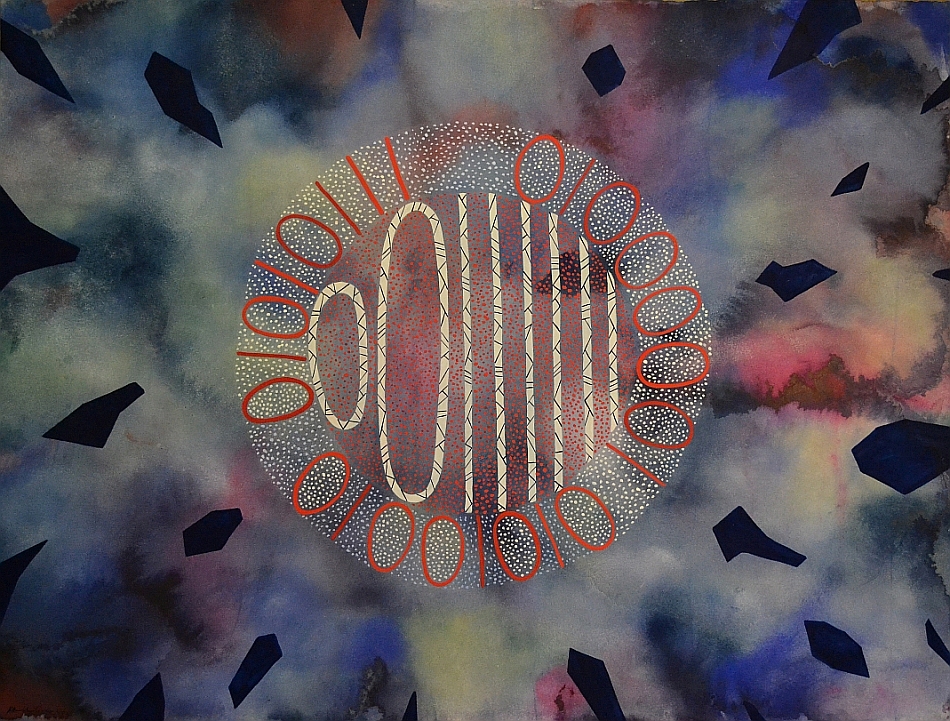
WHY WAR?

Why War? Gouache on paper 56 x76 cm 2024


Why War? is a question-painting or a painting-question. 

PhD
I have just finished my creative practice-lead PhD*. My research focused on increasing military interest in the electromagnetic spectrum (EMS), as an enabler of technology, a type of weapon, a manoeuvre space, and a domain. In the contemporary era, geographically-based kinetic warfare and new modes of warfare, such as, information, remote operations, electronic, and electromagnetic warfare, rely upon signalic connectivity and interconnectivity for operability and interoperability of systems and devices. War now exceeds geography, extending its operational apparatus and outcomes across the world, and from land to orbiting satellites. It is vitally important, though, to remember that in active kinetic war zones, the horror of war remains physically bloody and destructive.

Planetary war
In the age of algorithms, light-speed signalic connectivity, increasingly autonomous systems, airborne drones, and generative AI, Why War? presents contemporary war as planetary and space-based. Military technological reliance on the EMS martialises the environment from Earth to orbiting satellites. Significantly, this same techno-environment is also crucial for civilian technological operations. 

In the painting the Earth is formed by red dots and painted binary code 'instructing' a ? (question mark). This white code is cross-hatched with lines - perhaps revelations of signals ricocheting around the world? The white-dotted area surrounding the 'planet' is the Earth-to-orbiting-satellite environment. This environment is punctuated with painted binary code 'instructing' the word WAR. The zeros and ones encompass the planet, at the same time as occupying the space between land and orbiting satellites.

Photons?
The red and white dots could be interpreted as photons, the elemental particles that make up electromagnetic frequencies. All EMS frequencies consist of photons travelling at the speed-of-light in wave patterns. The light spectrum is the only frequency visible to the unaided human eye. But, the dots may not be photons - maybe they are bullet holes, bomb sites, smart-device hacks, social media disinformation dissemination? The dark shapes that surround the 'Earth' could be read as debris, or perhaps stealth space-craft, or maybe visual metaphors for danger? These shapes also appear in a few previous paintings  - THE CLOUD IS NOT A CLOUD, Force MultiplicationGhost Sky, and Ghost Shadows.

Cosmological perspective
The cosmological perspective taken in Why War? is an example of my imaginational metaveillance* approach and practice. Without the aid of augmenting devices I fly in imagination, and ask you, the viewer, to fly too. As you fly way beyond Earth, what do you see? Imaginational metaveillance is a play with perspective - literal, imagined and metaphoric.

Maybe I have painted a photon, rather than the Earth? 

Questions are important!

*You can access my PhD thesis: 
Drones, Signals, and the techno-Colonisation of Landscape
at Curtin's espace 
My thesis includes a chapter on imaginational metaveillance. 


Cheers,

Kathryn

Friday, January 05, 2024

THE CLOUD IS NOT A CLOUD

 The Cloud is Not a Cloud gouache on paper 56 x 76 cm 2024

The Cloud - Swarm?
With The Cloud is Not a Cloud I wanted to pose questions about the contemporary 'Cloud' as a weaponisable and weaponised system. I was thinking about swarming technology, pondering whether the techno-Cloud, enabling complex arrays of services and capabilities, could be described as a dexterous swarm with both benign and malign latencies. However, is the techno-Cloud the swarm or the swarm enabler? Or maybe its a swarm that can spawn more swarms? The proliferation of misinformation, disinformation and fake news/images across social media is an example of this conception of swarming. 

Signals
While the techno-Cloud is underpinned by bricks and mortar, for example, buildings housing massive computer infrastructure, relay nodes dotted across the landscape and space, and other tangible devices, I am particularly interested in the invisible infrastructure. Here, I am referring to signals that ensure connectivity, interconnectivity and interoperability of devices and systems. 

Signals carrying codified data and instructions are visualised in The Cloud is Not a Cloud as lines connecting ambiguous looking shapes. Their multiple sharp edges could indicate a not-so-friendly environment, a protective stance, tactical readiness or strategic preparedness. Could The Cloud is Not a Cloud be a visualisation of military preparedness, geopolitical alignments, force posturing? Are we projecting onto the techno-Cloud fears of geo-political instability, and the type of war that needs no physical invasion? 

Red and White
I have used red and white to indicate potentialities, such as, attack, vulnerability, disguise, stealth, blood. I have deliberately implied that the colours could oscillate or merge, depending on politics, technological resilience, or non-resilience. Like many of my paintings, The Cloud is Not a Cloud can be viewed from multiple perspectives - from above, as if you are flying over the sea; from below, as if you are peering through 'clouds' to a blue sky; in front of or behind, as if you are about to walk into a spider's web...

As always, there's a lot more to think about. But, I will leave it to you now...

____________________________


Previous Posts of Interest.
The Cloud is Not a Cloud visually references some other recent paintings where I have painted odd patterns that echo the shapes of airborne drones, munitions, debris. You can see these paintings on these blog links Force MultiplicationGhost Sky, and Ghost Shadows.

Since 2015 I have painted many paintings that refer to the techno-Cloud. You can search my BLOG by typing the word 'cloud' in the top left box above Art @ Kathryn Brimblecombe-Fox or in the 'Search this Blog' box on the right of the post.

NEWS

I am very happy to report that I am now a Dr. 
My PhD was conferred by Curtin University, Western Australia on the 1st December. 

You can access my PhD thesis: 
Drones, Signals, and the techno-Colonisation of Landscape
at Curtin's espace 


Cheers,
Kathryn
  

Thursday, December 28, 2023

FORCE MULTIPLICATION?

Force Multiplication? Gouache on paper 56 x 75 cm 2023
 

Ghost Bat Drones
Three MQ28-Ghost Bat drones form an horizon arc across the painting. I've painted them differently to indicate that as a team accompanying fighter jets, they have multi-modal capabilities. They all have  autonomous functions. The Ghost Bat drone is a collaboratively developed drone between Boeing and the Royal Australian Air Force (RAAF). It is the first military aircraft developed in Australia in more than 50 years.

The three drones occupy the sky-scape, like stealthy super-heroes - maybe.

Integrated Force
This is an ambiguous painting - deliberately so. What are the dark drone-fragment-like shapes? Do they indicate proliferation of techno-power? Is this an image of integrated force? Or, do the fragments indicate disintegration? The recent Australian National Defence Strategic Review (DSR) (2023) calls for an integrated force, rather than a joint-force. This term, like joint force, refers to national capabilities, but also integration with allied capabilities, for example, via partnerships such as AUKUS. Integration is enabled by signalic  connectivity and interconnectivity. These then enable interoperability of systems and devices. Interoperability is a foundational capability for integrated force structure.

Let's get back to the dark drone-fragment-like shapes. Imagine signals connecting them all. Now imagine a disconnection - a disruption to the enabling signals. At one instance the painting could be an exemplar of integrated force - and - at the next instance - an image of catastrophe. I am reminded here by security scholar and analyst Jaquelyn Schneider's idea of the capability/vulnerability paradox.

Is the sky falling?
What about the pale blue shapes that mimic the sky as well as the drone-fragments? Note there are no dark drone fragments above the Ghost Bat arc. However, there are some blue fragments below the drones. Is the sky falling? Or, are these pale blue 'fragments' indicators of space-based assets? If they are, can we read them as friendly or not? In the DSR, the MQ-28A Ghost Bat is described as a "sovereign autonomous air vehicle designed as part of an integrated system of crewed and uncrewed aircraft and space-based capabilities." (DSR 2023, 61). 

If the pale blue fragments are indicators of space-based assets, then the painting reveals a war zone from Earth to orbiting satellites, a techno-colonised landscape. Integration across the five domains - land - sea - air - cyber - space - is clearly a complex aspiration. 

What could go wrong?

Clearly a lot more to say!!! For example, I've got more to say about skies, fake skies, fantasy and fake fantasies....deception.

NEWS

I am very happy to report that I am now a Dr. 
My PhD was conferred by Curtin University, Western Australia on the 1st December. 

You can access my PhD thesis: 
Drones, Signals, and the techno-Colonisation of Landscape
at Curtin's espace 


Cheers,

Dr. 😊 Kathryn


Saturday, November 25, 2023

GHOST SKY


 Ghost Sky Oil on linen 56 x 122 cm 2023


This new painting continues my thoughts about airborne drones generally, and the MQ28 Ghost Bat drone specifically. The latter is Australia's first military aircraft in 50 years, a joint development between the Royal Australian Air Force (RAAF) and Boeing. 

Ghost Sky is related to a number of my paintings that depict Ghost Bat drones or indications of their presence. A recent painting is Ghost Shadows (2023). Ghost Shadows is similar to Ghost Sky, conveying a visual effect of dispersal or proliferation of  militarised aircraft - maybe even weapons. While I called this effect a "fragmented force", contemporary signalic connectivity ensures interconnectivity and interoperability, thus belying traditional notions of fragmentation. Maybe a better word is spawning

With Ghost Sky I wanted to create a sense of a fake sky, generated by the presence of air and space-based systems and devices. The idea to use the drone as a visual metaphor for a fake sky expands upon ideas expressed in a few earlier paintings, for example, Anomaly Detection  (2017) and Anomaly Detection 2 (2017) (below). In both of these earlier works I have used painted 'pixels' to form the drones' fuselages and wings (I refuse to say 'bodies'!). In this latest painting, Ghost Sky, it appears as if the pixels have morphed and erupted beyond their drone boundaries. Is this a kind of auto-generation, similar to generative AI capabilities? I do not know - it's a rhetorical, but interesting question. 

I think Ghost Sky appears less ominous than Ghost Shadows, but don't let appearances deceive you!

And, as always, lots more to say - but I will leave you to think about Ghost Sky for now.


                                     Anomaly Detection (Number 2) Oil on linen 120 x 180 cm 2017

Cheers,
Kathryn


Sunday, September 24, 2023

SUSPENDED LANDSCAPE

Suspended Landscape Oil on linen 67 x 61 cm 2023


In an age of persistent surveillance, heightened security needs, calls for civil and military preparedness for disaster and war [of various kinds], fears of fakery, and increasing numbers of displaced people, what does mapping of landscape and environment mean? Our world is not only traversed by human beings and animals; it is also scoped by arrays of land, sky, space and sub/marine based sensors. These sensors, attached to various devices and systems, register, detect and transmit data using electromagnetic frequencies. Movement of data, therefore, occurs in realms of space and time that are beyond human and animal experiential dimensions of mobility. 

Data is presented visually for human beings in graphics that overlay video or still images. Here, I am thinking about - for example - geolocating and terrain visualisation graphics, graphic recognition-squares that seemingly hover over the faces/heads of people, infrared markers monitoring human movement, guiding lines based on data transmitted from reversing cameras, on-board GPS screen-based directions, and crosshairs marking a remote operator's target.

Suspended Landscape plays with the appearance of computer-graphics. The continent of Australia is divided into squares, each one presumably containing information. If this painting was a screen, you could zoom in and out of each squared 'peep-hole'. Other dots and crosses mimic digital markers. Their purpose is ambiguous, maybe top secret? For me, I wanted to play with the idea of suspension - waiting, wondering, but also the idea that landscape is now suspended from 'hooks' of data. 

Each one of us, carrying a mobile phone, becomes one of these hooks. As we amble to work, play with our children in a park, fly in a plane, or speed off in a boat, our mobile devices can transmit and receive data, updates, and instructions at near light-speed. Unless signals are disrupted, or the power goes out and recharging your mobile phone is impossible, we are appendages or nodes in a ubiquitous data mapping system. 

While Suspended Landscape depicts the continent of Australia, the off-shore landscape is ambiguous. Maybe the splashes of red are close-up images of the Australian coastline. If so the digital system has dispersed the landscape across a screen. What for? Is it to closely analyse environmental impacts of climate change, or maybe it is a glimpse of a war gaming exercise. Maybe the dotted areas radiating outside Australia are pathways for future in-flow or out-flow exodus, maybe they are possible routes for incoming insurgents or combatants? 

Here, the idea of preparedness for future possibilities engenders suspense - as if dangling - waiting for something to happen. Yet, the painting also suggests a visual suspension of landscape, the continent laid out across a cosmic landscape. Perspective can shift from a possible aerial view to one where the viewer confronts the scene, like a spider web suspended across a gate-way. 

Shifting perspective - for me - is both literal and metaphoric. Please have fun imagining Suspended Landscape's many other possible interpretations!

Cheers,
Kathryn


Friday, September 08, 2023

VERIFICATION ERROR: IDENTITY CRISIS

Our Dog Delirium: Crash Gouache on paper 21 x 30 cm 2023

These three new small works on paper channel some of my thoughts about robotic quadrupeds. However, while this is a specific focus, the robotic quadruped is also a visual metaphor to stimulate thinking about other robotic systems and devices.  

I depict the robotic quadrupeds because I've seen them in action at the Australian Army's Landforces expo in Brisbane in 2021 and 2022. While interested in seeing the robots, I was more interested in watching how people reacted to them. So many people responded as if these robots were real dogs. There were smiles, laughs, wriggles to respond to robotic 'wriggling', and lots of selfie photos with the robots. People bent down to look into the robotic 'face', smiling as they did so. The robotic quadrupeds, clearly controlled by remote operators in the expo hall, 'pawed' the ground [actually more like cats!], tilted their head as if inquisitive, wagged their behinds as if they were happy. 

I am sure there were probably more neutral or circumspect responses by people to the robots, but these were not as obvious.  

Questions

I ask - in an era where so much technology is dual-use, how can we form resilient critical perspectives about human - machine interactions when normalising processes cross civilian and military arenas? I ask - how do we not fall into traps where we uncritically think we are in a relationship with a robot? I ask - if a robotic quadruped at a military expo elicits warm and fuzzy human reactions, how does this parlay into integrating human-robot partnering in the armed services? I ask - if a robot is present, for example, at an expo or an art exhibition, what happens to data it may collect via various sensors? What kind of training is provided for robotic developers by seemingly benign interactions with robots brought into places such as expos and galleries? 

Paintings

Our Dog Delirium: Crash [above] and Verification Error: Identity Crash Site [below] visually 'speak' to a confusion - our confusion between alive and synthetic - what is a dog in the twenty-first century? If we collapse dog and robot into one, or human being and robot into a singularity fantasy, what do we give up in the process? 


Verification Error: Identity Crash Site Gouache on paper 21 x 30 cm 2023

In Our Dog Delirium: Crash I have painted an Australian Kelpie with a robotic quadruped similar to an experiment where a Ghost Robotics quadruped was armed. In Verification Error: Identity Crash Site [the verification tick on the robot indicates that it is the real dog. In both paintings the shadows cast by both the dog and the robot seem to collide - crash. is the red seeping from the crash site real blood?

Shadow Litter [bottom] is a futuristic image of a figure - is it a human being or a robot - walking a 'litter' of robotic quadrupeds.

I have another post DOGS, QUADRUPEDS AND ROBOTS with more dog - robotic quadruped paintings.  

Needless to say, there is a lot more to say!

Cheers, Kathryn 


Shadow Litter Gouache on paper 21 x 30 cm 2023


Thursday, August 24, 2023

ZOOMING IN AND OUT

Zooming In and Out Oil on linen 92 x 112 cm 2023
Copyright Kathryn Brimblecombe-Fox


ALERT! My new website is live! Please check it out at KathrynBrimblecombe-Fox


Zooming In and Out

Like many of my paintings Zooming In and Out includes visual parodies of computer-like graphics. While you might be able to use your computer or phone to zoom in and out of the digital documentary photograph of the painting, the painting itself, as an object, offers a different kind of interactivity. While the title offers a clue, the viewer has to imagine how the painting may represent a zooming in and zooming out activity. The viewer might ask - If the ambiguous landscape juxtaposed with the map of Australia is a zoomed-in location, what location is it? Could it be the tip of Cape York Peninsular or part of a northern New South Wales coastline, or the edge of Wivenhoe Dam in Queensland? 

But, what if the image is, for example, imagined drone or satellite footage? If it is, then the landscape beyond the map depicts the oceans, seas and islands that surround Australia. If it is a drone or satellite image, then the viewer can imagine imaging sensors zooming in and out for a variety of scanning, documentary, surveillance, or targeting reasons.

While the small crosses act as grid co-ordinates that might be seen on various military and civilian maps, I also 'see' them as possible memorial markers. Like the symmetry of a military cemetery the small crosses could represent memorials for the environment. Zooming In and Out could be a post-human map of a small section of a global  memorial map. Perhaps it is a form of remembrance not only for the human species, but also for the planet. Each cross, zoomed into, may open into a shrine of remembrance - you can imagine this can't you?

I have a few more ideas, but I will leave it to you now!


NEWS

Next week 29-30 August 2023 at the Something Digital Festival, Brisbane, I am really excited to be participating on a panel to discuss,
 
Striking a balance: Ethics and creativity in generative AI.

The panel will be facilitated by Rob Hudson, Founder, SpoutLogic.

Panel members are: 
Ben Hutchinson, Trustworthy AI Lead, Google Research Australia
Kathryn Brimblecombe-Fox, PHD Student & Artist, Curtin University
Morgan Strong, Digital Transformation Manager, QAGOMA
Robert Feldman, Director, Gadens Lawyers
   
Tickets to the Something Digital Festival are still available 


Cheers,
Kathryn


Saturday, July 29, 2023

MIMICRY AND MEANING IN THE AGE OF AI

Mimicked Meanings Gouache on paper 56 x 76 cm 2023


NEWS
I am speaking on an AI and Creativity panel at the Something Digital Festival, Brisbane, 29-30 August. Please check out the website. I am very excited about being part of the Festival's program.


-----------------------------------------------------------------------------------------------------------------------------


Programmed Mimicry
These two new works on paper channel my interests in robotic and AI programmed mimicry of human behaviour. For example, a robotic companion in a childcare centre or a nursing home may display behaviours, through gesture and sounded words, of caring, interest and concern. These displays are designed to ensure that human beings feel cared for, protected, and even that they are experiencing a helpful relationship, albeit an unreciprocated one. 

Deception
BUT, what if we thought of programmed mimicry as programmed deception? For example, what if a robotic medical assistant first responder to an accident detects, via various sensors, that at human being's vital signs indicate death is 90% likely to occur within half an hour? If the injured person asks "Am I going to be ok?", the robot could give a factual statement that the person has a 90% likelihood of dying unless x y or z happens within half an hour. This may, in fact, cause a heart attack due to shock and severe distress - and the person dies before half an hour - before medical intervention can take place. Or, the robot could mimic a caring human being, sounding out words associated with comfort, calming and caring. For example, the robot could sound out the words "You will be ok. The ambulance will be here in very soon. I will hold your hand while we wait."

Sound Out or Speak Out
You may notice that I use the term "sound out" and "sounded words", rather than "speaking" and "spoken words" to indicate an audible robotic response to a situation or a question. I am experimenting with words we use to describe robotic or AI capabilities eg: thinking, creating, seeing, hearing, sensing. Is the use of these kinds of humanising words predisposing us to believing that robots and AI are becoming more like us? "Speaking" and "spoken words", I propose, carry so much more information about the character of being a human being. The term "spoken word" is laden with the multiple attributes of human expression! I add here that I am not excluding words spoken by those human beings who are deliberately manipulative and deceptive. A robot or AI cannot be deliberately deceptive, as that would imply some kind of intention - and intention is another of those words we seem to automatically use to describe robotic or AI capabilities. Intention ascribes a will to do or affect something. I would not describe AI or robots as having a will. Some would say - not yet! 

Warfare
Deception has long been a tactic in warfare. Robotic systems offer opportunities to  mimic human behaviours to deceive an enemy. They could even possibly mimic caring as a form of programmed weaponised deception. Another example is AI-faked social media accounts that deceive, churning misinformation and fake news as tactics of information-warfare. 

Mimicked Meanings and WHO/WHAT CARES?
These new paintings are like visual thought bubbles. I use painted binary code, accompanied with words, to indicate algorithmic mimicry. I paint neural-network-like patterns or computer circuitry as creeping kinds of contagion. In Mimicked Meanings I place a robotic quadruped with a real dog, an eye with scoping crosshairs, and binary code 'instructing' the word EMPATHY with the word EMPATHY. There are other visual entendres indicating synthetic mimicry, but I will let you find them! 

In both Mimicked Meanings and WHO/WHAT CARES? I play with Douglas Hofstadter's idea of the ambigram to suggest that same/same in the age of AI is not a game. In both paintings the background of the painting is marked with evenly spaced dots, clues to a world digitally geo-mapped for robotic systems.

And, the fact that these are paintings, not reliant on digital or AI-assistant technology, is an act of resistance!

There's more to say - but, I will leave it to you now! 😊


WHO/WHAT CARES? Gouache on paper 56 x 76 cm 2023

Cheers,
Kathryn


Saturday, April 29, 2023

FAKE SKIES, PEOPLE, DOGS & LANDSCAPE - ONLINE EXHIBITION

Fake Landscape HAM electronic parts on RF resistant material 21 x 30 cm 2023


FAKE SKIES, PEOPLE, DOGS & LANDSCAPE 

The five works in this online exhibition are all created using old electronic gear from my father's HAM amateur radio stash. My father died in 2016, leaving behind copious supplies of electronic parts, a multitude of electronic gadgets, a large number of computers and computer parts, arrays of power cords, and various other gadgets and gizmos. Most of his supply has now been sold or given away, including two large aerials. I retrieved a box full of electronic gear. It's only recently that I knew what I needed to do with it! I am sure my PhD research into increasing military interest in the electromagnetic spectrum opened up the opportunity.

You might like to read TWO PAINTINGS OF MY DAD 

So, Here We Are. 

I have created these five works as whimsical critique of AI generated images, particularly fake images. These act as a kind of violence on society. This violence needs addressing. 

The materiality of the five pieces in the exhibition reminds us that AI technology also requires material components, structures and infrastructure. These all entail extractive processes, industrial manipulation, and manufacturing development. Each work is created on radio frequency resistant material, also from my father's stash. I like that the idea that resistance, presented in these analogue critiques of contemporary technology, is materially embedded in the actual works. 

Fake
I have also used some of my father's old stencils, which he would have applied to the various gadgets he made or altered. In Fake Landscape (above) I have stenciled landscape-type words as labels, for example, I chose 'RANGE', used to denote frequency range, to denote a mountain range. 'PITCH' is used to denote the pitch of the mountain. I point out that there is even a fake fence, on the bottom right. This references electronic fencing to fend off wayward drones! In War Zone (below) I have stenciled 'CAUTION' and 'CITIZENS'. Here, I am sure my reasoning is self explanatory. In War Zone the row of five brown capacitors looks like a row of people - citizens. Fake People (further below) is a crowd of 'people', perhaps a crowd in a simulated virtual reality? Maybe a virtual reality war game?
 

War Zone HAM electronic parts on RF resistant material 21 x 30 cm 2023


Fake Sky HAM electronic parts  on RF resistant material 21 x 30 cm 2023 


Fake Sky is an array of blue transmitters and resistors. I was thinking about simulated skies in virtual reality - meta - environments. I was also thinking of blue-sky thinking, and how technology can stimulate, but also how it standardises and homogenises processes in ways that affect human thinking and expectations.


Fake People Capacitors on RF resistant material 21 x 30 cm 2023 


Fake Dogs Capacitors on RF resistant material 21 x 30 cm 2023 


Fake Dogs continues my interest in robotic quadrupeds - I refuse to call them 'dogs'. Robotic quadrupeds are used by military, security and policing forces. Recently I have noticed that the artworld is welcoming them into exhibitions as part of curatorial programming. Here, I hope criticality prevails, but I suspect the entertainment factor will win. Every encounter and activity a robot undertakes is a training experience providing copious amounts of data for their manufacturers and other users. I have a lot more to say about this! 

My fake dogs above could be armed, but maybe they are not...

I have previously written about dogs and robotic quadrupeds. I even created an online exhibition on this BLOG called DOGS, QUADRUPEDS AND ROBOTS


Cheers,

Kathryn

Tuesday, February 28, 2023

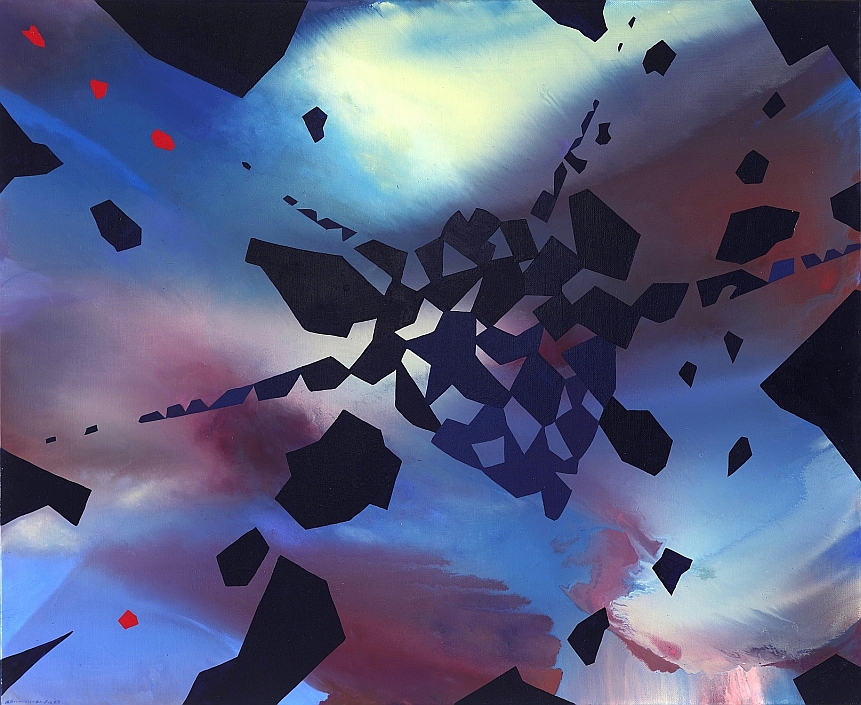
GHOST SHADOWS


Ghost Shadows Oil on linen 92 x 112 cm 2023


Ghost Shadows is a new painting, inspired by thinking about the Royal Australian Air Force and Boeing collaboration to develop the MQ-28 Ghost Bat drone, previously called the Loyal Wingman drone. I have a number of earlier paintings that also reference the Loyal Wingman/Ghost Bat drone. You can see them in my 2021 online exhibition Wingman (MQ-28 Ghost Bat) Online Exhibition

Ghost Bat
With this new painting I was thinking about the name Ghost Bat, the name of a real Australian bat, applied to a drone. So, that got me thinking about ghosts, bats and shadows, stealth and invisible aspects of contemporary war. I was also thinking about landscape, geographical, technological, military, and other-worldly. As regular readers know I am currently undertaking my creative practice-lead PhD with an examination of increasing military interest in the electromagnetic spectrum. 

I 'see' the technological landscape as mostly an invisible one, a stealthy signalic techno-colonised landscape from Earth to orbiting satellites. My aim, in my work, is to make the invisible 'landscape' visible! Yes, hardware and devices mark and move through our physical environments, but enabling signals are transmitted wirelessly or via discrete cables [eg: undersea internet cables]. I am mostly interested in wireless signaling/transmissions that enable light-speed or near light-speed connectivity, interconnectivity, operability and interoperability of civilian and military systems and devices. 

Shadow or Shadows 
Initially I was going to call the painting Ghost Shadow, but then I decided to make the shadow plural - thus, Ghost Shadows. The plural draws in multiple aspects of drone and robotic technologies - especially the fact that they are nodes in a system. Thinking imaginatively, what kinds of shadows does the militarised techno-system cast? Could the system be a multi-faceted shadow that we don't see - except in my painting? Maybe we should go looking for shadows! If we thought of ourselves as bats, let's lurk in the night, in the dark, using imagination to see things beyond sight. 

Fragmented Force
In  Ghost Shadows a Ghost Bat drone is identified as a fragmented force, a strange craft flying through the sky. This fragmentation 'speaks' to the drone's many capabilities, those disclosed by the developers, and those that have not been disclosed. The fragmentation evident in the whole painting alludes to pixels and the techno-reliance on imaging capabilities for operation, orientation, ISR, and targeting. Yet another interpretation could be that bits of the Ghost Bat drone have been flung into the sky. Has it spawned more bats? Or, has the drone been compromised? The dark large and small fragments might be shadow-indications of more drones or piloted aircraft - after all the Ghost Bat drone has been designed to accompany fighter jets. Thus, is this a scene of a mid-air battle between autonomously flown drones and piloted craft - debris scattered. But, is the debris material, or in an age of accelerating technological development, is it the debris of hopes and dreams?

Lots more to say - but I will leave the painting with you now! What do you think of the red fragments!?
Cheers,
Kathryn


Friday, December 23, 2022

WHERE'S THE BEATING HEART?


Where's the Beating Heart? Oil on linen 112 x 92 cm 2022
Photo: Rob Frith


This new painting relates to my last painting On The Edge of Being 

Human-Machine
In both paintings I visually question the human-machine relationship, including increasing developments and expectations of these relationships. Using a visual ambigramatic [after Douglas Hofstadter] ploy in both paintings, I have painted tree-like patterns as if they are about to merge, or maybe even repel each other. It's your choice to decide! An ambigram can be read, with multiple meanings, in both an upside and downside orientation. But, they can also be read as the same....

The tree-like patterns are those of a natural tree or branching system [roots, vascular, leaves, lines on our palms etc], plus tree-like patterns uses in computer science ie: tree logic, neural networks, chip boards etc. In Where's the Beating Heart? the upper oval represents natural life and systems, and the lower oval represents coded systems and their correlative hardware. Like an ambigram, the painting could be turned the other way - maybe orientation depends on aesthetics, but also beliefs about humanity, technology and the future?

Patterns
I am not a computer scientist, nor am I an arborist, but as an artist I like to look for patterns, and I like to present what I see as provocations to prod questions. Regular readers will know that I have a keen interest in technology, undertaking technical research to inform my work. These readers will also know that my current PhD research examines increasing military interest in the electromagnetic spectrum [EMS - radio, microwave etc frequencies]. Without consistent uncongested or uncontested access to signal-transmitting frequencies in the EMS, much of our contemporary technology would flounder.  

Theatre of War
Both On the Edge of Being and Where's the Beating Heart? have been inspired by my research, particularly my interest in the idea of 'theatre of war', a phrase often used by 19the century General Carl von Clausewitz in his famous tome On War. Clearly the contemporary  'theatre of war' is different to the 19th century idea of 'theatre of war', but if war is seen as a performance, I do think performativity is still a component of war. We now have 'roles' played by technological systems and hardware that are militarised and militarise-able. Militarise-ability of civilian systems/hardware is a key interest of mine ie: connectivity, interconnectivity and interoperability of systems/hardware, are enabled by signals transmitted via EMS frequencies. New modes of war, such as cyber, information, hybrid, and network-centric warfare draw civilian systems into the 'theatre'. One example is the use of social media for information warfare - there are many other examples.

Heart
Where's the Beating Heart? poses questions about human being-ness and technological utility. As autonomous components are embedded into systems, human speed is bypassed. I ask, isn't human speed, the pace at which we work and think, part of our being-ness? This is just one of many questions I ask myself, and embed in my work. The tree-logic pattern 'pulses' with a predominantly red centre of painted conduits. Is this a fake heart? 

There's more to say, but I will leave that to you! 

Cheers, 
Kathryn
 

Tuesday, November 22, 2022

ON THE EDGE OF BEING

On The Edge of Being Oil on linen 112 x 92 cm 2022
 

In an age of artificial intelligence, increasingly autonomous systems, technological interconnectivity and interoperability, drones and other robots, what happens to human identity? If our future is one of being human-machine, what kind of being-ness does this impose or require? Do we become more like the machines/systems or do they become more like us? How does algorithmic/machine utility and human being-ness work together? 

On The Edge of Being
This new painting visually poses a possible immanent battle or meeting between the upper section of trees and the lower section of different kinds of 'tree's. It's up to you to ponder whether a battle or a meeting is likely. Or maybe it's something else. The free flowing tree-like branches at the top of the painting are posed with a more standardised neural network tree-like structure in the bottom half of the painting. I was thinking about being-ness vs utility. I was also thinking about trees - for example, computer science tree-logic/hierarchies and the age-old transcultural/religious tree-of-life. Both 'coded', but differently. A lot to say here, but I won't go on - and on...!

I have not only painted different tree-structures, but I have used slightly different tones of colour in each section. The green in the top part of the painting is a more real-world tree or plant green, whereas the green in the lower section is a night-vision surveillance green. I have used different yellows and blues in each section, but the same cadmium red. This red dominates as each 'tree-scape' encroaches on the fiery and tumultuous centre. The red could indicate readiness - maybe for battle. The centre section could be a war zone, but it could also indicate fertile ground. Whatever it is, for me it symbolises a rubicon - like crossing the Rubicon River. Maybe there is no way back, especially if we don't pay attention. 

In 2017 I created a painting called Crossing the Rubicon  

PhD - Light Speed
On The Edge of Being came to me as I wrote one of my PhD chapters Speed: Light Speed = c. In an era where light-speed signal transmission enables technological speed, how do expectations of beyond-human dimensions of speed, and therefore, time, impact or influence human being-ness? What metaphoric tree should we grasp onto as speed engulfs?


There is more to say, and think about...

Cheers, Kathryn 

PS: You might be interesting another painting


Sunday, October 30, 2022

MAKING CODE VISIBLE: ONLINE EXHIBITION

 1. Unseen Oil on linen 90 x 80 cm 2015


2015-2022

This online exhibition of selected paintings starts with  Unseen (above), painted in 2015. Unseen is one of my first paintings where I depict binary code as part of an overall image. In this case a colourful string of zeros and ones repeatedly instructs the word LIFE. This string of visualised code extends from a branch of the tree, depicted with a colourful array of roots. The tree could be a tree-of-life, offering another kind of 'code'. Like many of my paintings a cosmic-like background helps to create a sense of flight.

Unseen was the source of inspiration for a collaboration with Brisbane-based internationally known jeweler Margot McKinney. The small series includes a fabulous necklace that follows the graphic lines of the tree, and zeros and ones. Square cut and round gems 'form' the binary code. A series of gorgeous earrings were inspired by the spiral of binary code in Picturing the Posthuman (painting number 16). I like the fact that code has been extracted and aestheticised in my paintings and in jewels made from natural geologically formed gemstones.     


LIFE and War
The next 19 paintings start with examples of recent works, ending with other earlier paintings. You will notice that as I experiment with visalising and eastheticising normally invisible code, its relationship with militarised technology and militiarise-able civilian technology becomes more politically charged. In a world where notions of warfare now include information, cyber, hybrid, grey-zone, and network-centric warfare, the key role played by code and algorithms demands attention. 

Various kinds of violence now insidiously play out in networks, enabled by light-speed transmission and reception of signals carried by radio and microwave frequencies in the electromagnetic spectrum. Signals are tentacular enablers and deliverers of codified data and instructions. 

Text Prompted AI Generated Images
This online exhibition also responds to recent hype surrounding text prompted AI image generation, using datasets of human artists' images scraped from the Internet. I offer my paintings of visualised code as a disruption and resistance to algorithmically generated image making. Painting is not reliant on digital or cyber technology, thus it has a capacity for independent critique, without feeding data back into the system. Interestingly I have discovered that one of my painting, in this online exhibition, has been scraped and used in a dataset - painting number 19 Coded Landscape. The binary code, 'instructing' the word LIFE, forms a landscape-like contour. It's kind of ironic that this painting was scraped. I add here, that the image scraped was a digital image of the painting, not digital artwork. 

A few issues relating to text prompted AI generated images [not I do not call it AI Art!] include:
  1. That work created by human artists has been scraped with intent to build datasets, without consent from original artists. 
  2. Currently, text prompted AI generated images appear very similar, exhibiting a banality that flags a creeping homogenisation of aesthetics. This is a quiet kind of violence. I am reminded of a statement made by Jean Baudrillard in Passwords (2003), where he describes a digitally coded destiny where it will be “possible to measure everything by the same extremely reductive yardstick: the binary, the alternation between 0 and 1”.
  3. While AI generated images might be considered cultural activity, production or performance, it does not mean that all AI generated/assisted images are art. 

* Please click on the hyperlinked titles to take you to the relevant posts on this BLOG. 


2. Theatre of War: Techno-Seduction Gouache on paper 56 x 76 cm 2022


In Theatre of War: Techno-Seduction visualised code is used to used to expose connections between various elements of network-centric warfare - from satellites, to drones, to military AI legal tools, to human targets. 


3.  Interface: Being HUMAN Being   Oil on linen 56 x 112 cm 2022


4. Interface Gouache o paper 56 x 76 cm 2022 


5. Competition Continuum: War  Gouache on paper 56 x 76 cm 2021

6. ME: 01001101 01000101 Oil on linen 92 x 112 cm 2021 

ME: 01001101 01000101 is a self-portrait that poses questions about portraiture in the age of facial recognition. It also raises questions about identity and verification of identity. Louise Amoore’s concerns about “how algorithms are implicated in new regimes of verification, new forms of identifying a wrong or of truth telling in the world” 'speaks' to the role played by AI in image and identity verification. Could we, weirdly and dangerously, come to a time where verification of identity is only confirmed by a digital tick?

Louise AmooreCloud Ethics: Algorithms and the Attributes of Ourselves and Others, 5-6.


7. GOD? Oil on linen 41 x 51 cm 2019 

8. HUMAN Oil on linen 31 x 36 cm 2019 


9. Drones and Code: Future Now Oil on linen 40 x 56 cm 2018


10. Manhunting Gouache on paper 56 x 76 cm 2017


11. Fake Tree Oil on linen 25 x 35 cm 2017


12. Data Heaven Oil on linen 100 x 120 cm 2017 

Code 'instructs' the word DATA in the storage centre of the fake cloud. Predominantly painted in night vision green the painting 'speaks' to surveillance and digital data storage - even after mortal death.


13. Combat Proven, Long-Range, Long-Dwell Gouache and watercolour on paper 56 x 76.5 cm 2016


14. I Am A Posthuman Gouache and watercolour on paper 42 x 30 cm 2016

01001001 00100000 01100001 01101101 00100000 01100001 00100000 01110000 01101111 01110011 01110100 01101000 01110101 01101101 01100001 01101110 00101110
The code above appears in my new painting I Am A Posthuman. It actually 'forms', or maybe 'performs', or otherwise 'instructs' a structural element to the 'figure'. You can guess the translation for sure!


15. A Human's House and A Posthuman's House Gouache on paper 30 x 42 cm 12016


16. Two Humans Gouache on paper 30 x 42 cm 2015


17. I am Am I? Gouache and watercolour on paper 30 x 42 cm 2015


18. Picturing the Posthuman Gouache and watercolour on paper 30 x 42 cm 2015


19. Coded Landscape Gouache on paper 15 x 21 cm 2015


20. Where There's Life There's... Oil on linen 92 x 102 cm 2015

Where there's life, there's hope or code?


Cheers,

Kathryn