Showing posts with label philosophy. Show all posts

Thursday, July 27, 2017

RESEARCH INTO DRONES: HOW IT HAS INFLUENCED MY CREATIVE PRACTICE

Dronescapes in my storage drawers


About ten days ago I submitted my Master of Philosophy thesis. For the last nearly two years I've spent most days at my desk at the University of Queensland, School of Communication and Arts. In the evenings and some weekends, I spent time in my studio, painting. It was here that I worked through my research in a different way. Regular readers will know, it has been quite productive!

My university research was focused on  how two Australian artists, George Gittoes and Jon Cattapan, represent contemporary militarised technology in their paintings. Particular attention was paid to their responses to using night vision technology, and in the case of Gittoes, witnessing the deployment of airborne drones. I examined the various moral, ethical and political questions raised by their work. I won't write too much about this aspect of my thesis - as I am looking into publishing articles about each artist. If they get published, I shall let you know!

UPDATE NOVEMBER 2017
My thesis was examined with in two weeks of submission, with no requests for changes and no corrections! And, I have been awarded a Honorary Fellowship in the School of Communications and Arts, University of Queensland. One of the examiners strongly encouraged me to write a book, so this is something I am pursuing during my Fellowship. 


ART HISTORY - And OTHER DISCIPLINES
Although I was in the Art History department, my research crossed into other disciplines, including Cultural Studies, International Relations and Political Science. Additionally, I thoroughly enjoyed technical research into militarised drones and night vision, and other cyber and digital technologies associated with their operation and deployment. 

The technical research, coupled with cultural, legal and philosophical critiques of militarised drone technology, inspired my own creative work; my out-of-hours responses to the pictures that popped into my head as I read book after book, article after article, explored drone manufacturer websites, and delved into the history of drone technology and night vision. 


Larger Dronescapes in my map drawers


CREATIVE PRACTICE - ACADEMIC RESEARCH
But, this kind of inspiration is not a departure from my interests prior to commencing my M. Phil. For example, my earlier paintings depicting strings of binary code reflect interests in contemporary technology, and its effects on humanity and life. By juxtaposing code with the age-old transcultural/religious tree-of-life these earlier paintings also reflect my responses to ideas about existential risk posed by emerging technologies. At uni I had to narrow my topic to specific contemporary technologies. Thus, the focus on militarised technology - drones and night vision's association with increasing surveillance. 

My academic research topic came out of my painting practice - and it has fed back into it. My creative work completed during the last nearly two years is not part of the degree in a formal sense, but I consider it a major contributor to processes of critical thinking and the generation of new ideas. These have influenced both my academic research and my creative inspiration.

BODY OF WORKS ON PAPER
As the photos above demonstrate, I have a lot of paintings to show for my near two years of study. Actually between 80 -90 paintings, some smaller and some larger. They are all works on paper, because I knew oil painting would take too long and I'd be torn between spending time in the studio and at university. Neither activity would have benefited from this! These works on paper, though, track my research processes in ways that enabled spontaneous reaction to the research. The whole experience was really rewarding.

I'd love to exhibit these paintings. Curatorially there are a few aspects that could be developed!

A few exciting things happened during my study with regards to my own paintings. 

  • My work was featured by the Center For The Study of the Drone, Bard College, New York - Portfolio: Dronescapes by Kathryn Brimblecombe-Fox 
  • My painting Gorgon Stare heads Dr. Christopher J Fuller's post on Yale University Press's Blog Yale Books Unbound in the lead up to the publication of Fuller's book See It/Shoot It
  • My painting The Tree of Life Sends its Energy Underground is on the front cover of The Australian Women's Book Review 27, no 1 and 2. Additionally my article “Airborne Weaponised Drones and the Tree-of-Life” was also published.
  • My painting Red Rain is on the cover of HECATE 42/1 (2016) and an article by me is included in the publication.

RETURN TO OIL PAINTING
The photo below is of two stretched canvases. Yes, the aroma of turps has returned to the studio and house. 


NEWS
My entry, Universal Code, for the inaugural $35,000 Ravenswood Australian Women's Art Prize has been selected as a finalist. The Award is announced on August 4.

Cheers,
Kathryn

Tuesday, March 17, 2015

FUTURE

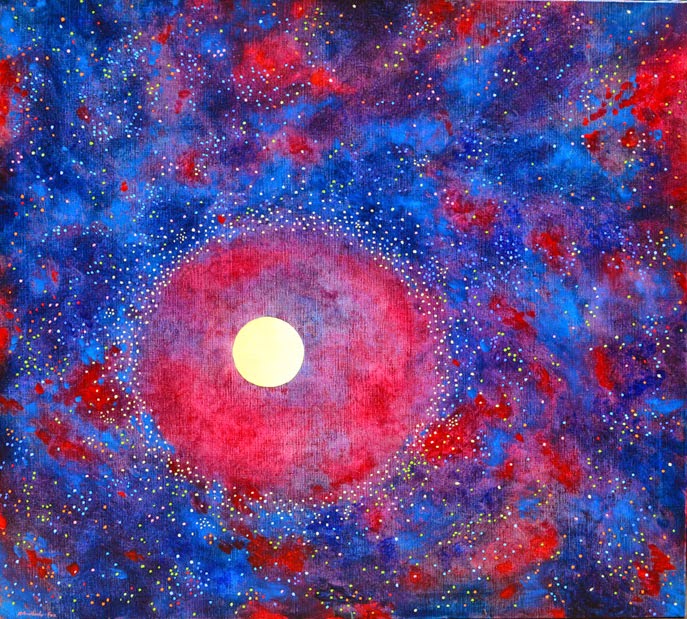
Future oil on linen 92 x 102 cm


THE FUTURE

Of The Universal 
And Maybe The Multiversal Kind
 
IS ENORMOUS
 
BUT
 
ARE WE HUMANS A PART OF IT?
 
 
EXISTENTIAL RISK + COSMOLOGY 
Regular readers know of my interest in existential risk. They also know of my fascination with cosmology. These two interests inter-relate.
 
Cosmology, the study of the Universe [maybe even the Multiverse], makes it very clear that we humans are new arrivals upon the trajectory of Universal/Multiversal time, space and distance. We did not exist for a very long time. The Universe is about 13.8 billion years old and we, Homo Sapiens, arrived in physical form only around 200,000 years ago...just a blip really! Check out the Big History Project's fascinating series Humans for more information.
 
So, we were definitely not around for a very long time. This perspective of the past makes our future seem quite vulnerable. How? There's no guarantee that the trajectory of the Universe/Multiverse will take us along for the full journey, whatever that may be. In the 21st century, a number of realisations and issues compel us to examine existence in different ways to existential ponderings of the past. Today, scientists, philosophers and a plethora of other thinkers and researchers, study the risk of real catastrophic risks that may lead to human extinction. These real possibilities include human-made and natural threats. The human-made ones are things like bio-terrorism, nuclear threat, rampant and uncontrolled artificial intelligence and much more. For further information on existential risks please visit Cambridge University's Centre for the Study of Existential Risk fascinating site .You'll see that science fiction's parameters need to be re-negotiated to acknowledge that some fictions are now being considered as distinct possibilities, especially in the area of artificial intelligence..
 
A cosmological perspective of time, is humbling. If we humans want to stick around, we have to seriously think about our behaviour, abilities and the future. Apart from human-made risks there's the issue that our Sun will not exist forever. Yes, it's got about 4 billion years to go, but it will make life on Earth very uncomfortable long before its ultimate demise. Even without the other smorgasbord of risks facing humanity, our Sun will ultimately cook us or force us to leave to find another planetary home/s. Indeed, many thinkers including Stephen Hawking see humanity's continued existence as contingent upon an interplanetary settlement.
 
 
So to my new painting FUTURE
Yes, it is ambiguous! Regular readers know I like ambiguity. Well, I certainly don't have THE answers in order to be less ambiguous, but I do have questions, musings, wonderings. I am engaged and I have fun with this engagement. It's like playing in a sand pit, where the sand slips and falls, but as it does this, I am entertained, become thoughtful, and I learn.

Future looks cosmological. The Universe seems to open up, maybe like an eye? This 'eye' sees... at the same time as beckoning us forward into its glow. There's promise. For me it is both past and future, because the future is always present-as-potential in the past. Maybe that's the promise?

Even though Homo Sapiens appeared only 200,000 years ago, the birth of the Universe created the 'dust' that ultimately lead to life on Earth, including us. 'Dusty' connections back to the source, give hope that they continue, in some form or another, into the future. Indeed, even if we humans are cooked by a dying Sun, we'll return to the cosmos as dust...literally!

And, who knows where that may lead?


http://kathrynbrimblecombeart.blogspot.com.au/2011/07/gate.html
 Gate Oil on linen 100 x 100 cm 2011
Viewers have seen an eye is this painting too!


Cheers,
Kathryn
www.kathrynbrimblecombe-fox.com


Sunday, May 05, 2013

HOPE


Hope Oil on linen 80 x 140 cm

 
So...I was thinking about hope.
 
Regular readers will know I have written about hope before [links below].  I again have been thinking about hope, for a number of reasons, but also in reference to my last painting and post Are We There Yet? The question implies a future destination, whether it be a literal place or a state of being. Is there hope implied in the question too? The more excited we are about a destination, the more likely we are to ask, especially repeatedly... 'Are we there yet?'... don't you think? If the destination is not a good one, then the question implies the hope that we don't get there!
 
I was going to call this painting Hope Springs Eternal, from Alexander Pope's long Essay On Man It is a short phrase from Epistle 1. In the end I decided on deceptively simple Hope
 
Hope humbly, then; with trembling pinions soar;
Wait the great teacher Death; and God adore.
What future bliss, He gives not thee to know,
But gives that hope to be thy blessing now.
Hope springs eternal in the human breast:
Man never is, but always to be blest:
The soul, uneasy and confined from home,
Rests and expatiates in a life to come.
 
I think Pope's poetry implies a future, even if it is death. But, that death is not the end of the soul...'life'...so Hope springs eternal...
 
APOCALYPSE?
As regular readers know, I sometimes think about apocalyptic futures: the demise of humanity and/or the planet at the hands of aberrant individuals or groups, or by 'natural' means such as wayward meteors slamming into Earth, or the 'natural' death of the sun and Earth's slow destruction.
 
I know, I know...all of this does not sound too hopeful!
 
But,
 
Out of the gloom hope raises its new shoots. For instance, hope drives much of science and philosophy...otherwise why would scientists and philosophers continue to ask questions? They hope for answers...and then...even more questions. Hope lives, even in the face of apocalypse! Hope is part of human complexity, and it is this complexity that gives hope for the future. 
 
UNIVERSE
Pope wrote the first Epistle of the Essay On Man in the context Of the Nature and State of Man, with respect to the Universe. In the 18th century humankind's understanding of the Universe was different to the understanding we have now. Yet, through the arts humanity attempts to vision its current understanding at the same time as posing questions...similarly to scientists and philosophers.
 
 He, who through vast immensity can pierce,
See worlds on worlds compose one universe,
Observe how system into system runs,
What other planets circle other suns,
What varied being peoples every star,
 
So, where does my painting Hope fit into all of this?
 
HOPE
When I imagined this painting I wanted a kind of post-apocalyptic 'landscape', as if remnants of Earth have been scattered across the galaxy. I wanted to suggest that these remnants could be metaphoric 'landscapes' of the human soul and imagination.
 
In the painting I have nine remnants of 'landscape', with one obviously issuing forth new life. Yes, my tree...the tree-of-life, the tree-of-knowledge lives on in a post apocalyptic 'landscape'! With life and knowledge there is hope...and with hope there is life and knowledge.
 
The 'landscape' remnant from which the tree erupts, is painted in slighty different colours compared with the other remnants. Its predominantly blue colour was chosen on purpose, to represent water a symbol of the subconscious, I imagine, more closely linked to soul. Water is also the 'blood' of life, the nurturer of growth, the essence of body. A few of the other 'landscape' remnants have glimpses of green, a colour that teases us with the potential for life, growth and renewal. Maybe, on these remnants, there are small shoots of life [trees] too small for us to see...yet? Hope!
 
I also liked the idea of 'landscape' remnants, because it helps untether concepts of landscape from being Earth bound, forcing new literal and metaphoric perspectives which, in turn, give rise to new 'landscapes'. I've previously written about some of my untethering landscape ideas.
 
Below is a photo of one of my initial sketches for Hope. Just thought you might like to see my very cursory sketch. I often do these kind of quick sketches to help my mind's eye take control of  the paint brush. My children's old and unused school pads come in handy.
 
Sketch for Hope
 
 
OTHER 'HOPE' POSTS
 
 
NEWS
  • The Art News is a dynamic website featuring an array of article, reviews and news about visual art in Australia. Each Friday they have what's called 'New Work Friday' and three of my recent paintings were selected for last Friday's 'New Work'. Check 'New Work Friday' out by clicking HERE
  • COSMIC ADDRESS is the title for my next exhibition 15-10-13 to 27-10-13 at Graydon Gallery, Brisbane. I am really excited about this show. Shall keep you posted!
 
Cheers,
Kathryn