Showing posts with label soil. Show all posts

Thursday, December 01, 2011

BELOW THE SURFACE

Below The Surface Gouache on paper 30 x 42 cm

BELOW THE SURFACE Gouache on paper 30 x 42 cm

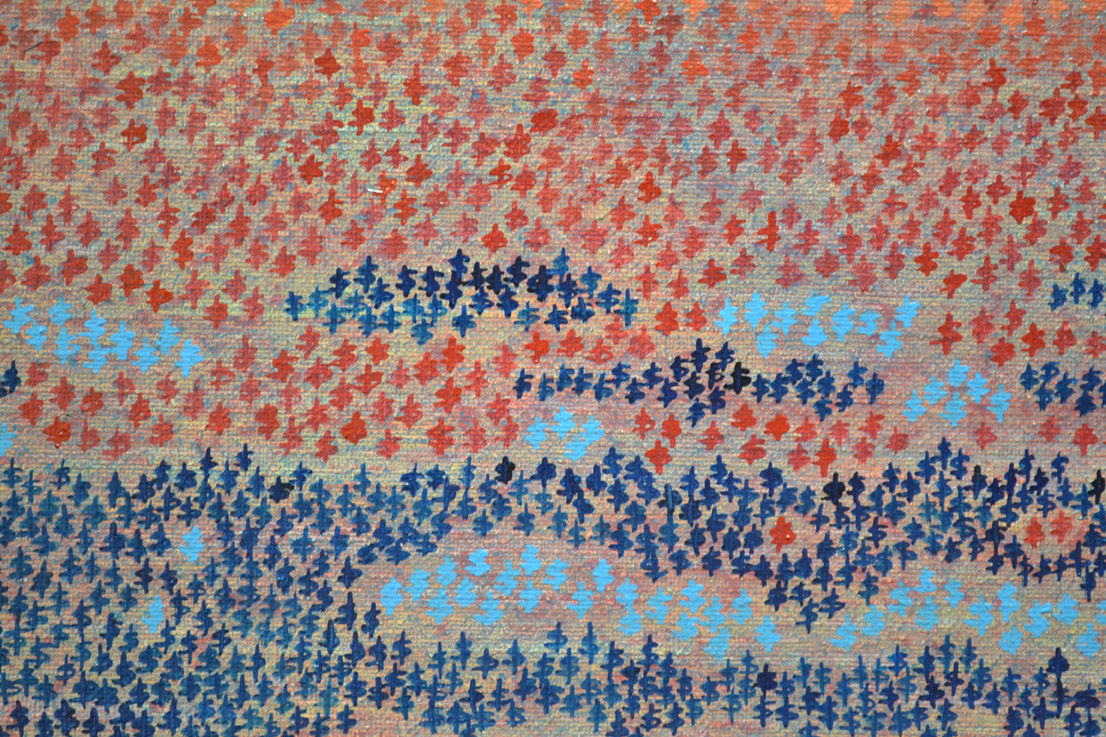
This work on paper is part of my Mother Nature series. The female figure is symbolic of Mother Nature. The trees which extend from her feet, and grow from her heart, reach out, below and beyond the surface. The pale green tree, which cascades across the 'scape', evokes the land's abundance, while the red, symbolic of soil, gifts the planet its nutrition. The white wavey lines and small blue strokes which whisper within the layers, speak of life systems, contours and hidden depths. The blue is suggestive of water and sky, the below and beyond. Regular readers will identify that the trees are my much loved transcultural/religious tree-of-life. This age old symbol speaks of life's systems and connects us with the past and propels us to the future. In the present it is up to us to hear its symbolic power.

BELOW THE SURFACE-LOADED TERM!

What a loaded term below the surface is! We talk about what's below the surface in a scandal, in financial implosions such as the GFC, beneath celebrity status, double entendres. We also talk and argue about what's below the surface of environmental issues. Below the surface can imply the 'real motive', the psychological impetus, the subconscious, intrigue, subtefuge, secrets. It also implies that what's below the surface is much larger, and possibly more significant, than what appears on the surface.

We are all so much more than what our exterior body appearance indicates. What's that old saying...'Beauty* is more than skin deep'. Or did I just make that up!? Funny though, when you think about what below the surface means it becomes appparent that it's not just about the below, but also the beyond. Indeed once the below is stirred and recognised its influence permeates across and beyond the surface. This can be a real physical influence on a material surface and into the atmosphere, or we can be propelled into other realms, such as the spiritual, imaginative and psychological.

CSG

This brings me to the coal seam gas debate [regular readers will know of my keen interest] which is heating up here in Australia with yesterday's release of the Senate Enquiry into CSG report. Here are just two media reports about the Senate Committeee's report  ABC Lateline Business and The Australian  Indeed, the Senate Enquiry dug beyond the surface, over many months of hearings and have recommended a number of actions based on well documented and research based fears, from various informed groups, about the affects of CSG mining on the Great Artesian Basin. Other issues involving potential impacts on prime agricultural land, health, social cohesion, farming practices, economic value were also presented to the Enquiry. The report is critical of, particularly the Queensland Government's, non precautionary principle stance. Indeed, I attended a forum on CSG at the University of Queensland in late 2009 where various representatives across the CSG debate spoke. The Government representatives indicated that their approach was 'well see as we go.' 

Another investigation that goes below and indeed beyond the surface is Paul Cleary's book 'Too Much Luck: The Mining Boom and Australia’s Future'. Check out the publisher's site Black Inc Books I have just finished this very thought provoking book. It examines a range of issues for us now and into the future. Cleary's concern for future generations means he has gone not just below the surface, but beyond as well. I highly recommend your read  'Too Much Luck: The Mining Boom and Australia’s Future'.

So, to a more literal level...a CSG well is not just its surface appearance. What happens below ground, and what is brought up from below ground, may have far more reaching influences, many of them possibly unknown for many years eg: a breakdown in naturally ocurring barriers between aquifers could possibly cause cross contamination of water types [saline and non-saline], loss of pressure could cause leakage from higher aquifers to lower ones and this may result in soil subsidance; methane gas leakage can cause a plethora of problems with one issue of paramount importance ie: methane is a  dangerous contributor to global warming. There are many more possible outcomes which have been expressed by farmers, scientists and academics. The precautionary principle seems pretty sensible to me!


PERSPECTIVE

Ideas of below and beyond the surface link with my interest in perspective. Regular readers will know of my interest! I play with perspective in my paintings by creating ambigious 'scapes'. As I have written before, I deliberately try to stimulate the viewer to move back and forth from my paintings. When viewed up close small details are discernible, but from a distance they are not. This dance back and forth, is similar to the 'dance' I move to as I paint. I work up close and then move back to view a painting from a distance, or I place a painting-in-progress in a spot where upon re-entering my studio, I see it with fresh eyes/perspective. I do think this 'dance' is a pretty good metaphor for how we need to negotiate life as we live locally in an increasingly globalised world.

Some earlier post on BEAUTY


FOR EVERYONE: WORDS AND PAINTINGS

My new book has it own PAGE - FOR EVERYONE


Cheers,
Kathryn

Sunday, October 23, 2011

BREATH

Breath Gouache on paper 30 x 42 cm

I am enjoying working with gouache on paper, continuing with the kind of paintings I wrote about in my last post QUIVER.

These new paintings are inspired by a few things...the age-old transcultural/religious tree-of-life, the female figure, my concerns for the environment, my interests in finding ways to visually seek out the potency of symbols so they have 21st century relevance and beauty. Regular readers will know of my interests and how they inter-connect to create paintings which are multi layered and often surprisingly political.
The painting above Breath places the figure of a woman, representing life giving, at the centre of a vortex or spiral. Have you ever played with a spiral? They quiver. It is this quivering, which reverberates back and forth, that makes me think of life forces, across time...past, present and future.
In Breath my much loved tree-of-life is depicted a number of times, with the red trees appearing almost lung like. The tree's capacity to mirror vascular systems and viscera excites and inspires me.

Signs of life ie: pulse and breath, do not recognise colour of skin, religion, sex or culture. We all share these fundamental signs of life, and as we feel our hearts beat and our breath's inhalation and exhalation, it reminds us of larger forces, earth's pulse and breath, and indeed, those of the multiverse. But, maybe we don't listen or take notice of these forces within us and around us? This question leads to the next painting called Montetizing Mother Nature, which has a more noticeably political intent, going beyond the reminder to notice which is implicit in Breath.

Monetizing Mother Nature Gouache on paper 30 x 42 cm

The three female figures are connected to earth via trees-of-life, as they are connected to the heavens. These vascular-like trees seem to pulse with life. The women are representative of nature, with the figure on the right is inspired by me! Yes, I have a very long plait, which reaches well past my hips. When my children and I went to see 'Avatar' we all thought I must have been the inspiration for the blue people, the ones with long plaits that could be connected to the life forces in the ground.!!!

Anyway, moving on...the women are 'decorated' with small $ signs. The 'landscape' is also painted largely with small $ signs. Regular readers will know that I often use small $ signs, initially not discernible when viewed at a distance, but clearly seen when the viewer is up close. I am 'asking' the question 'Have you noticed?'. I am also interested in the idea that a painting seen from a distance can be a different painting when viewed up close. This is a metaphor for the life we lead today ie: we live locally in an increasingly globalised world and we need to be able to 'see' multiple perspectives simultaneously in order to negotiate [I prefer dance] across the 'stage' which exists between the local and global.

In Monetizing Mother Nature I am thinking about the commoditisation of natural resources, the monetry value placed on carbon, water, wind and so on. Will a carbon tax eleviate global warming? That will be something we'll know in time, but I am sure there will be people making a lot of money carbon trading. Regular readers will know of my concerns about coal seam gas extraction and mining here in Australia and overseas. Huge amounts of money are being paid for exploration, mining, production, and foreign companies buying land and Australian mining companies. But at what real and ongoing cost? There is a vocal and growing community anti-CSG movement here in Australia, asking this very question. Without adequate scientific analysis of impacts on above and below ground water resources, potential soil degradation, plus social and health issues what might we ultimately lose? People are very concerned, frustrated, angry and anxious...all potent ingredients for social unrest.

Regular readers will know that I grew up on a farm on the Darling Downs and that I also lived, as an adult, for 18 years further west in the samll rural township of Goondiwindi. I understand the concerns people have about water and soil. I also understand farming practices and how CSG, and increased open cut coal mines, can affect production and efficiency. After reading a number of reports and articles, and attending forums on CSG I have been, and continue to be, deeply concerned about the haste of CSG activity, and the government's inadequate pre and current monitoring of the industry.

If one steps back from the close view ie: money money money to be spent and made...to take a view of the bigger picture as seen from a 'distance', the money to be spent and made now pales against the potential massive 'value' loss caused by a plethora of issues ie: the potential for loss of food producing farm land due to aquifer water cross contaminations, introduced contaminations, depletion, plus soil degradation; erosion of farming IP due to farmers leaving or forced to leave the industry plus subsequent unraveling of rural social fabric; the fact that methane is a more dangerous contributer to global warming than carbon dioxide..I could go on because the picture is BIG.

In Monetizing Mother Nature I am playing with the word monetize. It's a word I see on my BLOG backpage where I have opportunities to monetize it. The opportunistic nature of the commercial world is fascinating, but not so when the mindset erodes how we might 'value' things by monetization when their 'value' goes way beyond money.

Please see below a list of other psots where I write about my use of small $ signs.

Now for something a bit lighter!

What I Think About Whilst Planking/Bridging Gouache on paper 30 x 42 cm

This is me planking. Yes, my long plait, mentioned above too, has a gravity defying life of its own! I started planking, to keep me trim and tight, a while ago when a friend spoke glowingly about its affect on his waist line...and it was discernible! But, it is so incredibly boring. I count in tens, sometimes in 20s, just to break up the time, to get to around 40- 80 seconds, depending on how bored I am. But, when I start to imagine, as in the painting above, the time goes much more quickly.

OTHER SMALL $ SIGN POSTS


BLAKE PRIZE DIRECTORS' CUT EXHIBITION

My entry for the BLAKE PRIZE http://www.blakeprize.com.au/ whilst not a finalist was  in the group considered for the finals. AND, from that group the directors select works for what's called the DIRECTORS' CUT EXHIBITION. And, my entry COMPASSION is in it! http://kathrynbrimblecombeart.blogspot.com/2010/07/compassion.html
This link will take you to where you can see the list of selected artists. http://www.blakeprize.com.au/news/2011-directors-cut-artists-announced
The DIRECTORS' CUT is an online exhibition and the images are live from 26 October - 23 January.

Cheers,
Kathryn

Tuesday, May 24, 2011

GAS GALLERY

Commodified Oil on linen 36 x 36 cm


I am back in my studio working on an oil painting. But, it will be awhile before it is finished. I am working towards my exhibition Paradise @ Purgatory Artspace in Melbourne 8 Sept- 8 October. Stay tuned for updates as time goes by.

Regular readers will know of my concerns about the impacts of the burgeoning Coal Seam Gas industry [plus open cut coal mining] here in Australia and elsewhere around the world. In the last couple of months public awareness of, and concern about, the industry has increased. So much so, that the media, politicians and the industry itself are beginning to realise public concern is not coming from only the fringes.

Yesterday a gas well at Daandine, near Dalby where I grew up, blew. Here are two articles about the event. 


Events such as these [and this is the 4th leakage, blowout on this property] highlight the risks of this industry, not only to safety, but to the environment; to water, soil and ultimately food production and sustainability. As I have written before, applying the % risk that business is used to, is not the % risk science would apply to activities with potential impacts on the balance of nature eg: the intricate and complex system that is the Great Artesian Basin. [Please see my painting Risk below]

I decided to create a 'Gas Gallery' with a small selection of my paintings that have been 'inspired' by my deep concerns. As I have written before this is my 'quiet activist' work.  In most of the paintings I use small $ signs to create the image details ie: soil, water, sky etc. The smallness of the $ signs means viewers do not discern them from a distance, but as the viewer moves closer the $ signs become apparent. I am 'asking' the question, "Have you noticed what's happening?'


Cooked With Gas Gouache on paper 30 x 42 cm


$oils Ain't $oils Anymore Oil on linen 80 x 100 cm


Detail $oils Ain't $oils Anymore


Salt Eternal Gouache on paper


Can We Eat Coal For Breakfast?  Gouache on paper 30 x 42 cm


GAB: Great Artesian Basin Gouache on paper 30 x 42 cm


Risk Gouache on paper 30 x 42 cm


Earth For Sale Oil on linen 120 x 160 cm


Lifeblood Oil on linen 90 x 200 cm

Well, it is back to the studio for me. But, before I go, I am very happy to report that 2 of my 3 paintings in the Women's legal Service Qld Exhibition sold on the opening night, plus the painting that was included in the Auction.

Cheers for now,
Kathryn

Wednesday, March 30, 2011

DAMNED

Rain Gouache on paper 30 x 42 cm


It is raining again here in Brisbane, just after major floods! I certainly hope we don't get a wet winter, then followed by a wet summer just like the one we've just had. The soil needs time to dry out a bit. Floods are not something we want to experience so soon! The painting above is called Rain. I am actually very happy with this work as it almost exudes wetness. Indeed, it involved a lot of water splashed, sprayed and dribbled, plus some small brush markings.

'Water: The Epic Struggle For Wealth, Power, and Civilization' by Steven Solomon
Despite many areas of Australia being currently replete with water...water is still a major issue here and around the world. I have just finished an amazing book called 'Water: The Epic Struggle For Wealth, Power, and Civilization' by Steven Solomon [Harper Collins, NY, 2010]. It is a meticulously researched world history of water from it earliest uses for irrigation in the ancient world, to our present day looming crisis. The latter is coupled with threats to food supply, as well our thirst for energy and climate change.  As Solomon says, The lesson of history is that in the tumultuous adjustment that surely lies ahead, those societies that find the most innovative responses to the crisis are most likely to come out as winners, while others fall behind. Civilization will be shaped as well by water's inextricable, deep dependencies with energy, food and climate change

The last paragraph of the book offers a profound call for people to take water very seriously, At the end of the day, how each member of the world community ultimately acts in response to the global freshwater crisis is not just a matter of economic and political history, but a judgement on our own humanity-and the ultimate fate of human civilization. As one scientist succinctly puts it: "After all, we are water."

Mining vs Farming
In my own neck of the woods ie: South East Queensland, Australia we are seeing major potential threats to water, plus food supply and quality, with the burgeoning battle between mining and farming. Regular readers will know of my concerns for water quality, supply and the accompanying potential degradation of prime food producing farmlands on the Darling Downs and in the Bowen and Surat Basins. The increasing presence of open cut coal mining, plus the frenzied activity surrounding coal seam gas extraction, pose threats to above and below ground water quality and supply. These mining activites also threaten soils, efficient farming practices, community health and social fabric. Ultimately the threats will not be localised concerns, as food supply, costs and quality will affect everyone.

Water management can make or break a civilization
The one overarching message I received as a result of reading 'Water: The Epic Struggle For Wealth, Power, and Civilization'  was that history has shown us that water management can make or break a civilization. This is followed and linked closely by food supply, which includes a plethora of issues from how food is grown, quality, cost and distribution. I am currently reading 'The Coming Famine: The Global Food Crisis And What We Can Do To Avoid It' by Julian Cribb [CSIRO Publishing, Collingwood Victoria, 2010]. This is a great book to read just after Solomon's 'Water', because the linkages between water and  food with economic, cultural and social health, and thus political stability are clearly apparent.

As a history student [I studied Ancient History and Art History at University], plus  a reader of history books, I have learnt that history is the last and most critical judge. So, politically it may seem expedient to fill government coffers, depleted by the GFC, with the money gained from mining exploration and export, but if it ultimately means we have no, or vastly depleted, food producing capacity plus poor water quality and supply, the resultant human loss and civil unrest, will make the expediency seem inhumane and politically naive...plus potentially worse. As Soloman wrote but a judgement on our own humanity.
 
Damned
Damned [below] says it all really don't you think!? Click on the image and you'll see I have created the dam with the repeated word 'damned'. Surely there is a way for mining and farming to co-exist? I am not anti mining per se, but a balanced and more scientific approach to analysis and risk needs to be undertaken.


Damned Gouache on paper 21 x 30 cm

More of my posts about water, food etc.
http://kathrynbrimblecombeart.blogspot.com/2011/01/underground-currency.html
http://kathrynbrimblecombeart.blogspot.com/2010/11/murray-darling-currency.html
http://kathrynbrimblecombeart.blogspot.com/2010/10/water-gallery.html

Cheers,
Kathryn
http://www.kathrynbrimblecombe-fox.com/

Monday, February 14, 2011

COMMODIFIED

Commodified Oil on linen 30 x 30 cm 2011

PARADISE @ Purgatory Artspace Melbourne
'Paradise' is open to the public from Thursday 8 September! The opening night is Friday 9 September 6-8 pm. The exhibition dates are 8 September - 8 October, 11 am - 5 pm Tuesday to Saturday at PURGATORY ARTSPACE, 170 Abbotsford St, North Melbourne.

'COMMODIFIED' Oil on linen 30 x 30 cm 2011
The painting is obviously a map of Australia, but upon closer scrutiny the viewer will discern that the 'map' is created with small $ signs. Regular readers of this BLOG will know that I use small $ signs to depict water, soil etc to pose or stimulate questions about how we 'value' our land. I deliberately make the $ signs small so that from a distance the viewer does not discern them, but when the viewer is close the $ signs become clearly apparent. This play with distance asks questions such as, 'Have you noticed?' It plays with the responsibility we all have to negotiate distance as we live locally in an increasingly globalised world. AND, I don't mean just physical distance, but temporal, cultural, emotional and spiritual.


I am deeply concerned about the sustainability of prime and strategic farmland in Australia. An enslaught of rapid and hectic activity from mining companies, especially coal seam gas miners, threatens this sustainability. I am anti any kind of activity that threatens water sustainability, strategic and prime food producing farmland. With a burgeoning population the world needs to maintain its farmlands in order to feed people. After all, you cannot flick the light switch if you've expired from hunger! Governments need to ensure prime farmlands, and the farmers who farm them, are protected from invasive mining activities. These include those activities that threaten above and below ground water supplies and quality, soil health, and efficient and environmentally sound farming practices. Regular readers will know that I have written about these before. Here are some links to previous posts:
http://kathrynbrimblecombeart.blogspot.com/2011/01/underground-currency.html
http://kathrynbrimblecombeart.blogspot.com/2010/12/oils-aint-oilsany-more.html
http://kathrynbrimblecombeart.blogspot.com/2010/11/food-fantasy-in-future.html
http://kathrynbrimblecombeart.blogspot.com/2010/11/murray-darling-currency.html

Governments must prioritise food sustainability for obvious humane reasons, but also for political stability. Hungry stomachs make for angry hearts, and angry hearts make for civil unrest and worse.

'Commodified' is a simple looking painting...indeed it did not take as long as some of my more intricate ones, but it speaks of the madness erupting across parts of Qld and NSW [indeed across the globe! Have you seen 'Gasland'?] with regards to potential degradation of farmlands by mining activities. This madness is what I see as the outer VORTEX, the chaotic whirlwind that does not allow for contemplation and considered scrutiny...or for a scientific analysis of risk. Two soil scientists who spoke at the public forum on the CSG industry, which I attended at the University of Queensland late last year, both started their presentations describing what's happening as 'madness'. Here's the link to my post about the forum:  http://kathrynbrimblecombeart.blogspot.com/2010/11/donkey-and-other-things.html


Cheers,
Kathryn
http://www.kathrynbrimblecombe-fox.com/

Friday, January 07, 2011

UNDERGROUND CURRENCY


Underground Currency Oil on linen 80 x 100 cm 2010

I have really had fun painting this new work 'Underground Currency'. Yes, it is a painting of Australia! But, it is Australia with one of her most wondrous life sustaining natural gifts exposed. This gift is the Great Artesian Basin (GAB) which extends across 22% of the continent. It is not one big underground lake, but rather a system of aquifers, some very deep and others closer to the surface. 

GREAT ARTESIAN BASIN and MINING
There are risks to the Great Artesian Basin due to a burgeoning mining industry, especially coal seam gas [CSG] mining. Regular readers will know how concerned I am about the potential for degradation to water and soils. 

In fact, the federal Government's own National Water Commission's recent position paper on CSG and Water clearly calls for caution.

FARM GIRL
I grew up on a grain farm outside Dalby, on the Darling Downs, Queensland. My Dad had a bore, which provided us with water in times of drought. However, whilst it kept plants alive and allowed us to wash clothes and ourselves during dry times, it was a too salty for ongoing human or animal consumption. Yet, 2-3 km away our neighbour's bore provided water that was drinkable for human beings and animals. The worry is that mining and CSG fracking techniques [pushing chemicals, water and sand into coal seams to release gas ie: creating mini-like earthquakes] could cause natural occurring barriers in aquifer systems to break down and allow for cross contamination, not only of different water qualities, but also chemicals [natural and introduced]. Many farmers rely on underground water to sustain livestock and grow our food.


UNDERGROUND CURRENCY  Oil on linen 80 x 100 cm
So, to the painting! This work is closely related to two earlier works on paper 'Murray Darling Currency' and 'GAB: Great Artesian Basin'. Its title, with the word currency, plays with ideas of water flowing, financial terms, and contemporaneousness...the flow/current of water, money and time! But, it also refers to political currency; the machinations of political agendas molded and stroked by power, business, lobbyists and needs, desires and wants. Look closely and you will see that I have painted the area of the GAB with small blue $ signs. 

The word underground in the title can be read as literally referring to underground aquifer water supplies, but it also refers to a subtext of political decision making that impacts on the environment and thus...us. In a broader context it also refers to the kind of secrets and subterfuge which propelled the world towards the Global Financial Crisis [GFC]...indeed is it really over? Even the Wikileaks revelations exposes the 'underground'; the secrets that form a hidden dimension, populated by shadows, that impact life.  

The picture below is a detail of 'Underground Currency'. You can see more clearly the small blue $ signs I have used  to depict the Great Artesian Basin...currency!!! From a distance these $ are not discernible, but they are as the viewer moves closer to the painting. Regular readers will know that I like to entice the viewer to move back and forth posing questions like, 'Have you noticed?' But, also alluding to the back and forth movements, from far to close perspective, that are necessary as we live locally in an increasingly globalised world.  The use of a symbol of wealth, to depict a natural substance, questions how we 'value' nature's gifts.

Tree-of-Life
But there is hope! My much loved transcultural/religious tree-of-life motif creates the sea surrounding Australia as well as the continent. The tree 'speaks' of pulsing life systems. Its vascular like essence linking everything seen and unseen. Its beauty deliberately edging out ugliness to provide hope for a future ongoing. 

 
                                                         Detail Underground Currency


Cheers,
Kathryn

Monday, December 13, 2010

BEAUTY AND THE VORTEX

Finding The Light Oil on linen 100 x 70 cm


I have uploaded some of the paintings that will be in my forthcoming exhibition VORTEX. Here's a short statement I have written for the exhibition:

Solo exhibition exploring vortexes, taking the viewer to cosmological extremes and to intimate spiritual places. The turmoil of the outer vortex, depicted in images of environmental degradation, is balanced by images of the inner vortex where stillness offers a place to listen to ourselves. VORTEX traverses distance by playing with perspective and using the age old trans-cultural/religious tree-of-life as a guiding motif which explores the intimate and vast, both temporally and spatially.

Regular readers of my BLOG will know that I have been writing about vortexes for some time now. The statement above just touches upon some of my thoughts. It is always quite difficult to condense something, one is somewhat obsessed by, into a short statement!

I see VORTEX as being a coherent exhibition with paintings exploring the beauty of stillness at the core of the vortex...and other paintings exploring the turmoil on the outer vortex, particularly in regards to the 'madness' I see happening with CSG mining on prime food producing farmland. AND, regular readers will know my thoughts there!

OUTER VORTEX
Yet, my paintings exploring the turmoil of the outer vortex are not ugly...well I don't think they are! I see beauty as offering hope. I cannot see the point in creating more ugliness or reminding people of it in an unrelenting way. There's enough in the mass media to remind us of the plunderous and degrading activities which the human race has inflicted upon the Earth. Image after image, seemingly imploring for enlightened solutions lose their impact after awhile. We become desensitised and in the process we feel neutered, as if the problems are SO huge there is no way we can make a difference. Now.... this is where beauty has the power to uplift as it reminds people of paradise... that if beauty can still exist, even in imagination, the potential to resurrect any 'paradise lost' is still there.

One painting of the 'madness', which will be in VORTEX, is the painting below, called $oils Ain't $oils...Anymore! This painting questions value by using small $ signs to signify water, soil and coal. It's prophecy is not attractive, yet I feel that beauty still stretches its hand out through the turmoil to the viewer, in a way which stimulates hope rather than destroying it. http://kathrynbrimblecombeart.blogspot.com/2010/12/oils-aint-oilsany-more.html

As I have written a number of times before, I prefer to consciously elide ugliness. This means that ugliness, and all its contingent erosive attributes, exists in absentia in my work, thus negating criticisms of naivity. Indeed, as regular readers of this BLOG know, I have spent many years living in rural Queensland, and whilst I am not a soil or water expert, I do arrive at this point in my life, with decades of practical experience and observations, which are visually parley in my paintings.

I have previously written about beauty http://kathrynbrimblecombeart.blogspot.com/2010/03/beauty.html

$oils Ain't $oils...Anymore! Oil on linen 70 x 100 cm

VORTEX CORE

The painting at the top of the page 'Finding the Light' and the three paintings below, were all inspired by my imaginatings of what it might be like to be present inside a vortex at its core. The first time I closed my eyes and imagined the stillness, I felt calm. As I have written before, this stillness offers a quiet where we can hear things we did not know we could hear, see things we did not know we could see, and feel things we did not know we could feel. For me this beautiful sentient place is a place of hope, where the human race may find answers to questions it did not know to ask.


Compassion Oil on linen 100 x 100 cm 2010
                           http://kathrynbrimblecombeart.blogspot.com/2010/07/compassion.html


Colour Of Stillness Oil on linen 100 x 60 cm

                                                                  Hovering At The Centre Oil on lnen 30 x 30 cm
                               http://kathrynbrimblecombeart.blogspot.com/2010/08/hovering.html

SUPERCONDUCTORS

If art can trigger the collective imagination, to take us to places of stillness where hearing, seeing and feeling things we were previously unaware of is possible, then art could be called a superconductor!

Here's an explanation from http://www.superconductors.org/INdex.htm of what a superconductor literally is:


If art can be seen as a superconductor, we can now think about what might create resistence to render it impotent and inert. Maybe ugliness, in a way which regurgitates mass media's reportage, is one resistor? And, maybe beauty is a potent transistor?

Concepts like this tickle my imagination and have done so for a long time. My Dad is a HAM radio enthusiast and I grew up with electronic bits and pieces, plus our farm was uniquely identifiable by Dad's tall aerials. Our cars were always equipped with HAM radios, Dad made our first TV in the early 60s, and our first record player also. Here's some info for those of you who do not know what HAM radio is. http://en.wikipedia.org/wiki/Amateur_radio  AND...One of my brothers is in IT and his current specialty is supercomputing.

In another post I will write about art and its potential to be a superconductor for cultural diplomacy. Unfortunately, 'show and tell' type attitudes are resistors. I draw some of my thoughts from my own experiences exhibiting in London, Dubai, Abu Dhabi and Seoul.

VORTEX
22 Feb - 6 March 2011:  Graydon Gallery, Merthyr Rd, New Farm, Brisbane. I will be at the exhibition daily 10 am -6 pm, so it is a chance for me to chat to people. I had a great time chatting at my exhibition FRISSON in March this year.

Cheers,
Kathryn

Wednesday, December 01, 2010

$oils Ain't $oils...Any More!

$oils Ain't $oils...Any More! Oil on linen 70 x 100 cm 2010

This is the painting I wrote about, and uploaded a detail photo of, in my last post. Everything, apart from the sky and the sheets of rain in the distance, is painted with small $ signs. Now...regular readers of my BLOG will know that I often use $ signs in my work, to pose questions about how we 'value' those gifts, such as water, which sustain life.

With this painting I am posing questions about how we value our soils. I was inspired to paint this image after attending a public forum 'Environmental Implications of Coal Seam Gas and Coal to Liquid Projects' at the University of Queensland. The two soil scientists who spoke on the panel at this forum, both categorically stated that soils, of the types on the Darling Downs, cannot be rejuvenated after any kind of degradation caused by mining or any other activity that can severely affect soils.

I grew up on the rich black soil Pirrinuan Plain which is about 11 miles/18 km outside Dalby. The Jimbour Creek separates the Pirrinuan and Jimbour Plains. These treeless plains hold the deepest topsoils in the southern hemispherre...at least that's what I was lead to believe as I grew up. But at nearly 40 ft/ 12.2 m deep I suggest that if they are not the deepest, then they are certainly amongst the deepest. The soil is black, it cracks when it is dry and turns to thick mud when it is wet. Here's a link to a map showing my parent's farm.
http://maps.google.com.au/maps?ie=UTF8&hl=en&om=1&source=embed&ll=-27.031682,151.232665&spn=0.007512,0.019248&t=h&z=16

 I remember playing in the thick mud and loving it. As my brothers and I played the mud would become soupy the more we pummelled it and slid into it. No vehicle could travel more than a few metres in this mud before being bogged without hope of escape. This soil could grow anything and my father, and his father before him, grew crops of wheat, sorghum, maise, sunflowers and oats.


This is a photo of me and my two brothers on a swing our Dad made for us. Notice the flat horizon. My Mother created a park/garden and in this photo you can see the beginnings of it.

This is a photo of my 2 brothers standing against the edge of a wheat crop and my Mother standing in the middle of the crop. Notice the black soil ...and the quality of the crop...prime hard category I am sure. Wheat crops don't grow this tall anymore, because with modification shorter varieties are preferred. They are preferred because they're less prone to being flattened by heavy rain, wind, or other strange happenings. If you flick back and forth between these two photos from my youth and $oils Ain't $oils...Any More! I bet you'll see where my vision comes from!

$oils Ain't $oils...Any More! depicts a cross section-like view of a flat horizoned landscape, similar to the one I grew up in. The blue represents underground aquifers, creating the Great Artesian Basin which straddles the hidden depths of around 22% of Australia. There are two layers of aquifers, the deep Artesian Basin ones and those closer to the surface. The dark colour represents coal and coal seams, the red/brown colour represents rock, and the darker brown is the soil which grows our crops and pastures, both supplying food for our tables.

The strips of rain in the distance are symbols of hope. I have spent many hours driving into the relentless distance of western rural Queensland, hoping that strips of rain glimpsed afar were watering my part of the world. Yet, these strips, like the rest of the 'landscape' are ambiguous. At first glance they may appear to be some kind of construction, tanks or towers conjuring thoughts and fears of a landscape dotted with burdensome infrastructure.

The red vein of small $ signs, flourishing across the sky, refers to another painting with a similar theme. Lifeblood also depicts a vein of $ signs gesturing across the sky. Here's the link to the post I wrote for Lifeblood  http://kathrynbrimblecombeart.blogspot.com/2009/05/lifeblood.html  The vein in $oils Ain't $oils...Any More! speaks of the same things ie: that water is the lifeblood of the earth, that is is intrinsically important to maintain fertility and soil viability. I feel the vein in $oils Ain't $oils...Any More! seems to pulse more rapidly than the one in Lifeblood.  I suspect it is because its sky is far from languid with its thunderous, stormy and turbulent undertones witnessing the potential plunder below... paradise lost. 

As regular readers of my BLOG know, I am very interested in deliberately enticing the viewer to move close and far from my work. The small $ signs are not discernible from a distance, but they become evident as the viewer moves closer. For me this movements begs the question, 'Have you noticed?'

NEXT
I have prepared the backgrounds of two more paintings and by Friday I hope to have started another 'vortex' painting...although I see my 'quiet activism' paintings like $oils Ain't $oils...Any More! as commenting on the madness of the outer vortex. As regular readers of my BLOG know my next solo exhibition is VORTEX. It will open Wednesday 23 feb and continue daily until Sunday March 6 at Graydon Gallery, Merthyr Rd, New Farm, Brisbane.

CHRISTMAS
With Christmas just around the corner, I have made a 'gallery' of suggestions for presents ranging from around $200 to $4000. A painting is a wonderful gift for Christmas...or any time really! Check my Christmas gallery out at http://www.visualartist.info/visualartist/artist/subpage.asp?ex=gallery&I=1690&sub=5444&artistId=1292&PageId=1690

Until next time,
Kathryn

Monday, November 22, 2010

FOOD - A FANTASY IN THE FUTURE?

                                  Can We Eat Coal For Breakfast?...NO. Gouache on paper 30 x 42 cm

                                                                       Value Gouache on paper 30 x 42 cm

These two new works on paper are a continuation of my interest in water. Regular readers will know very well of this intense interest. Please have a look at this previous post, which also has links to other earlier posts http://kathrynbrimblecombeart.blogspot.com/2010/11/murray-darling-currency.html

Can We Eat Coal For Breakfast?...NO
Can We Eat Coal For Breakfast?...NO was inspired by a number of things, but two are significant. The first is that about 2-3 years ago I took my youngest child out to Dalby, where I grew up. She had never seen where I came from and I thought it would be a great mother/daughter pilgrimage. On the drive out to Dalby, and as we got closer, I could not get over the number of mounds of coal. In fact, I must have had my head buried in the sand, because up until then, I had not realised the extent and growth of the mining industry in the region. Since that trip open cut mining's  burgeoning partner ie: Coal Seam Gas is also changing the landscape, both externally and internally [underground aquifers].

In the painting Can We Eat Coal For Breakfast?...NO, the two mounds, painted with small dark $ signs, represent coal mounds. The red $ signs underground signify the potency of the soil and the environmental dilemmas confronting citizens of the planet. The white layer on top of the soil and underneath the mounds alludes to the disastrous potential of soil salinization.

The second significant influence for this painting, and its title, was hearing about a grass roots action group called Coal4Breakfast. 

Value 
Now to Value which speaks of how we value our land. Soil is not something we should compromise in any form. For me, risking soil quality, should not ever be considered...even a small risk. Soil quality underpins food production, not only now, but into the future, both foreseeable and not foreseeable. Compromising our soils diminishes the quality and amount of produce.

Food in the Future
BUT...HEY...in the future...if we don't have food we can always come up with some kind of alternative...pills, intravenous drips, nanobot internal distributors we replenish once a year! Oh what fun... replays of Masterchef will seem like fantasies as our great and great-great grandchildren ask their parents , 'What are those people doing?' ....'Cooking? What's that?'

PUBLIC FORUM
Tonight [Monday 22 Nov, 2010] there is a public forum at the University of Queensland 'Environmental Implications of Coal Seam Gas and Coal-to-Liquids Projects'
The list of speakers looks impressive.


Cheers,
Kathryn